



Abstract
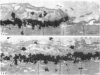
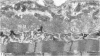
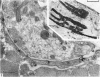
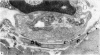
1. The distribution of acetylcholine receptors (AChR) at frog cutaneous pectoris neuromuscular junctions was studied quantitatively using [1125]alpha-bungarotoxin (alpha-BTX) labelling and EM autoradiography. 2. We found that, as in mouse end-plates, the AChR is localized uniformly along the thickened post-junctional membrane. In the frog muscle this specialized membrane constitutes approximately the top 50% of the junctional folds. 3. The receptor site density is approximately 26,000 +/- 6000 sites/micrometer2 on the thickened post-junctional membrane and falls sharply to approximately 50 sites/micrometer2 within 15 micrometer from the axon terminal. 4. alpha-BTX site density on the presynaptic axonal membrane was directly determined to be at most 5% of the value on the thickened post-junctional membrane. 5. The high post junctional AChR site density leads us to conclude that: (a) each quantum of ACh needs to spread only over a very small post-junctional area (to be called the 'critical area') before it encounters as many AChR (plus AchE) sites as there are ACh molecules in the quantum (for a packet of 10(4) ACh molecules this critical area is approximately 0.3 micrometer2), (b) the average concentration of ACh prevailing in the cleft over this critical area during a quantal response will be approximately 10(-3)M (independent of the size of the quantal packet), and (c) since 10(-3)M-ACh is large compared to any estimates of the dissociation constant Kd for ACh binding to the AChR, the ACh will essentially saturate the AChR within the critical area (provided the ACh binding rate is sufficiently faster than the ACh spreading rate). 6. The total receptive surface for a frog end-plate is calculated to be approximately 1500 micrometer2, and therefore an end-plate potential resulting from 300 quanta will be due to the activation of less than 10% of the total receptive area. 7. Free diffusion would allow each small post-junctional critical area to be reached in less than 15 musec. Therefore, either the recorded rise time of the miniature end-plate is not predominantly a function of ACh diffusion time, or, as suggested by Gage & McBurney (1975), the net rate of movement of ACh in the cleft is much slower than indicated by the free diffusion constant.
Full text
PDF


Images in this article
Selected References
These references are in PubMed. This may not be the complete list of references from this article.
- Albuquerque E. X., Barnard E. A., Porter C. W., Warnick J. E. The density of acetylcholine receptors and their sensitivity in the postsynaptic membrane of muscle endplates. Proc Natl Acad Sci U S A. 1974 Jul;71(7):2818–2822. doi: 10.1073/pnas.71.7.2818. [DOI] [PMC free article] [PubMed] [Google Scholar]
- BIRKS R., HUXLEY H. E., KATZ B. The fine structure of the neuromuscular junction of the frog. J Physiol. 1960 Jan;150:134–144. doi: 10.1113/jphysiol.1960.sp006378. [DOI] [PMC free article] [PubMed] [Google Scholar]
- Barnard E. A., Dolly J. O., Porter C. W., Albuquerque E. X. The acetylcholine receptor and the ionic conductance modulation system of skeletal muscle. Exp Neurol. 1975 Jul;48(1):1–28. doi: 10.1016/0014-4886(75)90219-8. [DOI] [PubMed] [Google Scholar]
- CHANG C. C., LEE C. Y. ISOLATION OF NEUROTOXINS FROM THE VENOM OF BUNGARUS MULTICINCTUS AND THEIR MODES OF NEUROMUSCULAR BLOCKING ACTION. Arch Int Pharmacodyn Ther. 1963 Jul 1;144:241–257. [PubMed] [Google Scholar]
- Cartaud J., Benedetti E. L., Cohen J. B., Meunier J. C., Changeux J. P. Presence of a lattice structure in membrane fragments rich in nicotinic receptor protein from the electric organ of Torpedo marmorata. FEBS Lett. 1973 Jun 15;33(1):109–113. doi: 10.1016/0014-5793(73)80171-1. [DOI] [PubMed] [Google Scholar]
- Couteaux R., Pécot-Dechavassine M. Les zones spécialisées des membranes présynaptiques. C R Acad Sci Hebd Seances Acad Sci D. 1974 Jan 7;278(2):291–293. [PubMed] [Google Scholar]
- Daniels M. P., Vogel Z. Immunoperoxidase staining of alpha-bungarotoxin binding sites in muscle endplates shows distribution of acetylcholine receptors. Nature. 1975 Mar 27;254(5498):339–341. doi: 10.1038/254339a0. [DOI] [PubMed] [Google Scholar]
- Dolly J. O., Barnard E. A. Affinity of cholinergic ligands for the partially purified acetylcholine receptor from mammalian skeletal muscle. FEBS Lett. 1974 Sep 15;46(1):145–148. doi: 10.1016/0014-5793(74)80355-8. [DOI] [PubMed] [Google Scholar]
- Dreyer F., Peper K., Akert K., Sandri C., Moor H. Ultrastructure of the "active zone" in the frog neuromuscular junction. Brain Res. 1973 Nov 23;62(2):373–380. doi: 10.1016/0006-8993(73)90699-9. [DOI] [PubMed] [Google Scholar]
- Dreyer F., Peper K. Density and dose-response curve of acetylcholine receptors in frog neuromuscular junction. Nature. 1975 Feb 20;253(5493):641–643. doi: 10.1038/253641a0. [DOI] [PubMed] [Google Scholar]
- Dreyer F., Peper K. The acetylcholine sensitivity in the vicinity of the neuromuscular junction of the frog. Pflugers Arch. 1974 May 6;348(4):273–286. doi: 10.1007/BF00589217. [DOI] [PubMed] [Google Scholar]
- ECCLES J. C., JAEGER J. C. The relationship between the mode of operation and the dimensions of the junctional regions at synapses and motor end-organs. Proc R Soc Lond B Biol Sci. 1958 Jan 1;148(930):38–56. doi: 10.1098/rspb.1958.0003. [DOI] [PubMed] [Google Scholar]
- FATT P. Biophysics of junctional transmission. Physiol Rev. 1954 Oct;34(4):674–710. doi: 10.1152/physrev.1954.34.4.674. [DOI] [PubMed] [Google Scholar]
- Feltz A., Mallart A. An analysis of acetylcholine responses of junctional and extrajunctional receptors of frog muscle fibres. J Physiol. 1971 Oct;218(1):85–100. doi: 10.1113/jphysiol.1971.sp009605. [DOI] [PMC free article] [PubMed] [Google Scholar]
- Fertuck H. C., Salpeter M. M. Localization of acetylcholine receptor by 125I-labeled alpha-bungarotoxin binding at mouse motor endplates. Proc Natl Acad Sci U S A. 1974 Apr;71(4):1376–1378. doi: 10.1073/pnas.71.4.1376. [DOI] [PMC free article] [PubMed] [Google Scholar]
- Fertuck H. C., Salpeter M. M. Quantitation of junctional and extrajunctional acetylcholine receptors by electron microscope autoradiography after 125I-alpha-bungarotoxin binding at mouse neuromuscular junctions. J Cell Biol. 1976 Apr;69(1):144–158. doi: 10.1083/jcb.69.1.144. [DOI] [PMC free article] [PubMed] [Google Scholar]
- Fertuck H. C., Salpeter M. M. Sensitivity in electron microscope autoradiography for 125I. J Histochem Cytochem. 1974 Feb;22(2):80–87. doi: 10.1177/22.2.80. [DOI] [PubMed] [Google Scholar]
- Gage P. W., McBurney R. N. Effects of membrane potential, temperature and neostigmine on the conductance change caused by a quantum or acetylcholine at the toad neuromuscular junction. J Physiol. 1975 Jan;244(2):385–407. doi: 10.1113/jphysiol.1975.sp010805. [DOI] [PMC free article] [PubMed] [Google Scholar]
- Hartzell H. C., Kuffler S. W., Yoshikami D. Post-synaptic potentiation: interaction between quanta of acetylcholine at the skeletal neuromuscular synapse. J Physiol. 1975 Oct;251(2):427–463. doi: 10.1113/jphysiol.1975.sp011102. [DOI] [PMC free article] [PubMed] [Google Scholar]
- Heuser J. E., Reese T. S., Landis D. M. Functional changes in frog neuromuscular junctions studied with freeze-fracture. J Neurocytol. 1974 Mar;3(1):109–131. doi: 10.1007/BF01111936. [DOI] [PubMed] [Google Scholar]
- KARNOVSKY M. J., ROOTS L. A "DIRECT-COLORING" THIOCHOLINE METHOD FOR CHOLINESTERASES. J Histochem Cytochem. 1964 Mar;12:219–221. doi: 10.1177/12.3.219. [DOI] [PubMed] [Google Scholar]
- KATZ B., THESLEFF S. A study of the desensitization produced by acetylcholine at the motor end-plate. J Physiol. 1957 Aug 29;138(1):63–80. doi: 10.1113/jphysiol.1957.sp005838. [DOI] [PMC free article] [PubMed] [Google Scholar]
- KRNJEVIC K., MITCHELL J. F. Diffusion of acetylcholine in agar gels and in the isolated rat diaphragm. J Physiol. 1960 Oct;153:562–572. doi: 10.1113/jphysiol.1960.sp006555. [DOI] [PMC free article] [PubMed] [Google Scholar]
- Katz B., Miledi R. The binding of acetylcholine to receptors and its removal from the synaptic cleft. J Physiol. 1973 Jun;231(3):549–574. doi: 10.1113/jphysiol.1973.sp010248. [DOI] [PMC free article] [PubMed] [Google Scholar]
- Kuffler S. W., Yoshikami D. The distribution of acetylcholine sensitivity at the post-synaptic membrane of vertebrate skeletal twitch muscles: iontophoretic mapping in the micron range. J Physiol. 1975 Jan;244(3):703–730. doi: 10.1113/jphysiol.1975.sp010821. [DOI] [PMC free article] [PubMed] [Google Scholar]
- Land B. R., Podleski T. R., Salpeter E. E., Salpeter M. M. Acetylcholine receptor distribution on myotubes in culture correlated to acetylcholine sensitivity. J Physiol. 1977 Jul;269(1):155–176. doi: 10.1113/jphysiol.1977.sp011897. [DOI] [PMC free article] [PubMed] [Google Scholar]
- Lee C. Y., Chang S. L., Kau S. T., Luh S. H. Chromatographic separation of the venom of Bungarus multicinctus and characterization of its components. J Chromatogr. 1972 Oct 5;72(1):71–82. doi: 10.1016/0021-9673(72)80009-8. [DOI] [PubMed] [Google Scholar]
- Letinsky M. S., Fischbeck K. H., McMahan U. J. Precision of reinnervation of original postsynaptic sites in frog muscle after a nerve crush. J Neurocytol. 1976 Dec;5(6):691–718. doi: 10.1007/BF01181582. [DOI] [PubMed] [Google Scholar]
- Mautner H. G., Bartels E., Webb G. D. Sulfur and selenium isologs related to acetycholine. and choline IV. Activity in the electroplax preparation. Biochem Pharmacol. 1966 Feb;15(2):187–193. doi: 10.1016/0006-2952(66)90059-1. [DOI] [PubMed] [Google Scholar]
- Meunier J. C., Sealock R., Olsen R., Changeux J. P. Purification and properties of the cholinergic receptor protein from Electrophorus electricus electric tissue. Eur J Biochem. 1974 Jun 15;45(2):371–394. doi: 10.1111/j.1432-1033.1974.tb03563.x. [DOI] [PubMed] [Google Scholar]
- Miledi R., Potter L. T. Acetylcholine receptors in muscle fibres. Nature. 1971 Oct 29;233(5322):599–603. doi: 10.1038/233599a0. [DOI] [PubMed] [Google Scholar]
- Moreau M., Changeux J. P. Studies on the electrogenic action of acetylcholine with Torpedo marmorata electric organ. I. Pharmacological properties of the electroplaque. J Mol Biol. 1976 Sep 25;106(3):457–467. doi: 10.1016/0022-2836(76)90246-1. [DOI] [PubMed] [Google Scholar]
- Morrison M., Bayse G. S. Catalysis of iodination by lactoperoxidase. Biochemistry. 1970 Jul 21;9(15):2995–3000. doi: 10.1021/bi00817a010. [DOI] [PubMed] [Google Scholar]
- Negrete J., Del Castillo J., Escobar I., Yankelevich G. Correlation between amplitudes and rise times of the miniature endplate potentials in frog muscle. Int J Neurosci. 1972 Jul;4(1):1–10. doi: 10.3109/00207457209147158. [DOI] [PubMed] [Google Scholar]
- Negrette J., Del Castillo J., Escobar I., Yankelevich G. Spreading activation of end-plate receptors by single transmitter quanta. Nat New Biol. 1972 Feb 2;235(57):158–159. doi: 10.1038/newbio235158a0. [DOI] [PubMed] [Google Scholar]
- PEACHEY L. D. Thin sections. I. A study of section thickness and physical distortion produced during microtomy. J Biophys Biochem Cytol. 1958 May 25;4(3):233–242. doi: 10.1083/jcb.4.3.233. [DOI] [PMC free article] [PubMed] [Google Scholar]
- Peper K., Dreyer F., Sandri C., Akert K., Moor H. Structure and ultrastructure of the frog motor endplate. A freeze-etching study. Cell Tissue Res. 1974 Jun 24;149(4):437–455. doi: 10.1007/BF00223024. [DOI] [PubMed] [Google Scholar]
- Porter C. W., Barnard E. A., Chiu T. H. The ultrastructural localization and quantitation of cholinergic receptors at the mouse motor endplate. J Membr Biol. 1973;14(4):383–402. doi: 10.1007/BF01868086. [DOI] [PubMed] [Google Scholar]
- Porter C. W., Barnard E. A. The density of cholinergic receptors at the endplate postsynaptic membrane: ultrastructural studies in two mammalian species. J Membr Biol. 1975;20(1-2):31–49. doi: 10.1007/BF01870626. [DOI] [PubMed] [Google Scholar]
- Rash J. E., Ellisman M. H. Studies of excitable membranes. I. Macromolecular specializations of the neuromuscular junction and the nonjunctional sarcolemma. J Cell Biol. 1974 Nov;63(2 Pt 1):567–586. doi: 10.1083/jcb.63.2.567. [DOI] [PMC free article] [PubMed] [Google Scholar]
- Rogers A. W., Darzynkiewicz Z., Salpeter M. M., Ostrowski K., Barnard E. A. Quantitative studies on enzymes in structures in striated muscles by labeled inhibitor methods. I. The number of acetylcholinesterase molecules and of other DFP-reactive sites at motor endplates, measured by radioautography. J Cell Biol. 1969 Jun;41(3):665–685. doi: 10.1083/jcb.41.3.665. [DOI] [PMC free article] [PubMed] [Google Scholar]
- Rosenbluth J. Substructure of amphibian motor end plate. Evidence for a granular component projecting from the outer surface of the receptive membrane. J Cell Biol. 1974 Sep;62(3):755–766. doi: 10.1083/jcb.62.3.755. [DOI] [PMC free article] [PubMed] [Google Scholar]
- SALPETER M. M., BACHMANN L. AUTORADIOGRAPHY WITH THE ELECTRON MICROSCOPE. A PROCEDURE FOR IMPROVING RESOLUTION, SENSITIVITY, AND CONTRAST. J Cell Biol. 1964 Aug;22:469–477. doi: 10.1083/jcb.22.2.469. [DOI] [PMC free article] [PubMed] [Google Scholar]
- Salpeter M. M., Azabo M. An improved Kodak emulsion for use in high resolution electron microscope autoradiography. J Histochem Cytochem. 1976 Nov;24(11):1204–1206. doi: 10.1177/24.11.1002974. [DOI] [PubMed] [Google Scholar]
- Salpeter M. M., Bachmann L., Salpeter E. E. Resolution in electron microscope radioautography. J Cell Biol. 1969 Apr;41(1):1–32. doi: 10.1083/jcb.41.1.1. [DOI] [PMC free article] [PubMed] [Google Scholar]
- Salpeter M. M., Elderfrawi M. E. Sizes of end plate compartments, densities of acetylcholine receptor and other quantitative aspects of neuromuscular transmission. J Histochem Cytochem. 1973 Sep;21(9):769–778. doi: 10.1177/21.9.769. [DOI] [PubMed] [Google Scholar]
- Salpeter M. M. Electron microscope radioautography as a quantitative tool in enzyme cytochemistry. II. The distribution of DFP-reactive sties at motor endplates of a vertebrate twitch muscle. J Cell Biol. 1969 Jul;42(1):122–134. doi: 10.1083/jcb.42.1.122. [DOI] [PMC free article] [PubMed] [Google Scholar]
- Salpeter M. M., Fertuck H. C., Salpeter E. E. Resolution in electron microscope autoradiography. III. Iodine-125, the effect of heavy metal staining, and a reassessment of critical parameters. J Cell Biol. 1977 Jan;72(1):161–173. doi: 10.1083/jcb.72.1.161. [DOI] [PMC free article] [PubMed] [Google Scholar]
- Salpeter M. M., Plattner H., Rogers A. W. Quantitative assay of esterases in end plates of mouse diaphragm by electron microscope autoradiography. J Histochem Cytochem. 1972 Dec;20(12):1059–1068. doi: 10.1177/20.12.1059. [DOI] [PubMed] [Google Scholar]
- Salpeter M. M., Szabo M. Sensitivity in electron microscope autoradiography. I. The effect of radiation dose. J Histochem Cytochem. 1972 Jun;20(6):425–434. doi: 10.1177/20.6.425. [DOI] [PubMed] [Google Scholar]
- Sheridan R. E., Lester H. A. Rates and equilibria at the acetylcholine receptor of Electrophorus electroplaques: a study of neurally evoked postsynaptic currents and of voltage-jump relaxations. J Gen Physiol. 1977 Aug;70(2):187–219. [PMC free article] [PubMed] [Google Scholar]
- Sheridan R. E., Lester H. A. Relaxation measurements on the acetylcholine receptor. Proc Natl Acad Sci U S A. 1975 Sep;72(9):3496–3500. doi: 10.1073/pnas.72.9.3496. [DOI] [PMC free article] [PubMed] [Google Scholar]
- WILSON I. B., HARRISON M. A. Turnover number of acetyl-cholinesterase. J Biol Chem. 1961 Aug;236:2292–2295. [PubMed] [Google Scholar]