



Abstract
目的
探讨影响数字化印模中全冠预备体终止线扫描正确度的因素。
方法
在树脂牙列模型上制备右上第一磨牙标准全冠预备体,分别进行牙列内全冠预备体和孤立全冠预备体终止线的扫描正确度检测。牙列内全冠预备体终止线的扫描正确度检测:(1)应用Imetric扫描仪扫描全冠预备体,获得STL格式数据作为参考真值;(2)应用CEREC Omnicam口内扫描仪和3Shape TRIOS口内扫描仪扫描全冠预备体,同一操作者重复6次,获得STL格式数据,将Imetric扫描仪、CEREC Omnicam口内扫描仪和3Shape TRIOS口内扫描仪的扫描数据导入Geomagic Studio 2013软件中,提取全冠预备体整体终止线和局部终止线(近、远中和颊、舌侧)图像及数据,与Imetric扫描仪参考真值进行3D偏差分析,输出配准数据间的均方根误差(root mean square,RMS)值作为扫描正确度评价指标,RMS值越大,正确度越低。应用SPSS软件进行独立样本t检验,对CEREC Omnicam口内扫描仪和3Shape TRIOS扫描仪的全冠预备体终止线RMS值进行比较,并分析各部位终止线RMS值与整体终止线的关系。孤立全冠预备体终止线的扫描正确度检测:(1)去除预备体前后邻牙,建立孤立全冠预备体模型;(2)应用CEREC Omnicam口内扫描仪和3Shape TRIOS口内扫描仪扫描全冠预备体,同一操作者重复6次,数据采集和分析同牙列内全冠预备体终止线的扫描正确度检测。
结果
在完整牙列内,(1)CEREC Omnicam口内扫描仪扫描全冠预备体整体终止线的RMS值[(44±7) μm]大于3Shape TRIOS口内扫描仪[(35±6) μm](P < 0.05);(2)CEREC Omnicam口内扫描仪扫描全冠预备体远中终止线的RMS值[(63±7) μm]最大(P < 0.05),近中RMS值[(45±9) μm]大于颊侧[(38±3) μm]和舌侧[(40±3) μm],但差异无统计学意义(P>0.05)。3Shape TRIOS口内扫描仪扫描近、远中终止线的RMS值分别为[(45±8) μm]和[(50±10) μm],均显著高于颊侧[(33±8) μm]、舌侧[(33±6) μm](P < 0.05)。CEREC Omnicam口内扫描仪扫描远中终止线的RMS值大于3Shape TRIOS口内扫描仪(P < 0.05)。无邻牙时,(1)CEREC Omnicam口内扫描仪和3Shape TRIOS口内扫描仪扫描整体终止线的RMS值均明显减小(P < 0.05),其中CEREC Omnicam口内扫描仪(34±3) μm,3Shape TRIOS口内扫描仪(26±4) μm;(2)CEREC Omnicam口内扫描仪和3Shape TRIOS口内扫描仪扫描近中终止线的RMS值明显减小,且两者间差异无统计学意义(P>0.05),其中CEREC Omnicam口内扫描仪(32±8) μm,3Shape TRIOS口内扫描仪(32±6) μm。CEREC Omnicam口内扫描仪和3Shape TRIOS口内扫描仪扫描远中终止线的RMS值也明显减小(P < 0.05),CEREC Omnicam口内扫描仪[(38±3) μm]减小幅度更大,与3Shape TRIOS口内扫描仪[(36±1) μm]相近(P>0.05)。CEREC Omnicam口内扫描仪和3Shape TRIOS口内扫描仪扫描颊侧、舌侧终止线的RMS值无明显变化(P>0.05),其中CEREC Omnicam口内扫描仪颊侧(44±7) μm、舌侧(43±3) μm,3Shape TRIOS口内扫描仪颊侧(29±5) μm、舌侧(40±7) μm。
结论
邻牙会影响口内扫描仪对全冠预备体近、远中局部终止线的扫描正确度,从而降低整体终止线的正确度。
Keywords: 口内扫描仪, 正确度, 预备体, 终止线
Abstract
Objective
To investigate the factors affecting the trueness of finish lines of full crown preparations in digital impressions.
Methods
A full crown preparation of the right maxillary molar was prepared on the standard resin dentition model, the trueness of the finish lines, the full crown preparation in the whole dentition and the isolated full crown preparation were measured respectively. Detection of scanning trueness of the finish lines of the full crown preparation in the whole dentition: (1) Using Imetric scanner to scan the full crown preparation, obtaining STL (Stereo lithographic) format data as the reference true value; (2) Using CEREC Omnicam oral scanner and 3Shape TRIOS oral scanner to scan the full crown preparation, obtaining all the STL format data, import Geomagic Studio 2013 software, extraction of images and data of the complete finish lines or local finish lines (mesial, distal, buccal, lingual) of the full crown preparation, then using the data to 3D Compare Analysis with the reference true value, outputting RMS (root mean square) values which could evaluate the scanning trueness, the lower RMS value was, the lower the trueness was. The detection of scanning trueness of the finish lines of the isolated full crown preparation: (1) the anterior and posterior adjacent teeth of the preparation were removed to establish the model of the isolated full crown preparation; (2) CEREC Omnicam oral scanner and 3Shape TRIOS oral scanner were used to scan the isolated preparations, and each group was repeated 6 times. Data collection and analysis were the same as the first part, that is, detection of scanning trueness of finish lines of the full crown preparation in the whole dentition.
Results
In the whole dentition, (1) the RMS value [(44±7) μm] of CEREC Omnicam oral scanner scanning complete finish lines was greater than that of 3Shape TRIOS oral scanner [(35±6) μm](P < 0.05). (2) the RMS values of the mesial [(45±9) μm], buccal [(38±3) μm] and lingual [(40±3) μm] finish lines in CEREC Omnicam oral scanner scanning were all lower than that in distal [(63±7) μm](P < 0.05), and the RMS values in mesial were higher than that in buccal and lingual (P>0.05). The RMS values of 3Shape TRIOS oral scanner scanning mesial and distal finish lines were significantly higher than those of the buccal and lingual side (P>0.05), in which:(45±8) μm in mesial, (50±10) μm in the distal, (33±8) μm in the buccal and (33±6) μm in the lingual side. The RMS value of CEREC Omnicam oral scanner scanning distal finish line was greater than that of 3Shape TRIOS oral scanner (P < 0.05). Without adjacent teeth, (1) the RMS values of the complete finish lines of CEREC Omnicam oral scanner and 3 Shape TRIOS oral scanner were significantly reduced (P < 0.05), including CEREC Omnicam oral scanner (34±3) μm and 3 Shape TRIOS oral scanner (26±4) μm; (2) the RMS values of the buccal and lingual finish lines of CEREC Omnicam oral scanner and 3Shape TRIOS oral scanner showed no significant changes (P>0.05), among which, CEREC Omnicam oral scanner buccal (44±7) μm, lingual (43±3) μm, 3Shape TRIOS oral scanner buccal (29±5) μm, lingual (40±7) μm. The RMS values of CEREC Omnicam oral scanner and 3Shape TRIOS oral scanner were significantly reduced and there was no significant difference between them (P>0.05). CEREC Omnicam oral scanner (32±8) μm and 3Shape TRIOS oral scanner (32±6) μm. The RMS values of the distal finish lines of CEREC Omnicam oral scanner and 3 Shape TRIOS oral scanner also decreased significantly (P < 0.05), and CEREC Omnicam oral scanner (38±3) μm decreased more significantly, similar to 3Shape TRIOS oral scanner (36±1) μm, P>0.05.
Conclusion
When adjacent teeth exist in the full crown preparation, the mesial and distal parts of the finish line will be blocked by adjacent teeth, which will affect the trueness of the local finish line, and ultimately reduce the trueness of the complete finish line.
Keywords: Intraoral scanners, Trueness, Preparation, Finish line
椅旁修复牙体缺损的计算机辅助设计与计算辅助制造(computer aided design/computer aided manufacturing,CAD/CAM)系统自1984年问世以来,因其操作流程简便而在临床越来越广泛地应用[1]。这项数字化技术在临床上实施的第一步是应用口内扫描仪对预备体进行扫描以获取数字化印模,它替代了传统修复中印模材料制取的实体印模[2],这一操作的精准性是整个数字化牙体修复成败的关键[3]。随着口内扫描仪临床应用的普及,研究报道也逐渐增多。早期研究多关注于口内扫描仪获取全冠预备体的整体扫描正确度,并得到其与传统印模正确度类似的结果[4-5]。随着近年来研究的进一步深入,学者们开始发现全冠预备体某些局部位置的终止线扫描数据存在缺陷[4]。2002年,Mou等[6]发现CEREC口内扫描系统对全冠预备体远中部位终止线的扫描正确度低于其他区域。2018年,Nedelcu等[7]揭示全冠预备体终止线局部位于龈下时其扫描正确度远低于局部位于龈上的扫描正确度。2019年,Sim等[8]最新研究表明,全冠预备体邻面局部区域及终止线的扫描正确度低于预备体其他部位。终止线作为修复体组织面与预备体之间衔接界面的外缘线,是唯一可以与口腔环境发生连通的区域,即便是局部终止线的扫描正确度有问题,也会导致修复体的这一部位边缘适合性降低,甚至发生微渗漏,影响修复体的远期效果[9]。Nedelcu等[7]还对应用三角测量原理、共聚焦显微成像原理以及主动波阵面采样原理的7种目前临床常用的口内扫描仪获取全冠预备体终止线的扫描正确度进行了比较和评价,结果显示各口内扫描仪的扫描正确度有所差异。目前,临床在进行口内扫描时,尚未能了解到全冠预备体终止线易产生扫描缺陷的部位及其原因。本研究旨在比较CEREC Omnicam口内扫描仪和3Shape TRIOS口内扫描仪获取全冠预备体局部终止线的扫描正确度,并探寻终止线扫描正确度下降的部位及可能的影响因素,为临床提高全冠预备体边缘扫描质量提供指导。
1. 资料与方法
1.1. 标准全冠预备体模型制备与分组
使用上颌标准树脂牙列模型(日进公司,日本)作为实验模型,将右上第一磨牙制备为标准全冠预备体,其中 面预备量1.5 mm,龈向高度5 mm,轴壁聚合度10°~12°,肩台宽1 mm,为内线角圆钝的直角肩台,终止线平齐龈缘。
将预备体近、远中均有邻牙的扫描后数据作为牙列内全冠预备体组,将近、远中均无邻牙的扫描后数据作为孤立全冠预备体组。另外, 根据使用的口内扫描仪分为CEREC Omnicam口内扫描仪组和3Shape TRIOS口内扫描仪组。
1.2. 操作者自身一致性检验
1.2.1. 应用三种扫描仪扫描全冠预备体
(1) 扫描方法:①应用Imetric扫描仪扫描全冠预备体:按照设备指导,先对Imetric扫描仪进行校准,然后将全冠预备体标准模型放入扫描仪内部扫描平台上,对全冠预备体进行扫描,将其以STL格式数据导出并储存。②应用CEREC Omnicam口内扫描仪和3Shape TRIOS口内扫描仪扫描全冠预备体:将牙列模型固定于匀速平移台上,同时用固定夹分别固定CEREC Omnicam口内扫描仪和3Shape TRIOS口内扫描仪取像探头,使取像探头透光面平行全冠预备体面,应用数显角度尺(分辨率0.05°,规格0~200 mm)固定扫描距离(指取像探头至全冠预备体终止线的垂直距离)为10 mm。由远中向近中方向匀速移动标准模型,平移速度约2mm/s,从而使取像探头由近中向远中方向相对匀速平移,从右上第二前磨牙面开始,至右上第二磨牙面止,计为一次整体扫描。将其以STL格式数据导出并储存。(2)扫描程序:首次扫描:应用Imetric扫描仪、CEREC Omnicam口内扫描仪和3Shape TRIOS口内扫描仪,分别按照上述扫描方法,重复扫描6次,获得6个STL格式数据。第二次扫描:1周后由同一操作者应用同一扫描仪按照同样方法, 对同一全冠预备体标准模型再次重复扫描6次,储存为STL格式数据。
1.2.2. 提取整体终止线STL格式数据
将上述STL格式数据文件导入Geomagic Studio 2013软件(Geomagic公司,美国),使用软件中的绘制曲线、转为边界、选择有界组件功能,提取全冠预备体整体终止线图像(图 1)。
图 1.

提取的全冠预备体终止线示例
An example of finish line of the full crown preparation
1.2.3. 扫描终止线STL格式数据间差异的比较
将Imetric扫描仪、CEREC Omnicam口内扫描仪和3Shape TRIOS口内扫描仪获取的全冠预备体整体终止线STL格式数据导入Geomagic Studio 2013软件中,应用最佳拟合对齐功能对同一扫描仪前后两次扫描的整体终止线STL格式数据进行两两配准,采样大小设为1 500个参考点(图 2),配准的两个图像数据以最佳适配校准算法重叠; 然后对配准了的数据进行3D偏差分析,以差异分布彩图的形式输出,获得均方根误差(root mean square,RMS)值(图 3)。
图 2.
最佳拟合对齐示例
Example of best fit alignment
A, finish line of the full crown preparation obtained by Imetric scanner; B, finish line of the full crown preparation obtained by CEREC Omnicam oral scanner; C, finish line of the full crown preparation after best fit alignment.

图 3.

3D偏差分析示例
Example of 3D compare analysis
RMS值用以作为两个三维模型数据间差异大小的指标,RMS值越小,表明两数据差异越小[10]。
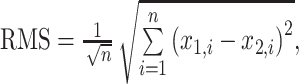 |
其中x1, i表示参考三维模型的测量点,x2, i表示口内扫描仪三维模型的测量点,n代表三维模型的点数,RMS值仅计算牙齿区域,不计算牙龈区域。
1.3. 牙列内全冠预备体终止线RMS值比较
1.3.1. CEREC Omnicam口内扫描仪和3Shape TRIOS口内扫描仪全冠预备体整体终止线RMS值比较
采用Imetric扫描仪首次扫描获得的STL格式数据作为参考真值,同时将CEREC Omnicam口内扫描仪和3Shape TRIOS口内扫描仪首次扫描的牙列内全冠预备体整体终止线STL格式数据,均导入Geomagic Studio 2013软件中;然后应用最佳拟合对齐功能,将CEREC Omnicam口内扫描仪和3Shape TRIOS口内扫描仪获取的STL格式数据与参考真值进行配准,采样大小设为1 500个参考点,对配准后的图像数据进行3D偏差分析,获得RMS值。RMS值越小,表明与参考真值间差异越小,正确度越高[10]。
1.3.2. 全冠预备体局部终止线RMS值比较
(1) 提取局部终止线STL格式数据:提取参考真值、CEREC Omnicam口内扫描仪和3Shape TRIOS口内扫描仪首次扫描时获取的全冠预备体局部(近、远中端,颊、舌侧)终止线STL格式数据(图 4), 方法与提取整体终止线STL格式数据相同。(2)全冠预备体局部终止线RMS值比较:采用CEREC Omnicam口内扫描仪和3Shape TRIOS口内扫描仪的局部终止线STL格式数据,与参考真值进行配准及3D偏差分析,获得相关RMS值,同样RMS值越小,正确度越高。
图 4.
提取的全冠预备体局部终止线示例
An example of local finish lines of the full crown preparation
A, mesial finish line; B, distal finish line; C, buccal finish line; D, lingual finish line.

1.4. 孤立全冠预备体终止线RMS值比较
1.4.1. 应用CEREC Omnicam口内扫描仪和3Shape TRIOS口内扫描仪扫描孤立全冠预备体
将右上第一磨牙全冠预备体的前后邻牙去除,建立孤立全冠预备体模型。分别应用CEREC Omnicam口内扫描仪和3Shape TRIOS口内扫描仪获得6个孤立全冠预备体的STL格式数据,数据采集方法与操作者一致性检验的方法相同。
1.4.2. 提取孤立全冠预备体终止线STL格式数据
将STL格式数据导入Geomagic Studio 2013软件中,提取出整体终止线及局部终止线的STL格式数据,提取方法与牙列内全冠预备体终止线RMS值比较部分的方法相同。
1.4.3. 孤立全冠预备体终止线RMS值比较
(1) 孤立全冠预备体整体终止线RMS值比较:获得RMS值方法与牙列内全冠预备体终止线RMS值比较这一部分相同。(2)孤立全冠预备体局部终止线RMS值比较:获得RMS值方法与牙列内全冠预备体终止线RMS值比较这一部分相同。
1.5. 统计学分析
1.5.1. 操作者自身的一致性检验
将Imetric扫描仪、CEREC Omnicam口内扫描仪和3Shape TRIOS口内扫描仪前后两次获取的RMS值导入SPSS 22.0软件(IBM公司,美国),进行组内相关系数(intraclass correlation coeficient,ICC)检验[11]。
1.5.2. 全冠预备体终止线RMS值比较
使用Kolmogorov-Smirnoff检验各组数值的正态分布,使用Levene’s test检验方差齐性。对于CEREC Omnicam口内扫描仪和3Shape TRIOS口内扫描仪间的整体或局部终止线数据比较以及同一口内扫描仪牙列内全冠预备体与孤立预备体整体或局部终止线数据的比较,如符合正态分布及方差齐性,则进行配对样本t检验,如不符合则应使用Wilcoxon signed-rank检验。对于同一口内扫描仪牙列内全冠预备体或孤立全冠预备体各部位终止线间的数据比较,若符合正态分布及方差齐性,则进行重复测量方差分析,如不符合则应使用Frideman检验。检验水准均为α=0.05。
2. 结果
2.1. 操作者自身的一致性
Imetric扫描仪的ICC值是0.84,CEREC Omnicam口内扫描仪的ICC值是0.77,3Shape TRIOS口内扫描仪的ICC值是0.77。ICC值均大于0.75,表明一致性好。
2.2. 牙列内全冠预备体终止线的RMS值比较
2.2.1. 整体终止线的RMS值比较
CEREC Omnicam口内扫描仪扫描全冠预备体整体终止线的RMS值[(44±7) μm]大于3Shape TRIOS口内扫描仪[(35±6) μm],差异有统计学意义(P < 0.05)。
2.2.2. 局部终止线的RMS值比较
CEREC Omnicam口内扫描仪扫描全冠预备体的近、远中, 颊、舌侧终止线RMS值与3Shape TRIOS口内扫描仪的RMS值见表 1。CEREC Omnicam口内扫描仪扫描全冠预备体远中终止线的RMS值最大,大于近中和颊、舌侧终止线的RMS值,经重复测量方差分析,差异有统计学意义(P < 0.05)。近中RMS值大于颊、舌侧,但差异无统计学意义(P>0.05)。3Shape TRIOS口内扫描仪扫描全冠预备体近、远中终止线的RMS值均大于颊、舌侧终止线的RMS值,经重复测量方差分析,差异有统计学意义(P < 0.05), 但近中与远中终止线的RMS值差异无统计学意义(P>0.05),颊侧和舌侧终止线的RMS值差异也无统计学意义(P>0.05)。CEREC Omnicam口内扫描仪远中终止线的RMS值大于3Shape TRIOS口内扫描仪(P < 0.05),见表 1。
表 1.
全冠预备体各部位终止线的RMS值比较(n=6)
Comparison of RMS values for different parts of finish lines(n=6)
| Site | Scanner type | t | P | |
| CEREC Omnicam oral scanner | 3Shape TRIOS oral scanner | |||
| RMS, root mean square. | ||||
| Mesial/μm | 45±9 | 45±8 | -0.36 | 0.74 |
| Distal/μm | 63±7 | 50±10 | 3.63 | 0.02 |
| Buccal/μm | 38±3 | 33±8 | 1.14 | 0.34 |
| Lingual/μm | 40±3 | 33±6 | 2.11 | 0.10 |
| F | 17.57 | 5.83 | ||
| P | < 0.001 | 0.010 | ||
2.3. 孤立全冠预备体终止线的RMS值比较
2.3.1. 整体终止线的RMS值比较
CEREC Omnicam口内扫描仪和3Shape TRIOS口内扫描仪获取牙列内全冠预备体与孤立全冠预备体整体终止线的RMS值见表 2。CEREC Omnicam口内扫描仪和3Shape TRIOS口内扫描仪获取孤立全冠预备体整体终止线的RMS值均显著小于牙列内全冠预备体组,经配对样本t检验,差异均有统计学意义(P < 0.05)。CEREC Omnicam口内扫描仪获取孤立全冠预备体整体终止线的RMS值与3Shape TRIOS口内扫描仪相比,经配对样本t检验,差异无统计学意义(P>0.05)。
表 2.
牙列内全冠与孤立全冠预备体完整终止线的RMS值比较(n=6)
Comparison of RMS values between finish lines of preparation in the dentition and isolated preparation(n=6)
| Preparation position | CEREC Omnicam oral scanner | 3Shape TRIOS oral scanner |
| RMS, root mean square. | ||
| Preparation in the dentition/μm | 44±7 | 35±6 |
| Isolated preparation/μm | 34±3 | 26±4 |
| t | 2.37 | 3.49 |
| P | 0.04 | 0.02 |
2.3.2. 局部终止线的RMS值比较
CEREC Omnicam口内扫描仪和3Shape TRIOS口内扫描仪扫描牙列内全冠预备体与孤立全冠预备体的局部终止线RMS值见表 3。CEREC Omnicam口内扫描仪和3Shape TRIOS口内扫描仪获取孤立全冠预备体近、远中局部终止线的RMS值均小于牙列内全冠预备体,经配对样本t检验,差异有统计学意义(P < 0.05),而对于颊、舌侧局部终止线的RMS值,CEREC Omnicam口内扫描仪和3Shape TRIOS口内扫描仪间差异无统计学意义(P>0.05)。CEREC Omnicam口内扫描仪获取孤立全冠预备体近中局部终止线的RMS值,与3Shape TRIOS口内扫描仪相比差异无统计学意义(P>0.05),远中终止线的RMS值虽然大于3Shape TRIOS口内扫描仪,但差异也无统计学意义(P>0.05)。
表 3.
孤立全冠与牙列内全冠预备体局部终止线扫描RMS值比较(n=6)
A comparison of RMS values for different parts of finish lines of the isolated preparation and preparation in the dentition(n=6)
| Site | CEREC Omnicam oral scanner | 3Shape TRIOS oral scanner | |||||||
| Preparation in the dentition | Isolated preparation | t | P | Preparation in the dentition | Isolated preparation | t | P | ||
| RMS, root mean square. | |||||||||
| Mesial/μm | 45±9 | 32±8 | 2.92 | 0.04 | 45±8 | 32±6 | 3.30 | < 0.05 | |
| Distal/μm | 63±7 | 38±3 | 6.61 | 0.01 | 50±10 | 36±1 | 3.50 | 0.04 | |
| Buccal/μm | 38±3 | 44±7 | -1.49 | 0.23 | 33±8 | 29±5 | 0.47 | 0.67 | |
| Lingual/μm | 40±3 | 43±3 | -2.60 | 0.08 | 33±6 | 40±7 | -1.01 | 0.39 | |
3. 讨论
3.1. 扫描成像原理对全冠预备体终止线扫描正确度的影响
正确度指大量测量值的均值与参考真值间的一致程度, RMS值可表示两个三维模型间的差异,用来评估三维模型的正确度,本研究用RMS值来表示扫描正确度。RMS值越小即两个三维模型间的差异越小,扫描正确度越高。计算RMS值时在软件取样中可能存在误差,为控制该误差首先检验了操作者自身一致性,研究首先保证扫描取像获得模型数据的稳定,实验中将牙列模型固定于匀速平移台, 并用固定夹固定扫描仪探头进行扫描取像;其次,保证正确提取三维模型图像终止线,实验中每个样本均采用了相同版本的Geomagic软件,使用人工曲线绘制、自动边界转化功能,检验结果显示一致性良好,有效避免了软件取样对计算RMS值的影响。
不同口内扫描系统的扫描正确度有可能不一样,这与扫描成像原理有关系。本研究比较了CEREC Omnicam口内扫描仪和3Shape TRIOS口内扫描仪两种口内扫描仪的扫描正确度,结果发现CEREC Omnicam口内扫描仪获取全冠预备体整体终止线的正确度低于3Shape TRIOS口内扫描仪。现有口内扫描技术主要应用主动三角测量、共聚焦显微成像和主动波阵面采样三种扫描成像原理[12]。三角测量指的是光束从扫描探头斜向投射到牙齿表面,经反射后被图像传感器捕获,从而获取牙齿表面图像信息成像,如CEREC Omnicam口内扫描仪采用该工作原理进行扫描成像。共聚焦显微成像原理是通过点光源逐层扫描,获取牙齿不同深度的焦平面形貌数据,从而构建出牙齿的三维形貌,如3Shape TRIOS口内扫描仪。主动波阵面采样原理是利用采样光路中的旋转偏心孔装置过滤牙齿上的反射光线,然后结合已知光路系统参数,计算获得牙齿表面被测点的空间坐标形成图像,3M的True Definition口内扫描仪即采用该成像原理[2]。Nedelcu等[7]的研究推测扫描原理的差异可能是扫描仪获取全冠预备体终止线正确度有差异的原因之一。他们的研究比较了应用上述3种扫描原理的7个口内扫描仪的扫描精度,结果表明3Shape TRIOS口内扫描仪获取全冠预备体整体终止线精度最佳,优于CEREC Omnicam口内扫描仪和3M True Definition口内扫描仪,这与本研究结果类似。
本研究进一步提取全冠预备体近、远中和颊、舌侧局部终止线,比较各部位正确度差异,发现CEREC Omnicam口内扫描仪对远中终止线的扫描正确度显著低于3Shape TRIOS口内扫描仪,这导致前者获取全冠预备体整体终止线的正确度值低于后者。CEREC扫描系统应用三角测量原理,其扫描光线从近中斜向远中入射,预备体本身会形成遮挡,在远中部位产生阴影现象[3, 10],因而远中终止线扫描正确度下降,影响了整体扫描正确度。3Shape TRIOS口内扫描仪应用共聚焦显微成像原理[1],扫描光源入射光路与反射光路的路径一致,不存在预备体自身遮挡导致的远中阴影现象, 因此CEREC Omnicam口内扫描仪对全冠预备体整体终止线的扫描正确度也就显著低于3Shape TRIOS口内扫描仪。其他扫描仪如Lava C.O.S口内扫描仪的扫描原理为主动波阵面采样技术[1],也不存在预备体自身遮挡导致的远中阴影现象。
本研究还发现CEREC Omnicam口内扫描仪对全冠预备体远中部位终止线的扫描正确度最低,低于近中和颊、舌侧,Mou等[6]的研究也得出类似结果。他们观察了预备体聚合度和高度对全冠修复体内部适合性的影响,发现修复体与全冠预备体近、远中轴壁间的内部间隙均增大,但远中轴壁的内部间隙增大幅度更多,该学者也认为是CEREC系统三角测量原理的远中阴影现象所致。
3.2. 邻牙遮挡对全冠预备体终止线扫描正确度的影响
本研究发现CEREC Omnicam口内扫描仪和3Shape TRIOS口内扫描仪获取全冠近、远中终止线的RMS值均显著大于颊、舌侧,即近、远中部位的终止线正确度都低于颊、舌侧。由于CEREC Omnicam口内扫描仪和3Shape TRIOS口内扫描仪扫描光源均为非平行光,当两种口内扫描仪的取像探头由牙列近中向远中匀速移动扫描时,近、远中区域均可能受邻牙遮挡,导致进入近、远中部位终止线的入射光线光强下降,同时预备体表面的反射、散射光线也可能受邻牙的遮挡,导致扫描仪的光线接收设备接收的反射、散射光线光强下降,而颊、舌侧部位终止线区域的扫描光线没有遮挡的因素影响。这可能是导致近、远中终止线正确度低的原因。
为验证上述推论,本研究设计去除邻牙遮挡, 观察孤立预备体的扫描正确度,结果发现无论是CEREC Omnicam口内扫描仪还是3Shape TRIOS口内扫描仪,获取全冠预备体整体终止线的正确度显著提高。同样进一步提取全冠预备体近、远中和颊、舌侧局部终止线,比较各部位正确度差异,结果显示近、远中终止线的正确度明显提高,而颊、舌侧终止线正确度没有明显变化,充分验证了邻牙对扫描光线的遮挡作用是造成全冠近、远中部位终止线正确度下降的重要原因。消除邻牙遮挡之后,虽然CEREC Omnicam口内扫描仪获取整体终止线及远中终止线的扫描正确度仍低于3Shape TRIOS口内扫描仪,但两者间差异无统计学意义,说明邻牙遮挡是造成终止线正确度下降的主要原因,而自身结构的遮挡对终止线扫描正确度影响较小。
本研究发现,全冠预备体近、远中局部终止线的扫描正确度远低于其他部位,其主要原因是邻牙遮挡,由此可导致整体终止线扫描正确度的下降。本研究所采用的两种口内扫描仪的扫描正确度也存在差异,因此,在临床应用口内扫描技术获取牙冠预备体数字化印模时,术者应充分了解所使用扫描仪的光学成像原理,从操作层面调整扫描方向和角度,尽量避开邻牙对光线的遮挡,力争将扫描正确度提高,从而获得高质量的全冠修复体。
志谢
感谢北京大学口腔医学院·口腔医院口腔医学数字化研究中心王勇教授、张馨月老师在仪器设备使用及口腔数字化理论基础方面给出的指导
References
- 1.Logozzo S, Zanetti EM, Franceschini G, et al. Recent advances in dental optics: Part I. 3D intraoral scanners for restorative dentistry. Opt Laser Eng. 2014;54(3):203–221. [Google Scholar]
- 2.王 勇. 口内数字印模技术. 口腔医学. 2015;35(9):705–709, 743. [Google Scholar]
- 3.张 馨月, 李 虹, 赵 一姣, et al. 两种结构光口内三维扫描仪获取单冠预备体数据质量的模型评价. 中华口腔医学杂志. 2016;51(7):432–436. doi: 10.3760/cma.j.issn.1002-0098.2016.07.011. [DOI] [Google Scholar]
- 4.Mangano F, Gandolfi A, Luongo G, et al. Intraoral scanners in dentistry: a review of the current literature. BMC Oral Health. 2017;17(1):1–11. doi: 10.1186/s12903-016-0228-6. [DOI] [PMC free article] [PubMed] [Google Scholar]
- 5.Lee JJ, Jeong ID, Park JY, et al. Accuracy of single-abutment digital cast obtained using intraoral and cast scanners. J Prosthet Dent. 2016;117(2):253–259. doi: 10.1016/j.prosdent.2016.07.021. [DOI] [PubMed] [Google Scholar]
- 6.Mou SH, Chai T, Wang JS, et al. Influence of different convergence angles and tooth preparation heights on the internal adaptation of Cerec crowns. J Prosthet Dent. 2002;87(3):248–255. doi: 10.1067/mpr.2002.122011. [DOI] [PubMed] [Google Scholar]
- 7.Nedelcu R, Olsson P, Nyström I, et al. Finish line distinctness and accuracy in 7 intraoral scanners versus conventional impression: an in vitro descriptive comparison. BMC Oral Health. 2018;18(1):1–11. doi: 10.1186/s12903-017-0444-8. [DOI] [PMC free article] [PubMed] [Google Scholar]
- 8.Sim J, Jang Y, Kim W, et al. Comparing the accuracy (trueness and precision) of models of fixed dental prostheses fabricated by digital and conventional workflows. J Prosthodont Res. 2019;63(1):25–30. doi: 10.1016/j.jpor.2018.02.002. [DOI] [PubMed] [Google Scholar]
- 9.Re D, Cerutti F, Augusti G, et al. Comparison of marginal fit of Lava CAD/CAM crown-copings with two finish lines. Int J Esthet Dent. 2014;9(3):426–435. [PubMed] [Google Scholar]
- 10.Schaefer O, Watts DC, Sigusch BW, et al. Marginal and internal fit of pressed lithium disilicate partial crowns in vitro: A three-dimensional analysis of accuracy and reproducibility. Dental Materials. 2012;28(3):320–326. doi: 10.1016/j.dental.2011.12.008. [DOI] [PubMed] [Google Scholar]
- 11.药学与临床研究编辑部 如何正确运用组内相关系数进行一致性检验:药物研究中的统计学(一) 药学与临床研究. 2018;26(1):7–8. [Google Scholar]
- 12.赵 一姣, 王 勇. 从工程技术角度谈口腔医学椅旁数字化技术. 中华口腔医学杂志. 2018;53(4):230–235. doi: 10.3760/cma.j.issn.1002-0098.2018.04.004. [DOI] [PubMed] [Google Scholar]