



Abstract
Background
The criteria for defining severe malaria have evolved over the last 20 years. We aimed to assess the strength of association of death with features currently characterizing severe malaria through a systematic review and meta-analysis.
Method
Electronic databases (Medline, Embase, Cochrane Database of Systematic Reviews, Thomson Reuters Web of Knowledge) were searched to identify publications including African children with severe malaria. PRISMA guidelines were followed. Selection was based on design (epidemiological, clinical and treatment studies), setting (Africa), participants (children < 15 years old with severe malaria), outcome (survival/death rate), and prognostic indicators (clinical and laboratory features). Quality assessment was performed following the criteria of the 2011 Quality Assessment of Diagnostic Accuracy Studies (QUADAS-2). Odds ratios (ORs) were calculated for each study and prognostic indicator, and, when a test was assessed in at least two studies, pooled estimates of ORs were computed using fixed- or random-effects meta-analysis.
Results
A total of 601 articles were identified and screened and 30 publications were retained. Features with the highest pooled ORs were renal failure (5.96, 95% CI 2.93–12.11), coma score (4.83, 95% CI 3.11–7.5), hypoglycemia (4.59, 95% CI 2.68–7.89), shock (4.31, 95% CI 2.15–8.64), and deep breathing (3.8, 95% CI 3.29–4.39). Only half of the criteria had an OR > 2. Features with the lowest pooled ORs were impaired consciousness (0.58, 95% CI 0.25–1.37), severe anemia (0.76, 95% CI 0.5– 1.13), and prostration (1.12, 95% CI 0.45–2.82).
Conclusion
The findings of this meta-analysis show that the strength of association between the criteria defining severe malaria and death is quite variable for each clinical and/or laboratory feature (OR ranging from 0.58 to 5.96). This ranking allowed the identification of features weakly associated with death, such as impaired consciousness and prostration, which could assist to improve case definition, and thus optimize antimalarial treatment.
Electronic supplementary material
The online version of this article (doi:10.1186/s12916-017-0906-5) contains supplementary material, which is available to authorized users.
Keywords: Severe malaria, Predictors, Death, Mortality, Systematic review
Background
Severe malaria accounted for approximately 2 million out of 207 million estimated malaria cases in 2012 [1]. In areas with intense and stable transmission, children under the age of 5 years carry the heaviest burden, especially in the sub-Saharan region [2]. Although a correct and prompt diagnosis of severe malaria is crucial for prescribing appropriate therapy, and thus for reducing mortality, the parenteral administration of first-line treatment often remains a challenge in resource poor settings. Improved targeting of children who would benefit most from parenteral treatment rather than oral treatment would help the overall management of malaria cases.
A child is diagnosed with severe malaria when asexual P. falciparum parasitemia is detected in the peripheral blood smear or confirmed by a rapid diagnostic test, there is no other cause for its symptoms, and at least one of impaired consciousness, respiratory distress, multiple convulsions, prostration, shock, pulmonary edema, abnormal bleeding, jaundice, severe anemia, hypoglycemia, acidosis, hyperlactatemia, renal impairment, or hyperparasitemia is present. These criteria reflect the definition of severe malaria established by the World Health Organization (WHO) in 2000, according to which any child with positive blood parasitemia and at least one of abovementioned criteria is qualified to receive parenteral treatment [3].
In recent years, a decrease in the case fatality rate of malaria has been observed [4]. The reasons for this improvement are not entirely clear, but introduction of drugs with increased efficacy [5, 6] and effective control programs [7] have certainly played a crucial role. A reduction in the case fatality rate of severe malaria has also been documented in controlled trials [5, 6]. A potential confounder for this observed reduction may be related to a selection bias due to a shift in severe malaria case definition. In 1990, the WHO set the criteria for a strict definition of severe malaria for research and epidemiological purposes [8]. In 2000, new neurological criteria, i.e., prostration and impaired consciousness, were introduced into the definition [9], and recent works have relied on a wider pragmatic case definition. For example, the Severe Malaria in African Children (SMAC) studies included children with P. falciparum detected on blood smear and classified as “being severely ill enough to be hospitalized”, without further specifications [10].
In this context, we conducted a systematic review and meta-analysis to better understand the prognostic value of clinical and laboratory findings used to diagnose severe malaria in African children. This assessment was aimed at refining the commonly employed definition of severe malaria to then explore the possibility to define ‘moderately severe malaria’ cases that could benefit from much more accessible oral treatment.
Methods
Search strategy and sources
We performed a systematic literature search using Medline, Embase, Cochrane Database of Systematic Reviews, and Thomson Reuters Web of Knowledge. Study selection followed the Preferred Reporting Items for Systemic Reviews and Meta-Analyses (PRISMA) guidelines [11]. The first search was undertaken in January 2014, with an update in February 2015. We searched Medline and Embase using Medical Subject Headings and subheadings used for indexing articles. We combined the following terms: “malaria/complications OR malaria/mortality” AND “treatment outcome” AND “infant, newborn OR infant OR child OR adolescent”. In the Cochrane Database, we looked for the words “malaria and children” in the main title of the review. We searched the Thomson Reuters Web of Knowledge using the words “malaria child”, “Africa”, “mortality” and “complications”. We did not put any language or time restrictions on the search and we expanded it by examining the reference list of the selected studies. Additionally, we used three landmark articles [10, 12, 13] on severe malaria in African children to search for citations closely related to the selected article using the PubMed option “Related citations”.
Inclusion and exclusion criteria
Studies reporting clinical and laboratory variables, including at least 100 children aged < 15 years who were diagnosed with severe malaria according to the WHO definitions, and which allowed reconstructing of two-by-two tables made up of outcome (survival/death) and presence/absence of prognostic indicator, were included in this review. Controlled trials, non-controlled trials, cohort studies, case control studies and case series, both prospective and retrospective, were considered. When necessary, authors were contacted to obtain data to construct two-by-two tables. Two independent reviewers (BG and JD) conducted this search. Two [5, 10] of the included studies served as reference publications for other enclosed publications, although no direct prognostic indicators could be extracted. Three selected studies [13–15] considered either partial or the whole population included originally in the study comparing artesunate with quinine in severe malaria treatment in Africa (known as the AQUAMAT study). In this case, the study with a greater number of study subjects with available clinical or laboratory features associated with death was selected. Two articles [16, 17] encompassed the same study population though they focused on distinct clinical or laboratory variables; thus, both of them were retained. In addition, 356 out of 2901 children enrolled in a study in The Gambia [18] also participated in the AQUAMAT study, which leads to duplication of the subjects included in these two large studies.
Finally, in view of the size of the comprised population, we also considered data from the SMAC studies [19] in our systematic review, although study inclusion criteria did not fully comply with the strict WHO definition of severe malaria. Therefore, we performed separate analyses with and without the SMAC studies.
Quality assessment
Quality of selected studies and their risk of biases were assessed by applying the 2011 revised version of the Quality Assessment of Diagnostic Accuracy Studies (QUADAS-2) tool [20], which was adjusted to the particularity of this review following the recommendation of the Cochrane Collaboration (details in Additional file 1) [21]. When the patients’ inclusion criteria differed from the WHO criteria, we reported in the methodological quality assessment that there were great concerns about the applicability of the results to the research question. Regarding prognostic indicators, clinical and laboratory features were assessed separately. Furthermore, any reported death was considered as a reference standard. Studies including less than 80% of enrolled patients were labeled as highly biased. Quality assessment was performed by one reviewer (PS) and checked by a second reviewer (BG). Any disagreements were resolved through discussion and consensus.
Data extraction
Data on clinical features among children who survived or died were extracted by one reviewer (PS) using a standardized data extraction form and checked by the second (JD), as well as on random basis by the third (BG) reviewer. Information on characteristics (design, year of publication, study country, healthcare setting), study population (size, age range, mortality, inclusion and exclusion criteria), and prognostic indicators was gathered. Any identified errors were re-examined and corrected accordingly.
Statistical analysis
A two-by-two table including crossing variables, index test (0,1) and death (0,1), was constructed for each prognostic indicator. Odds ratios (ORs) were calculated to measure the association of each prognostic indicator with death. When a prognostic indicator was assessed in at least two studies, pooled estimates of ORs were calculated. A random effects meta-analysis was performed in the case of a significant heterogeneity among studies (P < 0.05). Otherwise, the fixed-effect approach was preferred. Metan command in STATA version 12 was used to perform these meta-analyses [22]. Results for all predictors were summarized in a Forrest plot, ordering markers from the least to the most strongly associated with death. The size of each predictor’s box is proportional to the global sample size of studies involved in the corresponding summary ORs. Two separate analyses were conducted; one enclosing additional findings derived from the SMAC studies and one without it, covering studies that referred strictly to the definition of WHO as diagnosis criteria. Prognostic indicators with definitive thresholds and few without single definition (acidosis, hyperparasitemia, renal failure, respiratory distress, shock) were pooled for the usage of this analysis. The combination of symptoms was not analyzed in this systematic review due to unavailability of individual records.
Results
A total of 601 studies were identified and screened in the systematic database search. Through the selection process presented in the flow diagram (Fig. 1), 30 titles [5, 10, 13–19, 23–43] published between 1994 and 2014 were selected and used to identify predictors; 28 were finally included in the meta-analysis (no direct data could be extracted from two referral studies). Overall, 90% of eligible studies were reported in English and 10% in French. The characteristics of the studies are outlined in Table 1. The summary of quality assessment of analyzed studies, according to the QUADAS-2 tool, is presented in Table 2. The detailed analysis of each study according to the QUADAS-2 tool was captured in Additional file 2.
Fig. 1.
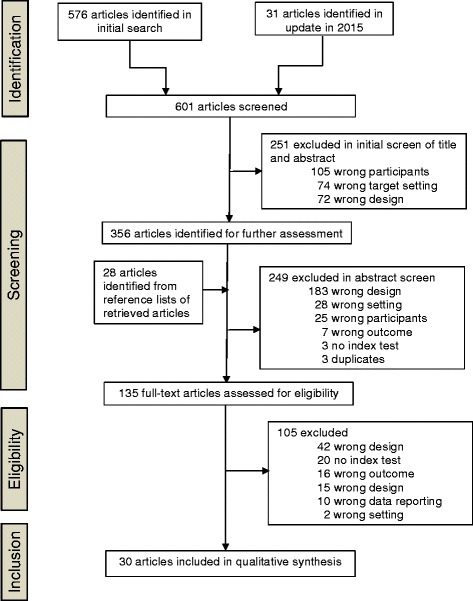
Flow diagram of the study selection process. Only the first reason for exclusion (as ordered in Appendix) is reported
Table 1.
Characteristics of included studies
| Reference | Design | Setting | Age range | Patients (N) | Case fatality rate (in the study) | Inclusion criteria | Exclusion criteria | List of prognostic indicators |
|---|---|---|---|---|---|---|---|---|
| Krishna 1994 [23] | Prosp | The Gambia; IPD; Research institute | 1.5–12 years | 115 | 18.3% | P. falciparum-positive blood film and one or more of the following features: BCS ≤2, parasitemia >100000/μL with 15%, or shock | Other causes of fever or altered consciousness (excluded by examination of blood culture and cerebrospinal fluid) | Included: hyperlactatemia, hypoglycemia, coma (BCS ≤2) Excluded: parasitemia, TNF, IL-1α |
| English 1996 [16] | Prosp | Kenya; pediatric ward | mean age:31 months | 350 | 8.6% | P. falciparum and one or more of the following clinical symptoms: coma, prostration, hyperparasitaemia, respiratory distress | NR | Included: respiratory distress, deep breathing, nasal flaring, acidosis, chest indrawing |
| English 1997 [17] | Prosp | Kenya; pediatric ward | mean age 31 months | 306 | 8.0% | P. falciparum and one or more of the following clinical syndromes: coma, prostration, hyperparasitaemia, respiratory distress | Death prior to admission assessment | Included: coma score Excluded: respiratory distress, acidosis, hyperparasitemia and prostration, respiratory distress and cerebral malaria |
| Assimadi 1998 [24] | Prosp | Togo; pediatric ward | 0–15 years | 549 | 18.9% | WHO (1995) criteria of severe malaria | NR | Included: renal failure, circulatory collapse, abnormal hemorrhage, jaundice, choluria, prostration, impaired consciousness, respiratory distress, hypoglycemia, convulsions, coma score, severe anemia, acidosis |
| Modiano 1998 [25] | Prosp | Burkina Faso; pediatric ward | 6 months to 15 years | 800 | 13.8% | WHO definition of severe malaria | Other detectable infections or causes | Included: prostration, coma, convulsions, anemia, hypoglycemia, pulmonary edema/respiratory distress, spontaneous bleeding, renal failure |
| Varandas 2000 [26] | RCT | Mozambique; pediatric ward | 6–72 months | 559 | 3.6% | Criteria for cerebral malaria: coma without a directional response to a painful stimulus 6 h after the last convulsion, clear CSF, parasitemia or positive PCR to P. falciparum; other forms of severe malaria: WHO criteria (1990) and confirmed by parasitemia | Children with a history of measles or measles vaccination in the 4 weeks preceding admission, clinical signs of vitamin A deficiency, signs of kwashiorkor or marasmus or other severe diseases | Included: age, respiratory distress on admission, acidotic breathing on admission, inability to localize painful stimulus on admission, convulsions before admission Excluded: maternal education, poor housing, loss of consciousness before admission, convulsions on admission, not-transfused children |
| Gérardin 2002 [27] | Prosp | Senegal; pediatric ward | 0–15 years | 215 | 12.1% | 2000 WHO definition of severe malaria | NR | Included: thrombocytopenia Excluded (no differentiation between severe malaria and malaria): light cerebral disorder, cerebral malaria, convulsions, respiratory distress, severe anemia, jaundice, acidosis, hyperparasitemia, hemoglobinuria, renal failure (abnormal bleeding/collapse/pulmonary edema) |
| Imbert 2003 [28] | Prosp | Senegal; pediatric ward | <15 years | 311 | 9.0% | P. falciparum trophozoites, WHO criteria of severe malaria | Simple malaria cases | Included: impaired consciousness, coma, respiratory distress, convulsions, jaundice, severe anemia, hyperparasitemia, hypoglycemia, prostration, hemoglobinuria, renal failure, shock, abnormal hemorrhage, pulmonary edema, pupillary anomalies, thrombocytopenia, leukocytosis, co-infection, hyperpyrexia Excluded: acidosis |
| Maitland 2003 [29] | Retro | Kenya; pediatric high-dependency unit | 75% <36 months | 515 | 12.8% | P. falciparum, and one or more of the following: prostration, coma, prolonged or recurrent seizures, respiratory distress, circulatory collapse, anemia, jaundice | NR | Included: impaired consciousness, acidosis, severe anemia, jaundice, hypoglycemia, sex, age, wasting, shock, deep breathing, convulsions Excluded: hypoglycemia |
| Mockenhaupt 2004 [30] | Prosp | Ghana; pediatric ward | 6–102 months | 285 | 11.2% | asexual P. falciparum parasitemia, and one or more of the following WHO (2000) criteria: severe anemia, prostration, respiratory distress, multiple convulsions, impaired consciousness, hemoglobinuria, clinical jaundice, circulatory collapse, abnormal bleeding, pulmonary edema | NR | Included: severe anemia, prostration, respiratory distress, convulsions, impaired consciousness, jaundice, circulatory collapse, hemoglobinuria, coma (BCS ≤2), hyperparasitemia, hypoglycemia, hyperlactatemia, hyperpyrexia |
| Dzeing-Ella 2005 [31] | Prosp | Gabon; tertiary referral center | 0–10 years | 576 | 8.9% | Age 0–10 years, more than two asexual forms of P. falciparum on blood film and one or more of the following features: BCS ≤2, convulsions, hyperlactatemia, hypoglycemia, severe anemia | Alternative diagnosis made clinically or by investigation (e.g., CSF examination, chest radiography, blood culture) | Included: coma, respiratory distress, severe anemia, hypoglycemia, hyperlactatemia, convulsions, sex |
| Gay-Andrieu 2005 [32] | Prosp | Niger; pediatric ward | 3–60 months | 114 | 21.0% | P. falciparum and at least one of the following clinical or biological criteria: coma (BCS ≤2), impaired consciousness (BCS >2 and <5), repeated convulsions, prostration, respiratory distress, jaundice, metabolic acidosis, severe anemia, hyperparasitemia, microscopic haemoglobinuria, renal failure, collapse, abnormal bleeding or pulmonary edema | NR | Included: coma, impaired consciousness, convulsions, respiratory distress, severe anemia, hypoglycemia, hyperparasitemia |
| Maitland 2005 [33] | RCT | Kenya; pediatric high-dependency unit | median age 2.8 years | 150 | 0.1% | Clinical feature of severe malaria (i.e., prostration, coma, or respiratory distress), and P. falciparum parasitemia and metabolic acidosis (base deficit >8 mmol/L) and Hb >50 g/L | Pulmonary edema, edematous malnutrition, papilledema | Included: acidosis |
| Zeidan 2005 [34] | Prosp, cx | Sudan; IPD | <15 years | 543 | 2.6% | Identification of P. falciparum in blood film and presence of any of combined complications of change of behaviors, confusion or drowsiness, altered consciousness or coma, convulsions, hypoglycemia, acidosis, difficulty in breathing, pulmonary edema, oliguria, acute renal failure, severe anemia (hematocrit <20%, Hb <6 g/dL), haemoglobinuria, jaundice, tendency to bleed, and generalized weakness rendering the patient unable to walk or sit up without assistance | NR | Included: prostration, age, hyperpyrexia, convulsions, leukocytosis, coma Excluded: delays, jaundice, anemia, hepatomegaly, splenomegaly, hypoglycemia, hemoglobinuria, fever, vomiting |
| Bronzan 2007 [35] | Retro | Malawi; pediatric research ward, | ≥6 months | 1388 | 16.0% | Presenting one of three severe malaria syndromes: CM, SMA, or CM with SMA and confirmed by P. falciparum blood film test | Other identifiable causes of coma (such as hypoglycemia, postictal state, and meningitis) | Included: severe anemia, cerebral malaria (BCS ≤2 persisting for >2 hours after other identifiable causes of coma have been excluded), HIV infection |
| Issifou 2007 [36] | Prosp | Gabon; medical research unit; IPD | 1–120 months | 2235 | 3.0% | Age 1–120 months, “non per os” falciparum malaria (patients hospitalized for malaria and treated with intravenous quinine in a 10% glucose infusion) | NR | Included: coma (BCS ≤2), hypoglycemia, severe anemia, respiratory distress |
| Oduro 2007 [37] | Prosp | Ghana; IPD | 6–59 months | 868 | 3.5% | 1990 and 2000 WHO severe malaria criteria | NR | Included: coma (BCS <3), severe anemia, respiratory distress, hyperlactatemia, hypoglycemia |
| Orimadegun 2007 [38] | Retro | Nigeria; tertiary hospital | 6 months to 15 years | 1806 | 6.9% | 2000 WHO severe malaria criteria | NR | Included: severe anemia, coma (BCS <3), sex Excluded: hypoglycemia, respiratory distress |
| Bassat 2008 [39] | Retro | Mozambique; district hospital | <15 years | 1100 | 4.4% | Malaria case with at least one of the following criteria: PCV <15%, deep coma (BCS ≤2), prostration, hypoglycemia, convulsions, respiratory distress | Children with malaria parasitaemia for whom the cause of death was not malaria were not considered severe malaria cases | Included: severe anemia, coma, convulsions, hypoglycemia, prostration, respiratory distress, impaired consciousness, jaundice, dehydration |
| Ranque 2008 [40] | Prosp | Mali; pediatric ward | <15 years | 455 | 16.0% | Fever >38 °C and P. falciparum trophozoites, and no suggestion of other diagnosis; all children diagnosed with CM and/or SMA | NR | Included: fever >4 days, personal history of CM, CM history in siblings, coma score, severe anemia, hypoglycemia, dehydration, spleen enlargement, liver enlargement, prior antimalarial treatment, respiratory distress, age group, sex |
| Ogetii 2010 [41] | Retro | Kenya; pediatric high-dependency unit | 0–12 years | 1236 | 10.5% | P. falciparum parasitemia plus impaired consciousness and/or respiratory distress | Children admitted to the general ward with malaria parasitaemia who deteriorated after admission fulfilling the definition of severe malaria | Included: hypoglycemia |
| Camara 2011 [42] | Prosp | Senegal; pediatric ward | 0–15 years | 162 | 11.1% | Aged 0–15 years, P. falciparum-positive thick drop examination and at least one of the WHO 2000 malaria severity criteria | All children with anti-malarial treatment started less than 72 hours prior to hospitalization | Included: sex, age, impaired consciousness, prostration, respiratory distress, coma, shock, convulsions, jaundice, hypoglycemia, thrombocytopenia, severe anemia, hemoglobinuria |
| Hendrikson 2012 [15]a | RCT | Mozambique; tertiary referral hospital | <15 years | 655 | 10.9% | Children (<15 years) with suspected severe malaria according to modified WHO clinical criteria, positive pLDH-based RDT | If treated parenterally for >24 hours before admission | Included: HIV infection |
| Hendriksen 2012 [14]a | RCT | Mozambique, Gambia, Kenya, Tanzania, Uganda, Rwanda, DRC; pediatric wards | 1 month to 15 years | 3826 | 9.9% | Positive P. falciparum histidine-rich protein two-based rapid test (Optimal), and at least one of coma, prostration, convulsions, compensated shock, decompensated shock, severe respiratory distress, hypoglycemia, severe symptomatic anemia, blackwater fever, clinical jaundice, hyperparasitemia | If treated parenterally for >24 hours before admission | Included: acidosis, severe anemia, hypoglycemia, hyperparasitemia Excluded: respiratory distress, coma, convulsions, jaundice, shock, black water fever |
| Jallow 2012 [18] | Prosp obser | Gambia; pediatric ward | 4 months to 14 years | 2901 | 13.0% | Asexual P. falciparum parasitemia, and one or more of the following WHO criteria for severe malaria: severe anemia, respiratory distress, hypoglycemia, decompensated shock, repeated convulsion, acidosis, hyperlactatemia | NR | Included: acidosis, coma score, convulsions, severe anemia, hyperalactatemia, hyperparsitemia, hyperpyrexia, hypoglycemia, impaired consciousness, deep breathing, jaundice, liver enlargement, prostration, renal failure, respiratory distress, shock, spleen enlargement |
| von Seidlein 2012 [13]a | RCT | Gambia, Mozambique, Nigeria, Rwanda, Kenya, DRC, Tanzania, Ghana, Uganda; pediatric wards | <15 years | 5426 | 9.7% | Positive P. falciparum histidine-rich protein two-based rapid test (Optimal), and at least one of coma, prostration, convulsions, compensated shock, decompensated shock, severe respiratory distress, hypoglycemia, severe symptomatic anemia, blackwater fever, clinical jaundice, hyperparasitemia | If treated parenterally for >24 hours before admission | Included: convulsions, prostration, coma shock, respiratory distress, deep breathing, jaundice, chronic disease, sex, black water fever Excluded: blood urea nitrogen, base excess, pH, respiratory rate, parasite density, hemoglobin, glucose level, temperature, age, heart rate |
| Kendjo 2013 [19]b | Prosp, cx | Sub-Saharan Africa; hospital research centres | <15 years | 26 296 | 4.3% | Severe P. falciparum malaria | NR | Included: seizures prior to admission, vomiting prior to admission, deep breathing, indrawing, irregular breathing, prostration, coma, hyperparasitemia, severe anemia, hypoglycemia Excluded: hyperlactatemia |
| Orimadegun 2014 [43] | Prosp, cx | Nigeria; tertiary hospital | <5 years | 369 | 8.1% | P. falciparum malaria parasitaemia confirmed with blood film microscopy and the presence of any of the defined life-threatening features for malaria according to WHO (2000) | Children who had clinical signs suggestive of cardiac defect and those whose parents refused consent | Included: severe anemia, hyperparasitemia, acidosis, hemoglobinuria, hypoglycemia, coma score, renal impairment, hypoxia Excluded: hypokalemia, hyponatremia, pneumonia, azotemia, wasting |
aReferral study: Dondorp 2010 [5]
bReferral study: Helbok 2009 [10]
Excluded prognostic indicators: not enough data to construct two-by-two tables
BCS Blantyre coma scale, CM cerebral malaria, CSF cerebrospinal fluid, Cx cross-sectional, IPD In-patient department, NR not reported, Obs observational, pLDH parasite lactate dehydrogenase, Prosp prospective, Retro retrospective, RCT randomized clinical trial, RDT rapid diagnostic test, SMA severe malarial anemia, WHO World Health Organization
Table 2.
Quality assessment according to the QUADAS-2 tool: potential bias and applicability concerns of included studies (without referral studies)
| Risk of bias | Applicability concerns | ||||||||
|---|---|---|---|---|---|---|---|---|---|
| Patient selection | Clinical predictors of mortality | Laboratory predictors of mortality | Reference standard | Flow and timing | Patient selection | Clinical predictors of mortality | Laboratory predictor of mortality | Reference standard | |
| Krishna et al. (1994) [23] | Low | Low | Low | Low | Low | High | Low | Low | Low |
| English et al. (1996) [16] | Low | Low | Low | Low | Low | Low | Low | Low | Low |
| English et al. (1997) [17] | High | Low | NA | Low | Low | Unclear | High | NA | Low |
| Assimadi et al. (1998) [24] | Low | High | High | Low | Low | Low | High | High | Low |
| Modiano et al. (1998) [25] | Low | Unclear | Low | Low | Low | Low | Unclear | Low | Low |
| Varandas et al. (2000) [26] | High | Low | NA | Low | Low | Low | Low | NA | Low |
| Gérardin et al. (2002) [27] | Low | Low | Low | Low | Low | Low | Low | Low | Low |
| Imbert et al. (2003) [28] | Low | Low | Low | Low | Low | Low | Low | Low | Low |
| Maitland et al. (2003) [29] | Low | Low | Low | Low | Low | Low | Low | Unclear | Low |
| Mockenhaupt et al. (2004) [30] | Low | Low | Low | Low | Low | Low | Low | Low | Low |
| Dzeing-Ella et al. (2005) [31] | Low | Low | Low | Low | Low | Low | Low | Low | Low |
| Gay-Andrieu et al. (2005) [32] | High | Unclear | Low | Low | Low | High | Unclear | Low | Low |
| Maitland et al. (2005) [33] | High | NA | Low | Low | Low | High | NA | Low | Low |
| Zeidan et al. (2005) [34] | Low | Low | Low | Low | Low | Low | Low | Low | Low |
| Bronzan et al. (2007) [35] | High | Low | Low | Low | Low | High | Low | Low | Low |
| Issifou et al. (2007) [36] | High | Low | Low | Low | Low | Unclear | Low | Low | Low |
| Oduro et al. (2007) [37] | High | Low | Low | Low | Low | Low | Unclear | Unclear | Low |
| Orimadegun et al. (2007) [38] | High | Unclear | Unclear | Low | Low | Low | Low | Low | Low |
| Bassat et al. (2008) [39] | Low | Low | Low | Low | Low | Low | Low | Low | Low |
| Ranque et al. (2008) [40] | High | Low | Low | Low | Low | High | Low | Low | Low |
| Ogetii et al. (2010) [41] | Low | NA | Low | Low | Low | Low | NA | Low | Low |
| Camara et al. (2011) [42] | Low | Unclear | Unclear | Low | Low | Low | Low | Unclear | Low |
| Hendriksen et al. (2012) [15] | Low | NA | Low | Low | Low | Low | NA | Low | Low |
| Hendriksen et al. (2012) [14] | Low | Low | Low | Low | Low | Low | Low | Low | Low |
| Jallow et al. (2012) [18] | Low | Low | Low | Low | High | Low | Low | Low | Low |
| von Seidlein et al. (2012) [13] | Low | Low | Low | Low | Low | Low | Low | Low | Low |
| Kendjo et al. (2012) [19] | Low | Low | Low | Low | High | High | Low | Low | Low |
| Orimadegun et al. (2014) [43] | Low | Low | Low | Low | Low | Low | Low | Low | Low |
NA not applicable
A total of 36 different prognostic indicators associated with death due to severe malaria were identified in 30 studies. The number of predictors of mortality evaluated per study ranged from 1 to 19 (median 6.5, interquartile range 3–11). Out of 36 identified prognostic indicators, 18 corresponded with the clinical criteria of severe malaria established by the WHO. Two forest plots displaying pooled estimates of ORs with 95% confidence intervals (CI) calculated for 17 and 18 prognostic indicators included in the WHO definition of severe malaria are captured in Figs. 2 and 3, respectively. Definitions and further characteristics of the analyzed prognostic indicators are assembled in Table 3.
Fig. 2.

Pooled estimates of odds ratios (with 95% confidence intervals) of each predictor of mortality assessed in at least two studies (without the Severe Malaria in African Children studies) and number of studies by each predictor. The size of each predictor’s box is proportional to the global sample size of studies involved in the corresponding summary odds ratios. *Results calculated by fixed effects
Fig. 3.

Pooled estimates of odds ratios (with 95% confidence intervals) of each predictor of mortality assessed in at least two studies (including the Severe Malaria in African Children studies) and number of studies by each predictor. The size of each predictor’s box is proportional to the global sample size of studies involved in the corresponding summary odds ratios. *Results calculated by fixed effects
Table 3.
Characteristics of assessed WHO prognostic indicators
| Predictor of mortality | Definition | N assessed | N with the condition | N died | Pooled PPV | Odds ratio (meta-analysis) | Study reference |
|---|---|---|---|---|---|---|---|
| Neurological symptoms and signs | |||||||
| Convulsions | ≥2/24 hours | 8197 | 2252 | 772 | 14.7% | 2 (1.71–2.34) | von Seidlein 2012 [13]; Bassat 2008 [39]; Mockenhaupt 2004 [30]; Imbert 2003 [28]; Gay-Andrieu 2005 [32]; Camara 2011 [42]; Modiano 1998 [25] |
| Convulsionsa | ≥2/24 hours | 34233 | 10573 | 1901 | 8.1% | 1.94 (1.76–2.13) | von Seidlein 2012 [13]; Bassat 2008 [39]; Mockenhaupt 2004 [30]; Imbert 2003 [28]; Gay-Andrieu 2005 [32]; Camara 2011 [42]; Modiano 1998 [25]; Kendjo 2013 [19] |
| Coma score | BCS ≤2 | 16796 | 1675 | 4881 | 21.3% | 4.83 (3.11–7.5) | Krishna 1994 [23]; von Seidlein 2012 [13]; Ranque 2008 [40]; Orimadegun 2007 [38]; Oduro 2007 [37]; Mockenhaupt 2004 [30]; Jallow 2012 [18]; Issifou 2007 [36]; Gay-Andrieu 2005 [32]; English 1997 [17]; Dzeing-Ella 2005 [31]; Bassat 2008 [39]; Camara 2011 [42]; Bronzan 2007 [35]; Orimadegun 2014 [43] |
| Coma scorea | BCS ≤2 | 42832 | 7316 | 2804 | 20.7% | 5.04 (3.35–759) | Krishna 1994 [23]; von Seidlein 2012 [13]; Ranque 2008 [40]; Orimadegun 2007 [38]; Oduro 2007 [37]; Mockenhaupt 2004 [30]; Jallow 2012 [18]; Issifou 2007 [36]; Gay-Andrieu 2005 [32]; English 1997 [17]; Dzeing-Ella 2005 [31]; Bassat 2008 [39]; Camara 2011 [42]; Bronzan 2007 [35]; Orimadegun 2014 [43]; Kendjo 2013 [19] |
| Impaired consciousness | BCS 3–4 | 276 | 95 | 42 | 9.5% | 0.58 (0.25–1.37) | Gay-Andrieu 2005 [32]; Camara 2011 [42] |
| Prostration | Cannot sit OR cannot eat (breastfeed) OR cannot walk OR cannot stand up | 11607 | 6452 | 1176 | 8.3% | 1.12 (0.45–2.82) | Jallow 2012 [18]; Zeidan 2005 [34]; von Seidlein 2012 [13]; Mockenhaupt 2004 [30]; Imbert 2003 [28]; Camara 2011 [42]; Bassat 2008 [39]; Assimadi 1998 [24]; Modiano 1998 [25] |
| Prostrationa | Cannot sit OR cannot eat (breastfeed) OR cannot walk OR cannot stand up | 37643 | 22322 | 2305 | 7.0% | 1.42 (0.39–5.14) | Jallow 2012 [18]; Zeidan 2005 [34]; von Seidlein 2012 [13]; Mockenhaupt 2004 [30]; Imbert 2003 [28]; Camara 2011 [42]; Bassat 2008 [39]; Assimadi 1998 [24]; Modiano 1998 [25]; Kendjo 2013 [19] |
| Respiratory symptoms and signs | |||||||
| Deep breathing | NR | 9106 | 1230 | 965 | 22.2% | 3.8 (3.29–4.39) | von Seidlein 2012 [13]; Maitland 2003 [29]; English 1996 [16]; Varandas 2000 [26]; Jallow 2012 [18] |
| Deep breathinga | NR | 32882 | 4049 | 1772 | 19.1% | 4.89 (3.28–7.29) | von Seidlein 2012 [13]; Maitland 2003 [29]; English 1996 [16]; Varandas 2000 [26]; Jallow 2012 [18]; Kendjo 2013 [19] |
| Indrawinga | NR | 26386 | 3137 | 1159 | 13.3% | 4.63 (4.08–5.25) | English 1996 [16]; Kendjo 2013 [19] |
| Respiratory distress | Nasal flaring or costal indrawing or accessory muscle use OR Kussmal breathing/Cheyne–Stokes breathing OR deep breathing OR abnormalities in respiratory rate/rhythm OR dyspnea OR pulmonary edema | 15343 | 3729 | 1526 | 17.5% | 3.15 (2.79–3.35) | Jallow 2012 [18]; von Seidlein 2012 [13]; Ranque 2008 [40]; Oduro 2007 [37]; Mockenhaupt 2004 [30]; Issifou 2007 [36]; Imbert 2003 [28]; Gay Andrieu 2005 [32]; English 1996 [16]; Dzeing-Ella 2005 [31]; Camara 2011 [42]; Bassat 2008 [39]; Assimadi 1998 [24]; Varandas 2000 [26]; Modiano 1998 [25] |
| Cardiovascular symptoms and signs | |||||||
| Shock/circulatory collapse | SBP <50 OR compensated shock (BP ≥70 + CRT ≥3 s) and decompensated (BP <70) OR SBP <60 in ≤5-year-old children OR SBP <80 in >5-year-old children OR septic shock score ≥2 | 7567 | 915 | 789 | 23.6% | 4.31 (2.15–8.64) | Jallow 2012 [18]; von Seidlein 2012 [13]; Mockenhaupt 2004 [30]; Maitland 2003 [29]; Imbert 2003 [28]; Assimadi 1998 [24]; Camara 2011 [42] |
| Abnormalhemorrhage | NR | 1349 | 17 | 199 | 23.5% | 1.84 (0.6–5.67) | Assimadi 1998 [24]; Modiano 1998 [25] |
| Jaundice | |||||||
| Jaundice | 11178 | 599 | 1203 | 17.4% | 1.65 (1.31–2.07) | Jallow 2012 [18]; von Seidlein 2012 [13]; Mockenhaupt 2004 [30]; Maitland 2003 [29]; Imbert 2003 [28]; Camara 2011 [42]; Bassat 2008 [39]; Assimadi 1998 [24] | |
| Renal symptoms and signs | |||||||
| Hemoglobinuria | Verified by dipstick | 7102 | 286 | 739 | 11.5% | 1.84 (0.75–4.52) | Mockenhaupt 2004 [30]; Imbert 2003 [28]; Assimadi 1998 [24]; Camara 2011 [42]; Orimadegun 2014 [43]; von Seidlein 2012 [13] |
| Laboratory values of severe malaria in selected studies | |||||||
| Acidosis | BE < –8 mmol/L OR base deficit >15 OR BE < –12 mmol/L (all) | 6549 | 2392 | 646 | 15.1% | 3.32 (1.35–8.18) | Hendriksen 2012 [14]; Maitland 2005; Jallow 2012 [18]; Maitland 2003 [29]; English 1996 [16], Assimadi 1998 [24]; Orimadegun 2014 [43] |
| Severe anemia | Hematocrit <15% or Hb <5 g/dL | 14078 | 5039 | 1406 | 8.2% | 0.76 (0.50–1.13) | Jallow 2012 [18]; Hendriksen 2012 [14]; Camara 2011 [42]; Bassat 2008 [39]; Ranque 2008 [40]; Orimadegun 2007 [38]; Mockenhaupt 2004 [30]; Maitland 2003 [29]; Issifou 2007 [36]; Gay-Andrieu 2005 [32]; Dzeing-Ella 2005 [31]; Imbert 2003 [28]; Modiano 1998 [25]; |
| Severe anemiaa | Hematocrit <15% or Hb <5 g/dL | 40114 | 10418 | 2535 | 7.4% | 0.81 (0.55–1.21) | Jallow 2012 [18]; Hendriksen 2012 [14]; Camara 2011 [42]; Bassat 2008 [39]; Ranque 2008 [40]; Orimadegun 2007 [38]; Mockenhaupt 2004 [30]; Maitland 2003 [29]; Issifou 2007 [36]; Gay-Andrieu 2005 [32]; Dzeing-Ella 2005 [31]; Imbert 2003 [28]; Modiano 1998 [25]; Kendjo 2013 [19] |
| Hyperlactatemia | Lactate ≥5 mmol/L or NR | 2188 | 773 | 183 | 14.7% | 3.76 (1.96–7.23) | Jallow 2012 [18]; Krishna 1994 [23]; Oduro 2007 [37]; Mockenhaupt 2004 [30]; Dzeing-Ella 2005 [31] |
| Hyperparasitemia | Hyperparsitemia >10% ([14]) or hyperparasitemia >4% ([32]) or parasitemia ≥250,000 p/μL ([43]) or P. falciparum parasite density >500,000/μL ([18]) | 7735 | 1164 | 873 | 13.2% | 1.37 (1.13–1.66) | Jallow 2012 [18]; Hendriksen 2012 [14]; Mockenhaupt 2004 [30]; Imbert 2003 [28]; Gay-Andrieu 2005 [32]; Orimadegun 2014 [43] |
| Hyperparasitemiaa | Hyperparsitemia > 10% ([14]) or hyperparasitemia >4% ([32]) or parasitemia ≥250,000 p/μL ([19, 43]) or P. falciparum parasite density >500,000/μL ([18]) | 33771 | 6123 | 2002 | 6.5% | 1.24 (1.11–1.4) | Jallow 2012 [18]; Hendriksen 2012 [14]; Mockenhaupt 2004 [30]; Imbert 2003 [28]; Gay-Andrieu 2005 [32]; Orimadegun 2014 [43]; Kendjo 2013 [19] |
| Hypoglycemia | Glucose <2.2 mmol/L | 6358 | 37 | 48 | 16.2% | 4.59 (2.68–7.89) | Jallow 2012 [18]; Krishna 1994 [23]; Imbert 2003 [28]; Mockenhaupt 2004 [30]; Issifou 2007 [36]; Gay-Andrieu 2005 [32]; Dzeing-Ella 2005 [31]; Camara 2011 [42]; Bassat 2008 [39]; Modiano 1998 [25] |
| Hypoglycemiaa | Glucose <2.2 mmol/L | 31348 | 2933 | 2662 | 45.4% | 4.81 (2.93–7.91) | Jallow 2012 [18]; Krishna 1994 [23]; Imbert 2003 [28]; Mockenhaupt 2004 [30]; Issifou 2007 [36]; Gay-Andrieu 2005 [32]; Dzeing-Ella 2005 [31]; Camara 2011 [42]; Bassat 2008 [39]; Modiano 1998 [25]; Kendjo 2013 [19] |
| Renal failure | Urine output of <12 mL/kg/24 hours and serum creatinine >265 μL/L over OR plasma creatinine >3 mg/dL | 4757 | 32 | 547 | 40.6% | 5.96 (2.93–12.11) | Jallow 2012 [18]; Imbert 2003 [28]; Assimadi 1998 [24]; Modiano 1998 [25]; Orimadegun 2014 [43] |
| Other symptoms and signs | |||||||
| Hyperpyrexia | >40 °C OR ≥40 °C | 3946 | 125 | 919 | 24.8% | 0.59 (0.11–3.19) | Jallow 2012 [18]; Zeidan 2005 [34]; Mockenhaupt 2004 [30]; Imbert 2003 [28] |
aIncluding the Severe Malaria in African Children studies.
BE base excess, BCS Blantyre coma scale, BP blood pressure, CRT capillary refill time, HB hemoglobin, NR not reported, PPV positive predictive value, SBP systolic blood pressure
Prognostic indicators with the strongest association with death included renal failure (5.96, 95% CI 2.93–12.11), coma (4.83, 95% CI 3.11–7.5), hypoglycemia (4.59, 95% CI 2.68–7.89), shock (4.31, 95% CI 2.15–8.64), and deep breathing (3.8, 95% CI 3.29–4.39). These five indicators also had the largest CI boundaries. Respiratory distress, while having a lower OR than the five indicators mentioned above, presented a narrower CI and lower CI boundaries in line with five top indicators (3.15, 95% CI 2.79–3.35). Moreover, the results were also consistent upon introduction of the SMAC study, with each association being slightly larger than without the SMAC, while the association with death of the top indicators was more homogeneous for renal failure (5.96, 95% CI 2.93–12.11), coma (5.04, 95% CI 3.35–7.59), deep breathing 4.89 (95% CI 3.28–7.29), hypoglycemia (4.81, 95% CI 2.93–7.91), and chest indrawing (4.63, 95% CI 4.08–5.25). The latter entered the top five indicators (in place of shock) and also presented the lower CI boundary (>4).
Two or more convulsions (2.0, 95% CI 1.71–2.34) were also associated with poor outcome. However, further neurological signs, such as prostration (1.12, 95% CI 0.45–2.82) and impaired consciousness (0.58, 95% CI 0.25–1.37) were not associated with death. These results are comparable to those after inclusion of the SMAC study, namely convulsions (1.94, 95% CI 1.76–2.13) and prostration (1.42, 95% CI 0.39–5.14). Neither severe anemia, with and without the SMAC studies (0.81, 95% CI 0.55–1.21 vs. 0.76, 95% CI 0.50–1.13, respectively) nor hyperpyrexia (1.19, 95% CI 0.71–1.99) were associated with death.
Discussion
The results of the meta-analysis show that there is a large variation in the strength of the association between the different WHO-defined criteria of severe malaria and death. Renal failure, coma, hypoglycemia, shock, and respiratory distress represent those with the highest prognostic value. These manifestations were also those with the highest prognostic value for death in the original paper by Marsh [12], which was supportive of the WHO definition of severe malaria. Similarly, impaired consciousness, prostration, hyperpyrexia, hyperparasitaemia, and severe anemia were weak predictors both in the present systematic review and in Marsh’s paper [12]. While 5039 (35.7%) of children from the enclosed studies suffered from severe anemia, its association with death, though widely acknowledged, was insignificant. This can possibly be explained by the fact that anemic children receive blood transfusion upon admission or by the lack of other concomitant feature such as respiratory distress or neurological impairment. On the other hand, hypoglycemia, which similarly to severe anemia could be reversed if early detected, remains a significant marker of severity, which can be possibly explained by its dependency on other severe markers. Conditions such as malnutrition or HIV co-infection have not been addressed in this analysis since they are not part of the definition of severe malaria. They are, however, very important contributors of mortality and should definitively be considered together with other clinical features when assessing a sick child.
The current systematic review recognizes coma (defined as Blantyre coma scale (BCS) ≤ 2) and deep breathing as robust prognostic factors of pediatric life-threatening malaria that can simply be determined and recorded by skilled observers in all types of settings. Deep breathing, as a crucial respiratory sign of severe malaria, is commonly a compensatory manifestation of underlying metabolic acidosis [44] and is more predictive than respiratory distress accompanied by signs of variable severity. These findings are nearly in line with the results from a prospective study [12] of 1844 patients in Kenya, which identified respiratory distress and impaired consciousness (defined as prostration or coma) as highly associated with death and, except for prostration, with the Lambaréné Organ Dysfunction Score, which combines coma, prostration, and deep breathing [10].
Although there is no definite consensus regarding the strongest predictors of death within the WHO clinical definition of severe malaria, the WHO distinguished three groups [1] classing clinical and laboratory features of the disease in a way to facilitate appropriate treatment. A major contrast of our results with the clinical features included in the WHO Group 1 symptoms (prostrate but conscious, prostrate with impaired consciousness, coma, mild/severe respiratory distress, shock), which are supposedly more severe and for which parenteral treatment is recommended, is that a child with prostration or impaired consciousness appears to be at a low risk of death when compared with the presence of any other listed signs and symptoms. One possible explanation for this unexpected finding is that, in some studies, the definition of impaired consciousness was less stringent than that of the WHO (BCS < 3). Interestingly, in the differentiated group of 1289 Gabonese children, Issifou et al. [36] applied a BCS between 3 and 4 to classify cases of moderate malaria. On the other hand, our findings are consistent with the WHO Group 2 clinical features (severe anemia, two or more convulsions in past 24 hours, hemoglobinuria, jaundice), which indicate a disease of lower severity and for which a supervised oral therapy is recommended.
The present attempt to rank clinical features according to their prognostic values was performed to potentially better distinguish children that should definitely be receiving parenteral treatment versus those that could be considered for prompt oral treatment with artemisinin-based combinations. At present, the WHO recommends injectable artesunate for all children with asexual forms of P. falciparum in peripheral blood and at least one criterion of severity [45]. In the light of the very different prognostic values of the different features, Kopel et al. [46] suggested that oral treatment could be a successful alternative for patients with a detected parasitemia and a criterion considered as less severe, e.g., jaundice. Certainly, all prognostic indicators that are able to be detected at the bedside need to be searched for, and finding a low-prognostic symptom or sign does not remove the need for parenteral treatment if a high-prognostic one is present. Identifying a subset of patients with moderately severe malaria who could be safely managed with oral treatment at the primary care level would simplify the patients’ management in settings where referral to hospital for injectable treatment is difficult, and allow better resources allocation. A simplified approach may be easier to implement. Already, in settings where laboratory facilities are unavailable, the laboratory tests used to define severe malaria are not considered in the classification of the disease. This new approach should be carefully assessed in a prospective multicentric clinical trial to demonstrate its safety.
To our knowledge, this is the first systematic review and meta-analysis of predictors of death drawn from all relevant studies of African children with strictly defined severe malaria. Methodological quality was assessed by using a priori adjusted and defined rules of the latest version of QUADAS-2 tool, which allowed better evaluation of risk of biases in several domains. In addition, this review assessed the disease severity criteria used in the SMAC studies [19]. Indeed, this represents the largest sample size ever recruited. The fact that the results did not change much when including or not prognostic indicators from the SMAC studies increases the robustness of the findings.
The main limitation of our analysis comes from the methodological or reporting weaknesses of some studies, of which the most important one is the lack of reproducibility of reported clinical symptoms and signs. Indeed, the inter-observer (clinician) agreement on the assessment of some of the signs, such as impaired consciousness or prostration for example, can be very low. Additionally, heterogeneity between studies regarding availability of laboratory data, threshold used to define abnormality, and quality of healthcare, especially with regards to blood transfusion and management of renal failure, need to be taken into account in results interpretation. Another limitation of our review is that it did not consider combinations of clinical and laboratory features of severe malaria because of the unavailability of individual records. It has been shown that having more than one manifestation of severe malaria increases the risk of dying [13] and this has to be taken into account in a child assessment of severity, and hence in case management. Furthermore, due to lack of data in the included studies, this meta-analysis could not explore the impact of other concurrent complications that do not form part of the definition of severe malaria but are known for increasing the risk of death such as, for example, bacteremia. In addition, since all data were aggregated in each study, we were not able to analyze predictors by age group or sex. This should not alter much the relevance of our findings since approximately 80% patient population was < 5 years of age and WHO has never considered a differential definition of severe malaria for children and adults or male and female. Finally, studies reporting less than 100 cases were excluded to reduce complexity, but some of those could have brought relevant information.
Conclusion
In conclusion, the findings of this meta-analysis show that the strength of association between the criteria defining severe malaria and death is quite variable for each clinical and/or laboratory features (OR ranging from 0.58 to 5.96). Despite the heterogeneity of entry criteria, the individual studies provided concordant results. A ranking allowed the identification of features weakly associated with death, such as impaired consciousness and prostration, which could assist to refine case definition and thus optimize antimalarial treatment.
Additional files
QUADAS-2 review-specific tailored tool and instructions for quality assessment of selected studies. (DOCX 19 kb)
QUADAS-2 tool. Risk of bias and applicability judgments. (PDF 499 kb)
Acknowledgements
Not applicable.
Funding
No specific funding was available for this work.
Availability of data and materials
The dataset for statistical analysis has been deposited in the Zenodo (www.zenodo.org) and can be found at https://doi.org/10.5281/zenodo.820626.
Abbreviations
- BCS
Blantyre Coma Scale
- CI
confidence interval
- ORs
odds ratios
- PRISMA
Preferred Reporting Items for Systemic Reviews and Meta-Analyses
- QUADAS
Quality Assessment of Diagnostic Accuracy Studies
- SMAC
Severe Malaria in African Children
- WHO
World Health Organization
Appendix
Criteria for study selection
Design: Epidemiological, clinical, and treatment studies on malaria were selected. Controlled trials, non-controlled trials, cohort studies, case control studies, and case series, either prospective or retrospective of 100 cases or more, were accepted. Systematic reviews, meta-analyses, letters, editorials, and comments were used only as a source of reference.
Setting: Studies conducted in Africa.
Participants: Studies that included children below the age of 15 with severe malaria according to the WHO definitions, with or without modified criteria. The cases needed to be diagnosed with parasitological confirmation defined as parasite identification by smear or as a positive rapid diagnostic test.
Outcome: Studies that reported death rate.
Prognostic indicators: Studies that reported clinical and laboratory variables associated with death due to malaria.
Reference standard: any reported death from admission to end of follow-up.
Data reporting: Studies that allow the reconstruction of two-by-two tables made up of death rate and prognostic indicators of death. When necessary, authors were contacted to obtain missing data.
Authors’ contributions
The corresponding author had final responsibility for the decision to submit for publication. PS, BG, JD, CRA, and FH contributed to the study conception and design. PS, JD, and BG extracted the data. PS, IL, and BG analyzed and interpreted the data. PS and BG drafted the article. All authors read and approved the final manuscript.
Ethics approval and consent to participate
Not applicable.
Consent for publication
Not applicable.
Competing interests
The authors declare that they have no competing interests.
Publisher’s Note
Springer Nature remains neutral with regard to jurisdictional claims in published maps and institutional affiliations.
Footnotes
Electronic supplementary material
The online version of this article (doi:10.1186/s12916-017-0906-5) contains supplementary material, which is available to authorized users.
References
- 1.World Health Organization Severe malaria. Trop Med Int Health. 2014;19:7. doi: 10.1111/tmi.12313_2. [DOI] [PubMed] [Google Scholar]
- 2.White NJ, Pukrittayakamee S, Hien TT, et al. Malaria. Lancet. 2014;383:723. doi: 10.1016/S0140-6736(13)60024-0. [DOI] [PubMed] [Google Scholar]
- 3.World Health Organization Severe falciparum malaria. Trans R Soc Trop Med Hyg. 2000;94(Suppl 1):S1–90. doi: 10.1016/S0035-9203(00)90300-6. [DOI] [PubMed] [Google Scholar]
- 4.Murray CJL, Ortblad KF, Guinovart C, et al. Global, regional, and national incidence and mortality for HIV, tuberculosis, and malaria during 1990 and 2013: a systematic analysis for the Global Burden of Disease Study 2013. Lancet. 2014;384:2. doi: 10.1016/S0140-6736(14)60844-8. [DOI] [PMC free article] [PubMed] [Google Scholar]
- 5.Dondorp AM, Fanello CI, Hendriksen IC, et al. Artesunate versus quinine in the treatment of severe falciparaum malaria in African children (AQUAMAT): an open-label, randomized trial. Lancet. 2010;376:1647–57. doi: 10.1016/S0140-6736(10)61924-1. [DOI] [PMC free article] [PubMed] [Google Scholar]
- 6.Dondorp AM, Nosten F, Stepniewska K, Day N, White N, South East Asian Quinine Artesunate Malaria Trial (SEQUAMAT) Artesunate versus quinine for treatment of severe falciparum malaria: a randomised trial. Lancet. 2005;366:717–25. doi: 10.1016/S0140-6736(05)67176-0. [DOI] [PubMed] [Google Scholar]
- 7.The Global Fund to Fight AIDS, Tuberculosis and Malaria . Fourth Replenishment (2014-2016). Update on Results and Impact. Geneva: GFTAM; 2013. [Google Scholar]
- 8.World Health Organization Severe and complicated malaria. Trans R Soc Trop Med Hyg. 1986;80:3–50. doi: 10.1016/0035-9203(86)90407-4. [DOI] [PubMed] [Google Scholar]
- 9.World Health Organization Severe falciparum malaria. Trans R Soc Trop Med Hyg. 2000;94:1–10. doi: 10.1016/S0035-9203(00)90300-6. [DOI] [PubMed] [Google Scholar]
- 10.Helbok R, Kendjo E, Issifou S, et al. The Lambaréné Organ Dysfuntion Score (LODS) is a simple clinical predictor of fatal malaria in African children. J Infect Dis. 2009;200:1834–41. doi: 10.1086/648409. [DOI] [PubMed] [Google Scholar]
- 11.Moher D, Liberati A, Tetzlaff J, Altman DG, The PRISMA Group Preferred Reporting Items for Systemic Reviews and Meta-Analyses: The PRISMA Statement. PLoS Med. 2009;7:e1000097. doi: 10.1371/journal.pmed.1000097. [DOI] [PMC free article] [PubMed] [Google Scholar]
- 12.Marsh K, Forster D, Waruiro CA, et al. Indicators if life-threatening malaria in African children. N Engl J Med. 1995;332:1399–404. doi: 10.1056/NEJM199505253322102. [DOI] [PubMed] [Google Scholar]
- 13.von Seidlein L, Olaosebikan R, Hendriksen ICE, et al. Predicting the clinical outcome of severe falciparaum malaria in African children: findings from a large randomized trial. Clin Infect Dis. 2012;54:1080–90. doi: 10.1093/cid/cis034. [DOI] [PMC free article] [PubMed] [Google Scholar]
- 14.Hendriksen IC, Mwanga-Amumpaire J, von Seidlein L, et al. Diagnosing severe falciparaum malaria in parasitaemic African children: a prospective evaluation of plasma PfHRP2 measurement. PLoS Med. 2012;9:e1001297. doi: 10.1371/journal.pmed.1001297. [DOI] [PMC free article] [PubMed] [Google Scholar]
- 15.Hendriksen IC, Ferro J, Montoya P, et al. Diagnosis, clinical presentation, and in-hospital mortality of severe malaria in HIV-coinfected children and adults in Mozambique. Clin Infect Dis. 2012;55:1144–53. doi: 10.1093/cid/cis590. [DOI] [PMC free article] [PubMed] [Google Scholar]
- 16.English M, Waruiru C, Amukoye E, et al. Deep breathing in children with severe malaria: indicator of metabolic acidosis and poor outcome. Am J Trop Med Hyg. 1996;55:521–4. doi: 10.4269/ajtmh.1996.55.521. [DOI] [PubMed] [Google Scholar]
- 17.English M, Sauerwein R, Waruiru C, et al. Acidosis in severe childhood malaria. Q J Med. 1997;90:263–70. doi: 10.1093/qjmed/90.4.263. [DOI] [PubMed] [Google Scholar]
- 18.Jallow M, Casals-Pascual C, Ackerman H, et al. Clinical features of severe malaria associated with death: a 13-year observational study in the Gambia. PLoS One. 2012;7:2. doi: 10.1371/journal.pone.0045645. [DOI] [PMC free article] [PubMed] [Google Scholar]
- 19.Kendjo E, Agbenyega T, Bojang K, et al. Mortality patterns and site heterogeneity of severe malaria in African Children. PLoS One. 2013;8:e58686. doi: 10.1371/journal.pone.0058686. [DOI] [PMC free article] [PubMed] [Google Scholar]
- 20.Whiting PF, Rutjes AW, Westwood ME, et al. QUADAS-2: a revised tool for the quality assessment of diagnostic accuracy studies. Ann Intern Med. 2011;155:529–36. doi: 10.7326/0003-4819-155-8-201110180-00009. [DOI] [PubMed] [Google Scholar]
- 21.Reitsma JB, Rutjes AWS, Whiting P, et al. Chapter 9: Assessing methodological quality. In: Deeks JJ, Bossuyt PM, Gastonis C, editors. Cochrane Handbook for Systematic Reviews of Diagnostic Test Accuracy Version 1.0. The Cochrane Collaboration. 2009. http://srdta.cochrane.org/. Accessed 20 Oct 2014.
- 22.Harris RJ, Bradburn MJ, Deeks JJ, et al. Metan: fixed- and random-effects meta-analysis. Stata J. 2008;8:3–28. [Google Scholar]
- 23.Krishna S, Waller DW, ter Kuile F, et al. Lactic acidosis and hypoglycemia in children with severe malaria: pathophysiological and prognostic significance. Trans R Soc Trop Med Hyg. 1994;88:67–73. doi: 10.1016/0035-9203(94)90504-5. [DOI] [PubMed] [Google Scholar]
- 24.Assimadi JK, Gbadoé AD, Atakouma DY, et al. Paludisme sévère de l’enfant au Togo. Arch Pediatr. 1998;5:1310–5. doi: 10.1016/S0929-693X(99)80048-7. [DOI] [PubMed] [Google Scholar]
- 25.Modiano D, Sirima BS, Sawadogo A, et al. Severe malaria in Burkina Faso: influence of age and transmission level on clinical presentation. Am J Trop Med Hyg. 1998;59:539–42. doi: 10.4269/ajtmh.1998.59.539. [DOI] [PubMed] [Google Scholar]
- 26.Varandas L, Julien M, van Lerberghe W, Goncalves L, Ferrinhos P. Independent indicators of outcome in severe paediatric malaria: maternal education, acidotic breathing and convulsions on admission. Ann Trop Paediatr. 2000;20:265–71. doi: 10.1080/1465328002003852. [DOI] [PubMed] [Google Scholar]
- 27.Gérardin P, Rogier C, Ka AS, Jouvencel P, Brousse V, Imbert P. Prognostic value of thrombocytopenia in African children with falciparum malaria. Am J Trop Med Hyg. 2002;66:686–91. doi: 10.4269/ajtmh.2002.66.686. [DOI] [PubMed] [Google Scholar]
- 28.Imbert P, Gérardin P, Rogier C, et al. Pertinence des critères OMS 2000 de paludisme grave chez l’enfant non immune à Dakar, Sénégal. Bull Soc Pathol Exot. 2003;96:156–60. [PubMed] [Google Scholar]
- 29.Maitland K, Levin M, English M, et al. Severe P. falciparum malaria in Kenyan children: evidence for hypovolaemia. Q J Med. 2003;96:427–34. doi: 10.1093/qjmed/hcg077. [DOI] [PubMed] [Google Scholar]
- 30.Mockenhaupt FR, Ehrhardt S, Burkhardt J, et al. Manifestation and outcome of severe malaria in children in northern Ghana. Am J Trop Med Hyg. 2004;71:167–72. [PubMed] [Google Scholar]
- 31.Dzeing-Ella A, Nze Obiang PC, Tchoua R, et al. Severe falciparum malaria in Gabonese children: clinical and laboratory features. Malar J. 2005;4:1. doi: 10.1186/1475-2875-4-1. [DOI] [PMC free article] [PubMed] [Google Scholar]
- 32.Gay-Andrieu F, Adehossi E, Lacroix V, et al. Epidemiological, clinical and biological features of malaria among children in Niamey, Niger. Malar J. 2005;4:10. doi: 10.1186/1475-2875-4-10. [DOI] [PMC free article] [PubMed] [Google Scholar]
- 33.Maitland K, Pamba A, English M, et al. Randomized trial of volume expansion with albumin or saline in children with severe malaria: preliminary evidence of albumin benefit. Clin Infect Dis. 2005;40:538–45. doi: 10.1086/427505. [DOI] [PubMed] [Google Scholar]
- 34.Zeidan ZA, Kojal EM, Habour AB, Nowary KA, Mohammed FH, Awadelkareem MA. Severe malaria in Sudanese children: clinical aspects and prognosis in hospitalized patients. J Family Community Med. 2005;12:127–32. [PMC free article] [PubMed] [Google Scholar]
- 35.Bronzan RN, Taylor TE, Mwenechanya J, et al. Bacteremia in Malawian children with severe malaria: prevalence, etiology, HIV coinfection, and outcome. J Infect Dis. 2007;195:895–904. doi: 10.1086/511437. [DOI] [PubMed] [Google Scholar]
- 36.Issifou S, Kendjo E, Missinou MA, et al. Differences in presentation of severe malaria in urban and rural Gabon. Am J Trop Med Hyg. 2007;77:1015–9. [PubMed] [Google Scholar]
- 37.Oduro AR, Koram KA, Rogers W, et al. Severe falciparum malaria in young children of the Kassena-Nankana district of northern Ghana. Malar J. 2007;27:96. doi: 10.1186/1475-2875-6-96. [DOI] [PMC free article] [PubMed] [Google Scholar]
- 38.Orimadegun AE, Fawole O, Okereke JO, Akinbami FO, Sodeinde O. Increasing burden of childhood severe malaria in Nigerian tertiary hospital: implication for control. J Trop Pediatr. 2007;53:185–9. doi: 10.1093/tropej/fmm002. [DOI] [PubMed] [Google Scholar]
- 39.Bassat Q, Guinovart C, Sigaúque B, et al. Malaria in rural Mozambique. Part II: children admitted to hospital. Malar J. 2008;7:37. doi: 10.1186/1475-2875-7-37. [DOI] [PMC free article] [PubMed] [Google Scholar]
- 40.Ranque S, Poudiougou B, Traoré A, et al. Life-threatening malaria in African children: a prospective study in a mesoendemic urban setting. Pediatr Infect Dis J. 2008;27:130–5. doi: 10.1097/INF.0b013e31815988ed. [DOI] [PubMed] [Google Scholar]
- 41.Ogetii GN, Akech S, Jemutai J, et al. Hypoglycemia in severe malaria, clinical associations and relationship to quinine dosage. BMC Infect Dis. 2010;10:334. doi: 10.1186/1471-2334-10-334. [DOI] [PMC free article] [PubMed] [Google Scholar]
- 42.Camara B, Diagne Gueye NR, Faye PM, Fall L, Niang D, Ba MM, Sow HD. Critères de gravité et facteurs pronostiques du paludisme chez l’enfant à Dakar. Med Mal Infect. 2011;41:63–7. doi: 10.1016/j.medmal.2010.09.001. [DOI] [PubMed] [Google Scholar]
- 43.Orimadegun A, Ogunbosi B, Orimadegun B. Hypoxemia predicts death from severe falciparum malaria among children under 5 years of age in Nigeria: the need for pulse oximetry in case management. Afr Health Sci. 2014;14:397–407. doi: 10.4314/ahs.v14i2.16. [DOI] [PMC free article] [PubMed] [Google Scholar]
- 44.Newton CR, Valim C, Krishna S, et al. The prognostic value of measures of acid/base balance in pediatric falciparum malaria, compared with other clinical and laboratory parameters. Clin Infect Dis. 2007;41:948–57. doi: 10.1086/432941. [DOI] [PMC free article] [PubMed] [Google Scholar]
- 45.Shanks GD. For severe malaria, artesunate is the answer. Lancet. 2010;376:1621. doi: 10.1016/S0140-6736(10)61928-9. [DOI] [PubMed] [Google Scholar]
- 46.Kopel E, Marhoom E, Sidi Y, Schwartz E. Short report: successful oral therapy for severe falciparum malaria: the World Health Organization criteria revisited. Am J Trop Med Hyg. 2012;86:409. doi: 10.4269/ajtmh.2012.11-0567. [DOI] [PMC free article] [PubMed] [Google Scholar]
Associated Data
This section collects any data citations, data availability statements, or supplementary materials included in this article.
Supplementary Materials
QUADAS-2 review-specific tailored tool and instructions for quality assessment of selected studies. (DOCX 19 kb)
QUADAS-2 tool. Risk of bias and applicability judgments. (PDF 499 kb)
Data Availability Statement
The dataset for statistical analysis has been deposited in the Zenodo (www.zenodo.org) and can be found at https://doi.org/10.5281/zenodo.820626.