



Abstract
Objective:
Sleep and circadian disturbances emerge as novel factors influencing glycemic control in type 1 diabetes (T1D). We aimed to explore the associations among sleep, behavioral circadian parameters, self-care, and glycemic parameters in T1D.
Methods:
Seventy-six non-shift working adult T1D patients participated. Blinded 7-day continuous glucose monitoring (CGM) and A1C were collected. Percentages of time-in-range (glucose levels 70–180 mg/dL) and glycemic variability (measured by coefficient of variation [%CV]) were calculated from CGM. Sleep (duration, efficiency) was recorded using 7-day actigraphy. Variability (SD) of midsleep time was used to represent sleep variability. Non-parametric behavioral circadian variables were derived from actigraphy activity recordings. Self-care was measured by Diabetes Self-Management Questionnaire (DSMQ-R). Multiple regression analyses were performed to identify independent predictors of glycemic parameters.
Results:
Median (IQR, interquartile range) age was 34.0 (27.2, 43.1) years, 48 (63.2%) were female, and median (IQR) A1C was 6.8% (6.2, 7.4). Sleep duration, efficiency, and non-parametric behavioral circadian variables were not associated with glycemic parameters. After adjusting for age, sex, insulin delivery mode/CGM use, and ethnicity, each hour increase in sleep variability was associated with 9.64% less time-in-range (B = −9.64, 95% (CI) [−16.29, −2.99], p ≤ 0.001). Higher DSMQ score was an independent predictor of lower A1C (B = −0.18, 95% CI −0.32, −0.04).
Conclusion:
Greater sleep variability is independently associated with less time spent in desirable glucose range in this T1D cohort. Reducing sleep variability could potentially lead to improved metabolic control and should be explored in future research.
Keywords: Sleep, type 1 diabetes, sleep variability, time-in-range, continuous glucose monitor, glycemic control, hemoglobin A1C
Introduction
Type 1 diabetes (T1D) accounts for approximately 5–10% of all cases of diabetes and is caused by autoimmune destruction of pancreatic β-cells, leading to endogenous insulin deficiency (1). The incidence of T1D has risen globally in recent decades, with the current rate of 15 per 100,000 people and prevalence of 9.5 per 10,000 people (2). Optimal glycemic control has been proven to reduce micro- and macrovascular complications; however, in 2018, only 21% of U.S. adults with T1D participating in the T1D Exchange study were reported to achieve glycemic targets (3). While the use of diabetes technology, including insulin pump and continuous glucose monitoring (CGM), has improved glucose control, the median hemoglobin A1C (A1C) among CGM users in the T1D Exchange cohort remained elevated at 7.7% (4).
Sleep and circadian regulation have emerged as potentially modifiable factors influencing glycemic control in T1D (5). Sleep health is a multidimensional pattern of sleep-wakefulness that promotes physical and mental well-being. Sleep health encompasses sleep duration, efficiency, satisfaction, timing, and alertness (6). Sleep disturbances, such as inadequate sleep duration, poor sleep quality, and obstructive sleep apnea, are common and have been shown to be associated with elevated A1C and glucose levels, as well as increased glycemic variability in T1D (7–10). Increased insulin resistance without adequate compensatory insulin secretion, demonstrated during sleep experiments in heathy volunteers, was proposed as a mechanism linking these sleep disturbances to altered glucose levels (11). In patients with T1D who lack endogenous insulin secretion, sleep curtailment was shown to reduce peripheral insulin sensitivity (12). Further, poor sleep was linked to psychological disturbances, including diabetes distress, increased depressive symptoms, and poor diabetes self-care behaviors, all of which can contribute to poor glycemic control (7, 13). Sleep and glycemia likely have a bidirectional relationship in T1D because glucose fluctuation, hypoglycemia, and diabetes treatments have been shown to affect sleep. In 2021, a consensus report by the American Diabetes Association and the European Association for the Study of Diabetes recommended that sleep evaluation be part of routine care for patients with T1D (1). However, the data supporting benefits of sleep interventions on health outcomes in T1D are currently lacking.
Day-to-day variability of sleep timing and/or duration could be associated with a mild form of circadian timing disruption. Because circadian regulation plays a role in metabolism, sleep variability could lead to impaired glucose metabolism. The evidence has been mixed in studies in the general population and those with type 2 diabetes, while the results were more supportive in patients with T1D (14, 15). Only a few studies have explored sleep variability and glycemic control in adults with T1D, none utilizing CGM as a glycemic assessment. Larcher et al. (16) found that increased social jetlag (a shift in sleep timing between week-days and weekends) was associated with higher A1C in 81 adults with T1D. Another study in 115 adults with T1D revealed that greater social jetlag as assessed by questionnaire was associated with higher A1C (17). We have previously described the association between greater variability of midsleep time and higher A1C (18). On the contrary, self-reported social jetlag was not associated with A1C in young adults (19). Further, circadian characteristics of rest-activity rhythm could offer insights into the behavioral circadian rhythm throughout the 24-hour period. Altered rest-activity parameters were found to be associated with metabolic syndrome, obesity, and type 2 diabetes (20, 21). Only one study in T1D explored rest-activity parameters in young adults, and results indicated that stronger rhythm adherence was associated with less hyperglycemia risk (22). These data support the role of sleep timing and circadian regulation in glucose control in T1D.
The recent uptake of diabetes technology, particularly CGM, has improved glycemic control in T1D (3). Therefore, the gap of knowledge remains about whether sleep factors including sleep variability and circadian rest-activity parameters are predictors of glucose control in adults with T1D. In this study, we aimed to explore the association between objectively measured sleep and circadian rest-activity parameters and glycemic outcomes as assessed by A1C and CGM. The results will inform an intervention targeting aspect(s) of sleep health mostly contributing to glycemic control.
Methods
This cross-sectional analysis included the baseline data of 76 participants who enrolled in our ongoing randomized controlled study “Sleep Optimization to Improve Glycemic Control in Adults with Type 1 Diabetes,” Clinical Trial Registration: NCT04506151 (23). Adult patients with T1D were recruited through two Midwestern university health centers, nationwide diabetes websites, and ResearchMatch. Participants were eligible if 18–65 years of age, diagnosed with T1D for a minimum of one year, and had self-reported habitual sleep variability (1 hour/week or more) or sleep duration < 7 h/night on average over work- and weekdays. Because the intervention study focuses specifically on increasing sleep duration and improving regularity, exclusion criteria included comorbid sleep disorders including moderate to severe, insomnia symptoms as assessed by the Insomnia Severity Index (score ≥ 15) (24), risk for sleep apnea (STOP score ≥ 2) (25), depressive symptoms (PHQ-8 ≥ 10) (26), , rotating shift or night shift work, use of sleep medications, and other conditions that would externally affect sleep or the glycemic outcomes including significant medical morbidities (e.g., cancer, end stage renal disease, neurologic disorders) severe hypoglycemia within the previous 6 months, self-reported A1C > 10%). The study was approved by the Institutional Review Board of the University of Illinois Chicago, and written informed consent was obtained prior to data collection.
Study Setting and Procedures
The study was conducted remotely with participants in the United States living in their community environment. Following informed consent, study supplies were mailed to the participants, and a video conference appointment was scheduled to provide instructions and supervision of data collection. The measures (see details below) included A1C (dried blood spot), urine pregnancy (if appropriate), 7-day actigraphy, sleep log, continuous glucose monitoring (CGM), and questionnaires. During the video conference, the study staff supervised the collection of A1C and application of the CGM device and then reviewed instructions on the Actiwatch and sleep log, as well as instructions for completion of questionnaires using Research Data Capture (REDCap).
Covariates
Demographics (age, sex, race/ethnicity), diabetes history (duration, mode of insulin delivery [multiple daily injection vs. insulin pump]), current medications, employment, weight/height, and educational level were collected via questionnaires. Body mass index (BMI, kg/m2) was calculated.
Actigraphy-Derived Sleep Parameters
Participants wore an Actiwatch Spectrum Plus (Respironics, USA) on their nondominant wrist for 7 days. Data were collected in 30-sec epochs. Participants were asked to keep a daily sleep log and press an event marker on the Actiwatch at bedtime and wake-up time, as previously described (23). Data were downloaded and reviewed with each participant to clarify inconsistencies when the Actiwatch was returned. Bedtime and wake time were determined by the researchers using the event markers, sleep logs, light, and activity signals (previously described) (27). Using the Immobile Minutes algorithm in the Actiware 6 software, the following variables were derived: sleep duration, sleep efficiency, and midsleep time (time point between sleep onset and sleep offset). Standard deviation (SD) of midsleep time was calculated and used as an indicator of sleep variability, previously shown to be related to glucose metabolism (18). SD of midsleep time was chosen because it represents a day-to-day variation in sleep timing and takes into account both sleep onset and sleep offset. The recordings were scored by two independent researchers, and 10% of the recordings were reviewed by a third researcher as a fidelity measure. Of the 76 participants, 64 had a full 7 days of actigraphy, 11 had between 5–6 days, and 1 had 4 days.
Rest-Activity Rhythm Parameters
The rest-activity rhythm from actigraphy-derived wrist activity recordings was assessed by nonparametric variables (28) using the “nparACT” package for R as previously described (29). We derived the following variables: intradaily variability (IV), which reflects the fragmentation of the rhythm; interdaily stability (IS), which quantifies the regularity of sleep patterns across days; and relative amplitude (RA), which takes into account the activity during the most active 10-h and the least active 5-h period, where a larger number reflects larger amplitude (28).
Glycemic Parameters: A1C and CGM
A1C was obtained using dried blood spot analysis (A1C; Everly, Inc.) as a marker of glycemic control (23). Additional glucose parameters were obtained using FreeStyle Libre Pro® glucose sensor or Dexcom® (FDA-approved). The systems capture glucose levels every 1 minute and record the data every 5–15 minutes, as previously described (23). Variables to be derived from the CGM were mean glucose level, coefficient of variation (CV), percentage of time spent in range (time-in-range) 70–180 mg/dL, percentage of time below range (time-below-range) < 70 mg/dl, and percentage of time spent above range (time-above-range) ≥ 180 mg/dl (30, 31).
Self-Management Behavior
Self-management behavior was measured with the Diabetes Self-Management Questionnaire-Revised (DSMQ-R) (32). This psychometrically validated 27-item, 4-point Likert scale measures self-care behaviors specific to achieving glycemic control and includes questions specific to those using rapid-acting insulin. Higher scores indicate better self-care behavior.
Sample Size Calculation
This secondary data analysis uses data from n=76 screened prospective participants of a behavioral intervention. With this sample size, we expected to achieve 80% power to detect moderate correlations of .32 or greater as significantly different than zero using a 2-sided test with alpha=0.05. In a multiple linear regression model, we would have 80% power to detect an increase of 0.11 to an R2 of 0.10 in a model adjusted for up to 4 covariates.
Statistical Analyses
The objective of this study was to understand the associations of sleep parameters and self-management behavior with glucose control among adults with T1D. All variables were screened using descriptive statistics and histograms to understand the distributions. Six separate multiple linear regression models for measures of glucose control (A1C, mean glucose, CV, time-in-range, time-below-range, and time-above-range) were conducted, including a measure of sleep or rest/activity rhythm and Self-Management behavior (DSMQ).
Potential confounders (age, gender, race/ethnicity, education, use of CGM/insulin delivery method) were considered based on the literature and screened across all outcomes; retaining those with bivariate associations having p<0.20 based on the purposeful selection approach (33). Correlations were examined among all glucose, sleep, rhythm, and self-management behaviors. Among sleep and rest-activity rhythm variables, variables with p<.10 were included in the initial model; models were simplified to retain the strongest sleep/rest-activity rhythm-related predictor in the adjusted model. Robust standard errors were used to address heteroskedasticity. Lastly, comparisons of participants’ characteristics between those with low vs. high sleep variability were performed using independent samples t-test, Fisher exact test, or Wilcoxon rank-sum test. The cut-off of sleep variability at one hour (< 1 h vs. ≥ 1 h) was used to reflect low vs. high sleep variability because this amount of sleep-time shift was shown to be related to glycemic control (18). Missing data were handled by listwise deletion. All analyses were conducted using Stata 15.1. P values <0.05 were considered statistically significant in the final models.
Results
Figure 1 shows the flow of the study. Adults (N=181) were screened for eligibility; 95 were eligible and enrolled, 18 withdrew for various reasons, and 1 did not complete data collection. Seventy-six participants were included in the study. Table 1 shows their demographic and health characteristics, employment status, self-management behavior, insulin delivery and glucose monitoring methods, glycemic parameters, and sleep and rest-activity rhythm parameters. Median age (interquartile range, IQR) was 34.0 (27.2, 43.1) years, and two-thirds were female. Most participants were White (81.6%), had a college degree or higher (80.2%), and were using CGM as a part of their diabetes care (89.5%). Median A1C level was 6.8 (6.2, 7.4)%, reflecting relatively well controlled diabetes, with time-in-range of 66.5 (53.5, 79.4)%. Mean (SD) sleep duration was 6.70 (0.85) h, which was less than the recommended amount for adults (34), while median (IQR) sleep efficiency was 87.0 (84.3, 89.0)%, reflecting relatively good sleep quality. Sleep variability, as assessed by the SD of midsleep time, was 0.77 (0.58, 1.12) h, with 31.6% of the participants having sleep variability of one hour or more.
Figure 1:
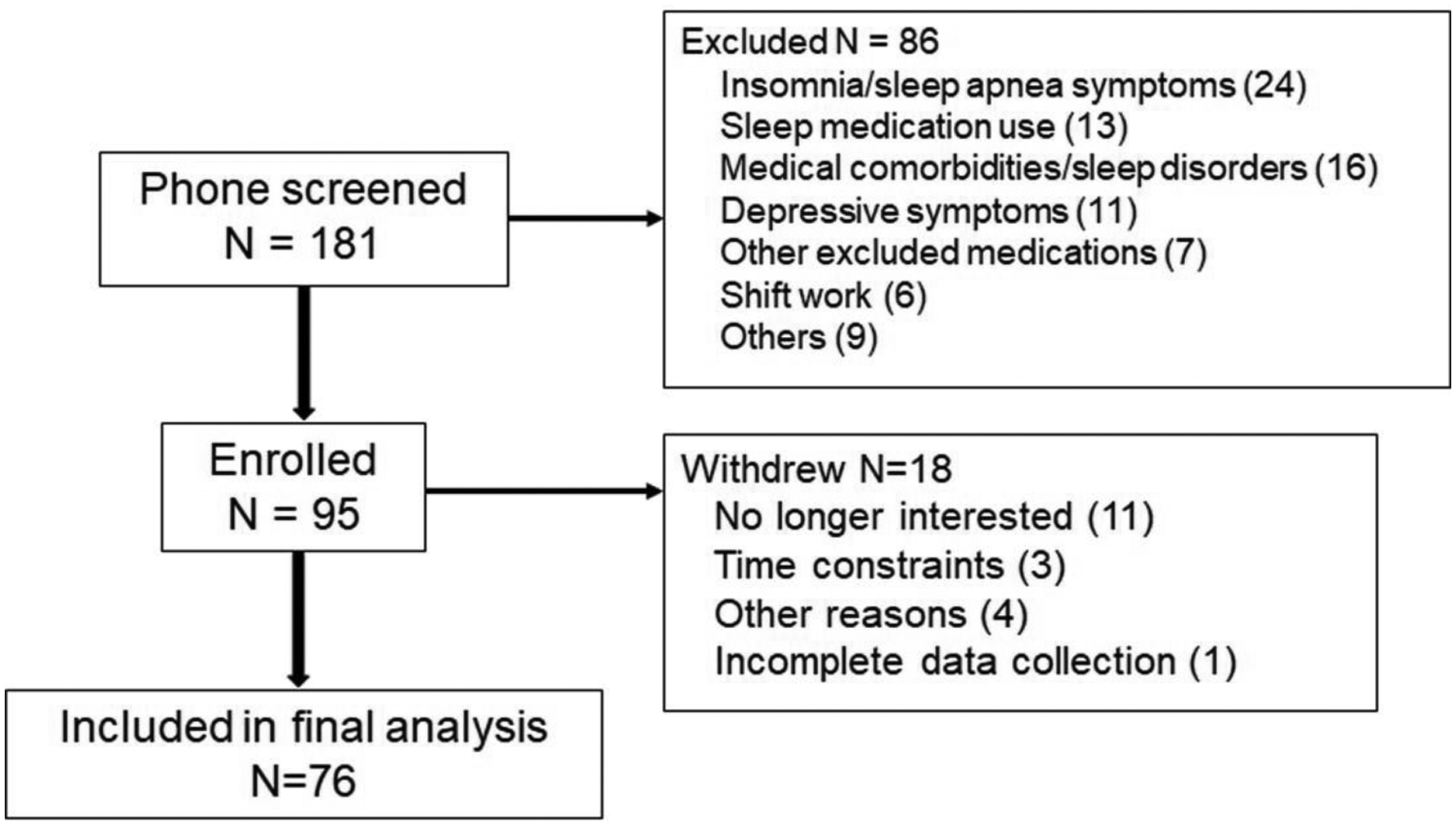
Flow of the study.
Table 1:
Demographics, self-management, glycemic, sleep, and rest-activity rhythms parameters (N = 76)
| Characteristic | Number |
|---|---|
| Age (years) | 34.0 (27.2, 43.1) |
| Female (n, %) | 48 (63.2) |
| Ethnicity | |
| Not Hispanic or Latino | 68 (89.5) |
| Hispanic or Latino | 8 (10.5) |
| Race, n (%) | |
| Non-Hispanic White | 62 (81.6) |
| Black/African American | 13 (17.1) |
| American Indian or Alaska Native | 1 (1.3) |
| Asian | 2 (2.6) |
| Others (Levantine, Mestizo) | 2 (2.6) |
| Diabetes duration (years) | 19.6 (10.0, 28.2) |
| Educational level, n (%) | |
| Less than high school | 1 (1.3) |
| High school | 2 (2.6) |
| Some college | 12 (15.8) |
| Finished college | 38 (50.0) |
| Master’s degree or doctorate | 23 (30.3) |
| Employment status, n (%) | |
| Full-time | 50 (65.8) |
| Part-time | 8 (10.5) |
| Student | 4 (5.3) |
| Employed & student | 8 (10.5) |
| No work | 6 (7.9) |
| Medication usage, n (%) | |
| Levothyroxine | 13 (17.1) |
| Statin | 15 (19.7) |
| Antidepressant | 10 (13.6) |
| Antihypertensives | 18 (23.7) |
| Non-insulin diabetes medications. | 3 (3.9) |
| Body mass index (kg/m2) | 25.74 (22.7, 28.6) |
| Diabetes management, n (%) | |
| MDIa and CGMb | 15 (19.74%) |
| Insulin pump and CGMb | 53 (69.74%) |
| No CGMb | 8 (10.53%) |
| Self-management parameter | |
| DSMQC score | 7.78 (7.04, 8.77) |
| Glycemic parameters | |
| A1cd (%) | 6.8 (6.2, 7.4) |
| Mean glucose (mg/dL) | 154.0 (133.8, 172.6) |
| Time-in-range (%) | 66.5 (53.5, 79.4) |
| Time above range (%) | 28.4 (14.7, 40.5) |
| Time below range (%) | 3.3 (1.0, 8.0) |
| CVe [%; mean (SD)] | 36.9 (8.8) |
| Sleep parameters | |
| Sleep Duration [h; mean (SD)] | 6.70 (0.85) |
| Sleep efficiency (%) | 87.0 (84.3, 89.0) |
| Midsleep time (hh:mm) | 03:00 (02:36, 03:57) |
| SD of midsleep time (h) | 0.77 (0.58, 1.12) |
| Rest-activity rhythm parameters | |
| ISf [mean (SD)] | 0.44 (0.16) |
| IVa | 0.80 (0.69, 0.89) |
| RAh | 0.85 (0.73, 0.91) |
Data are expressed as median (interquartile range, i.e., 25th and 75th percentiles) or frequency (%) unless otherwise noted.
Multiple daily injections,
Continuous glucose monitor,
Diabetes self-management questionnaire,
Hemoglobin A1c (%),
Coefficient of variation,
Interdaily stability,
Intradaily variability,
Relative amplitude
Correlations between Self-Management Behavior, Sleep and Rest-Activity rhythm, and Glycemic Parameters
Table 2 shows bivariate correlations between self-management behavior, sleep and rest-activity rhythm, and glycemic parameters. For A1C, later midsleep time, greater sleep variability, lower IS, lower RA, and lower DSMQ score were related to higher A1C at a significance level of p<0.1. Higher sleep variability and lower DSMQ were related to higher mean glucose levels and glycemic variability. In addition, later midsleep time, greater sleep variability, and lower DSMQ correlated with both lower time-in-range and higher time-above-range, while only greater sleep variability correlated with higher time-below-range. However, sleep duration and sleep efficiency were not significantly correlated with any glycemic parameters.
Table 2:
Bivariate correlations between self-management behavior, sleep and rest -activity rhythm, and glycemic parameters
| A1Ca | Mean glucose | CVb | TIRC | TBRd | TARe | Sleep duration | Sleep efficiency | MSTf | SD of MSTg | ISh | IVi | RAj | DSMQk score | |
|---|---|---|---|---|---|---|---|---|---|---|---|---|---|---|
| A1C a | 1 | |||||||||||||
| Mean glucose | 0.69 * | 1 | ||||||||||||
| CV b | 0.41 * | 0.29 * | 1 | |||||||||||
| TIR C | −0.74* | −0.84* | −0.57* | 1 | ||||||||||
| TBR d | −0.07 | −0.36* | 0.45 * | −0.14 | 1 | |||||||||
| TAR e | 0.75 * | 0.96 * | 0.40 * | −0.93* | −0.23* | 1 | ||||||||
| Sleep duration | −0.17 | −0.12 | 0.01 | 0.06 | 0.13 | −0.1 | 1 | |||||||
| Sleep efficiency | 0.15 | −0.06 | −0.08 | 0.05 | 0.06 | 0.07 | 0.32 * | 1 | ||||||
| MST f | 0.25* | 0.16 | 0.18 | 0.20 ** | 0.00 | 0.20 ** | −0.28* | −0.23* | 1 | |||||
| SD of MST g | 0.21** | 0.22** | 0.28 * | −0.35 * | 0.24 * | 0.25 * | −0.36* | −0.05 | 0.18 | 1 | ||||
| ISh | 0.19** | −0.17 | −0.05 | −0.14 | −0.01 | −0.13 | 0.48 * | 0.21** | −0.15 | −0.43* | 1 | |||
| IVi | 0.08 | −0.06 | −0.12 | 0.02 | 0.09 | −0.05 | −0.18 | −0.04 | 0.09 | 0.03 | −0.23* | 1 | ||
| RAj | −0.21** | −0.18 | −0.02 | 0.14 | 0.06 | −0.16 | 0.57 * | 0.37 * | −0.05 | −0.40* | 0.77 * | −0.15 | 1 | |
| DSMQk score | −0.43* | −0.21** | 0.30 * | 0.35 * | −0.17 | −0.28* | 0.11 | −0.05 | −0.23* | −0.14 | 0.01 | 0.05 | −0.04 | 1 |
p<.05,
p <.10
Hemoglobin A1c (%),
Coefficient of variation,
Time-in-range,
Time below range,
Time above range,
Midsleep time,
Standard deviation of midsleep time,
Interdaily stability,
Intradaily variability,
Relative amplitude,
Diabetes self-management questionnaire.
Independent Predictors of Glycemic Parameters
Table 3 shows six models of multiple regression analysis exploring predictors of different glycemic parameters. Adjusted models are presented; unadjusted models showed stronger associations with self-management behaviors, sleep variability, and rest-activity rhythm variables, consistent with the correlations in Table 2.
Table 3:
Multiple regression analyses predicting glycemic outcomes
| Glycemic Outcome Variables | ||||||||||||
|---|---|---|---|---|---|---|---|---|---|---|---|---|
| A1Ca | Mean glucose | CVb% | TIRc% | TBRd% | TARe% | |||||||
| Sample Size | 75 | 76 | 76 | 76 | 76 | 76 | ||||||
| R-Squared | 0.579 | 0.329 | 0.291 | 0.479 | 0.077 | 0.362 | ||||||
| Model F-test | 14.632 | 4.162 | 3.966 | 7.579 | 1.952 | 6.468 | ||||||
| p-value | Prob > F 0.000 | Prob > F 0.004 | Prob > F 0.001 | Prob > F 0.000 | Prob > F 0.149 | Prob > F 0.000 | ||||||
| Predictor Variables | B | 95% CI | B | 95% CI | B | 95% CI | B | 95% CI | B | 95% CI | B | 95% CI |
| SD of MST f | 12.22 | (−6.48, 30.92) | 3.46 | (−.25, 7.18) | −9.64** | (−16.29, −2.99) | 3.29 | (−2.31, 8.89) | 6.62 | (−2.51,15.75) | ||
| RA g | −.80 | (−1.81, .21) | -- | -- | -- | -- | -- | -- | -- | -- | -- | -- |
| DSMQ h score | −.18* | (−.32, −.04) | −0.96 | (−7.07, 5.15) | −.96 | (−2.36, 0.45) | 1.84 | (−0.56, 4.25) | −.81 | (−1.74,.11) | −1.31 | (−4.21,1.60) |
| Covariates | ||||||||||||
| Age | −0.98* | (−.192, −.004) | -- | -- | −0.98 | (−2.10, 15) | 1.44 | (−0.35, 3.23) | -- | -- | -- | -- |
| Age * Age | .001 * | (0.000,.003) | -- | -- | .012 | (−.002, .025) | −0.018 | (−0.04, .004) | -- | -- | -- | -- |
| Pump/CGM i | 0 | -- | 0 | -- | 0 | -- | 0 | -- | -- | -- | 0 | -- |
| MDIj/CGMi | −0.38 | (−0.85, .09) | −4.32 | (−17.87, 9.23) | −1.94 | (−7.40, 3.51) | 4.62 | (−3.70, 12.95) | -- | -- | −3.66 | (−11.64, 4.31) |
| No CGM i | 1.64 ** | (1.04, 2.23) | 61.08 ** | (18.12, 104.04) | 9.59 ** | (2.78, 16.41) | 31.56 ** | (−45.29, −17.84) | -- | -- | 31.33 ** | (14.62, 48.05) |
| Non-Hispanic White | −.36 | (−.72, .00) | -- | -- | −2.74 | (−6.66, 1.18) | 6.19 | (−1.19, 13.57) | -- | -- | −7.01 | (−15.06, 1.04) |
| Constant | 10.6 ** | (8.4, 12.8) | 148.5 ** | (102.9, 194.1) | 61.2 ** | (38.5, 84.0) | 31.7 | (−4.84, 68.14) | 8.8 * | (0.6, 17.0) | 35.9** | (12.48, 59.37) |
p<.01,
p<.05
B = unstandardized regression coefficient
Hemoglobin A1c (%),
Coefficient of variation,
Time-in-range,
Time below range,
Time above range,
Standard deviation of midsleep time,
Relative amplitude
Diabetes self-management questionnaire,
Continuous glucose monitor,
Multiple daily injections.
For A1C, lower DSMQ score (b = [−.18], p = [.014]), younger age (b = −.098], p = [.041]), and not using CGM (b = [1.64], p = [0]), were predictors of higher A1C, while sleep or rest-activity parameters were not related to A1C. Similarly, not using CGM (b = [61.08], p = [.006]), but no other sleep variable, was a predictor of higher mean glucose. For glycemic variability (CV), not using CGM was significantly related to higher CV (b = [9.59], p = [.006]), while greater sleep variability tended to relate to higher CV, but this was not statistically significant (b = [3.46], p = [0.067]). Higher sleep variability was a significant predictor of lower time-in-range; each hour increase in sleep variability was associated with 9.64% lower time-in-range (95% confidence interval −16.29, −2.99, p<0.01), even after adjusting for CGM use. Only no CGM use (b = [31.33], p <.01), but not self-management behavior or sleep variables, was a predictor of higher time-above-range. Midsleep time was not an independent predictor of glycemic parameters.
Comparisons between Participants with Low and High Sleep Variability
Table 4 shows the characteristics of participants with low (n=52) vs. high (n=24) sleep variability. The two groups are comparable in their age, gender distribution, race/ethnicity, diabetes duration, employment status, educational level, and methods of insulin delivery/glucose monitoring. Those with higher sleep variability, however, had a lower DSMQ score, reflecting lower diabetes self-care, higher A1C and mean glucose, and higher time-above-range and lower time-in-range than those with lower sleep variability, while time-below-range and CV did not differ. Further, sleep duration was significantly shorter and rest-activity parameters (lower IS and RA) were suggestive of a more fragmented behavioral rhythm in those with high as compared to low sleep variability. Figure 2 shows an example of comparison of sleep and CGM characteristics between two participants (low vs. high sleep variability).
Table 4.
Comparisons between participants with low and high sleep variability
| Low sleep variability (SD of MST < 1 h), n =52 | High sleep variability (SD of MST > 1 h), n=24 | P value | |
|---|---|---|---|
| Age (years) | 33.99 (27.36, 43.13) | 34.05 (24.93, 43.22) | 0.679 |
| Female (n, %) | (34, 65.38%) | (14, 58.33%) | 0.554 |
| Ethnicity | |||
| Not Hispanic or Latino | (47, 90.38%) | (21, 87.50%) | 0.702 |
| Hispanic or Latino | (5, 9.62%) | (3, 12.50%) | |
| Race, n (%) | |||
| Non-Hispanic White | (41, 78.85%) | (18, 75.00%) | 0.786 |
| Black/African American | (6, 11.54%) | (4, 16.66%) | |
| Asian | (1, 1.92%) | (1, 4.17%) | |
| Others | (4, 7.69%) | (1, 4.17%) | |
| Diabetes duration (years) | 18.70 (9.11, 26.93) | 21.72 (11.62, 32.67) | 0.163 |
| Educational level, n (%) | |||
| Less than high school | (0, 0.00%) | (1, 4.17%) | 0.119 |
| High school | (1, 1.92%) | (1, 4.17%) | |
| Some college | (6, 11.54%) | (6, 25.00%) | |
| Finished college | (30, 57.68%) | (8, 33.33%) | |
| Master’s degree or doctorate | (15, 28.85%) | (8, 33.33%) | |
| Employment Status, n (%) | |||
| Full-time | 37 (71.15%) | 13 (54.17%) | 0.205 |
| Part-time | 5 (9.62%) | 3 (12.50%) | |
| Student | 2 (3.84%) | 2 (8.33%) | |
| Employed & student | 3 (5.77%) | 5 (20.83%) | |
| No work | 5 (9.62%) | 1 (4.17%) | |
| Diabetes management, n (%) | |||
| MDIa and CGMb | (13, 25%) | (2, 8.33%) | 0.220 |
| Insulin pump and CGMb | (34, 65.38%) | (19, 79.17%) | |
| No CGMb | (5, 9.62%) | (3, 12.5%) | |
| Self-management parameter | |||
| DSMQC score | 8.02 (7.16, 8.89) | 7.53 (6.91, 8.21) | 0.048* |
| Glycemic parameters | |||
| A1cd (%) | 6.60 (6.20, 7.10) | 7.10 (6.50, 7.75) | 0.033* |
| Mean glucose (mg/dL) | 150.10 (130.04, 169.25) | 167.23 (145.90, 179.73) | 0.023* |
| Time-in-range (%) | 68.00 (58.38, 82.88) | 58.58 (43.06, 73.99) | 0.014* |
| Time above range (%) | 26.15 (11.82, 36.98) | 35.51 (21.70, 46.61) | 0.023* |
| Time below range (%) | 3.55 (0.85, 7.42) | 2.93 (1.16, 9.77) | 0.796 |
| CVe(%) | 35.70 (8.65) | 39.41 (8.72) | 0.087 |
| Sleep parameters | |||
| Sleep duration (h) | 6.88 (0.81) | 6.30 (0.83) | 0.005* |
| Sleep efficiency (%) | 87.30 (84.05, 89.43) | 86.63 (85.04, 87.88) | 0.710 |
| Midsleep time (hh:mm) | 02:55 (02:35, 03:52) | 03:28 (02:40, 04:01) | 0.516 |
| Rest-activity rhythm parameters | |||
| ISf | 0.47 (0.15) | 0.36 (0.14) | 0.002* |
| IVg | 0.80 (0.67, 0.85) | 0.81 (0.70, 0.98) | 0.493 |
| RAh | 0.89 (0.78, 0.92) | 0.78 (0.58, 0.85) | 0.001* |
Multiple daily injections,
Continuous glucose monitor,
Diabetes self-management questionnaire,
Hemoglobin A1c (%),
Coefficient of variation,
Interdaily stability,
Intradaily variability,
Relative amplitude
Figure 2:
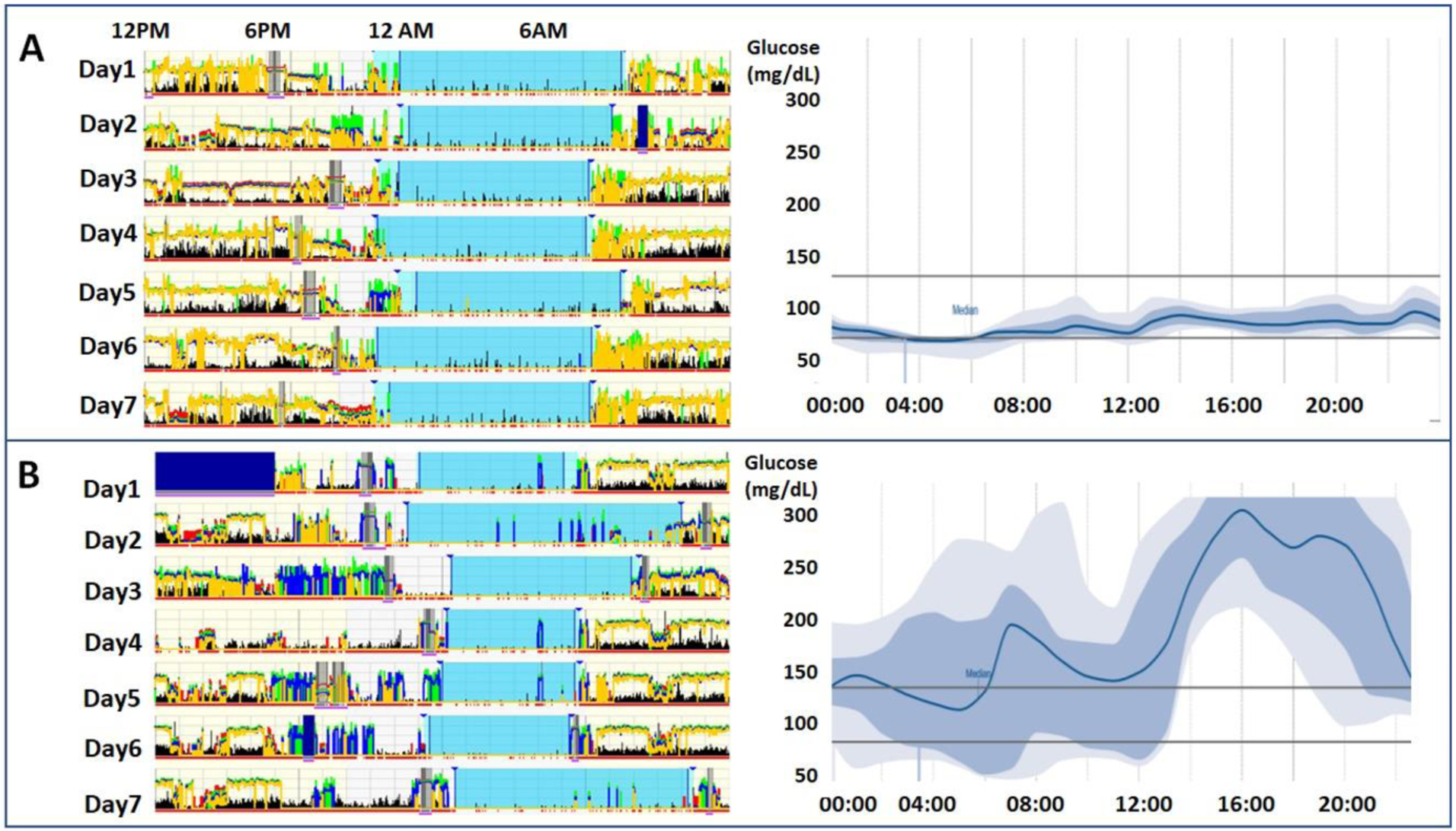
An example of actigraphy recordings (left) and CGM download (right) in two participants. A: a 25-year-old female, using insulin pump with CGM, with a low sleep variability (SD of midsleep time 0.6 h), sleep duration of 7.2 h, and time-in-range of 95%; B: a 24-year-old female, using insulin pump and CGM, with a high sleep variability (SD of midsleep time 1.2 h), sleep duration of 6.7 h, and time-in-range of 36%.
Discussion
In this study, higher sleep variability as assessed by SD of midsleep time was significantly associated with lower percentage of time spent in desirable glucose levels as assessed by CGM. Each hour increase in sleep variability was associated with 9.64% lower time-in-range even after adjusting for CGM use. The current guidelines for desirable glucose matrices from CGM in people with diabetes recommend that time-in-range should be ≥70% (35). Participants with high sleep variability (SD of midsleep time ≥1 h) in the current study had lower diabetes self-care behaviors, along with unfavorable glycemic indices including higher A1C and mean glucose, higher time-above-range, and lower time-below-range than those with lower sleep variability. They also had shorter sleep duration and a more fragmented behavioral rhythm compared to those with low sleep variability. Other sleep (e.g., sleep duration and efficiency) and behavioral rhythm parameters, however, were not associated with glycemic control. These results highlight the impact of irregular sleep schedule on glycemic control in T1D and suggest that behavioral sleep intervention targeting sleep timing/schedules may offer glycemic benefits in T1D.
Our results are in agreement with previous studies exploring sleep variability and glycemia in T1D in adolescents (36, 37) and in adults (18) . Objectively measured variability in sleep duration explained 8.2% of the variance in A1C in a study of 65 adolescents (36). In another study of 40 adolescents with T1D, higher sleep variability (SD of total sleep time across the nights) was associated with higher blood glucose index (37). In a study of 41 adults with T1D (mean age 41.5 years), greater variability of midsleep time was associated with higher A1C after adjusting for self-reported sleep quality, neuropathic pain and sleep apnea risk (18). Varying sleep timing could lead to a mild degree of circadian misalignment. The mechanisms linking circadian misalignment to glucose intolerance were demonstrated in a forced desynchrony experiment in healthy volunteers (38). When subjects ate and slept approximately 12 h out of phase from their habitual times, glucose levels increased despite increased insulin levels (38).
In contrast to previous results, the current study did not find associations of sleep duration or sleep efficiency with glycemic control. For example, Griggs et al. analyzed sleep and CGM parameters in 42 young adults with T1D using multilevel models (39). The results indicated that lower sleep efficiency predicted higher glucose variability (less time-in-range and more time-in-hyperglycemia) within-person and a longer wake after sleep onset and more sleep disruptions were associated with higher glucose variability between persons (39). A study in 20 T1D adults analyzed a total of 170 nights and found that poor sleep quality was significantly associated with greater glycemic variability overnight after adjusting for covariates (9). Children in the T1D Exchange clinic registry who reported sleeping <9h/night had significantly higher A1C than those sleeping ≥9 h/night (8.0% vs. 7.8%) (40). Further, in contrast to a previous study in T1D adults (22), rest-activity parameters in the current study were not related to glycemia. These results suggest that different sleep dimensions were contributing to different glycemic parameters among the cohorts. Therefore, considering the effects of composite sleep health on glucose metabolism may provide a more comprehensive perspective. A recent study revealed that a better Sleep Health Composite score (sleep duration, efficiency, satisfaction, timing, and alertness) was associated with higher achievement of glycemic targets in young adults with T1D (41).
The relationship between sleep and glycemia in T1D is complex and likely bidirectional (5). Poor sleep was shown to be related to decreased diabetes self-care (e.g., less frequent glucose monitoring) (36, 42) and psychological distress (13), which can lead to hyperglycemia. Glucose disturbances, including hypoglycemia and glycemic fluctuation, could affect sleep (5). Diabetes technology use (e.g., hybrid closed-loop pump, CGM) was associated with improved sleep in some studies (43, 44) but not others (45, 46). Our results, however, showed that sleep variability contributed to time-in-range even when adjusting for diabetes self-care behavior and CGM use. While our participants with lower sleep variability had better sleep characteristics, diabetes self-care behaviors, and rest-activity parameters than those with higher sleep variability, these factors did not independently contribute to their time-in-range. The complexity of sleep disturbances, their causes, and relationship with health outcomes in T1D highlights the need for future research, including qualitative research (causes, consequences, attitudes, and priorities of T1D patients and their families), research using mixed methods of sleep assessments, and longitudinal outcome studies (47).
Emerging research studies have explored the role of behavioral sleep interventions on glucose metabolism. Some evidence suggested that sleep extension in chronic short sleepers (48, 49) and cognitive behavioral therapy for insomnia in patients with type 2 diabetes (50) resulted in improved glucose parameters, including insulin resistance and A1C. The effects of a 3-month sleep coaching focusing on healthy sleep habits in T1D have been explored in a randomized study in 39 teens (51). There was a significant increase in sleep duration (48 minutes), sleep efficiency, and self-reported sleep quality in the intervention group as compared to the control group, but there was no significant change in A1C (51). Our pilot study in 14 T1D adults with insufficient or irregular sleep revealed that an 8-week technology-assisted behavioral sleep intervention resulted in improved sleep regularity, increased time-in-range (6.9%) and decreased glycemic variability (52). Another recent study in patients with prediabetes and type 2 diabetes showed that sleep education focusing on sleep duration and regularity resulted in greater improvement in self-reported sleep quality and A1C than a control intervention, although sleep variability was not measured (53). A few larger randomized studies exploring the effects of sleep intervention on health outcomes in both adults and youths with T1D are currently ongoing, including within our lab, and results will help determine whether improving regularity can improve outcomes in T1D (23, 54).
Our study has strengths of using both objectively measured sleep and glucose parameters. The participants also represented people who were using diabetes technology for their glycemic control. Limitations include the relatively well controlled diabetes (median A1C 6.8%) of the cohort; thus, our results might not be generalizable to the T1D population and may have diminished the power to observe associations. Further, our sample was screened to have short sleep duration or high sleep variability, without high risk of OSA or insomnia symptoms, and therefore may not be generalizable to all participants with T1D.. The duration of actigraphy recordings varied, but all participants had more than 3 days of the recommended recording periods (55), and 98.6% had 5 days or more. The number of recording days was not related to sleep variability. Obstructive sleep apnea (which could contribute to glycemia) was not objectively assessed. In addition, the causal inference between sleep variability and glycemia could not be established due to the cross-sectional nature of the study. Other markers of sleep variability (e.g., sleep duration variability) have been used in other studies; however, sleep duration variability in this cohort was not found to be independently associated with glycemic control (result not shown). Furthermore, aside from differences in sleep duration, diabetes self-management behaviors, and rest-activity parameters between those with high vs. low sleep variability, there could have been other intrinsic or extrinsic factors that relate to sleep variability but were not explored in this study (e.g., dim light melatonin onset). Lastly, our sample size was somewhat limited, affecting power and possible stability of the parameter estimates.
In conclusion, this study demonstrated an independent association between greater sleep variability and lower time spent in desirable glucose levels in adults with T1D, while other sleep and rest-activity rhythm parameters did not contribute to glycemic control. These results suggested that regular sleep timing may result in improved glycemic control and will be important to evaluate within current and future randomized sleep intervention studies.
Supplementary Material
Acknowledgement
We would like to acknowledge Kevin Grandfield, Publication Manager, Department of Biobehavioral Nursing Science, University of Illinois Chicago for his assistance in proof reading.
Funding:
NIH NIDDK R01 DK121726
Footnotes
Publisher's Disclaimer: This is a PDF file of an unedited manuscript that has been accepted for publication. As a service to our customers we are providing this early version of the manuscript. The manuscript will undergo copyediting, typesetting, and review of the resulting proof before it is published in its final form. Please note that during the production process errors may be discovered which could affect the content, and all legal disclaimers that apply to the journal pertain.
Declaration of Conflicts of Interest
Sirimon Reutrakul: Speaker fee from Eli Lilly
Kelly Baron: Google, unrestricted research gift, not applicable to this project, National Sleep Foundation.
Other authors declare no conflict of interest
Data availability statement:
Data are available upon a reasonable request to the corresponding author.
References
- 1.Holt RIG, DeVries JH, Hess-Fischl A, Hirsch IB, Kirkman MS, Klupa T, et al. The Management of Type 1 Diabetes in Adults. A Consensus Report by the American Diabetes Association (ADA) and the European Association for the Study of Diabetes (EASD). Diabetes Care. 2021;44(11):2589–625. [DOI] [PubMed] [Google Scholar]
- 2.Mobasseri M, Shirmohammadi M, Amiri T, Vahed N, Hosseini Fard H, Ghojazadeh M. Prevalence and incidence of type 1 diabetes in the world: a systematic review and meta-analysis. Health Promot Perspect. 2020;10(2):98–115. [DOI] [PMC free article] [PubMed] [Google Scholar]
- 3.Foster NC, Beck RW, Miller KM, Clements MA, Rickels MR, DiMeglio LA, et al. State of Type 1 Diabetes Management and Outcomes from the T1D Exchange in 2016–2018. Diabetes Technology & Therapeutics. 2019;21(2):66–72. [DOI] [PMC free article] [PubMed] [Google Scholar]
- 4.DeSalvo DJ, Noor N, Xie C, Corathers SD, Majidi S, McDonough RJ, et al. Patient Demographics and Clinical Outcomes Among Type 1 Diabetes Patients Using Continuous Glucose Monitors: Data From T1D Exchange Real-World Observational Study. Journal of diabetes science and technology. 2021:19322968211049783. [DOI] [PMC free article] [PubMed] [Google Scholar]
- 5.Zhu B, Abu Irsheed GM, Martyn-Nemeth P, Reutrakul S. Type 1 Diabetes, Sleep, and Hypoglycemia. Current diabetes reports. 2021;21(12):55. [DOI] [PubMed] [Google Scholar]
- 6.Buysse DJ. Sleep health: can we define it? Does it matter? Sleep. 2014;37(1):9–17. [DOI] [PMC free article] [PubMed] [Google Scholar]
- 7.Nefs G, Donga E, van Someren E, Bot M, Speight J, Pouwer F. Subjective sleep impairment in adults with type 1 or type 2 diabetes: Results from Diabetes MILES--The Netherlands. Diabetes Res Clin Pract. 2015;109(3):466–75. [DOI] [PubMed] [Google Scholar]
- 8.Reutrakul S, Thakkinstian A, Anothaisintawee T, Chontong S, Borel AL, Perfect MM, et al. Sleep characteristics in type 1 diabetes and associations with glycemic control: systematic review and meta-analysis. Sleep Med. 2016;23:26–45. [DOI] [PMC free article] [PubMed] [Google Scholar]
- 9.Brandt R, Park M, Wroblewski K, Quinn L, Tasali E, Cinar A. Sleep quality and glycaemic variability in a real-life setting in adults with type 1 diabetes. Diabetologia. 2021;64(10):2159–69. [DOI] [PMC free article] [PubMed] [Google Scholar]
- 10.Barone MT, Wey D, Schorr F, Franco DR, Carra MK, Lorenzi FG, et al. Sleep and glycemic control in type 1 diabetes. Arch Endocrinol Metab. 2015;59(1):71–8. [DOI] [PubMed] [Google Scholar]
- 11.Broussard JL, Ehrmann DA, Van Cauter E, Tasali E, Brady MJ. Impaired insulin signaling in human adipocytes after experimental sleep restriction: a randomized, crossover study. Ann Intern Med. 2012;157(8):549–57. [DOI] [PMC free article] [PubMed] [Google Scholar]
- 12.Donga E, vD M, van Dijk JG, Biermasz NR, Lammers GJ, van KK, et al. Partial sleep restriction decreases insulin sensitivity in type 1 diabetes. Diabetes Care. 2010;33(7):1573–7. [DOI] [PMC free article] [PubMed] [Google Scholar]
- 13.Tracy EL, Berg CA, Kent De Grey RG, Butner J, Litchman ML, Allen NA, et al. The Role of Self-regulation Failures and Self-care in the Link Between Daily Sleep Quality and Blood Glucose Among Adults with Type 1 Diabetes. Annals of behavioral Medicine : a publication of the Society of Behavioral Medicine. 2020;54(4):249–57. [DOI] [PMC free article] [PubMed] [Google Scholar]
- 14.Zhu B, Wang Y, Yuan J, Mu Y, Chen P, Srimoragot M, et al. Associations between sleep variability and cardiometabolic health: A systematic review. Sleep Med Rev. 2022;66:101688. [DOI] [PubMed] [Google Scholar]
- 15.Brouwer A, van Raalte DH, Rutters F, Elders PJM, Snoek FJ, Beekman ATF, et al. Sleep and HbA(1c) in Patients With Type 2 Diabetes: Which Sleep Characteristics Matter Most? Diabetes Care. 2020;43(1):235–43. [DOI] [PubMed] [Google Scholar]
- 16.Larcher S, Gauchez AS, Lablanche S, Pepin JL, Benhamou PY, Borel AL. Impact of sleep behavior on glycemic control in type 1 diabetes: the role of social jetlag. European journal of endocrinology. 2016;175(5):411–9. [DOI] [PubMed] [Google Scholar]
- 17.Rusu A, Ciobanu D, Bala C, Cerghizan A, Roman G. Social jetlag, sleep-related parameters, and glycemic control in adults with type 1 diabetes: Results of a cross-sectional study. Journal of Diabetes. 2019;11(5):394–401. [DOI] [PubMed] [Google Scholar]
- 18.Chontong S, Saetung S, Reutrakul S. Higher sleep variability is associated with poorer glycaemic control in patients with type 1 diabetes. Journal of sleep research. 2016;25(4):438–44. [DOI] [PubMed] [Google Scholar]
- 19.Saylor J, Ji X, Calamaro CJ, Davey A. Does sleep duration, napping, and social jetlag predict hemoglobin A1c among college students with type 1 diabetes mellitus? Diabetes research and clinical practice. 2019;148:102–9. [DOI] [PMC free article] [PubMed] [Google Scholar]
- 20.Sohail S, Yu L, Bennett DA, Buchman AS, Lim AS. Irregular 24-hour activity rhythms and the metabolic syndrome in older adults. Chronobiology international. 2015;32(6):802–13. [DOI] [PMC free article] [PubMed] [Google Scholar]
- 21.Xiao Q, Qian J, Evans DS, Redline S, Lane NE, Ancoli-Israel S, et al. Cross-sectional and Prospective Associations of Rest-Activity Rhythms With Metabolic Markers and Type 2 Diabetes in Older Men. Diabetes Care. 2020;43(11):2702–12. [DOI] [PMC free article] [PubMed] [Google Scholar]
- 22.Griggs S, Strohl KP, Grey M, Barbato E, Margevicius S, Hickman RL, Jr. Circadian characteristics of the rest-activity rhythm, executive function, and glucose fluctuations in young adults with type 1 diabetes. Chronobiology international. 2021;38(10):1477–87. [DOI] [PMC free article] [PubMed] [Google Scholar]
- 23.Martyn-Nemeth P, Duffecy J, Quinn L, Reutrakul S, Steffen AD, Burke L, et al. Sleep optimization to improve glycemic control in adults with type 1 diabetes: study protocol for a randomized controlled parallel intervention trial. Trials. 2022;23(1):686. [DOI] [PMC free article] [PubMed] [Google Scholar]
- 24.Morin CM, Belleville G, Belanger L, Ivers H. The Insomnia Severity Index: psychometric indicators to detect insomnia cases and evaluate treatment response. Sleep. 2011;34(5):601–8. [DOI] [PMC free article] [PubMed] [Google Scholar]
- 25.Chung F, Yang Y, Brown R, Liao P. Alternative scoring models of STOP-bang questionnaire improve specificity to detect undiagnosed obstructive sleep apnea. Journal of clinical sleep medicine : JCSM : official publication of the American Academy of Sleep Medicine. 2014;10(9):951–8. [DOI] [PMC free article] [PubMed] [Google Scholar]
- 26.Kroenke K, Strine TW, Spitzer RL, Williams JB, Berry JT, Mokdad AH. The PHQ-8 as a measure of current depression in the general population. Journal of affective disorders. 2009;114(1–3):163–73. [DOI] [PubMed] [Google Scholar]
- 27.Patel SR, Weng J, Rueschman M, Dudley KA, Loredo JS, Mossavar-Rahmani Y, et al. Reproducibility of a Standardized Actigraphy Scoring Algorithm for Sleep in a US Hispanic/Latino Population. Sleep. 2015;38(9):1497–503. [DOI] [PMC free article] [PubMed] [Google Scholar]
- 28.van Someren EJ, Hagebeuk EE, Lijzenga C, Scheltens P, de Rooij SE, Jonker C, et al. Circadian rest-activity rhythm disturbances in Alzheimer’s disease. Biological psychiatry. 1996;40(4):259–70. [DOI] [PubMed] [Google Scholar]
- 29.Blume C, Santhi N, Schabus M. ‘nparACT’ package for R: A free software tool for the non-parametric analysis of actigraphy data. MethodsX. 2016;3:430–5. [DOI] [PMC free article] [PubMed] [Google Scholar]
- 30.Bergenstal RM, Ahmann AJ, Bailey T, Beck RW, Bissen J, Buckingham B, et al. Recommendations for standardizing glucose reporting and analysis to optimize clinical decision making in diabetes: the Ambulatory Glucose Profile (AGP). Diabetes Technology & Therapeutics. 2013;15(3):198–211. [DOI] [PubMed] [Google Scholar]
- 31.Rodbard D New and improved methods to characterize glycemic variability using continuous glucose monitoring. Diabetes Technology & Therapeutics. 2009;11(9):551–65. [DOI] [PubMed] [Google Scholar]
- 32.Schmitt A, Gahr A, Hermanns N, Kulzer B, Huber J, Haak T. The Diabetes Self-Management Questionnaire (DSMQ): development and evaluation of an instrument to assess diabetes self-care activities associated with glycaemic control. Health and quality of life outcomes. 2013;11:138. [DOI] [PMC free article] [PubMed] [Google Scholar]
- 33.Bursac Z, Gauss CH, Williams DK, Hosmer DW. Purposeful selection of variables in logistic regression. Source Code Biol Med. 2008;3:17. [DOI] [PMC free article] [PubMed] [Google Scholar]
- 34.Watson NF, Badr MS, Belenky G, Bliwise DL, Buxton OM, Buysse D, et al. Recommended Amount of Sleep for a Healthy Adult: A Joint Consensus Statement of the American Academy of Sleep Medicine and Sleep Research Society. Sleep. 2015;38(6):843–4. [DOI] [PMC free article] [PubMed] [Google Scholar]
- 35.Battelino T, Danne T, Bergenstal RM, Amiel SA, Beck R, Biester T, et al. Clinical Targets for Continuous Glucose Monitoring Data Interpretation: Recommendations From the International Consensus on Time in Range. Diabetes Care. 2019;42(8):1593–603. [DOI] [PMC free article] [PubMed] [Google Scholar]
- 36.Patel NJ, Savin KL, Kahanda SN, Malow BA, Williams LA, Lochbihler G, et al. Sleep Habits in Adolescents with Type 1 Diabetes: Variability in Sleep Duration Linked with Glycemic Control. Pediatric diabetes. 2018. [DOI] [PMC free article] [PubMed] [Google Scholar]
- 37.Rechenberg K, Griggs S, Jeon S, Redeker N, Yaggi HK, Grey M. Sleep and Glycemia in Youth With Type 1 Diabetes. Journal of pediatric health care : official publication of National Association of Pediatric Nurse Associates & Practitioners. 2020. [DOI] [PMC free article] [PubMed] [Google Scholar]
- 38.Scheer FA, Hilton MF, Mantzoros CS, Shea SA. Adverse metabolic and cardiovascular consequences of circadian misalignment. Proc Natl Acad Sci U S A. 2009;106(11):4453–8. [DOI] [PMC free article] [PubMed] [Google Scholar]
- 39.Griggs S, Grey M, Strohl KP, Crawford SL, Margevicius S, Kashyap SR, et al. Variations in Sleep Characteristics and Glucose Regulation in Young Adults With Type 1 Diabetes. J Clin Endocrinol Metab. 2022;107(3):e1085–e95. [DOI] [PMC free article] [PubMed] [Google Scholar]
- 40.Jaser SS, Foster NC, Nelson BA, Kittelsrud JM, DiMeglio LA, Quinn M, et al. Sleep in children with type 1 diabetes and their parents in the T1D Exchange. Sleep medicine. 2017;39:108–15. [DOI] [PMC free article] [PubMed] [Google Scholar]
- 41.Griggs S, Pignatiello G, Hickman RL Jr., A composite measure of sleep health is associated with glycaemic target achievement in young adults with type 1 diabetes. J Sleep Res. 2022:e13784. [DOI] [PMC free article] [PubMed] [Google Scholar]
- 42.McDonough RJ, Clements MA, DeLurgio SA, Patton SR. Sleep duration and its impact on adherence in adolescents with type 1 diabetes mellitus. Pediatric diabetes. 2017;18(4):262–70. [DOI] [PMC free article] [PubMed] [Google Scholar]
- 43.Al Hayek AA, Al Dawish MA. Assessing Diabetes Distress and Sleep Quality in Young Adults with Type 1 Diabetes Using FreeStyle Libre: A Prospective Cohort Study. Diabetes therapy : research, treatment and education of diabetes and related disorders. 2020;11(7):1551–62. [DOI] [PMC free article] [PubMed] [Google Scholar]
- 44.Messer LH, Campbell K, Pyle L, Forlenza GP. Basal-IQ technology in the real world: satisfaction and reduction of diabetes burden in individuals with type 1 diabetes. Diabetic medicine : a journal of the British Diabetic Association. 2020:e14381. [DOI] [PubMed] [Google Scholar]
- 45.Cobry EC, Hamburger E, Jaser SS. Impact of the Hybrid Closed-Loop System on Sleep and Quality of Life in Youth with Type 1 Diabetes and Their Parents. Diabetes technology & therapeutics. 2020;22(11):794–800. [DOI] [PMC free article] [PubMed] [Google Scholar]
- 46.Bisio A, Gonder-Frederick L, McFadden R, Cherñavvsky D, Voelmle M, Pajewski M, et al. The Impact of a Recently Approved Automated Insulin Delivery System on Glycemic, Sleep, and Psychosocial Outcomes in Older Adults With Type 1 Diabetes: A Pilot Study. Journal of diabetes science and technology. 2021:1932296820986879. [DOI] [PMC free article] [PubMed] [Google Scholar]
- 47.Gregory AM, Rutter MK, Ware J, Madrid-Valero JJ, Hovorka R, Buysse DJ. Type 1 diabetes as a prototypical condition challenging what we know about sleep. Sleep. 2022;45(11). [DOI] [PubMed] [Google Scholar]
- 48.So-ngern A, Chirakalwasan N, Saetung S, Chanprasertyothin S, Thakkinstian A, Reutrakul S. Effects of sleep extension on glucose metabolism in chronically sleep-deprived individuals Journal of clinical sleep medicine : JCSM : official publication of the American Academy of Sleep Medicine. 2019;15(5):8. [DOI] [PMC free article] [PubMed] [Google Scholar]
- 49.Leproult R, Deliens G, Gilson M, Peigneux P. Beneficial Impact of Sleep Extension on Fasting Insulin Sensitivity in Adults with Habitual Sleep Restriction. Sleep. 2015;35(5):707–15. [DOI] [PMC free article] [PubMed] [Google Scholar]
- 50.Alshehri MM, Alothman SA, Alenazi AM, Rucker JL, Phadnis MA, Miles JM, et al. The effects of cognitive behavioral therapy for insomnia in people with type 2 diabetes mellitus, pilot RCT part II: diabetes health outcomes. BMC Endocrine Disorders. 2020;20(1):136. [DOI] [PMC free article] [PubMed] [Google Scholar]
- 51.Jaser SS, Hamburger ER, Bergner EM, Williams R, Slaughter JC, Simmons JH, et al. Sleep coach intervention for teens with type 1 diabetes: Randomized pilot study. Pediatr Diabetes. 2020. [DOI] [PMC free article] [PubMed] [Google Scholar]
- 52.Martyn-Nemeth P, Duffecy J, Quinn L, Steffen A, Baron K, Chapagai S, et al. Sleep-Opt-In: A Randomized Controlled Pilot Study to Improve Sleep and Glycemic Variability in Adults With Type 1 Diabetes. Sci Diabetes Self Manag Care. 2022:26350106221136495. [DOI] [PMC free article] [PubMed] [Google Scholar]
- 53.García-Serrano C, Pujol Salud J, Aran-Solé L, Sol J, Ortiz-Congost S, Artigues-Barberà E, et al. Enhancing Night and Day Circadian Contrast through Sleep Education in Prediabetes and Type 2 Diabetes Mellitus: A Randomized Controlled Trial. Biology. 2022;11(6). [DOI] [PMC free article] [PubMed] [Google Scholar]
- 54.Perfect MM, Silva GE, Chin CN, Wheeler MD, Frye SS, Mullins V, et al. Extending sleep to improve glycemia: The Family Routines Enhancing Adolescent Diabetes by Optimizing Management (FREADOM) randomized clinical trial protocol. Contemp Clin Trials. 2022;124:106929. [DOI] [PubMed] [Google Scholar]
- 55.Smith MT, McCrae CS, Cheung J, Martin JL, Harrod CG, Heald JL, et al. Use of Actigraphy for the Evaluation of Sleep Disorders and Circadian Rhythm Sleep-Wake Disorders: An American Academy of Sleep Medicine Clinical Practice Guideline. Journal of clinical sleep medicine : JCSM : official publication of the American Academy of Sleep Medicine. 2018;14(7):1231–7. [DOI] [PMC free article] [PubMed] [Google Scholar]
Associated Data
This section collects any data citations, data availability statements, or supplementary materials included in this article.
Supplementary Materials
Data Availability Statement
Data are available upon a reasonable request to the corresponding author.