


Abstract
BACKGROUND:
Klebsiella ozaenae (K. ozaenae), a forgotten pathogen that normally colonizes the upper respiratory mucosa, can be associated with severe and invasive infections. The objectives of this study were to determine the frequency of isolation of K. ozaenae at the microbiology laboratory in a tertiary hospital and the scope of diseases associated with it and to characterize its antimicrobial susceptibility pattern.
MATERIALS AND METHODS:
This cross-sectional study analyzed the retrospective data, from 2002 to 2021, on cases with laboratory-confirmed isolation of K. ozaenae at a tertiary care hospital. The primary outcome was to identify the scope of K. ozaenae infections and their antimicrobial susceptibility patterns. K. ozaenae isolation was done by cultivation on microbiological culture media, whereas its identification and antimicrobial susceptibility pattern were performed using either Microscan or Vitek automated systems. Data was gathered and analyzed in Excel. The percentage of resistance was calculated as the number of resistant isolates from the total isolates multiplied by 100. Similarly, the percentage of sensitivity was calculated as the number of sensitive isolates from total isolates multiplied by 100.
RESULTS:
K. ozaenae was detected in 59 cases during the study period. K. ozaenae was associated with urinary tract infections (39%), nasal infections (18.6%), other respiratory tract infections including sinusitis, bronchiectasis, and pneumonia (16.9%), and wound infections (15.3%). It was also associated with invasive infections such as bacteremia (3.4%) and abscesses (3.4%). K. ozaenae showed susceptibility to multiple antibiotic classes, but was resistant to ampicillin, piperacillin, nalidixic acid, and nitrofurantoin. K. ozaenae isolates from urinary tract infections had higher antibiotic resistance percentage than isolates from other infections, particularly to amoxicillin/clavulanic acid (P = 0.007, 95% confidence interval [CI]: 1.84–375), ciprofloxacin (P < 0.0001, 95% CI: 4.6–111.2), and trimethoprim/sulfamethoxazole (P < 0.001, 95% CI: 3.1–63.6).
CONCLUSION:
Our data show that K. ozaenae is a pathogen with a spectrum of diseases wider than expected and a unique antibiotic susceptibility pattern in urinary tract infections.
Keywords: Antibiotic sensitivity, disease spectrum, Gram-negative pathogen, infectious disease, Klebsiella ozaenae
Introduction
Klebsiella ozaenae (K. ozaenae) is a member of the Klebsiella genus and shares multiple phenotypic and biological characteristics with Klebsiella pneumoniae species.[1] K. ozaenae could be differentiated biochemically from K. pneumoniae by its inability to use malonate as a source of carbon (malonate test) or produce acetyl methyl carbinol from glucose fermentation (Voges–Proskauer test).[1] The close biochemical and genetic similarities between these two pathogens led to the classification of K. ozaenae as a subspecies of K. pneumoniae.[2] However, the more comprehensive genetic classification methods employing the analysis of the pan-genome composition have allowed the identification of K. ozaenae as a species of the Klebsiella genus rather than a subspecies of K. pneumoniae.[3]
K. ozaenae is a Gram-negative capsulated bacillus that was isolated in 1983 from the nasal discharge of a patient with ozaena.[2] Since then, K. ozaenae has been considered a normal inhabitant of the oral and nasopharyngeal mucosa and associated with the rare condition of atrophic rhinitis accompanied by the discharge of an unpleasant smell, called ozaena. However, numerous reports have implicated K. ozaenae as a cause of serious invasive infections. Cholecystitis as well as urinary tract infection from K. ozaenae was reported in an obese female with diabetes mellitus.[4] Splenic abscess after dental infection was caused by K. ozaenae in a female with sickle cell disease.[5] K. ozaenae was identified in the blood of a female patient with a kidney transplant for 38 years with a minimum immunosuppression regimen.[6] K. ozaenae was reported not only in patients with comorbidities but also in a sepsis case of a healthy young Filipino male.[7] Albeit very rare, K. ozaenae has been reported in three cases of rhinoscleroma.[8] Rather more lethal infections with multiple organ involvement were also reported from K. ozaenae in patients with diabetes mellitus.[9,10]
Naturally, K. ozaenae is susceptible to several antibiotics including quinolones, cephalosporins, aminoglycosides, and tetracyclines.[11] However, K. ozaenae strains harboring drug resistance genes such as CTX-M and SHV have been reported.[12,13,14]
Despite the low frequency of the reported K. ozaenae infections, a lysate of these bacteria is included in a lysate from multiple other bacterial pathogens, called OM-85, to be used as a vaccine to prevent respiratory tract infections.[15]
There are no published reports from Saudi Arabia about the frequency of K. ozaenae infections in humans although there is one report of its association with pulmonary lesions in sheep.[16] Therefore, the aim of this study was to identify the scope of K. ozaenae infection and its antimicrobial susceptibility pattern in a tertiary hospital in the Eastern Province of Saudi Arabia.
Materials and Methods
This epidemiological analysis was a cross-sectional study based on data collected retrospectively for the period, from January 2001 to December 2021 from the medical records at a tertiary hospital in Eastern Saudi Arabia. Medical records, electronically archived in a healthcare information system at the study hospital, were retrieved from the system using the search word K. ozaenae. For all hits containing the search word, data about age, gender, nationality, type of specimen, date of testing, disease condition, isolated microorganisms, and antimicrobial susceptibility testing results were obtained from the medical records. The ethical approval for the study was obtained from the Institutional Review Board (IRB) vide letter number: IRB-2022-01-404 dated 26/10/2022 with a waiver of informed consent since there was no direct relation with human subjects in this study.
All cases with laboratory-confirmed isolation of K. ozaenae and documented antimicrobial susceptibility testing during the period of the study were included in the study. Cases where the isolation of K. ozaenae was considered commensal, such as the screening of nasal, nasopharyngeal, or rectal swabs of hospitalized patients, were excluded from the study. In addition, any repeated isolation from the same patient during the same hospital visit was also excluded.
K. ozaenae was isolated from the following samples: urine (midstream urine or urine from catheter), nasal swab, nasopharyngeal swab, sputum, bronchoalveolar lavage, endotracheal aspirates, ear swab, eye swab, blood, wound swab, and liver abscess, wound drainage, peritoneal swab, and skin swab. Samples from cesarean cut, sigmoidal colon surgery, peritoneal wound, and duodenal tissue and nonsurgical wounds such as botulinum toxin injection site and skin infections were cumulatively classified as wound infection. All samples were inoculated on the suitable culture media (including chocolate, blood, and MacConkey agar depending on the sample type) and incubated as per the laboratory policy.
Detection of K. ozaenae and its antimicrobial susceptibility testing was performed routinely in the diagnostic microbiology laboratory using MicroScan automated system (Beckman Coulter, California, USA) for samples tested before 2003 and Vitek automated card system (BioMerieux, Missouri, USA) for samples tested from 2003 onward.
All the above-mentioned data were tabulated in Excel Spreadsheets. The frequency and statistical associations were calculated using Excel software. Statistical significance was calculated using OpenEpi (Atlanta, GA, USA) website and considered significant with P < 0.05. The percentage of resistance was calculated as the number of resistant isolates from the total isolates multiplied by 100. Similarly, the percentage of sensitivity was calculated as the number of sensitive isolates from total isolates multiplied by 100.
Results
K. ozaenae was isolated from 59 patients: 20 males (33.9%) and 39 females (66.1%) [Table 1]. The mean age of the patients was 43 years (range: 1–94 years, standard deviation = 21.9 years) and the different age groups are shown in Table 1. There was no statistically significant difference for K. ozaenae isolation in different age groups (P value for Chi-square for linear trend 0.947).
Table 1.
Frequency of isolation of Klebsiella ozaenae by age and infection site/type among patients at a tertiary care hospital, Eastern Province, Saudi Arabia, 2001-2021
| Outcome | Male N (%) | Female N (%) | Total N (%) |
|---|---|---|---|
| Total number of cases | 20 (33.9) | 39 (66.1) | 59 (100) |
| UTI | 3 (13.0) | 20 (86.7) | 23 (39.0) |
| Nasal infection | 2 (18.2) | 9 (81.8) | 11 (18.6) |
| Other RTI | 5 (50.0) | 5 (50.0) | 10 (16.9) |
| Wound infection | 7 (77.8) | 2 (22.2) | 9 (15.3) |
| Abscess | 1 (50.0) | 1 (50.0) | 2 (3.4) |
| Bacteremia | 1 (50.0) | 1 (50.0) | 2 (3.4) |
| Eye infection | 0 | 1 (100) | 1 (1.7) |
| Ear infection | 1 (100) | 0 | 1 (1.7) |
| Age group | |||
| ≤15 | 3 (37.5) | 5 (62.5) | 8 (13.6) |
| 16–30 | 5 (45.5) | 6 (54.6) | 11 (18.6) |
| 31–45 | 3 (21.4) | 11 (78.6) | 14 (23.7) |
| 46–60 | 3 (25.0) | 9 (75.0) | 12 (20.3) |
| 61–75 | 4 (33.3) | 8 (66.7) | 12 (20.3) |
| >75 | 2 (100) | 0 | 2 (3.4) |
RTI=Respiratory tract infection, UTI=Urinary tract infection
Most of the patients were Saudis (78%), and the rest of the different nationalities comprised two Pakistani, two Bangladeshi, two Egyptians, and one patient each from Syria, Yemen, Eritrea, Sudan, India, Philippines, and Qatar.
K. ozaenae was mostly associated with urinary tract infections (39%) and nasal infections (18.6%). Only three cases were described as nasal infections without a clear description of ozaena. Another case was a facial swelling with nasal pain and atrophic nasal signs in a patient with sarcoidosis. The remaining cases were associated with sinusitis and recurrent nasal infections in a patient with plastic surgery at multiple time points. Other respiratory tract infections including sinusitis, bronchiectasis, and pneumonia constituted 16.9%. Wound infections (described above) ranked third with 15.3%. K. ozaenae was also associated with invasive infections such as bacteremia (3.4%) and abscesses (3.4%) [Table 1]. Other infections included those of the eye and ear [Table 1].
In six cases, K. ozaenae was isolated together with other pathogens: one case each of bacteremia, ear infection, eye infection, one urinary tract infection, one respiratory tract infection, and one wound infection.
Most of the isolated K. ozaenae strains were resistant to nalidixic acid (81.8%), norfloxacin (71.4%), and ampicillin (72.3%) [Figure 1]. However, most of the isolates showed a high percentage of sensitivity to multiple antibiotics including piperacillin/tazobactam, cefuroxime, cefepime, ceftriaxone, ceftazidime, aztreonam, meropenem, imipenem, tetracycline, gentamicin, amikacin, tobramycin, ciprofloxacin, nitrofurantoin, and trimethoprim/sulfamethoxazole [Figure 1].
Figure 1.

Percentage of resistance of Klebsiella ozaenae isolates to various classes of antibiotics (n = 59)
Notably, the antimicrobial susceptibility pattern for K. ozaenae isolates differed between those from urinary tract infections and other infections [Figure 2]. K. ozaenae isolates from urinary tract infection were more resistant to amoxicillin/clavulanic acid (P = 0.007, 95% confidence interval [CI] 1.84–375), ciprofloxacin (P < 0.0001, 95% CI: 4.6–111.2), and trimethoprim/sulfamethoxazole (P < 0.001, 95% CI: 3.1–63.6).
Figure 2.
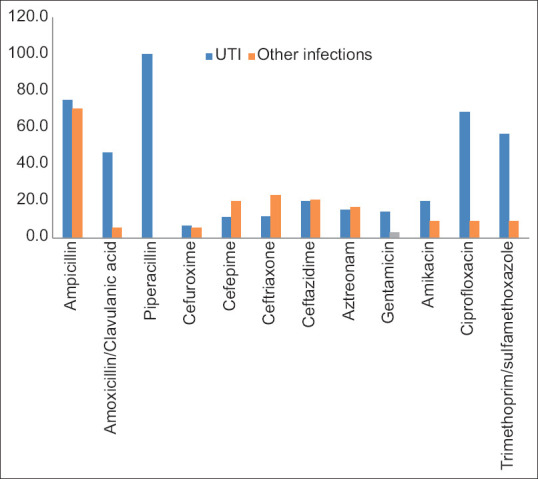
Percentage of Klebsiella ozaenae antibiotic resistance in urinary tract infections and other infections
Discussion
Our retrospective epidemiological analysis showed that despite its low frequency of isolation during the period of the study, K. ozaenae was associated with a wide range of infections including invasive infections such as bacteremia and abscesses. K. ozaenae was mostly isolated from urinary tract infections and was present in significant numbers in the samples indicating that the infection was caused by that pathogen. This is not unusual as it was the reported cause of 4.3% of urinary tract infections in pregnant women in Southern Ethiopia.[17] Two other studies reported the association of K. ozaenae with urinary tract infections.[4,18]
K. ozaenae was first identified as the causative agent of nasal discharge from a patient with ozaena.[2] In our study, nasal infections were the second-most common infection associated with K. ozaenae. Despite the fact that K. ozaenae is considered a normal inhabitant of the oral and nasopharyngeal mucosa, its association with the clinical condition and its isolation as a single pathogen from the sample is suggestive of its role in the disease. The other respiratory tract infections in the study included pneumonia and respiratory infections associated with bronchiectasis and chronic obstructive pulmonary disease. Multiple reports have implicated K. ozaenae in respiratory tract infections.[19,20,21] The importance of K. ozaenae in respiratory tract infections can also be shown from its inclusion in a lysate from multiple other bacterial pathogens, called OM-85, to be used as a vaccine for the prevention of respiratory tract infections.[15]
Diverse wound infections and two cases of abscess were reported in the study, one of which was liver abscess after surgery, indicating the wide range of infections that could be caused by this neglected pathogen. Several reports in the literature described the isolation of K. ozaenae from abscesses such as subphrenic abscess, pituitary, splenic, and multiorgan abscesses.[5,9,22,23]
Of the two cases of bacteremia reported in our study, one was due to acute pericarditis, in which K. ozaenae was isolated as a single pathogen, and the other was a case with multiple pathogens including K. ozaenae. This is in line with multiple reports in the literature on the association of K. ozaenae with blood infections.[7,9,24]
K. ozaenae strains in the study showed 70%–80% sensitivity to most antibiotics except ampicillin, piperacillin, norfloxacin, and nalidixic acid. In general, K. ozaenae shows good susceptibility to multiple classes of antibiotics.[11] However, some strains have been reported to harbor drug resistance genes such as CTX-M and SHV.[12,13,14]
A remarkable finding in our study, not previously described in the literature, is the significant difference in antibiotic susceptibility patterns between strains isolated from urinary tract infections and other infections. However, several studies have reported a general increase in the trend of antimicrobial resistance in urinary tract infections.[25,26] Furthermore, a difference in antibiotic susceptibility patterns based on gender and age groups was previously reported in urinary tract infections and other infections.[27,28,29,30] Therefore, it is tempting to also suggest the possibility of a difference in antimicrobial susceptibility patterns in a pathogen isolated from different infection sites. Such differences have been recognized in hospitals or community-acquired infections. Whether the K. ozaenae strains from the urinary tract infections in our study are community or nosocomial strains is not known to us. It is also possible that the strains that cause urinary tract infections are different from other strains or have been repeatedly exposed to antimicrobial therapy. Such an observation will probably have to be based on a larger-scale study.
Despite the extended period of the study, the small sample size and the nature of the retrospective study are limitations to the drawing of firm conclusions.
Conclusion
Our data show that K. ozaenae is a pathogen with a spectrum of disease wider than expected and a unique antibiotic susceptibility pattern in urinary tract infections. Further studies are needed to understand the disease association and the genetic causes of antimicrobial resistance of K. ozaenae.
Financial support and sponsorship
Nil.
Conflicts of interest
There are no conflicts of interest.
Acknowledgment
The author would like to acknowledge the support of the members of the microbiology laboratory.
References
- 1.Hansen DS, Aucken HM, Abiola T, Podschun R. Recommended test panel for differentiation of Klebsiella species on the basis of a trilateral interlaboratory evaluation of 18 biochemical tests. J Clin Microbiol. 2004;42:3665–9. doi: 10.1128/JCM.42.8.3665-3669.2004. [DOI] [PMC free article] [PubMed] [Google Scholar]
- 2.Brisse S, Grimont F, Grimont PA. Prokaryotes. Springer nature; London UK: 2006. The genus Klebsiella; pp. 159–96. [Google Scholar]
- 3.Caputo A, Merhej V, Georgiades K, Fournier PE, Croce O, Robert C, et al. Pan-genomic analysis to redefine species and subspecies based on quantum discontinuous variation: The Klebsiella paradigm. Biol Direct. 2015;10:55. doi: 10.1186/s13062-015-0085-2. [DOI] [PMC free article] [PubMed] [Google Scholar]
- 4.Baig A, Gujral M, Hameed R, Borra S. Klebsiella ozaenae cholecystitis. Am J Med Sci. 2011;342:259–61. doi: 10.1097/MAJ.0b013e318220ac6f. [DOI] [PubMed] [Google Scholar]
- 5.Sarma PS. Klebsiella ozaenae splenic abscess following odontogenic infection in a girl with sickle cell disease. Int J Infect Dis. 2007;11:86–7. doi: 10.1016/j.ijid.2005.11.003. [DOI] [PubMed] [Google Scholar]
- 6.Kumar S, Alfaadhel T, Albugami MM. Klebsiella ozaenae bacteremia in a kidney transplant recipient. Case Rep Transplant. 2013;2013:493516. doi: 10.1155/2013/493516. [DOI] [PMC free article] [PubMed] [Google Scholar]
- 7.Endailalu YW, Sealy P, Michael M, Al Khalloufi K, Nabhani H. Klebsiella ozaenae sepsis in a young healthy male. Malays J Pathol. 2012;34:153–6. [PubMed] [Google Scholar]
- 8.Gonzales Zamora J, Murali AR. Rhinoscleroma with pharyngolaryngeal involvement caused by Klebsiella ozaenae. Case Rep Infect Dis. 2016;2016:6536275. doi: 10.1155/2016/6536275. [DOI] [PMC free article] [PubMed] [Google Scholar]
- 9.Wu Y, Yang D, Wang K, Liu C. Multi-organ abscesses and 5th cervical vertebra bone destruction related with Klebsiella ozaenae infection: A case report. Infect Drug Resist. 2020;13:4321–5. doi: 10.2147/IDR.S274742. [DOI] [PMC free article] [PubMed] [Google Scholar]
- 10.Ng TH, How SH, Kuan YC, Adzura, Aziz AA, Fauzi AR. A mimicry of melioidosis by Klebsiella ozaenae infection. Malays J Pathol. 2009;31:147–50. [PubMed] [Google Scholar]
- 11.Stock I, Wiedemann B. Natural antibiotic susceptibility of Klebsiella pneumoniae, K. oxytoca, K. planticola, K. ornithinolytica and K. terrigena strains. J Med Microbiol. 2001;50:396–406. doi: 10.1099/0022-1317-50-5-396. [DOI] [PubMed] [Google Scholar]
- 12.Abbott SL, Lidgard JA, Cheung WK, Obeso MN, Berrada ZL, Janda JM. Expression of ESBL-like activity in infrequently encountered members of the family Enterobacteriaceae. Curr Microbiol. 2012;64:222–5. doi: 10.1007/s00284-011-0057-4. [DOI] [PubMed] [Google Scholar]
- 13.Vali P, Shahcheraghi F, Seyfipour M, Zamani MA, Allahyar MR, Feizabadi MM. Phenotypic and Genetic Characterization of Carbapenemase and ESBLs Producing Gram-negative Bacteria (GNB) Isolated from Patients with Cystic Fibrosis (CF) in Tehran Hospitals. J Clin Diagn Res. 2014;8:26–30. doi: 10.7860/JCDR/2014/6877.3916. [DOI] [PMC free article] [PubMed] [Google Scholar]
- 14.Huang J, Li X, Zhu N, Li G. Genetic characteristics of one highly multi-drug-resistant strain of Klebsiella ozaenae. J Med Microbiol. 2012;61:1303–5. doi: 10.1099/jmm.0.044115-0. [DOI] [PubMed] [Google Scholar]
- 15.Marseglia GL, Benazzo M, Biasci P, Blasi F, Cricelli C, Doria M, et al. OM-85 in the prevention of respiratory infections: State-of-the-art and future perspectives in clinical practice. J Biol Regul Homeost Agents. 2021;35:847–63. doi: 10.23812/21-147-A. [DOI] [PubMed] [Google Scholar]
- 16.Gameel AA, el-Sanousi SM, al-Nawawi F, al-Shazly MO. Association of Klebsiella organisms with pulmonary lesions in sheep. Rev Elev Med Vet Pays Trop. 1991;44:161–4. [PubMed] [Google Scholar]
- 17.Tula A, Mikru A, Alemayehu T, Dobo B. Bacterial Profile and antibiotic susceptibility pattern of urinary tract infection among pregnant women attending antenatal care at a tertiary care hospital in Southern Ethiopia. Can J Infect Dis Med Microbiol. 2020;2020:5321276. doi: 10.1155/2020/5321276. [DOI] [PMC free article] [PubMed] [Google Scholar]
- 18.Goldstein EJ, Lewis RP, Martin WJ, Edelstein PH. Infections caused by Klebsiella ozaenae: A changing disease spectrum. J Clin Microbiol. 1978;8:413–8. doi: 10.1128/jcm.8.4.413-418.1978. [DOI] [PMC free article] [PubMed] [Google Scholar]
- 19.Tachibana T, Mouri N, Sano C, Ohta R. A case of complicated pneumonia caused by Klebsiella ozaenae. Cureus. 2022;14:e23001. doi: 10.7759/cureus.23001. [DOI] [PMC free article] [PubMed] [Google Scholar]
- 20.Renois F, Jacques J, Guillard T, Moret H, Pluot M, Andreoletti L, et al. Preliminary investigation of a mice model of Klebsiella pneumoniae subsp. Ozaenae induced pneumonia. Microbes Infect. 2011;13:1045–51. doi: 10.1016/j.micinf.2011.05.013. [DOI] [PubMed] [Google Scholar]
- 21.De Champs C, Vellin JF, Diancourt L, Brisse S, Kemeny JL, Gilain L, et al. Laryngeal scleroma associated with Klebsiella pneumoniae subsp. Ozaenae. J Clin Microbiol. 2005;43:5811–3. doi: 10.1128/JCM.43.11.5811-5813.2005. [DOI] [PMC free article] [PubMed] [Google Scholar]
- 22.Zbar AP, Ranasinghe W, Kennedy PJ. Subphrenic abscess secondary to Actinomycosis meyeri and Klebsiella ozaenae following laparoscopic cholecystectomy. South Med J. 2009;102:725–7. doi: 10.1097/SMJ.0b013e3181abddc5. [DOI] [PubMed] [Google Scholar]
- 23.Danilowicz K, Sanz CF, Manavela M, Gomez RM, Bruno OD. Pituitary abscess: A report of two cases. Pituitary. 2008;11:89–92. doi: 10.1007/s11102-007-0033-y. [DOI] [PubMed] [Google Scholar]
- 24.Murray KA, Clements BH, Keas SE. Klebsiella ozaenae septicemia associated with Hansen's disease. J Clin Microbiol. 1981;14:703–5. doi: 10.1128/jcm.14.6.703-705.1981. [DOI] [PMC free article] [PubMed] [Google Scholar]
- 25.Paul R. State of the globe: Rising antimicrobial resistance of pathogens in urinary tract infection. J Glob Infect Dis. 2018;10:117–8. doi: 10.4103/jgid.jgid_104_17. [DOI] [PMC free article] [PubMed] [Google Scholar]
- 26.Shin HR, Moon J, Lee HS, Ahn SJ, Kim TJ, Jun JS, et al. Increasing prevalence of antimicrobial resistance in urinary tract infections of neurological patients, Seoul, South Korea, 2007-2016. Int J Infect Dis. 2019;84:109–15. doi: 10.1016/j.ijid.2019.05.002. [DOI] [PubMed] [Google Scholar]
- 27.Ji Z, Han F, Meng F, Tu M, Yang N, Zhang J. The association of age and antibiotic resistance of Helicobacter pylori: A study in Jiaxing City, Zhejiang Province, China. Medicine (Baltimore) 2016;95:e2831. doi: 10.1097/MD.0000000000002831. [DOI] [PMC free article] [PubMed] [Google Scholar]
- 28.Hossain A, Hossain SA, Fatema AN, Wahab A, Alam MM, Islam MN, et al. Age and gender-specific antibiotic resistance patterns among Bangladeshi patients with urinary tract infection caused by Escherichia coli. Heliyon. 2020;6:e04161. doi: 10.1016/j.heliyon.2020.e04161. [DOI] [PMC free article] [PubMed] [Google Scholar] [Retracted]
- 29.McGregor JC, Elman MR, Bearden DT, Smith DH. Sex- and age-specific trends in antibiotic resistance patterns of Escherichia coli urinary isolates from outpatients. BMC Fam Pract. 2013;14:25. doi: 10.1186/1471-2296-14-25. [DOI] [PMC free article] [PubMed] [Google Scholar]
- 30.Huang L, Huang C, Yan Y, Sun L, Li H. Urinary tract infection etiological profiles and antibiotic resistance patterns varied among different age categories: A retrospective study from a tertiary general hospital during a 12-year period. Front Microbiol. 2021;12:813145. doi: 10.3389/fmicb.2021.813145. [DOI] [PMC free article] [PubMed] [Google Scholar]