



Abstract
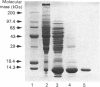
Fatty-acid-binding protein (FABP) is a 14 kDa protein found in hepatic cytosol which binds and transports fatty acids and other hydrophobic ligands throughout the cell. The purpose of this investigation was to determine whether LY171883, a leukotriene D4 antagonist, and other peroxisome proliferators bind to FABP and displace an endogenous fatty acid. [3H]Oleic acid was used to monitor the elution of FABP during chromatographic purification. [14C]LY171883 had a similar elution profile when substituted in the purification, indicating a common interaction with FABP. LY171883 and its structural analogue, LY189585, as well as the hypolipidaemic peroxisome proliferators clofibric acid, ciprofibrate, bezafibrate and WY14,643, displaced [3H]oleic acid binding to FABP. Analogues of LY171883 that do not induce peroxisome proliferation only weakly displaced oleate binding. [3H]Ly171883 bound directly to FABP with a Kd of 10.8 microM, compared with a Kd of 0.96 microM for [3H]oleate. LY171883 binding was inhibited by LY189585, clofibric acid, ciprofibrate and bezafibrate. These findings demonstrate that peroxisome proliferators, presumably due to their structural similarity to fatty acids, are able to bind to FABP and displace an endogenous ligand from its binding site. Interaction of peroxisome proliferators with FABP may be involved in perturbations of fatty acid metabolism caused by these agents as well as in the development of the pleiotropic response of peroxisome proliferation.
Full text
PDF


Images in this article
Selected References
These references are in PubMed. This may not be the complete list of references from this article.
- Appelkvist E. L., Dallner G. Possible involvement of fatty acid binding protein in peroxisomal beta-oxidation of fatty acids. Biochim Biophys Acta. 1980 Jan 18;617(1):156–160. doi: 10.1016/0005-2760(80)90233-7. [DOI] [PubMed] [Google Scholar]
- Bass N. M., Manning J. A., Ockner R. K. Turnover and short-term regulation of fatty acid binding protein in liver. J Biol Chem. 1985 Aug 15;260(17):9603–9607. [PubMed] [Google Scholar]
- Bassuk J. A., Tsichlis P. N., Sorof S. Liver fatty acid binding protein is the mitosis-associated polypeptide target of a carcinogen in rat hepatocytes. Proc Natl Acad Sci U S A. 1987 Nov;84(21):7547–7551. doi: 10.1073/pnas.84.21.7547. [DOI] [PMC free article] [PubMed] [Google Scholar]
- Blackburn G. R., Schnabel S. J., Danley J. M., Hogue-Angeletti R. A., Sorof S. Principal polypeptide target of carcinogen at the beginning of liver carcinogenesis by three carcinogens. Cancer Res. 1982 Nov;42(11):4664–4672. [PubMed] [Google Scholar]
- Brady P. S., Marine K. A., Brady L. J., Ramsay R. R. Co-ordinate induction of hepatic mitochondrial and peroxisomal carnitine acyltransferase synthesis by diet and drugs. Biochem J. 1989 May 15;260(1):93–100. doi: 10.1042/bj2600093. [DOI] [PMC free article] [PubMed] [Google Scholar]
- Brandes R., Kaikaus R. M., Lysenko N., Ockner R. K., Bass N. M. Induction of fatty acid binding protein by peroxisome proliferators in primary hepatocyte cultures and its relationship to the induction of peroxisomal beta-oxidation. Biochim Biophys Acta. 1990 Apr 23;1034(1):53–61. doi: 10.1016/0304-4165(90)90152-m. [DOI] [PubMed] [Google Scholar]
- Calvo M., Ena J. M. Relations between vitamin D and fatty acid binding properties of vitamin D-binding protein. Biochem Biophys Res Commun. 1989 Aug 30;163(1):14–17. doi: 10.1016/0006-291x(89)92091-3. [DOI] [PubMed] [Google Scholar]
- Dahlberg E., Snochowski M., Gustafsson J. A. Removal of hydrophobic compounds from biological fluids by a simple method. Anal Biochem. 1980 Aug;106(2):380–388. doi: 10.1016/0003-2697(80)90537-0. [DOI] [PubMed] [Google Scholar]
- Dutta-Roy A. K., Gopalswamy N., Trulzsch D. V. Prostaglandin E1 binds to Z protein of rat liver. Eur J Biochem. 1987 Feb 2;162(3):615–619. doi: 10.1111/j.1432-1033.1987.tb10683.x. [DOI] [PubMed] [Google Scholar]
- Eacho P. I., Foxworthy P. S., Dillard R. D., Whitesitt C. A., Herron D. K., Marshall W. S. Induction of peroxisomal beta-oxidation in the rat liver in vivo and in vitro by tetrazole-substituted acetophenones: structure-activity relationships. Toxicol Appl Pharmacol. 1989 Aug;100(1):177–184. doi: 10.1016/0041-008x(89)90100-2. [DOI] [PubMed] [Google Scholar]
- Eacho P. I., Foxworthy P. S. Inhibition of hepatic fatty acid oxidation by bezafibrate and bezafibroyl CoA. Biochem Biophys Res Commun. 1988 Dec 30;157(3):1148–1153. doi: 10.1016/s0006-291x(88)80993-8. [DOI] [PubMed] [Google Scholar]
- Eacho P. I., Foxworthy P. S., Johnson W. D., Hoover D. M., White S. L. Hepatic peroxisomal changes induced by a tetrazole-substituted alkoxyacetophenone in rats and comparison with other species. Toxicol Appl Pharmacol. 1986 May;83(3):430–437. doi: 10.1016/0041-008x(86)90225-5. [DOI] [PubMed] [Google Scholar]
- Elcombe C. R., Mitchell A. M. Peroxisome proliferation due to di(2-ethylhexyl) phthalate (DEHP): species differences and possible mechanisms. Environ Health Perspect. 1986 Dec;70:211–219. doi: 10.1289/ehp.8670211. [DOI] [PMC free article] [PubMed] [Google Scholar]
- Foxworthy P. S., Eacho P. I. Conditions influencing the induction of peroxisomal beta-oxidation in cultured rat hepatocytes. Toxicol Lett. 1986 Feb;30(2):189–196. doi: 10.1016/0378-4274(86)90102-5. [DOI] [PubMed] [Google Scholar]
- Foxworthy P. S., Eacho P. I. Inhibition of hepatic fatty acid oxidation at carnitine palmitoyltransferase I by the peroxisome proliferator 2-hydroxy-3-propyl-4-[6-(tetrazol-5-yl) hexyloxy]acetophenone. Biochem J. 1988 Jun 1;252(2):409–414. doi: 10.1042/bj2520409. [DOI] [PMC free article] [PubMed] [Google Scholar]
- Foxworthy P. S., Perry D. N., Hoover D. M., Eacho P. I. Changes in hepatic lipid metabolism associated with lipid accumulation and its reversal in rats given the peroxisome proliferator LY171883. Toxicol Appl Pharmacol. 1990 Dec;106(3):375–383. doi: 10.1016/0041-008x(90)90334-q. [DOI] [PubMed] [Google Scholar]
- Glatz J. F., Veerkamp J. H. Intracellular fatty acid-binding proteins. Int J Biochem. 1985;17(1):13–22. doi: 10.1016/0020-711x(85)90080-1. [DOI] [PubMed] [Google Scholar]
- Glatz J. F., van der Vusse G. J. Cellular fatty acid-binding proteins: current concepts and future directions. 1990 Oct 15-Nov 8Mol Cell Biochem. 98(1-2):237–251. doi: 10.1007/BF00231390. [DOI] [PubMed] [Google Scholar]
- Hawkins J. M., Jones W. E., Bonner F. W., Gibson G. G. The effect of peroxisome proliferators on microsomal, peroxisomal, and mitochondrial enzyme activities in the liver and kidney. Drug Metab Rev. 1987;18(4):441–515. doi: 10.3109/03602538708994130. [DOI] [PubMed] [Google Scholar]
- Kanda T., Ono T., Matsubara Y., Muto T. Possible role of rat fatty acid-binding proteins in the intestine as carriers of phenol and phthalate derivatives. Biochem Biophys Res Commun. 1990 May 16;168(3):1053–1058. doi: 10.1016/0006-291x(90)91136-g. [DOI] [PubMed] [Google Scholar]
- Kawashima Y., Nakagawa S., Tachibana Y., Kozuka H. Effects of peroxisome proliferators on fatty acid-binding protein in rat liver. Biochim Biophys Acta. 1983 Nov 1;754(1):21–27. doi: 10.1016/0005-2760(83)90077-2. [DOI] [PubMed] [Google Scholar]
- Ketterer B., Tipping E., Hackney J. F., Beale D. A low-molecular-weight protein from rat liver that resembles ligandin in its binding properties. Biochem J. 1976 Jun 1;155(3):511–521. doi: 10.1042/bj1550511. [DOI] [PMC free article] [PubMed] [Google Scholar]
- Khan S. H., Sorof S. Preferential binding of growth inhibitory prostaglandins by the target protein of a carcinogen. Proc Natl Acad Sci U S A. 1990 Dec;87(23):9401–9405. doi: 10.1073/pnas.87.23.9401. [DOI] [PMC free article] [PubMed] [Google Scholar]
- Laemmli U. K. Cleavage of structural proteins during the assembly of the head of bacteriophage T4. Nature. 1970 Aug 15;227(5259):680–685. doi: 10.1038/227680a0. [DOI] [PubMed] [Google Scholar]
- Lock E. A., Mitchell A. M., Elcombe C. R. Biochemical mechanisms of induction of hepatic peroxisome proliferation. Annu Rev Pharmacol Toxicol. 1989;29:145–163. doi: 10.1146/annurev.pa.29.040189.001045. [DOI] [PubMed] [Google Scholar]
- Mannaerts G. P., Debeer L. J., Thomas J., De Schepper P. J. Mitochondrial and peroxisomal fatty acid oxidation in liver homogenates and isolated hepatocytes from control and clofibrate-treated rats. J Biol Chem. 1979 Jun 10;254(11):4585–4595. [PubMed] [Google Scholar]
- Markwell M. A., Bieber L. L., Tolbert N. E. Differential increase of hepatic peroxisomal, mitochondrial and microsomal carnitine acyltransferases in clofibrate-fed rats. Biochem Pharmacol. 1977 Sep 15;26(18):1697–1702. doi: 10.1016/0006-2952(77)90147-2. [DOI] [PubMed] [Google Scholar]
- Paulussen R. J., Jansen G. P., Veerkamp J. H. Fatty acid-binding capacity of cytosolic proteins of various rat tissues: effect of postnatal development, starvation, sex, clofibrate feeding and light cycle. Biochim Biophys Acta. 1986 Jul 18;877(3):342–349. doi: 10.1016/0005-2760(86)90198-0. [DOI] [PubMed] [Google Scholar]
- Peeters R. A., Veerkamp J. H., Demel R. A. Are fatty acid-binding proteins involved in fatty acid transfer? Biochim Biophys Acta. 1989 Mar 14;1002(1):8–13. doi: 10.1016/0005-2760(89)90057-x. [DOI] [PubMed] [Google Scholar]
- Raza H., Pongubala J. R., Sorof S. Specific high affinity binding of lipoxygenase metabolites of arachidonic acid by liver fatty acid binding protein. Biochem Biophys Res Commun. 1989 Jun 15;161(2):448–455. doi: 10.1016/0006-291x(89)92619-3. [DOI] [PubMed] [Google Scholar]
- Renaud G., Foliot A., Infante R. Increased uptake of fatty acids by the isolated rat liver after raising the fatty acid binding protein concentration with clofibrate. Biochem Biophys Res Commun. 1978 Jan 30;80(2):327–334. doi: 10.1016/0006-291x(78)90680-0. [DOI] [PubMed] [Google Scholar]
- Rosenthal H. E. A graphic method for the determination and presentation of binding parameters in a complex system. Anal Biochem. 1967 Sep;20(3):525–532. doi: 10.1016/0003-2697(67)90297-7. [DOI] [PubMed] [Google Scholar]
- Sacchettini J. C., Banaszak L. J., Gordon J. I. Expression of rat intestinal fatty acid binding protein in E. coli and its subsequent structural analysis: a model system for studying the molecular details of fatty acid-protein interaction. 1990 Oct 15-Nov 8Mol Cell Biochem. 98(1-2):81–93. doi: 10.1007/BF00231371. [DOI] [PubMed] [Google Scholar]
- Sacchettini J. C., Gordon J. I., Banaszak L. J. The structure of crystalline Escherichia coli-derived rat intestinal fatty acid-binding protein at 2.5-A resolution. J Biol Chem. 1988 Apr 25;263(12):5815–5819. [PubMed] [Google Scholar]
- Takahashi K., Odani S., Ono T. A close structural relationship of rat liver Z-protein to cellular retinoid binding proteins and peripheral nerve myelin P2 protein. Biochem Biophys Res Commun. 1982 Jun 30;106(4):1099–1105. doi: 10.1016/0006-291x(82)91225-6. [DOI] [PubMed] [Google Scholar]
- Trulzsch D., Arias I. M. Z protein: isolation and characterization of multiple forms in rat liver cytosol. Arch Biochem Biophys. 1981 Jul;209(2):433–440. doi: 10.1016/0003-9861(81)90300-3. [DOI] [PubMed] [Google Scholar]
- Wilton D. C. Studies on fatty-acid-binding proteins. The purification of rat liver fatty-acid-binding protein and the role of cysteine-69 in fatty acid binding. Biochem J. 1989 Jul 1;261(1):273–276. doi: 10.1042/bj2610273. [DOI] [PMC free article] [PubMed] [Google Scholar]