



Abstract
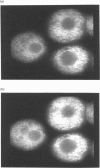
In isolated rat hepatocytes a sustained high increase in intracellular free Ca2+ ([Ca2+]i), induced by extracellular ATP, is associated with mitochondrial dysfunction and cell death. The Ca(2+)-induced effects are Pi-dependent and less severe when the intracellular K+ content is low. In this study, the involvement of mitochondrial K+ processing in Ca(2+)-induced loss of mitochondrial membrane potential (MMP) and viability was investigated. The recently introduced K(+)-sensitive dye PBFI (K(+)-binding benzofuran isophthalate) has been used in combination with video-microscopy to assess intramitochondrial free K+ concentration ([K+]mito) in rat liver mitochondria in situ. After rapid permeabilization of the plasma membrane to remove cytosolic PBFI, the remaining PBFI was localized in mitochondria, and a 'resting' [K+]mito of approx. 15 mM could be measured. Increased [K+]mito levels were measured after induction of a prolonged increase in [Ca2+]i by ATP. Much lower [K+]mito, more comparable with control levels, were observed when intracellular K+ was depleted by omission of extracellular K+. In permeabilized cells the Ca(2+)-induced, Pi-dependent, dissipation of the MMP was markedly delayed in the absence of K+. These observations suggest involvement of [K+]mito as modulating agent in Ca(2+)-induced cytotoxicity in hepatocytes.
Full text
PDF


Images in this article
Selected References
These references are in PubMed. This may not be the complete list of references from this article.
- Blatter L. A., Wier W. G. Intracellular diffusion, binding, and compartmentalization of the fluorescent calcium indicators indo-1 and fura-2. Biophys J. 1990 Dec;58(6):1491–1499. doi: 10.1016/S0006-3495(90)82494-2. [DOI] [PMC free article] [PubMed] [Google Scholar]
- Broekemeier K. M., Carpenter-Deyo L., Reed D. J., Pfeiffer D. R. Cyclosporin A protects hepatocytes subjected to high Ca2+ and oxidative stress. FEBS Lett. 1992 Jun 15;304(2-3):192–194. doi: 10.1016/0014-5793(92)80616-o. [DOI] [PubMed] [Google Scholar]
- Carafoli E. Calcium pump of the plasma membrane. Physiol Rev. 1991 Jan;71(1):129–153. doi: 10.1152/physrev.1991.71.1.129. [DOI] [PubMed] [Google Scholar]
- Chacon E., Ulrich R., Acosta D. A digitized-fluorescence-imaging study of mitochondrial Ca2+ increase by doxorubicin in cardiac myocytes. Biochem J. 1992 Feb 1;281(Pt 3):871–878. doi: 10.1042/bj2810871. [DOI] [PMC free article] [PubMed] [Google Scholar]
- Chávez E., Moreno-Sánchez R., Zazueta C., Reyes-Vivas H., Arteaga D. Intramitochondrial K+ as activator of carboxyatractyloside-induced Ca2+ release. Biochim Biophys Acta. 1991 Dec 9;1070(2):461–466. doi: 10.1016/0005-2736(91)90087-o. [DOI] [PubMed] [Google Scholar]
- Crompton M., Ellinger H., Costi A. Inhibition by cyclosporin A of a Ca2+-dependent pore in heart mitochondria activated by inorganic phosphate and oxidative stress. Biochem J. 1988 Oct 1;255(1):357–360. [PMC free article] [PubMed] [Google Scholar]
- Farber J. L. The role of calcium in lethal cell injury. Chem Res Toxicol. 1990 Nov-Dec;3(6):503–508. doi: 10.1021/tx00018a003. [DOI] [PubMed] [Google Scholar]
- Garlid K. D., DiResta D. J., Beavis A. D., Martin W. H. On the mechanism by which dicyclohexylcarbodiimide and quinine inhibit K+ transport in rat liver mitochondria. J Biol Chem. 1986 Feb 5;261(4):1529–1535. [PubMed] [Google Scholar]
- Gunter T. E., Pfeiffer D. R. Mechanisms by which mitochondria transport calcium. Am J Physiol. 1990 May;258(5 Pt 1):C755–C786. doi: 10.1152/ajpcell.1990.258.5.C755. [DOI] [PubMed] [Google Scholar]
- Halestrap A. P. The regulation of the matrix volume of mammalian mitochondria in vivo and in vitro and its role in the control of mitochondrial metabolism. Biochim Biophys Acta. 1989 Mar 23;973(3):355–382. doi: 10.1016/s0005-2728(89)80378-0. [DOI] [PubMed] [Google Scholar]
- Hughes B. P., Milton S. E., Barritt G. J. Effects of vasopressin and La3+ on plasma-membrane Ca2+ inflow and Ca2+ disposition in isolated hepatocytes. Evidence that vasopressin inhibits Ca2+ disposition. Biochem J. 1986 Sep 15;238(3):793–800. doi: 10.1042/bj2380793. [DOI] [PMC free article] [PubMed] [Google Scholar]
- Kaneko A., Hayashi N., Tsubouchi H., Tanaka Y., Ito T., Sasaki Y., Fusamoto H., Daikuhara Y., Kamada T. Intracellular calcium as a second messenger for human hepatocyte growth factor in hepatocytes. Hepatology. 1992 Jun;15(6):1173–1178. doi: 10.1002/hep.1840150632. [DOI] [PubMed] [Google Scholar]
- Kasner S. E., Ganz M. B. Regulation of intracellular potassium in mesangial cells: a fluorescence analysis using the dye, PBFI. Am J Physiol. 1992 Mar;262(3 Pt 2):F462–F467. doi: 10.1152/ajprenal.1992.262.3.F462. [DOI] [PubMed] [Google Scholar]
- Kraus-Friedmann N. Calcium sequestration in the liver. Cell Calcium. 1990 Nov-Dec;11(10):625–640. doi: 10.1016/0143-4160(90)90017-o. [DOI] [PubMed] [Google Scholar]
- Minta A., Tsien R. Y. Fluorescent indicators for cytosolic sodium. J Biol Chem. 1989 Nov 15;264(32):19449–19457. [PubMed] [Google Scholar]
- Nagelkerke J. F., Barto K. P., van Berkel T. J. In vivo and in vitro uptake and degradation of acetylated low density lipoprotein by rat liver endothelial, Kupffer, and parenchymal cells. J Biol Chem. 1983 Oct 25;258(20):12221–12227. [PubMed] [Google Scholar]
- Nagelkerke J. F., Dogterom P., De Bont H. J., Mulder G. J. Prolonged high intracellular free calcium concentrations induced by ATP are not immediately cytotoxic in isolated rat hepatocytes. Changes in biochemical parameters implicated in cell toxicity. Biochem J. 1989 Oct 15;263(2):347–353. doi: 10.1042/bj2630347. [DOI] [PMC free article] [PubMed] [Google Scholar]
- Novgorodov S. A., Gudz T. I., Jung D. W., Brierley G. P. The nonspecific inner membrane pore of liver mitochondria: modulation of cyclosporin sensitivity by ADP at carboxyatractyloside-sensitive and insensitive sites. Biochem Biophys Res Commun. 1991 Oct 15;180(1):33–38. doi: 10.1016/s0006-291x(05)81250-1. [DOI] [PubMed] [Google Scholar]
- Orrenius S., McConkey D. J., Bellomo G., Nicotera P. Role of Ca2+ in toxic cell killing. Trends Pharmacol Sci. 1989 Jul;10(7):281–285. doi: 10.1016/0165-6147(89)90029-1. [DOI] [PubMed] [Google Scholar]
- Pounds J. G., Rosen J. F. Cellular Ca2+ homeostasis and Ca2+-mediated cell processes as critical targets for toxicant action: conceptual and methodological pitfalls. Toxicol Appl Pharmacol. 1988 Jul;94(3):331–341. doi: 10.1016/0041-008x(88)90275-x. [DOI] [PubMed] [Google Scholar]
- Richelmi P., Mirabelli F., Salis A., Finardi G., Berte F., Bellomo G. On the role of mitochondria in cell injury caused by vanadate-induced Ca2+ overload. Toxicology. 1989 Jul 3;57(1):29–44. doi: 10.1016/0300-483x(89)90032-2. [DOI] [PubMed] [Google Scholar]
- Richter C., Kass G. E. Oxidative stress in mitochondria: its relationship to cellular Ca2+ homeostasis, cell death, proliferation, and differentiation. Chem Biol Interact. 1991;77(1):1–23. doi: 10.1016/0009-2797(91)90002-o. [DOI] [PubMed] [Google Scholar]
- Romani A., Scarpa A. Regulation of cell magnesium. Arch Biochem Biophys. 1992 Oct;298(1):1–12. doi: 10.1016/0003-9861(92)90086-c. [DOI] [PubMed] [Google Scholar]
- Shen W., Kamendulis L. M., Ray S. D., Corcoran G. B. Acetaminophen-induced cytotoxicity in cultured mouse hepatocytes: effects of Ca(2+)-endonuclease, DNA repair, and glutathione depletion inhibitors on DNA fragmentation and cell death. Toxicol Appl Pharmacol. 1992 Jan;112(1):32–40. doi: 10.1016/0041-008x(92)90276-x. [DOI] [PubMed] [Google Scholar]
- Siegmund B., Zude R., Piper H. M. Recovery of anoxic-reoxygenated cardiomyocytes from severe Ca2+ overload. Am J Physiol. 1992 Oct;263(4 Pt 2):H1262–H1269. doi: 10.1152/ajpheart.1992.263.4.H1262. [DOI] [PubMed] [Google Scholar]
- Smith M. W., Phelps P. C., Trump B. F. Cytosolic Ca2+ deregulation and blebbing after HgCl2 injury to cultured rabbit proximal tubule cells as determined by digital imaging microscopy. Proc Natl Acad Sci U S A. 1991 Jun 1;88(11):4926–4930. doi: 10.1073/pnas.88.11.4926. [DOI] [PMC free article] [PubMed] [Google Scholar]
- Snyder J. W., Pastorino J. G., Thomas A. P., Hoek J. B., Farber J. L. ATP synthase activity is required for fructose to protect cultured hepatocytes from the toxicity of cyanide. Am J Physiol. 1993 Mar;264(3 Pt 1):C709–C714. doi: 10.1152/ajpcell.1993.264.3.C709. [DOI] [PubMed] [Google Scholar]
- Soltoff S. P., Mandel L. J. Potassium transport in the rabbit renal proximal tubule: effects of barium, ouabain, valinomycin, and other ionophores. J Membr Biol. 1986;94(2):153–161. doi: 10.1007/BF01871195. [DOI] [PubMed] [Google Scholar]
- Somogyi R., Stucki J. W. Hormone-induced calcium oscillations in liver cells can be explained by a simple one pool model. J Biol Chem. 1991 Jun 15;266(17):11068–11077. [PubMed] [Google Scholar]
- Ueda N., Shah S. V. Role of intracellular calcium in hydrogen peroxide-induced renal tubular cell injury. Am J Physiol. 1992 Aug;263(2 Pt 2):F214–F221. doi: 10.1152/ajprenal.1992.263.2.F214. [DOI] [PubMed] [Google Scholar]
- Walajtys-Rhode E., Zapatero J., Moehren G., Hoek J. B. The role of the matrix calcium level in the enhancement of mitochondrial pyruvate carboxylation by glucagon pretreatment. J Biol Chem. 1992 Jan 5;267(1):370–379. [PubMed] [Google Scholar]
- Weis M., Kass G. E., Orrenius S., Moldéus P. N-acetyl-p-benzoquinone imine induces Ca2+ release from mitochondria by stimulating pyridine nucleotide hydrolysis. J Biol Chem. 1992 Jan 15;267(2):804–809. [PubMed] [Google Scholar]
- Zoeteweij J. P., van de Water B., de Bont H. J., Mulder G. J., Nagelkerke J. F. Calcium-induced cytotoxicity in hepatocytes after exposure to extracellular ATP is dependent on inorganic phosphate. Effects on mitochondrial calcium. J Biol Chem. 1993 Feb 15;268(5):3384–3388. [PubMed] [Google Scholar]
- Zoeteweij J. P., van de Water B., de Bont H. J., Mulder G. J., Nagelkerke J. F. Involvement of intracellular Ca2+ and K+ in dissipation of the mitochondrial membrane potential and cell death induced by extracellular ATP in hepatocytes. Biochem J. 1992 Nov 15;288(Pt 1):207–213. doi: 10.1042/bj2880207. [DOI] [PMC free article] [PubMed] [Google Scholar]