



Abstract
Importance:
Weight loss prior to conception is recommended for women with overweight or obesity to improve fertility outcomes, but evidence supporting this recommendation is mixed.
Objective:
To examine the effectiveness of weight loss interventions using lifestyle modification and/or medication in women with overweight or obesity on pregnancy, live birth, and miscarriage.
Data sources:
An electronic search of MEDLINE, Embase, Cochrane Library including Cochrane Database of Systematic Reviews and Cochrane Central Register of Controlled Trials, and Cumulative Index to Nursing and Allied Health Literature was conducted through July 6, 2022, via Wiley.
Study selection and synthesis:
Randomized controlled trials examining weight loss interventions through lifestyle and/or medication in women with overweight or obesity planning pregnancy were included. Random-effects meta-analysis was conducted reporting the risk ratio (RR) for each outcome. Sub-group analyses were conducted by intervention type, type of control group, fertility treatment, intervention length, and body mass index (BMI).
Main outcomes:
Clinical pregnancy, live birth, and miscarriage events.
Results:
A narrative review and meta-analysis was possible for 16 studies for pregnancy (n=3588), 13 for live birth (n=3329), and 11 for miscarriage (n=3248). Women randomized and exposed to a weight loss intervention were more likely to become pregnant (RR=1.24, 95% CI[1.07, 1.44] I2=59%), but not to have live birth (RR=1.19, 95% CI[0.97, 1.45] I2=69%) or miscarriage (RR=1.17, 95% CI[0.79, 1.74] I2=31%) compared to women in control groups. Subgroup analyses revealed women randomized to weight loss interventions lasting 12 weeks or fewer (n=9, RR = 1.43, 95% CI [1.13, 1.83]) and women with a BMI ≥ 35 kg/m2 (n=7, RR=1.54, 95% CI[1.18, 2.02]) were more likely to become pregnant compared to women in the control groups. Miscarriage was higher in intervention groups who underwent fertility treatment (n=8, RR 1.45, 95% CI [1.07, 1.96]).
Conclusion and relevance:
Pregnancy rates were higher in women undergoing preconception weight loss interventions with no impact on live birth or miscarriage rates. Findings do not support one-size-fits-all recommendation for weight loss through lifestyle modification and/or medication in women with overweight or obesity immediately prior to conception to improve live birth or miscarriage outcomes.
Keywords: lifestyle intervention, anti-obesity medication, pregnancy, preconception weight loss, overweight/obesity
Capsule:
Preconception weight loss interventions in women with overweight or obesity led to higher pregnancy rates compared to controls but there was no impact on live birth or miscarriage rates.
1. Introduction
The prevalence of obesity (body mass index (BMI) ≥ 30 kg/m2) among women age 20–39 in the United States has more than tripled and severe obesity has increased 10-fold between 1960 and 2014 (1). Obesity increases risk of cardiometabolic diseases and pregnancy complications, impairs fertility, and influences the next generation through increased risk of poor fetal outcomes and obesity in offspring (2–4). Therefore, weight loss prior to pregnancy or fertility treatment is routinely recommended (5).
Weight loss through lifestyle modification including caloric restriction and increased physical activity is considered first-line treatment for obesity, but lifestyle interventions are intensive, tend to be less successful in women (6), have limited long-term efficacy (7, 8), and lack convincing evidence supporting benefits for fecundity, pregnancy, birth, or fetal outcomes (9, 10). Pharmaceutical interventions utilizing anti-obesity medications (AOMs) produce superior weight loss compared to lifestyle modification (11–15), but less is known about their impact on reproductive health outcomes (16). Six large-scale, randomized controlled trials (RCTs) (17–21) have been published since the most recent data synthesis, and prior reviews had methodological limitations that preclude definitive conclusions on the effects of weight loss through lifestyle modification and/or medication on fertility, and pregnancy outcomes.
The first systematic review only included studies of lifestyle interventions for weight loss in women prior to assisted reproductive technology (ART) (22) with conclusions supporting recommendations for weight loss before ART. A similar review and meta-analysis of weight loss on fertility/birth outcomes in women undergoing in-vitro fertilization (IVF) was published in 2017 and echoed the narrative review’s findings that weight loss improved pregnancy (RR: 1.61, 95% CI: 1.15 – 2.27), live birth (RR: 1.86, 95% CI: 1.41 – 2.45), and miscarriage (RR: 0.56, 95% CI: 0.34 – 0.93) (23). However, studies among women seeking infertility treatments are not necessarily generalizable to all women of reproductive age desiring pregnancy.
A 2019 systematic review was not limited to women undergoing ART and included studies using lifestyle modification, pharmaceutical, and bariatric surgery interventions for weight loss (24). However, it only included a quantitative synthesis of weight outcomes, rather than pregnancy or live birth outcomes. A recent meta-analyses found interventions combining diet and exercise led to higher pregnancy (RR: 1.87, CI: 95% 1.20 – 2.93) and live birth rates (RR: 2.20, CI: 95% 1.23 – 3.94) compared to women in control groups (10). In another, lifestyle interventions led to higher pregnancy rates (RR: 1.43, CI: 95% 1.02 – 2.01), had no impact on live birth but were associated with a higher miscarriage rate (RR: 1.50, CI: 95% 1.04 –2.16) (9). These meta-analyses used per-protocol analyses to calculate pregnancy and live birth rates, rather than using intent-to-treat (ITT).
Findings from recent large-scale RCTs question the efficacy of weight loss interventions for improving fertility and live birth outcomes and raise concerns about increased risks for women from weight loss attempts prior to fertility treatment (9, 19–21, 25). An up-to-date and comprehensive quantitative synthesis that includes these RCTs and pharmaceutical interventions is needed to replace blanketed guidelines for preconception weight loss in women with obesity.
To that end, we conducted a systematic review and meta-analysis that includes studies of women with overweight or obesity seeking pregnancy and the use of a weight loss intervention (lifestyle modification and/or medication) on subsequent pregnancy, live birth, and miscarriage. To overcome methodological limitations of previous reviews we used intent-to-treat principles to provide a more pragmatic, “real-world” analysis of the extent to which being randomized and exposed to a weight loss intervention improves outcomes, rather than successfully completing the weight loss intervention, appreciating that lack of compliance is common in weight management interventions, particularly in reproductive-aged women (26–28).
2. Materials and Methods
The 2020 Preferred Reporting Items for Systematic Reviews and Meta-Analyses (PRISMA) guidelines were followed and registered on PROSPERO (CRD42021269138)(29). Inclusion/exclusion criteria, search criteria, search strategy, process used to evaluate evidence quality, and meta-analysis methods are detailed below. Institutional Review Board approval was not required due to the public availability of the data.
2.1. Search Strategy
The search was conducted on July 6, 2022. See Supplemental Table 1 for database search strategies and Figure 1 for the PRISMA 2020 diagram.
Figure 1.

PRISMA diagram of included studies
2.2. Population and Condition
Randomized-controlled weight loss interventions in women with overweight (BMI ≥ 25 kg/m2 - < 30 kg/m2) or obesity (BMI ≥ 30 kg/m2) planning pregnancy were included. Studies that required pregnancy as inclusion criteria were excluded since pregnancy rate could not be determined. Cross-sectional, observational studies, conference papers and abstracts, dissertations, and reviews were excluded. We did not include non-English articles.
2.3. Intervention
Weight loss could be achieved by any intervention including lifestyle modifications (diet and/or physical activity/exercise) and/or pharmacological treatment. We excluded studies where the intervention was solely exercise as exercise has many beneficial effects independent of weight loss and this review focused on the outcomes of interest as they relate to weight loss. Included studies required a control group, of any form, to compare rates of primary and secondary outcomes.
2.4. Outcomes
The primary outcome was clinical pregnancy defined as either pregnancy visualized by ultrasonography of one or more gestational sacs or definitive clinical proof of pregnancy (positive blood or urine test for human chorionic gonadotropin). Secondary outcomes were live birth and miscarriage rates.
2.5. Study Selection
Review and selection of potential manuscripts were facilitated by Covidence systematic review software (Veritas Health Innovation, Melbourne, Australia). Identified records were imported and duplicates removed. Titles and abstracts were screened in duplicate by independent reviewers (AEC, AG, AB, JN, SP, CE, TN). Manuscripts meeting inclusion criteria based on title/abstract were retrieved for full-text review and screened in duplicate by independent reviewers (AEC, AG, AB, JN). Discrepancies in inclusion/exclusion were resolved by a third reviewer or group discussion.
2.6. Data extraction
The following data were extracted by 2 independent reviewers (AEC, AG, AB, JN, SP, CE, TN) from each manuscript meeting eligibility criteria (author, type of study, country of origin, etc.): procedural (participant number, population characteristics, protocol for inclusion, randomization, number randomized, etc.) and outcome data (pregnancy, live birth, miscarriage events) using a specifically designed form.
2.7. Risk of bias assessment
Risk of bias was assessed using the Cochrane Collaboration Handbook tool (30). Bias related to the randomization process, deviations from intended intervention delivery, missing outcome data, measurement of the outcome and selective reporting were categorized as either low, high, or unclear levels of bias. Studies were assessed independently by two reviewers with a third reviewer as needed in the event of disagreement.
2.8. Statistical Analysis
Statistical analyses were performed using R©. Binary data were assessed using the log-risk-ratio (LRR) and random-effects models (REM) were used to estimate the average LRR given the heterogeneity of studies. The LRR was used for modeling due to it being distributed closer to normal than the risk ratio (RR)(31); however, for ease of interpretation the model estimated LRRs were then transformed to the more widely used RRs. Heterogeneity was evaluated using Chi-square tests with p-values and I2 index values for each outcome. To explore heterogeneity, we conducted sub-group analyses by study design characteristics including intervention type (lifestyle only or AOMs+/−lifestyle), control group (usual care, immediate fertility treatment or active weight loss), intervention length (≤ 12 weeks or > 12 weeks) fertility treatment (yes or no), and baseline BMI (<35 kg/m2 or ≥35 kg/m2). Further, given the heterogeneity among studies we calculated a 95% prediction interval, which can be interpreted as an interval that would contain approximately 95% RRs calculated in similar future studies (32). All presented RRs are estimated from the REM models as opposed to the raw data. The primary outcome was pregnancy and all other analyses, both secondary and subgroup were unadjusted for multiplicity and should be interpreted as such.
3. Results
3.1. Study selection
The preliminary literature search yielded 4121 records that were screened for inclusion (Figure 1). After screening 67 full text records for eligibility, 16 studies met criteria for inclusion.
3.2. Study characteristics
Of the 16 studies, four took place in the United States (17, 20, 33, 34) or Australia (18, 35–37), two took places in The Netherlands (26, 38) and the others in Brazil (39), Spain (40), Finland (19), Slovenia (41), China (21) and Sweden, Denmark, and Iceland (42). Eight studies were multisite RCTs (17–20, 34, 38, 42, 43) and eight were single site including data on n=3588 participants for pregnancy, n=3329 for live birth, and n=3248 for miscarriage. Sample sizes ranged from 14 (33) to 877 (21) and studies were published between 2011 and 2022. Weight loss intervention length ranged from 5 weeks up to 1 year. Twelve trials evaluated weight loss through lifestyle modification (17–19, 26, 33, 35–40, 42), three through lifestyle plus AOMs (20, 34, 41, 43), and one using an AOM only (21). Retention in the weight loss interventions ranged from 59% - 100% and 57%−100% in the control groups. Characteristics of the studies are displayed in Table 1.
Table 1.
Descriptions of included studies
| Country Setting | Intervention duration | ITT Sample size (N) | Group size (n) | Age (yrs.) | BMI (kg/m2) | Intervention Details | Retention | Weight change (kg) | Fertility treatment | |
|---|---|---|---|---|---|---|---|---|---|---|
| Becker et al., 2015 | Brazil | 12 weeks | 35 | Intervention: 16 Control: 19 |
31.4 31.3 |
28.7 28.8 |
CR + Low Glycemic NWL; UC |
88% 63% |
−4.51 0.72 |
No |
| Einarsson et al., 2017a | Sweden, Denmark, Iceland | 12 weeks | 314 | Intervention: 159 Control: 155 |
31.5 31.7 |
33.1 33.0 |
VLCD+MR, RD NWL; IVF |
96% 99% |
−9.1 1.19 |
Yes |
| Espinos et al., 2017b | Spain | 12 weeks | 41 | Intervention: 21 Control: 20 |
32.0 32.9 |
34.6 34.0 |
CR, PA NWL; UC |
95% 95% |
−5.4 NR |
Yes |
| Jiskoot et al., 2021c | Netherlands | 52 weeks | 183 | Intervention: 123 Control: 60 |
29.0 28.0 |
33.5 30.6 |
CBT, DA, PA NWL; UC |
59% 57% |
−6.3 −2.32 |
No |
| LeBlanc et al., 2021d | United States | 26 weeks | 326 | Intervention: 164 Control: 162 |
31.3 31.6 |
34.8 34.9 |
CR+DASH, PA NWL; UC |
99% 99% |
−3.7 0.6 |
No |
| Moran et al. 2011 | Australia | 5−9 weeks | 46 | Intervention: 21 Control: 25 |
33.8 32.5 |
34.0 33.9 |
CR + MR, PA NWL; UC |
86% 80% |
−3.8 −0.5 |
Yes |
| Muirhead et al., 2021 | Australia | 10 weeks | 48 | Intervention: 24 Control: 24 |
33.7 31.5 |
34.7 32.9 |
CR + MR + RD, PA WL; RD |
88% 75% |
−5.3 −2.8 |
No |
| Mutsaerts et al., 2016e | Netherlands | 26 weeks | 574 | Intervention: 289 Control: 285 |
29.7 29.8 |
36.0 36.0 |
CR, PA NWL; Infertility tx. |
77% 100% |
−4.4 −1.1 |
Yes |
| Price et al., 2020, 2021f | Australia | 12 weeks | 164 | Intervention: 85 Control: 79 |
32.6 32.1 |
37.9 39.5 |
VLCD+MR, PA, RD WL; CR, PA, RD |
84% 67% |
−11.2 −2.1 |
No |
| Rönö et al., 2018 | Finland | up to 39 weeks | 228 | Intervention: 116 Control: 112 |
33.0 32.0 |
30.4 29.4 |
CR, PA NWL; UC |
100% 100% |
NR NR |
No |
| Rothberg et al., 2018 | United States | 16 weeks | 14 | Intervention: 7 Control: 7 |
32 31 |
40.0 41.0 |
VLCD + MR WL; CR |
86% 71% |
−14 −5.0 |
Yes |
| Sim et al., 2014 | Australia | 12 weeks | 49 | Intervention: 27 Control: 22 |
32.9 32.8 |
35.1 38.0 |
VLCD+MR, RD, PA NWL; UC |
85% 77% |
−6.6 −1.6 |
Yes |
| Legro et al., 2015, 2016g | United States | 16 weeks | 282 | Intervention: 95 Control: 187 |
28.6 28.9 |
35.2 34.8 |
CR+MR, PA, Orlistat NWL; Infertility tx. |
100% 100% |
−6.1 NR |
Yes |
| Legro et al., 2022 | United States | 16 weeks | 379 | Intervention: 188 Control: 191 |
32.4 32.1 |
39.4 39.2 |
CR+MR, PA, Orlistat NWL; PA |
84% 79% |
−7.3 −0.3 |
Yes |
| Salamun et al., 2018 | Slovenia | 12 weeks | 28 | Intervention: 14 Control: 14 |
31.1 30.1 |
35.5 37.8 |
PA, Metformin+ Liraglutide WL; CR, PA, Metformin |
86% 79% |
−7.6 −7.0 |
Yes |
| Wang et al., 2021h | China | 4–12 weeks | 877 | Intervention: 439 Control: 438 |
30.5 31.0 |
29.3 29.5 |
Orlistat NWL; Placebo |
100% 100% |
−7.3 −0.3 |
Yes |
Abbreviations: BMI: Body mass index (kg/m2), CBT: Cognitive Behavioral Therapy CR: Calorie restriction central to dietary advice, DA: Dietary advice not centering around calorie restriction, DASH: Diet approaches to stop hypertension, ITT: intent-to-treat, IVF: In vitro fertilization, Kg: kilograms, NR: not reported, NWL: Non weight loss, PA: Physical activity prescription, UC: Usual care, VLCD: Very low calorie diet, MR: Meal replacements, RD: Registered dietician, Tx: Treatment WL: weight loss, Yrs.: Years
Notes: Pregnancy rates from one cycle of IVF only
Only includes outcomes from 1st embryo cryotransfer
SMS + and SMS- combined to form intervention group
Including rates and statistics for singleton pregnancies >=14 weeks because full results only reported in this group. ITT denominators for meta-analysis came from consort because authors excluded ppl who were lost to follow-up,
Those lost to follow-up are included in our ITT analysis - presumed not to have become pregnant
Only including singleton pregnancies because live birth and miscarriage rates are not reported for multiple pregnancies but do include spontaneous pregnancies during the intervention (authors exclude as non-completers)
Both intensive lifestyle intervention groups from 2015 were subsequently published in 2016 and compared to immediate fertility treatment in 2016. Meta-analysis combined these treatment groups and excluded the oral contraceptive group from 2015
Meta-analysis includes clinical pregnancy rate and clinical pregnancy loss from all pregnancies (not just singletons because live births and miscarriages numbers reported for singleton and multiple pregnancies)
Ten studies included ovulation induction (OI), intrauterine insemination (IUI) or IVF (20, 21, 33–35, 37, 38, 40–42) after weight loss while the others did not include fertility treatment (17–19, 26, 36, 39). The mean age of women at baseline ranged from 29 to 33 years old and BMI was 28.7 to 39.4 kg/m2. Nine studies enrolled women with a BMI < 35 kg/m2 and seven with a BMI ≥ 35 kg/m2 (18, 20, 33, 37, 38, 41, 43). Weight change ranged from −3.7 kg (17) to −14 kg (33) in the intervention groups and −5 kg (33) to 1.2 kg (42) in the control groups.
3.3. Risk of bias assessment results
All the included trials implemented random sequence generation and were assessed a low risk of selection bias (Supplemental Figure 2) (44). Due to the nature of weight loss lifestyle interventions, blinding was not possible for participants except in Wang et al (21) where Orlistat was compared to a placebo. Thus, 15 studies were identified as high risk of performance bias. High risk of attrition bias was noted in three trials (26, 33, 35). Finally, one trial had high risk of selective reporting bias because the outcomes included on ClinicalTrials.gov did not match the results reported in the published manuscript (33).
3.4. Intervention type
Of the 12 lifestyle modification only trials (17–19, 26, 33, 35–40, 42), several different dietary approaches were included such as caloric restriction with and without meal replacements, very low-calorie diets (VLCD) with meal replacements or low glycemic index diet. All but two trials included a physical activity component (39, 42). The physical activity component of most interventions included a gradual progression to meet the Physical Activity Guidelines for Americans recommendation of 150 min./wk. of moderate intensity physical activity (45). Two studies included lifestyle plus pharmaceutical interventions (20, 34, 43) utilizing caloric restriction through meal replacements, increasing physical activity, and an AOM (Orlistat). While another study included caloric restriction, increasing physical activity, Metformin and Liraglutide (41). One study used an AOM (Orlistat) alone (21).
3.5. Control group type
Women in the control group in four trials received some type of weight loss intervention including caloric restriction and at least one meeting with a registered dietitian (18, 33) or health coach (36), or Metformin (41). Two studies had active control groups that were not designed to support clinically meaningful weight loss including accumulating 10,000 steps per day (20) or recommendation to consult general practitioner for weight loss and received printed intervention material (37) therefore we classified both as usual care. One study utilized a placebo for the control group (21). The remaining five studies consisted of usual care (17, 19, 26, 35, 39). In four studies, participants received immediate fertility treatment (38, 40, 42, 43). The two lifestyle and pharmaceutical treatment groups in Legro et al., 2015 and 2016 were combined and compared to the immediate fertility treatment group from the 2016 publication to avoid non-independence in the control groups in the meta-analytic comparisons (46).
3.6. Primary and secondary outcomes
3.6.1. Pregnancy
All 16 studies reported pregnancy by group, with seven reporting no difference in pregnancy rates (19–21, 35, 38, 40, 42) and five reporting statistically significantly higher pregnancy rates in the intervention group relative to controls (18, 34, 36, 37, 41). Aggregated data from 16 RCTs show that women randomized and exposed to a weight loss intervention had higher pregnancy rates 753/1788 (42.1%) compared to women in the control group 663/1800 (36.8%) (RR = 1.24, 95% CI [1.07, 1.44], I2 = 59%, Figure 2A). The 95% prediction interval was (0.82, 1.88) which indicates that while the average estimated effect was for a higher RR in weight loss intervention compared to controls there may be situations where this does not hold. When analyzed by type of weight loss intervention, significantly higher pregnancy rates were observed in lifestyle only intervention 528/1052 (50.2%) compared to control groups 453/970 (46.7%) (n=12; RR = 1.24, 95% CI [1.03, 1.49]), but not in studies including AOMs (n=4) (Figure 2B). Results showed higher pregnancy rates from weight loss intervention 81/130 (62.3%) compared to an active weight loss control group 46/124 (37.1%) (n = 4, RR = 1.69, 95% CI [1.16, 2.48]) but not usual care (n = 8, RR = 1.08, 95% CI [0.97, 1.20]) or immediate access to ART (n = 4, RR = 1.24, 95% CI [0.88, 1.77], Figure 2C). Fertility treatment was associated with higher pregnancy rates (n=10, RR 1.28, 95% CI [1.03, 1.60], Figure 2D). Weight loss interventions that were 12 weeks or fewer were associated with higher rates of pregnancy 310/806 (38.5%) compared to the control group 266/796 (30.7%) (n=9, RR = 1.43, 95% CI [1.13, 1.83], I2 = 49%, Figure 2E). Interventions where the study population of women had an average baseline BMI ≥ 35 kg/m2 had higher rates of pregnancy in the intervention 159/416 (38.2%) compared to the control (23.4%) (n = 7, RR = 1.41, 95% CI [1.03, 1.92], I2 = 73%, Figure 2F).
Figure 2. Forest plots showing risk ratios for pregnancy.


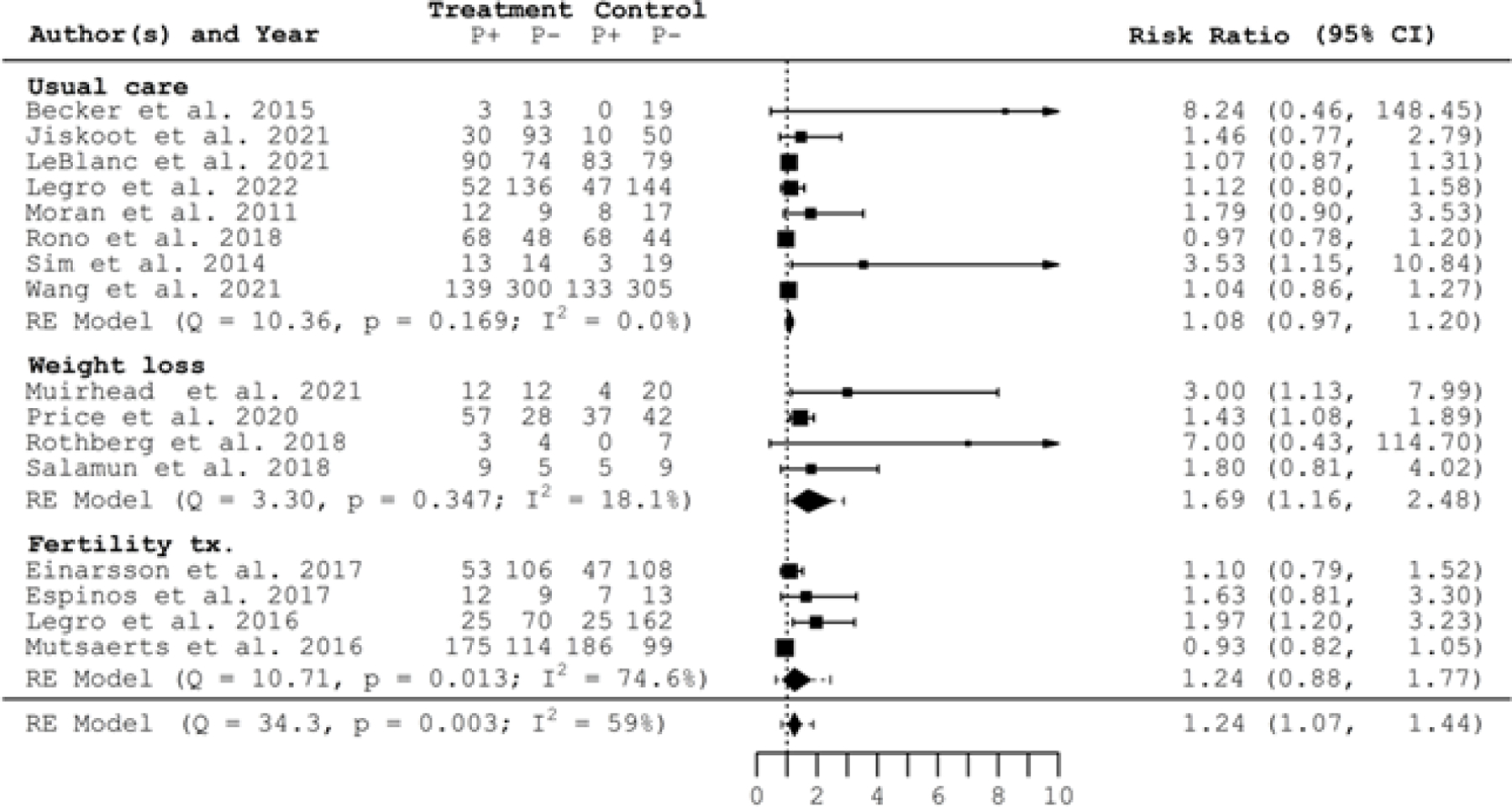


A. Impact of treatment on pregnancy by study
B. Impact of treatment on pregnancy by intervention type
C. Impact of treatment on pregnancy by control type
D. Impact of treatment on pregnancy by fertility treatment
E. Impact of treatment on pregnancy by intervention length
F. Impact of treatment on pregnancy by baseline BMI
3.6.2. Live birth
Overall, live births were higher, but not statistically significantly so, in the intervention group 566/1627 (34.8%) compared to control 545/1702 (32.0%) (n = 13, RR = 1.19, 95% CI [0.97, 1.45], I2 =69%, Figure 3A). There were no differences in live birth rates by intervention type in lifestyle only (n = 10, RR = 1.14, 95% CI [0.93, 1.42]) or those including medications (n = 3, RR = 1.27, 95% CI [0.71, 2.27], Figure 3B). Nor were there differences by control group type in usual care (n = 7, RR = 1.05, 95% CI [0.93, 1.18]), active weight loss control (n = 2, RR = 1.69, 95% CI [0.71, 4.07]) or those receiving immediate fertility treatment (n = 4, RR = 1.29, 95% CI [0.77, 2.18], Figure 3C). Women randomized to weight loss interventions ≤ 12 weeks had a nonsignificant trend toward more live births 228/768 (29.7%) compared to the control group 192/758 (25.3%) (n = 7, RR = 1.28, 95% CI [0.99, 1.66], Figure 3D). Subgroup analyses by baseline BMI or fertility treatment had no impact on live birth.
Figure 3. Forest plot showing risk ratios for live birth.


A. Impact of treatment on live birth by study
B. Impact of treatment on live birth by intervention type
C. Impact of treatment on live birth by fertility treatment
D. Impact of treatment on live birth by intervention length
3.6.3. Miscarriage
Pooling results from the 11 studies reporting miscarriage rates, there was no difference between the intervention 110/687 (16.0%) compared to the control group 79/636 (12.4%) (n = 11, RR = 1.17, 95% CI [0.79, 1.74], I2=31%, Figure 4A). There was no impact of intervention characteristics (intervention type, control group type or intervention length) or baseline BMI on miscarriage rates per participant. However, in studies providing fertility treatment, a higher miscarriage rate was observed in intervention groups 92/472 (19.5%) relative to control 61/488 (12.5%) (n=8, RR 1.45 95% CI [1.07, 1.96], Figure 4B).
Figure 4. Forest plot showing risk ratios for miscarriage.


A. Impact of treatment on miscarriage by study
B. Impact of treatment on miscarriage by fertility treatment
4. Discussion
This meta-analysis focuses on randomized studies for preconception weight reduction in women with overweight or obesity planning pregnancy. Weight loss interventions included those using lifestyle modification only and the addition or sole use of AOMs compared to different types of control conditions. Overall, results suggest a beneficial effect in women randomized to lifestyle interventions without AOMs on clinical pregnancy rates. There was no impact of weight loss interventions on overall live birth or miscarriage compared to control. However, women randomized to weight loss interventions and undergoing fertility treatment had significantly higher rates of miscarriage.
Lifestyle interventions only (n=12) were associated with higher pregnancy rates but not the use of AOMs either solo or in conjunction with lifestyle interventions (n=4). This review is notable for the addition of weight loss interventions including AOMs. Little is known about the use of AOMs to achieve a healthy weight prior to pregnancy thus this is a timely addition to the literature. New trials will need to examine the impact of more effective AOMs, as well as the benefits and risks of using these newer AOMs for preconception weight loss. Clinicians should provide appropriate contraceptive counseling to reproductive-aged women taking AOMs to decrease potential maternal and fetal risk (16).
Strengths of this review include subgroup analyses conducted by study and population characteristics. Enrollment into preconception weight loss interventions is complicated due to the competing demands of advancing maternal age and delaying infertility treatment, in addition to barriers noted in the general population such as availability of evidence-based programs, time, cost, motivation, perceived effectiveness and social support. Thus, the finding that weight loss interventions ≤ 12 weeks (n=7) resulted in higher pregnancy rates is something to explore in future trials. Although the result was not quite significant, there was a trend toward more live births for women in weight loss interventions ≤ 12 weeks (n=7) compared to the control. This amount of time may be more palatable for women of reproductive age wishing to conceive and is in line with the view by Hoek and colleagues (47) noting that different phases (preconception, active fertility treatment, pregnancy) require strategic approaches for weight management.
Furthermore, study populations where the baseline BMI of women was ≥ 35 kg/m2 were associated with higher pregnancy rates in the intervention compared to the control. Although there is no available data on a weight loss threshold for improvement in fertility outcomes in women, our findings add to the literature the importance of identifying population characteristics in which weight loss may be most beneficial. In future individual participant data meta analyses (IPDMA), exploring the treatment response by baseline BMI will provide crucial information for clinical practice (48).
There are several limitations of the current synthesis. First, we did not limit our population of interest to women undergoing infertility treatment or those not undergoing fertility treatment. Identifying a representative population of women seeking pregnancy is an inherent difficulty that must be overcome in future studies as rates of overweight and obesity among reproductive aged women continues to increase. Although the percent of variability due to heterogeneity in this meta-analysis was lower than that observed in two recent meta-analyses (9, 10) (59% vs. 65% and 92%), the narrative synthesis details the wide variety of study characteristics including the target study population, weight loss duration, and weight loss intervention details. Given the heterogeneity among studies we calculated a 95% prediction interval, which can be interpreted as an interval that would contain approximately 95% RRs calculated in similar future studies. This indicates that while the average estimated effect was for a higher RR in weight loss intervention compared to controls for pregnancy, there may be situations where this does not hold.
Additional unexplored variables may influence the extent to which weight loss improves conception, live birth, and miscarriage. We were unable to conduct subgroup analyses by PCOS or other causes of infertility, which may affect the extent to which weight loss interventions improve conception rates, particularly when participants with male factor infertility are included, as in several studies in this review. Finally, we were unable to parse out unassisted or natural conceptions with subsequent live birth and miscarriage rates to compared to OI, IUI, or IVF pregnancies and subsequent live birth and miscarriage rates as these were not provided in the large-scale trials. This highlights a need to further explore our finding that miscarriage rates were higher in women undergoing fertility treatment.
5. Conclusions
Our results suggest that there is no one-size-fits-all recommendation for preconception weight loss in women with overweight or obesity on fertility outcomes. A more nuanced and personalized approach should be taken when recommending weight loss through lifestyle modification to improve fertility outcomes. At the same time, adverse pregnancy and perinatal outcomes associated with obesity pose serious risks for women and their offspring. Preconception weight loss should be supervised by clinicians with specific expertise in obesity treatment, especially with the increased availability of AOMs. Weight loss may need to precede attempting conception for a longer interval than that used in existing studies, which may not be feasible in women with lower ovarian reserve or advancing maternal age. Clinicians in primary care and obstetrics and gynecology should provide patients the opportunity to thoroughly discuss preconception health to weigh the potential costs and benefits of attempting weight loss through lifestyle modifications or AOMs prior to attempting pregnancy (49). Improving the preconception health of reproductive-aged women with overweight or obesity will entail conducting adequately powered, interdisciplinary, well-designed RCTs to generate more robust evidence.
Supplementary Material
Attestation Statement:
Data regarding any of the subjects in the study has not been previously published unless specified.
Data will be made available to the editors of the journal for review or query upon request.
Funding Statement:
Dr. Caldwell is supported by the National Heart, Lung, and Blood Institute (K01HL143039). Dr. Gorczyca is supported by the National Institute of General Medical Sciences (P20GM144269). The funding sources had no role in the design and conduct of the study; collection, management, analysis, and interpretation of the data; preparation, review, or approval of the manuscript; and decision to submit the manuscript for publication.
Footnotes
Publisher's Disclaimer: This is a PDF file of an unedited manuscript that has been accepted for publication. As a service to our customers we are providing this early version of the manuscript. The manuscript will undergo copyediting, typesetting, and review of the resulting proof before it is published in its final form. Please note that during the production process errors may be discovered which could affect the content, and all legal disclaimers that apply to the journal pertain.
Article type: Systematic review (with meta-analysis)
Conflict of Interest Statement: The authors have no conflicts of interest to disclose.
Data sharing statement:
Raw data, data dictionary, and statistical/analytic code will be made available upon publication in a git-hub repository.
References
- 1.Flegal KM, Kruszon-Moran D, Carroll MD, Fryar CD, Ogden CL. Trends in obesity among adults in the United States, 2005 to 2014. Jama 2016;315:2284–91. [DOI] [PMC free article] [PubMed] [Google Scholar]
- 2.Mission JF, Marshall NE, Caughey AB. Pregnancy risks associated with obesity. Obstetrics and Gynecology Clinics 2015;42:335–53. [DOI] [PubMed] [Google Scholar]
- 3.Talmor A, Dunphy B. Female obesity and infertility. Best practice & research Clinical obstetrics & gynaecology 2015;29:498–506. [DOI] [PubMed] [Google Scholar]
- 4.Chandrasekaran S, Neal-Perry G. Long-term consequences of obesity on female fertility and the health of the offspring. Current opinion in obstetrics & gynecology 2017;29:180. [DOI] [PMC free article] [PubMed] [Google Scholar]
- 5.McAuliffe FM, Killeen SL, Jacob CM, Hanson MA, Hadar E, McIntyre HD et al. Management of prepregnancy, pregnancy, and postpartum obesity from the FIGO Pregnancy and Non-Communicable Diseases Committee: A FIGO (International Federation of Gynecology and Obstetrics) guideline. International Journal of Gynaecology and Obstetrics 2020;151:16. [DOI] [PMC free article] [PubMed] [Google Scholar]
- 6.Williams R, Wood L, Collins C, Callister R. Effectiveness of weight loss interventions–is there a difference between men and women: a systematic review. obesity reviews 2015;16:171–86. [DOI] [PMC free article] [PubMed] [Google Scholar]
- 7.MacLean PS, Wing RR, Davidson T, Epstein L, Goodpaster B, Hall KD et al. NIH working group report: innovative research to improve maintenance of weight loss. Obesity 2015;23:7–15. [DOI] [PMC free article] [PubMed] [Google Scholar]
- 8.Magkos F, Fraterrigo G, Yoshino J, Luecking C, Kirbach K, Kelly SC et al. Effects of moderate and subsequent progressive weight loss on metabolic function and adipose tissue biology in humans with obesity. Cell metabolism 2016;23:591–601. [DOI] [PMC free article] [PubMed] [Google Scholar]
- 9.Espinós JJ, Solà I, Valli C, Polo A, Ziolkowska L, Martínez-Zapata MJ. The effect of lifestyle intervention on pregnancy and birth outcomes on obese infertile women: a systematic review and meta-analysis. International Journal of Fertility & Sterility 2020;14:1. [DOI] [PMC free article] [PubMed] [Google Scholar]
- 10.Hunter E, Avenell A, Maheshwari A, Stadler G, Best D. The effectiveness of weight-loss lifestyle interventions for improving fertility in women and men with overweight or obesity and infertility: A systematic review update of evidence from randomized controlled trials. Obes Rev 2021;22:e13325. [DOI] [PubMed] [Google Scholar]
- 11.Pi-Sunyer X, Astrup A, Fujioka K, Greenway F, Halpern A, Krempf M et al. A randomized, controlled trial of 3.0 mg of liraglutide in weight management. New England Journal of Medicine 2015;373:11–22. [DOI] [PubMed] [Google Scholar]
- 12.Sjostrom L, Andersen T. Randomised placebo-controlled trial of orlistat for weight loss and prevention of weight regain in obese patients. The Lancet 1998;352:167–72. [DOI] [PubMed] [Google Scholar]
- 13.Garvey WT, Ryan DH, Look M, Gadde KM, Allison DB, Peterson CA et al. Two-year sustained weight loss and metabolic benefits with controlled-release phentermine/topiramate in obese and overweight adults (SEQUEL): a randomized, placebo-controlled, phase 3 extension study. The American journal of clinical nutrition 2012;95:297–308. [DOI] [PMC free article] [PubMed] [Google Scholar]
- 14.Heymsfield SB, Wadden TA. Mechanisms, pathophysiology, and management of obesity. New England Journal of Medicine 2017;376:254–66. [DOI] [PubMed] [Google Scholar]
- 15.Greenway FL, Fujioka K, Plodkowski RA, Mudaliar S, Guttadauria M, Erickson J et al. Effect of naltrexone plus bupropion on weight loss in overweight and obese adults (COR-I): a multicentre, randomised, double-blind, placebo-controlled, phase 3 trial. The Lancet 2010;376:595–605. [DOI] [PubMed] [Google Scholar]
- 16.Nuako A, Tu L, Reyes KJC, Chhabria SM, Stanford FC. Pharmacologic Treatment of Obesity in Reproductive Aged Women. Curr Obstet Gynecol Rep 2023;12:138–46. [DOI] [PMC free article] [PubMed] [Google Scholar]
- 17.LeBlanc ES, Smith NX, Vesco KK, Paul IM, Stevens VJ. Weight loss prior to pregnancy and subsequent gestational weight gain: Prepare, a randomized clinical trial. American journal of obstetrics and gynecology 2021;224:99. e1-. e14. [DOI] [PMC free article] [PubMed] [Google Scholar]
- 18.Price SA, Sumithran P, Prendergast LA, Nankervis AJ, Permezel M, Proietto J. Time to pregnancy after a prepregnancy very-low-energy diet program in women with obesity: substudy of a randomized controlled trial. Fertility and sterility 2020;114:1256–62. [DOI] [PubMed] [Google Scholar]
- 19.Rönö K, Stach-Lempinen B, Eriksson JG, Pöyhönen-Alho M, Klemetti MM, Roine RP et al. Prevention of gestational diabetes with a prepregnancy lifestyle intervention–findings from a randomized controlled trial. International Journal of Women’s Health 2018:493–501. [DOI] [PMC free article] [PubMed] [Google Scholar]
- 20.Legro RS, Hansen KR, Diamond MP, Steiner AZ, Coutifaris C, Cedars MI et al. Effects of preconception lifestyle intervention in infertile women with obesity: The FIT-PLESE randomized controlled trial. PLoS Medicine 2022;19:e1003883. [DOI] [PMC free article] [PubMed] [Google Scholar]
- 21.Wang Z, Zhao J, Ma X, Sun Y, Hao G, Yang A et al. Effect of orlistat on live birth rate in overweight or obese women undergoing IVF-ET: a randomized clinical trial. The Journal of Clinical Endocrinology & Metabolism 2021;106:e3533–e45. [DOI] [PubMed] [Google Scholar]
- 22.Sim K, Partridge SR, Sainsbury A. Does weight loss in overweight or obese women improve fertility treatment outcomes? A systematic review. Obesity reviews 2014;15:839–50. [DOI] [PubMed] [Google Scholar]
- 23.Song J-Y, Xiang S, Sun Z-G. Effect of weight loss on In Vitro fertilization treatment outcome. Reproductive and Developmental Medicine 2017;1:210–5. [Google Scholar]
- 24.Price SA, Sumithran P, Nankervis A, Permezel M, Proietto J. Preconception management of women with obesity: a systematic review. Obesity Reviews 2019;20:510–26. [DOI] [PubMed] [Google Scholar]
- 25.Best D, Avenell A, Bhattacharya S. How effective are weight-loss interventions for improving fertility in women and men who are overweight or obese? A systematic review and meta-analysis of the evidence. Human reproduction update 2017;23:681–705. [DOI] [PubMed] [Google Scholar]
- 26.Jiskoot G, Timman R, Beerthuizen A, Dietz de Loos A, Busschbach J, Laven J. Weight reduction through a cognitive behavioral therapy lifestyle intervention in PCOS: the primary outcome of a randomized controlled trial. Obesity 2020;28:2134–41. [DOI] [PMC free article] [PubMed] [Google Scholar]
- 27.Moran LJ, Hutchison SK, Norman RJ, Teede HJ. Lifestyle changes in women with polycystic ovary syndrome. Cochrane Database of Systematic Reviews 2011. [Google Scholar]
- 28.Elobeid MA, Padilla MA, McVie T, Thomas O, Brock DW, Musser B et al. Missing data in randomized clinical trials for weight loss: scope of the problem, state of the field, and performance of statistical methods. PloS one 2009;4:e6624. [DOI] [PMC free article] [PubMed] [Google Scholar]
- 29.Parums DV. Review articles, systematic reviews, meta-analysis, and the updated preferred reporting items for systematic reviews and meta-analyses (PRISMA) 2020 guidelines. Medical science monitor: international medical journal of experimental and clinical research 2021;27:e934475–1. [DOI] [PMC free article] [PubMed] [Google Scholar]
- 30.Higgins JP, Altman DG, Gøtzsche PC, Jüni P, Moher D, Oxman AD et al. The Cochrane Collaboration’s tool for assessing risk of bias in randomised trials. Bmj 2011;343. [DOI] [PMC free article] [PubMed] [Google Scholar]
- 31.Bakbergenuly I, Hoaglin DC, Kulinskaya E. Pitfalls of using the risk ratio in meta-analysis. Res Synth Methods 2019;10:398–419. [DOI] [PMC free article] [PubMed] [Google Scholar]
- 32.IntHout J, Ioannidis JP, Rovers MM, Goeman JJ. Plea for routinely presenting prediction intervals in meta-analysis. BMJ open 2016;6. [DOI] [PMC free article] [PubMed] [Google Scholar]
- 33.Rothberg A, Lanham M, Randolph J, Fowler C, Miller N, Smith Y. Feasibility of a brief, intensive weight loss intervention to improve reproductive outcomes in obese, subfertile women: a pilot study. Fertility and sterility 2016;106:1212–20. [DOI] [PMC free article] [PubMed] [Google Scholar]
- 34.Legro RS, Dodson WC, Kunselman AR, Stetter CM, Kris-Etherton PM, Williams NI et al. Benefit of delayed fertility therapy with preconception weight loss over immediate therapy in obese women with PCOS. The Journal of Clinical Endocrinology & Metabolism 2016;101:2658–66. [DOI] [PMC free article] [PubMed] [Google Scholar]
- 35.Moran L, Tsagareli V, Norman R, Noakes M. Diet and IVF pilot study: short-term weight loss improves pregnancy rates in overweight/obese women undertaking IVF. Australian and New Zealand Journal of Obstetrics and Gynaecology 2011;51:455–9. [DOI] [PubMed] [Google Scholar]
- 36.Muirhead R, Kizirian N, Lal R, Black K, Prys-Davies A, Nassar N et al. A pilot randomized controlled trial of a partial meal replacement Preconception weight loss program for women with overweight and obesity. Nutrients 2021;13:3200. [DOI] [PMC free article] [PubMed] [Google Scholar]
- 37.Sim K, Dezarnaulds G, Denyer G, Skilton M, Caterson I. Weight loss improves reproductive outcomes in obese women undergoing fertility treatment: a randomized controlled trial. Clinical obesity 2014;4:61–8. [DOI] [PubMed] [Google Scholar]
- 38.Mutsaerts MA, Van Oers AM, Groen H, Burggraaff JM, Kuchenbecker WK, Perquin DA et al. Randomized trial of a lifestyle program in obese infertile women. New England Journal of Medicine 2016;374:1942–53. [DOI] [PubMed] [Google Scholar]
- 39.Becker GF, Passos EP, Moulin CC. Short-term effects of a hypocaloric diet with low glycemic index and low glycemic load on body adiposity, metabolic variables, ghrelin, leptin, and pregnancy rate in overweight and obese infertile women: a randomized controlled trial. The American journal of clinical nutrition 2015;102:1365–72. [DOI] [PubMed] [Google Scholar]
- 40.Espinós JJ, Polo A, Sánchez-Hernández J, Bordas R, Pares P, Martínez O et al. Weight decrease improves live birth rates in obese women undergoing IVF: a pilot study. Reproductive biomedicine online 2017;35:417–24. [DOI] [PubMed] [Google Scholar]
- 41.Salamun V, Jensterle M, Janez A, Bokal EV. Liraglutide increases IVF pregnancy rates in obese PCOS women with poor response to first-line reproductive treatments: a pilot randomized study. European journal of endocrinology 2018;179:1–11. [DOI] [PubMed] [Google Scholar]
- 42.Einarsson S, Bergh C, Friberg B, Pinborg A, Klajnbard A, Karlström P-O et al. Weight reduction intervention for obese infertile women prior to IVF: a randomized controlled trial. Human Reproduction 2017;32:1621–30. [DOI] [PubMed] [Google Scholar]
- 43.Legro RS, Dodson WC, Kris-Etherton PM, Kunselman AR, Stetter CM, Williams NI et al. Randomized controlled trial of preconception interventions in infertile women with polycystic ovary syndrome. The Journal of Clinical Endocrinology & Metabolism 2015;100:4048–58. [DOI] [PMC free article] [PubMed] [Google Scholar]
- 44.McGuinness LA, Higgins JPT. Risk-of-bias VISualization (robvis): An R package and Shiny web app for visualizing risk-of-bias assessments. Res Synth Methods 2021;12:55–61. [DOI] [PubMed] [Google Scholar]
- 45.Services UDoHaH. Physical Activity Guidelines for Americans. In. Wasington, DC: US Dept of Health and Human Services, 2018. [Google Scholar]
- 46.Higgins J, Thomas J, Chandler J, Cumpston M, Li T, Page M et al. Cochrane Handbook for systematic reviews of interventions version 6.2, 2021. Cochrane, Canada 2021. [Google Scholar]
- 47.Hoek A, Wang Z, van Oers AM, Groen H, Cantineau AEP. Effects of preconception weight loss after lifestyle intervention on fertility outcomes and pregnancy complications. Fertil Steril 2022;118:456–62. [DOI] [PubMed] [Google Scholar]
- 48.Evans-Hoeker E, Wang Z, Groen H, Cantineau AE, Thurin-Kjellberg A, Bergh C et al. Dietary and/or physical activity interventions in women with overweight or obesity prior to fertility treatment: protocol for a systematic review and individual participant data meta-analysis. BMJ open 2022;12:e065206. [DOI] [PMC free article] [PubMed] [Google Scholar]
- 49.Harper T, Kuohung W, Sayres L, Willis MD, Wise LA. Optimizing preconception care and interventions for improved population health. Fertility and Sterility 2023;120:438–48. [DOI] [PubMed] [Google Scholar]
Associated Data
This section collects any data citations, data availability statements, or supplementary materials included in this article.
Supplementary Materials
Data Availability Statement
Raw data, data dictionary, and statistical/analytic code will be made available upon publication in a git-hub repository.