



Abstract
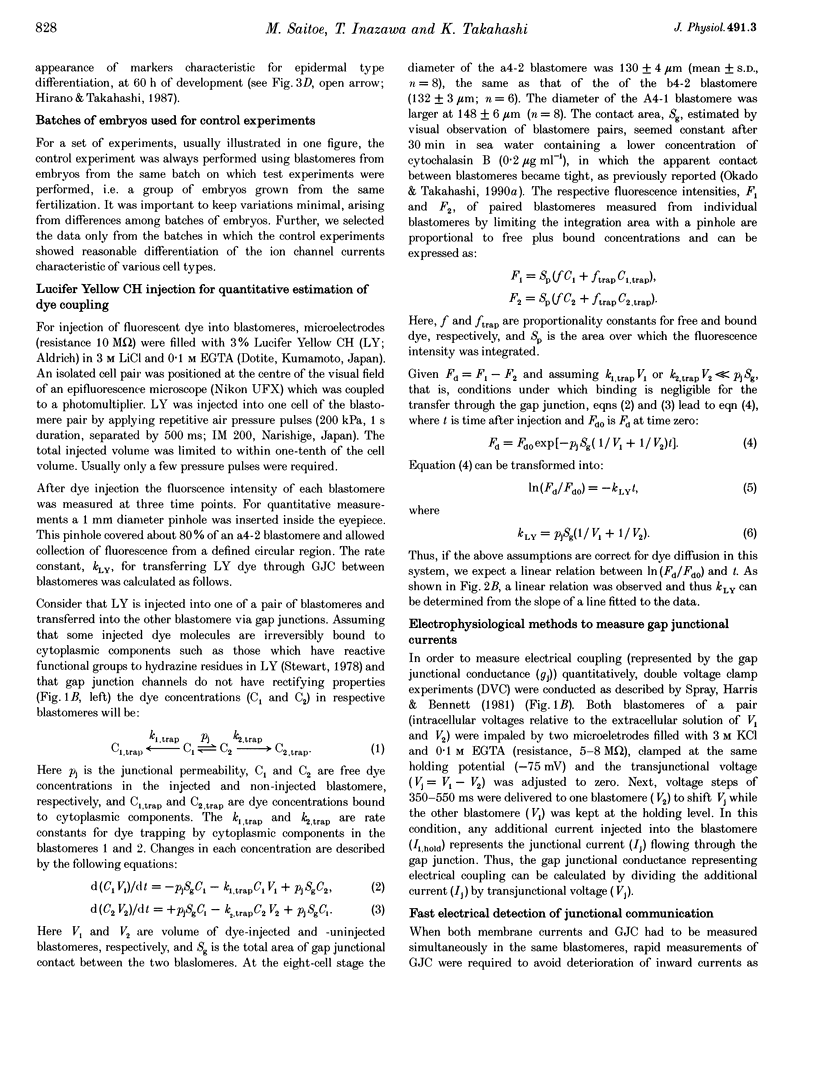
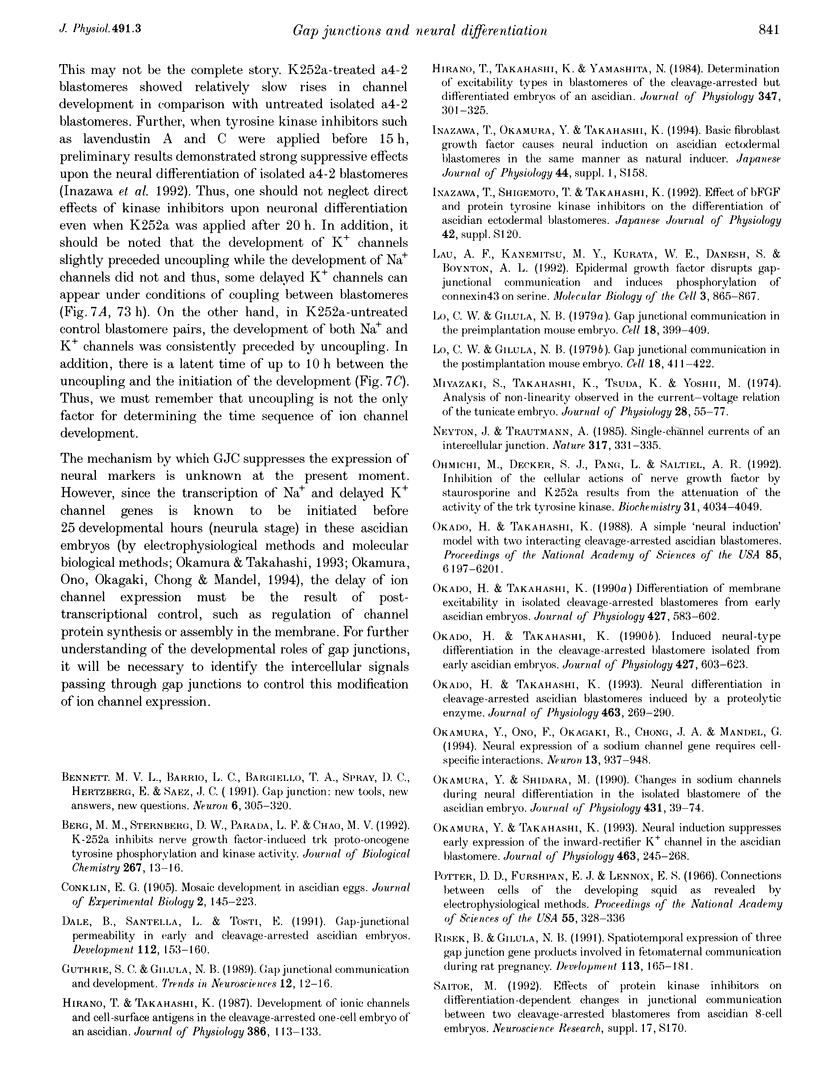
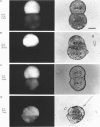
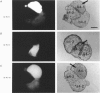
1. When anterior-animal (a4-2) blastomeres isolated from 8-cell ascidian embryos were cultured under cleavage-arrested conditions in contact with anterior-vegetal (A4-1) blastomeres (a-A blastomere pairs), the a4-2 blastomeres differentiated into neuronal cells that expressed Na+ and delayed K+ channels at a time when normal sister embryos became tadpole larvae (after 40 developmental hours at 9 degrees C). When a4-2 blastomeres were cultured in contact with posterior-animal (b4-2) blastomeres (a-b blastomere pairs), the a4-2 blastomeres differentiated into epidermal cells expressing Ca2+ channels and tunic on their exterior surface. In these blastomere pairs, we analysed changes in gap junctional communication during neural and epidermal differentiation by using both dye transfer and double voltage clamp. 2. In both types of blastomere pairs, gap junctional communication was detectable at 5 h by double voltage clamp and at 7 h by dye transfer. Gap junctional communication in both types gradually increased until 25 h (equivalent to the neurula stage). However, during 25-35 h (late neurula or tailbud) in the a-A pair it decreased and finally disappeared, while it increased steeply in the a-A pair. When blastomere pairs were treated with a transcription inhibitor, actinomycin D, gap junctional communication also appeared at around 7 h but remained at a plateau level, showing neither a steep increase in a-b pairs nor a disappearance in a-A pairs. 3. In blastomere triplets in which an epidermally committed a4-2 was in contact with both blastomeres of an a-A pair, the epidermally committed a4-2 blastomere did, but the neurally committed a4-2 blastomere did not, communicate through gap junctions with the A4-1 blastomere, indicating that gap junctional communication is restricted when a4-2 blastomeres are neurally committed. 4. When a kinase inhibitor, K252a (0.5-1.0 microM), was applied at 20 h (prior to the disappearance of gap junctional communication), gap junctional communication was maintained in the a-A pair for more than 40 h. The persistence of gap junctional communication delayed the expression of Na+ and K+ channels in the a4-2 blastomere. However, channel expression followed an almost normal time sequence in single neuronally committed a4-2 blastomeres separated from A-a pairs and treated with K252a. 5. We conclude that the persistence of gap junctions causes a delay in expression of neuronal characteristics, and suggest that one of the functional roles of embryonic gap junctions is to time the expression of neuron-specific ion channels and other markers in preneuronal cells.
Full text
PDF





Images in this article

Selected References
These references are in PubMed. This may not be the complete list of references from this article.
- Bennett M. V., Barrio L. C., Bargiello T. A., Spray D. C., Hertzberg E., Sáez J. C. Gap junctions: new tools, new answers, new questions. Neuron. 1991 Mar;6(3):305–320. doi: 10.1016/0896-6273(91)90241-q. [DOI] [PubMed] [Google Scholar]
- Dale B., Santella L., Tosti E. Gap-junctional permeability in early and cleavage-arrested ascidian embryos. Development. 1991 May;112(1):153–160. doi: 10.1242/dev.112.1.153. [DOI] [PubMed] [Google Scholar]
- Hirano T., Takahashi K. Development of ionic channels and cell-surface antigens in the cleavage-arrested one-cell embryo of an ascidian. J Physiol. 1987 May;386:113–133. doi: 10.1113/jphysiol.1987.sp016525. [DOI] [PMC free article] [PubMed] [Google Scholar]
- Hirano T., Takahashi K., Yamashita N. Determination of excitability types in blastomeres of the cleavage-arrested but differentiated embryos of an ascidian. J Physiol. 1984 Feb;347:301–325. doi: 10.1113/jphysiol.1984.sp015067. [DOI] [PMC free article] [PubMed] [Google Scholar]
- Lau A. F., Kanemitsu M. Y., Kurata W. E., Danesh S., Boynton A. L. Epidermal growth factor disrupts gap-junctional communication and induces phosphorylation of connexin43 on serine. Mol Biol Cell. 1992 Aug;3(8):865–874. doi: 10.1091/mbc.3.8.865. [DOI] [PMC free article] [PubMed] [Google Scholar]
- Lo C. W., Gilula N. B. Gap junctional communication in the post-implantation mouse embryo. Cell. 1979 Oct;18(2):411–422. doi: 10.1016/0092-8674(79)90060-6. [DOI] [PubMed] [Google Scholar]
- Lo C. W., Gilula N. B. Gap junctional communication in the preimplantation mouse embryo. Cell. 1979 Oct;18(2):399–409. doi: 10.1016/0092-8674(79)90059-x. [DOI] [PubMed] [Google Scholar]
- Miyazaki S. I., Takahashi K., Tsuda K., Yoshii M. Analysis of non-linearity observed in the current-voltage relation of the tunicate embryo. J Physiol. 1974 Apr;238(1):55–77. doi: 10.1113/jphysiol.1974.sp010510. [DOI] [PMC free article] [PubMed] [Google Scholar]
- Neyton J., Trautmann A. Single-channel currents of an intercellular junction. 1985 Sep 26-Oct 2Nature. 317(6035):331–335. doi: 10.1038/317331a0. [DOI] [PubMed] [Google Scholar]
- Ohmichi M., Decker S. J., Pang L., Saltiel A. R. Inhibition of the cellular actions of nerve growth factor by staurosporine and K252A results from the attenuation of the activity of the trk tyrosine kinase. Biochemistry. 1992 Apr 28;31(16):4034–4039. doi: 10.1021/bi00131a019. [DOI] [PubMed] [Google Scholar]
- Okado H., Takahashi K. A simple "neural induction" model with two interacting cleavage-arrested ascidian blastomeres. Proc Natl Acad Sci U S A. 1988 Aug;85(16):6197–6201. doi: 10.1073/pnas.85.16.6197. [DOI] [PMC free article] [PubMed] [Google Scholar]
- Okado H., Takahashi K. Differentiation of membrane excitability in isolated cleavage-arrested blastomeres from early ascidian embryos. J Physiol. 1990 Aug;427:583–602. doi: 10.1113/jphysiol.1990.sp018189. [DOI] [PMC free article] [PubMed] [Google Scholar]
- Okado H., Takahashi K. Induced neural-type differentiation in the cleavage-arrested blastomere isolated from early ascidian embryos. J Physiol. 1990 Aug;427:603–623. doi: 10.1113/jphysiol.1990.sp018190. [DOI] [PMC free article] [PubMed] [Google Scholar]
- Okado H., Takahashi K. Neural differentiation in cleavage-arrested ascidian blastomeres induced by a proteolytic enzyme. J Physiol. 1993 Apr;463:269–290. doi: 10.1113/jphysiol.1993.sp019594. [DOI] [PMC free article] [PubMed] [Google Scholar]
- Okamura Y., Ono F., Okagaki R., Chong J. A., Mandel G. Neural expression of a sodium channel gene requires cell-specific interactions. Neuron. 1994 Oct;13(4):937–948. doi: 10.1016/0896-6273(94)90259-3. [DOI] [PubMed] [Google Scholar]
- Okamura Y., Shidara M. Changes in sodium channels during neural differentiation in the isolated blastomere of the ascidian embryo. J Physiol. 1990 Dec;431:39–74. doi: 10.1113/jphysiol.1990.sp018320. [DOI] [PMC free article] [PubMed] [Google Scholar]
- Okamura Y., Takahashi K. Neural induction suppresses early expression of the inward-rectifier K+ channel in the ascidian blastomere. J Physiol. 1993 Apr;463:245–268. doi: 10.1113/jphysiol.1993.sp019593. [DOI] [PMC free article] [PubMed] [Google Scholar]
- Potter D. D., Furshpan E. J., Lennox E. S. Connections between cells of the developing squid as revealed by electrophysiological methods. Proc Natl Acad Sci U S A. 1966 Feb;55(2):328–336. doi: 10.1073/pnas.55.2.328. [DOI] [PMC free article] [PubMed] [Google Scholar]
- Risek B., Gilula N. B. Spatiotemporal expression of three gap junction gene products involved in fetomaternal communication during rat pregnancy. Development. 1991 Sep;113(1):165–181. doi: 10.1242/dev.113.1.165. [DOI] [PubMed] [Google Scholar]
- Schroeder T. E. Cytochalasin B, cytokinesis, and the contractile ring. Front Biol. 1978;46:91–112. [PubMed] [Google Scholar]
- Spray D. C., Harris A. L., Bennett M. V. Equilibrium properties of a voltage-dependent junctional conductance. J Gen Physiol. 1981 Jan;77(1):77–93. doi: 10.1085/jgp.77.1.77. [DOI] [PMC free article] [PubMed] [Google Scholar]
- Stewart W. W. Functional connections between cells as revealed by dye-coupling with a highly fluorescent naphthalimide tracer. Cell. 1978 Jul;14(3):741–759. doi: 10.1016/0092-8674(78)90256-8. [DOI] [PubMed] [Google Scholar]
- Tapley P., Lamballe F., Barbacid M. K252a is a selective inhibitor of the tyrosine protein kinase activity of the trk family of oncogenes and neurotrophin receptors. Oncogene. 1992 Feb;7(2):371–381. [PubMed] [Google Scholar]
- Wade M. H., Trosko J. E., Schindler M. A fluorescence photobleaching assay of gap junction-mediated communication between human cells. Science. 1986 Apr 25;232(4749):525–528. doi: 10.1126/science.3961495. [DOI] [PubMed] [Google Scholar]
- Warner A. The gap junction. J Cell Sci. 1988 Jan;89(Pt 1):1–7. doi: 10.1242/jcs.89.1.1. [DOI] [PubMed] [Google Scholar]
- Whittaker J. R. Segregation during ascidian embryogenesis of egg cytoplasmic information for tissue-specific enzyme development. Proc Natl Acad Sci U S A. 1973 Jul;70(7):2096–2100. doi: 10.1073/pnas.70.7.2096. [DOI] [PMC free article] [PubMed] [Google Scholar]
- Yamada K., Iwahashi K., Kase H. K252a, a new inhibitor of protein kinase C, concomitantly inhibits 40K protein phosphorylation and serotonin secretion in a phorbol ester-stimulated platelets. Biochem Biophys Res Commun. 1987 Apr 14;144(1):35–40. doi: 10.1016/s0006-291x(87)80471-0. [DOI] [PubMed] [Google Scholar]