



Abstract
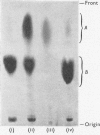
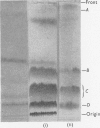
1. [26-14C]- and [4-14C]-Cholesterol were incubated with liver mitochondria from normal and thyroxine-treated rats, and the radioactivity was measured in the carbon dioxide evolved during the incubation, in a butanol extract of the incubation mixture and in a volatile fraction containing substances of low molecular weight derived from the side chain of cholesterol. The butanol extract was separated by paper chromatography into three radioactive fractions, one of which contained the steroids more polar than cholesterol. 2. The butanol extract from incubations with [4-14C]cholesterol contained a radioactive substance moving with the same RF as cholic acid on thin-layer chromatography. 3. After incubation with [26-14C]-cholesterol, 60–80% of the radioactivity extracted by steam-distillation of the incubation mixture at acid pH was recovered as [14C]propionic acid. 4. In the presence of [26-14C]cholesterol, mitochondria from thyroxine-treated rats produced more radioactivity in carbon dioxide and in the volatile fraction, and less radioactivity in the fraction containing the polar steroids, than did mitochondria from normal rats. In the presence of [4-14C]cholesterol, mitochondria from thyroxine-treated rats produced the same amount of radioactivity in the polar steroids as did normal mitochondria. 5. Thyroxine treatment had no effect on the capacity of the mitochondria to oxidize propionate to carbon dioxide. 6. These results are best explained by supposing that thyroxine stimulates a rate-limiting reaction leading to the cleavage of the side chain of cholesterol, but has little or no influence on the hydroxylations of the ring system or on the oxidation of the C3 fragment removed from the side chain.
Full text
PDF



Images in this article
Selected References
These references are in PubMed. This may not be the complete list of references from this article.
- Bergström S., Danielsson H. Factors influencing formation and excretion of bile acids. Biochem Soc Symp. 1963;24:63–73. [PubMed] [Google Scholar]
- CARPENTER K. J., GOTSIS A., HEGSTED D. M. Estimation of total cholesterol in serum by a micro method. Clin Chem. 1957 Aug;3(4 Pt 1):233–238. [PubMed] [Google Scholar]
- CLELAND K. W., SLATER E. C. Respiratory granules of heart muscle. Biochem J. 1953 Mar;53(4):547–556. doi: 10.1042/bj0530547. [DOI] [PMC free article] [PubMed] [Google Scholar]
- DANIELSSON H., HORNING M. G. On the oxidation of cholesterol by mouse liver mitochondria. Bile acids and steroids 88. Biochim Biophys Acta. 1959 Aug;34:596–598. doi: 10.1016/0006-3002(59)90666-3. [DOI] [PubMed] [Google Scholar]
- DANIELSSON H. PRESENT STATUS OF RESEARCH ON CATABOLISM AND EXCRETION OF CHOLESTEROL. Adv Lipid Res. 1963;1:335–385. doi: 10.1016/b978-1-4831-9937-5.50015-6. [DOI] [PubMed] [Google Scholar]
- ERIKSSON S. Biliary excretion of bile acids and cholesterol in bile fistula rats; bile acids and steroids. Proc Soc Exp Biol Med. 1957 Mar;94(3):578–582. doi: 10.3181/00379727-94-23018. [DOI] [PubMed] [Google Scholar]
- FREDRICKSON D. S. The conversion of cholesterol-4-C14 to acids and other products by liver mitochondria. J Biol Chem. 1956 Sep;222(1):109–120. [PubMed] [Google Scholar]
- FRIEDBERG F., ADLER J., LARDY H. A. The carboxylation of propionic acid by liver mitochondria. J Biol Chem. 1956 Apr;219(2):943–950. [PubMed] [Google Scholar]
- HAIS I. M., MYANT N. B. PHOTOLYSIS OF CHOLESTEROL DURING BIOLOGICAL EXPERIMENTS. Biochem J. 1965 Jan;94:85–90. doi: 10.1042/bj0940085. [DOI] [PMC free article] [PubMed] [Google Scholar]
- KODICEK E., ASHBY D. R. Paper chromatography of vitamin D and other sterols. Biochem J. 1954 Mar 20;57(ANNUAL):xii–xiii. [PubMed] [Google Scholar]
- STRAND O. EFFECTS OF D- AND L-TRIIODOTHYRONINE AND OF PROPYLTHIOURACIL ON THE PRODUCTION OF BILE ACIDS IN THE RAT. J Lipid Res. 1963 Jul;4:305–311. [PubMed] [Google Scholar]
- SULD H. M., STAPLE E., GURIN S. Mechanism of formation of bile acids from cholesterol: oxidation of 5bita-choles-tane-3alpha,7alpha,12alpha-triol and formation of propionic acid from the side chain by rat liver mitochondria. J Biol Chem. 1962 Feb;237:338–344. [PubMed] [Google Scholar]
- WAGNER H., HOERHAMMER L., WOLFF P. [Thin layer chromatography of phosphatides and glycolipids]. Biochem Z. 1961;334:175–184. [PubMed] [Google Scholar]
- WEISS S. B., MARX W. The fate of radioactive cholesterol in mice with modified thyroid activities. J Biol Chem. 1955 Mar;213(1):349–353. [PubMed] [Google Scholar]
- WHITEHOUSE M. W., RABINOWITZ J. L., STAPLE E., GURIN S. Formation of acetone and acetoacetate from cholesterol rat and mouse liver mitochondria. Biochim Biophys Acta. 1960 Jan 15;37:382–384. doi: 10.1016/0006-3002(60)90262-6. [DOI] [PubMed] [Google Scholar]
- WHITEHOUSE M. W., STAPLE E., GURIN S. Catabolism in vitro of cholesterol. I. Oxidation of the terminal methyl groups of cholesterol to carbon dioxide by rat liver preparations. J Biol Chem. 1959 Feb;234(2):276–281. [PubMed] [Google Scholar]