



SUMMARY
Introduction:
While therapies based on endogenous gut peptides such as glucagon-like peptide-1 (GLP-1) receptor agonists (GLP-1RAs) have been compelling therapeutic agents for obesity and type 2 diabetes (T2D), only a few have achieved long-term weight loss and all have shown significant side-effects, including nausea/malaise and gastrointestinal ailments.
Objective:
As the pathophysiology of obesity is driven by dysregulation of multiple, inter-related, pathways, we tested a novel peptide targeting multiple receptors of complementary neurocircuits regulating the controls of energy balance.
Methods:
Response to daily injections of GEP44, a GLP-1R and neuropeptide Y1R and Y2R receptor (Y1R/Y2R) triple agonist was tested vs. the GLP-1R agonist liraglutide (LIRA) in diet-induced obese (DIO) male and female rats. Glucose tolerance tests after intraperitoneal injection of glucose (IPGTT) were performed at baseline and after 14-d of treatment in GEP44 treated rats. Other metabolic parameters were assessed in blood at the end of a 28-d intervention.
Results:
Upon conclusion at 28-d, body weight reduction compared to vehicle was −15.6%/-11.9% in response to GEP44, vs. −9.7%/-5.1% after LIRA, males, and females, respectively. Significant reductions of cumulative food intake occurred over 28-d in female rats treated with GEP44 (−30%; p < 0.0001), vs. LIRA (−10%), and in male rats GEP44 (−39%; p < 0.0001), vs. LIRA (−20%; p = 0.003). In IPGTTs, a similar stimulation glucose induced insulin secretion was noted in rats treated with GEP44 and LIRA.
Conclusion:
The strong reductions of body weight in response to long-term applications of the triple agonist GEP44 confirms the therapeutic potential of targeting multiple receptors for achieving more robust and potentially more sustained improvement of energy balance.
Keywords: Obesity, Drug intervention, Monomeric multi-receptor agonist, Calorie intake, Body weight, Glucose tolerance
1. Introduction
Child and adult obesity rates and comorbidities such as T2D are rising globally [1], with T2D prevalence in 2021 at 10.5% (536.6 million people), projected to rise to 12.2% (783.2 million) by 2045 [2,3]. To reduce the burden and risk of obesity-associated diseases, there is a dire unmet clinical need for new anti-obesity agents with increased efficacy, safety and patient tolerance [4]. Clinical pharmacotherapeutic studies have demonstrated loss of efficacy of current treatments over time [5–7], have significant safety concerns [8–10], and/or show frequent adverse events, including all glucagon-like peptide-1 (GLP-1) receptor agonists (GLP-1RAs) [11,12], as these drugs have been associated with gastrointestinal malaise, such as nausea, emesis, and other gastrointestinal issues [13]. Recent treatments based on combinations of effects of endogenous gut peptides such as GLP-1, glucagon and/or glucose-dependent insulinotropic polypeptide (GIP), using dual or triple agonists/antagonists of such, have achieved partial long-term weight loss [14–16], but all continue to show significant side-effects and/or safety concerns, which can potentially lead to poor patient compliance and/or discontinuation of treatment [11,16,17].
In our approach we have focused on novel combinations of GLP-1RAs with neuropeptide Y1 and Y2 receptor (Y1R, Y2R) agonists, such as GEP44, as described herein (Fig. 1). We postulated for more effective and better tolerated obesity interventions that target multiple receptors of complementary neurocircuits regulating energy balance will potentially lead to more sustained reductions of body weight requiring lower doses leading to better tolerability compared to single therapies. In support of this, we recently described a novel monomeric, chimeric peptide (GEP44) based on the GLP-1RA exendin-4 and peptide YY3-36 (PYY3-36), which binds at the GLP-1R and the Y1R and Y2R [18,19], which are expressed in brain areas of energy regulation. GEP44 showed potent anorectic effects in lean and diet-induced obese (DIO) rats and mice with greater weight loss than GLP-1RA exenatide and without visceral malaise [18,19]. The goal of this study was to test GEP44 on food intake patterns, changes in body weight, and metabolic functions, during long-term intervention in DIO male and female rats. We demonstrate that reductions of body weight are more robust in response to GEP44 compared to equimolar treatment with LIRA.
Fig. 1.

Sequences of Ex-4, PYY3-36, and monomeric triple agonist peptide GEP44. Lowercase and underlined letters denote d-amino acids.
2. Materials and methods
2.1. Animals
All procedures performed in rats were approved by the Institutional Animal Care and Use Committee at the Seattle Children’s Research Institute and were in accordance with the NIH Guide for Care and Use of Laboratory Animals. This facility is approved by the Association of the Assessment and Accreditation of Laboratory Animal Care International (AAALAC). For studies utilizing a DIO rat model, male and female Wistar rats were purchased from Charles River Laboratories (Wilmington, MA; strain code 003) at approximately 4 weeks of age; 51–75g). These rats were pair-housed and fed a diet of 60% calories from fat (D12492; Research Diets, Inc; New Brunswick, NJ; 5.24 kcal/g) for a minimum of 5 months for male rats and 10 months for female rats prior to the start of the study to induce excess weight gain [20], modeling the most common form of obesity. All rats had ad libitum access to food and water and were kept on a 12 h light/12 h dark cycle. Animals were housed in a temperature (22 ± 1 °C) and humidity (57 ± 4%) controlled room. All body weight measurements were taken just prior to the start of the dark cycle. Cage maintenance, measurement of body weight, and administration of treatments were performed daily just before start of the dark cycle. Unless otherwise noted, food intake was continuously recorded using a BioDAQ cage system, which measures continuously food intake through a computerized system from multiple cages simultaneously, each with its own feeding sensor.
2.2. Synthesis and purification of peptides
Solid-phase peptide synthesis was performed on ProTide Rink amide resin using a microwave-assisted CEM Liberty Blue peptide synthesizer (Matthews, NC, USA). Fmoc-protected amino acids were coupled to the resin using Oxyma Pure (0.25 M) and N, N′-diisopropyl carbodiimide (0.125 M) as the coupling additive and agent, respectively. Fmoc was removed between couplings with 20% piperidine. Global deprotection and cleavage of the peptides from the solid-support resin were achieved using a CEM Razor instrument via a 40-min incubation at 40 °C in a mixture of 95% trifluoroacetic acid, 2.5% triisopropylsilane, and 2.5% water. Peptides were precipitated with cold (4 °C) diethyl ether and purified on an Agilent 1200 series High-Performance Liquid Chromatography (HPLC) instrument (10–75% HPLC-grade acetonitrile for 20 min at a 2 mL/min flow rate over an Agilent Zorbax C18 column (5 μm, 9.4 × 250 mm) tracked at 220, 254, and 280 nm. Peptides were purified to >95%.
2.3. In silico binding interactions of GEP44 at the Y2-R
The binding interactions of PYY3-36 and GEP44 at the Y2R were analyzed in silico with Molecular Operating Environment version 2022.02 (MOE). GEP44 was built using ‘protein builder’ tool according to reported sequence and secondary/tertiary structure [19]. The structures of Y2R (PDB:7DDZ) and PYY3-36 (PDB:2DFO) were obtained from the Protein Data Bank https://www.rcsb.org/. Receptors and ligands were corrected and protonated once in the MOE system. The ‘site finder’ tool was used to introduce dummy atoms in the Y2R binding site to which both ligands were directed. All docking experiments were completed using the following methodology: Placement: proxy Δ scored by London dG; Refinement: induced fit, scored by GBV/WSA dG; general docking. Ligand specific residue interactions were analyzed via protein–protein contacts and scored by ΔE.
2.4. Preparation and administration of drugs
GEP44 stock solutions were prepared using sterile 0.9% saline solution and vortexed at 1000 rpm for 4 min. LIRA was purchased from, Selleck Chemicals (Cat. No: NN2211; Houston, TX) dissolved in 100 μl DMSO before being diluted to a working solution in 0.9% normal saline, resulting in a final DMSO concentration of <2%. Working solutions were stored at 4 °C for up to two days and mixed gently before use. Normal saline solution was used as the vehicle control in all studies. Working solutions of GEP44, LIRA, or vehicle control were administered by subcutaneous injection once daily at the start of the dark cycle using a 1 cc 29G insulin syringe. The concentration of each drug solution was adjusted to maintain the dosing volume at 0.5 mL/kg.
2.5. Sub-chronic testing of GEP44 in male and female rats
DIO male (n = 8 per treatment group, 20-week exposure to HFD) and female (n = 7–8 per treatment group, 40-week exposure to HFD) Wistar rats were used to determine sub-chronic treatment effects of GEP44 vs. LIRA (males and females); vehicle-treated pairfed and ad libitum-fed animals as well as vehicle-treated chow-fed lean rats (females only) were included as controls. Animals were singly housed in BioDAQ cages and given a 10-day acclimation period prior to start of the experiment. Animal group assignments were based on food intake and body weight data collected during a 9-d vehicle-treated baseline phase.
For treatment groups using a pair-fed control, animals were matched into pairs based on baseline data. These pairs were then used to create sets of paired groups that were used for pair-feeding; effort was made to ensure that the pair-matched groups were comparable to other treatment groups in the given cohort. Two sets of paired male groups were created for cohort 1, one set of paired female groups were created for cohort 2, and two sets of paired female groups were created for cohort 3. Both the assignment of a paired set to a drug treatment (i.e., GEP44 or LIRA treatment in male or female rats), as well as individual group assignment of drug treatment or pair-feeding within the set were assigned at random by flip of coin.
Drug treatments were administered daily via sc injection for 28-days. Drug were escalated every 4 days until the maintenance dose was reached (GEP44: 25 nmol/kg; LIRA: 50 nmol/kg) as outlined in Fig. 3; equimolar doses to LIRA were tested during the last 8 days of GEP44 treatment. Body weight was recorded daily, and food intake was continuously recorded. Fasting (4 h) blood samples were collected pre- and post-treatment for assessment of metabolic parameters.
Fig. 3.

Changes in body weight and food intake over 28-d treatment with GEP44 vs. LIRA vs. vehicle and vehicle pair-fed to GEP44 or LIRA in DIO male (A–D) and female (E–H) Wistar rats. Rats in different groups were matched based on baseline food intake and body weight gain trajectory. A group of age-matched lean females were included as controls (E, F). Changes of body weight were followed in response to GEP44 and LIRA at doses escalating from 5 to 50 nmol/kg, or pair-feeding to the same amount food consumed by their GEP44 treated animals. In both sexes, reductions of body weight and food intake in response to GEP44 vs. LIRA were greater during the experiment (A, B, E, F), and from baseline to the end of the treatment (C, G). In addition, significant reductions of HOMA-IR were seen in male rats in response to GEP44, LIRA, pair-feeding to GEP44 or LIRA (D), but those differences were not significant in female rats (H). Data for pair-fed animals are mostly not visible due to superimposition of drug-treated animal data (B, E, F).
All cohorts followed the same experimental design with one exception, the female rats from the GEP44, GEP44 pair-fed, LIRA, and vehicle treatment groups underwent additional intraperitoneal (ip) glucose tolerance testing the day prior to start of treatment and on day 14 of drug treatment (Fig. 4).
Fig. 4.

Changes in post-dextrose bolus blood glucose during a 120 min intraperitoneal glucose tolerance test before and after 14-d treatment with GEP44 (A) vs. pair-fed to GEP-44 (B) vs. LIRA (D) vs. vehicle (E) in DIO female Wistar rats. Animals were matched based on baseline food intake and body weight gain trajectory. Significant reductions of blood glucose were noted in response to treatment with GEP44 and LIRA as well as pair feeding to GEP44 (A, B, D, F). During the glucose tolerance test, insulin was assessed at −30, 0, 15, 30, and 60 min in relation to glucose ip bolus. Insulin secretion was significantly stimulated in response to GEP44 and LIRA (C).
Animals were singly housed in BioDAQ cages and given a 10-day acclimation period prior to testing. Drug treatments were administered once daily via sc injection for 16-days. Drug doses were escalated every 4 days starting with an initial dose of 5 nmol/kg, then 10 nmol/kg, until the maintenance dose of 25 nmol/kg was reached.
2.6. Blood parameters and glucose tolerance testing
Fasting (4 h) blood samples were collected pre- and post-treatment (prior to ip glucose tolerance tests (IPGTT) in GEP44 and LIRA treated animals) for assessment of metabolic parameters. For IPGTT, blood samples were collected from via tail tip nick prior to and after ip glucose (1.5 g/kg body weight) administration. Glucose and insulin were measured to assess the islet secretory response during IPGTT. Blood glucose concentrations were determined with a handheld glucometer (Contour Next One, Ascensia Diabetes Care, Parsippany, NJ) from 0 to 120 min of testing.
Commercially available enzyme-linked immunosorbent assay was used for quantitative assessment of insulin (MilliporeSigma, Burlington, MA) at time points of −30, 0, 15, 30, and 60 min of the IPGTT. All metabolic testing were performed under conscious conditions, during the dark cycle following a 6-h fast; all animal handling is performed under red light. Levels of cholesterol (total and HDL), triglycerides, alanine transaminase (ALT), and aspartate transaminase (AST) were determined in serum obtained at sacrifice by standard techniques on a Modular P chemistry analyzer (Roche Diagnostics, Germany) at the Nutrition Obesity Research Center (NORC) core facility of the University of Washington, Seattle, WA. Samples from each rat were analyzed for fasting glucose and insulin before start and at the end of intervention to calculate the homeostasis assessment of insulin resistance (HOMA IR) using the formula glucose (mmol/L) x fasting insulin (μU/ml) divided by 22.5.
2.7. Statistical analyses
Statistical analyses were performed using GraphPad Prism Software (la Jolla, CA USA) and STATA (StataCorp LP, College Station, TX). Methods robust to missing data such as generalized linear mixed models were used as appropriate. Multiple imputation was applied to improve estimation accuracy. A repeated measures linear mixed model was constructed for all longitudinal measures as in our recent study [21]. Post-tests for planned comparisons included pairwise comparisons of predictive margins and adjusted predictions, as well as contrast of marginal linear predictions as appropriate. One-way ANOVA was used for cross-sectional comparisons of measures taken at only one time point. Post hoc comparisons were made using Dunnett’s Multiple Comparison Test with the vehicle group as a control. Skewed data were log-transformed prior to analysis, or a nonparametric test was used, i.e., Kruskal–Wallis. In all instances, a P < 0.05 was considered significant. All values are represented as mean ± SEM.
3. Results
3.1. In vitro and in silico studies on GEP44
The design of GEP44 as well as its competitive binding and internalization at GLP-1R, Y1R and Y2R have been described in detail in our previous papers [18,19]. Through in silico docking of GEP44 and PYY3-36., differences in interaction at the Y2R were predicted at the residue level. These docking simulations suggest that the C-terminal end of GEP44 interacts with different residues at the binding site of the Y2R compared to the bona fide ligand PYY3-36. The differences outlined in Fig. 2 are consistent with, and possibly explain the reasons for, the idea that the unique phenotype of GEP44 is due in part to biased agonism at Y2R [18,19], in this case lack of internalization as we have shown previously [19].
Fig. 2.
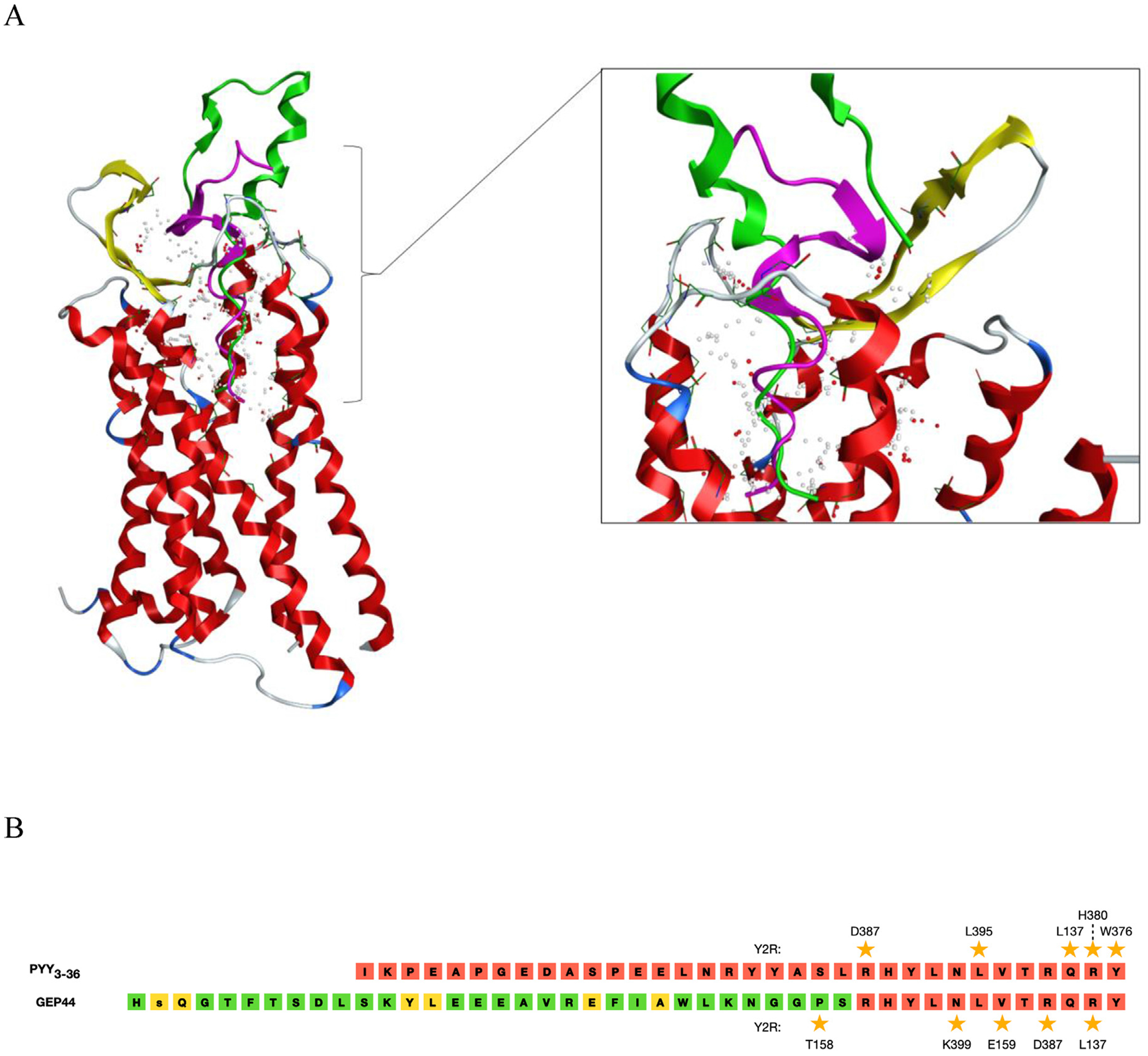
A: In silico modeling using Molecular Operating Environment (MOE) analysis of the C-terminal portion of GEP44 (pink) and PYY3-36 (green) at the Y2R. Scores for GEP44 and PYY3-36 were −21.02 and −19.82, respectively. FIG. 2B: Diagram summarizing the important interactions between GEP44 and PYY3-36 with Y2R as predicted with MOE.
3.2. Sub-chronic testing of GEP44
GEP44 produced greater reduction in food intake and body weight compared to equimolar, or greater, dosing with LIRA. DIO male and female rats were sub chronically treated with GEP44 or LIRA at gradually escalating doses (5–50 nmol/kg/day) and vehicle-treated animals were included as controls. Throughout the acclimation phase when equimolar doses of GEP44 and LIRA were used, as well as the maintenance phase when LIRA was administered at a dose twice that of GEP44, GEP44 treatment yielded greater reductions in body weight and food intake relative to LIRA. At the end of the 28-d experiment, GEP44 treatment induced body weight change relative to vehicle was −15.6% in males and −11.9% in females vs. −9.7% in male and −5.1% in female LIRA treated rats. The reduction in 28-day cumulative food intake relative to ad libitum fed vehicle treated animals was greater with GEP44 (males: −38.9%; females: −30%) vs. LIRA (males: −19.6%; females: −11%) treatment. In addition, significant reductions of HOMA-IR were seen in male rats in response to GEP44, LIRA, pairfeeding to GEP44 or LIRA, but not in female rats (Fig. 3, Tables 1 and 2).
Table 1.
Pre- and post-treatment body measures, calorie intake, and post treatment serum levels in male DIO rats.
| Vehicle | GEP44 | GEP44 pair-fed | Liraglutide | Liraglutide pair-fed | |||||
|---|---|---|---|---|---|---|---|---|---|
| Body Weight (g) | |||||||||
| Baseline | 660 ± 33 | 660 ± 20 | 667 ± 22 | 660 ± 23 | 658 ± 27 | ||||
| Post–Tx | 695 ± 37 | ### | 592 ± 19 | #### | 611 ± 25 | #### | 631 ± 18 | ## | 647 ± 31 |
| Cumulative Food Intake (kcal) | 2633 ± 116 | 1610 ± 65 | *** | 1637 ± 66 | 2116 ± 106 | ** | 2166 ± 116 | ||
|
| |||||||||
| Blood Glucose (mg/dL) | 93 ± 3 | 83 ± 2 | * | 90 ± 2 | 89 ± 1 | 93 ± 3 | |||
| Insulin (μU/mL) | 397 ± 84 | 197 ± 25 | * | 186 ± 30 | 238 ± 27 | 231 ± 32 | |||
| HOMA-IR | 15.2 ± 3.2 | 6.8 ± 1.0 | ** | 7.0 ± 1.2 | 8.7 ± 1.0 | 54 ± 8 | |||
| ALT (U/L) | 64 ± 31 | 34 ± 6 | 25 ± 4 | 32 ± 4 | 31 ± 8 | ||||
| AST (U/L) | 256 ± 67 | 214 ± 60 | 183 ± 33 | 175 ± 44 | 163 ± 38 | ||||
| Cholesterol (mg/dL) | 74 ± 5 | 83 ± 6 | †† | 55 ± 4 | 71 ± 5 | 60 ± 5 | |||
| Triglycerides (mg/dL) | 76 ± 8 | 64 ± 5 | 55 ± 5 | 61 ± 6 | 56 ± 5 | ||||
| HDL (mg/dL) | 23 ± 1 | 26 ± 1 | ††† | 18 ± 1 | 22 ± 1 | 19 ± 1 | |||
| Calculated LDL (mg/dL) | 36 ± 3 | 44 ± 5 | † | 27 ± 4 | 36 ± 4 | 29 ± 4 | |||
HOMA-IR = blood glucose (mg/dL) * plasma insulin (μU/mL)/2430 for rats.
Two-way ANOVA with Šídák’s multiple comparisons test
P < 0.01,
P < 0.001,
P < 0.001 vs. baseline.
One-way ANOVA with Šídák’s multiple comparisons test or Kruskal–Wallis test with Dunn’s multiple comparison test as appropriate.
P < 0.05,
P < 0.01,
P < 0.001 vs. vehicle.
P < 0.05,
P < 0.01,
P < 0.001 vs. pair-fed.
Data are mean ± SEM.
Table 2.
Pre- and post-treatment body measures, calorie intake, and post treatment serum levels in female DIO and lean rats.
| Lean Vehicle | DIO Vehicle | GEP44 | GEP44 pair-fed | Liraglutide | |||||
|---|---|---|---|---|---|---|---|---|---|
| Body Weight (g) | |||||||||
| Baseline | 363 ± 8 | 566 ± 43 | 597 ± 32 | 587 ± 34 | 566 ± 46 | ||||
| Post–Tx | 388 ± 9 | # | 590 ± 41 | # | 551 ± 26 | #### | 538 ± 26 | #### | 561 ± 46 |
| Cumulative Food Intake (kcal) | 1901 ± 65 | 2000 ± 141 | 1408 ± 80 | **** | 1410 ± 46 | 1790 ± 89 | |||
|
| |||||||||
| Blood Glucose (mg/dL) | 104 ± 3 | 102 ± 3 | 100 ± 4 | 100 ± 2 | 104 ± 2 | ||||
| Insulin (μU/mL) | 148 ± 20 | ** | 336 ± 37 | 315 ± 37 | 203 ± 38 | 424 ± 57 | |||
| HOMA-IR | 6.3 ± 0.8 | * | 14.3 ± 1.8 | 13.0 ± 1.5 | 8.7 ± 1.8 | 110 ± 16 | |||
| Leptin (ng/mL) | 9.4 ± 1 | **** | 23.9 ± 1 | 22.0 ± 1.7 | 18.5 ± 1.8 | 24.3 ± 2.0 | |||
| ALT (U/L) | 26 ± 4 | 25 ± 1 | 27 ± 2 | 26 ± 2 | 24 ± 2 | ||||
| AST (U/L) | 135 ± 27 | 125 ± 18 | 116 ± 10 | 147 ± 16 | 132 ± 10 | ||||
| Cholesterol (mg/dL) | 72 ± 8 | 87 ± 4 | 77 ± 7 | 71 ± 4 | 78 ± 4 | ||||
| Triglycerides (mg/dL) | 142 ± 54 | 185 ± 42 | 139 ± 35 | 101 ± 14 | 170 ± 16 | ||||
| HDL (mg/dL) | 25 ± 2 | 25 ± 1 | 25 ± 2 | 23 ± 2 | 25 ± 1 | ||||
| Calculated LDL (mg/dL) | 19 ± 12 | 25 ± 6 | 24 ± 4 | 27 ± 4 | 19 ± 4 | ||||
HOMA-IR = blood glucose (mg/dL) * plasma insulin (μU/mL)/2430 for rats.
Two-way ANOVA with Šídák’s multiple comparisons test
P < 0.05,
P < 0.001 vs. baseline.
One-way ANOVA with Šídák’s multiple comparisons test or Kruskal–Wallis test with Dunn’s multiple comparison test as appropriate.
P < 0.05,
P < 0.05,
P < 0.0001 vs. DIO vehicle.
P < 0.05,
††P < 0.01 vs. pair-fed.
Data are mean ± SEM.
Pair-fed animals were used as a comparator when assessing treatment-induced changes in weight and glucose metabolism. While reductions of mean body weight were consistently less for vehicle-treated pair-fed male rats compared to their GEP44- and LIRA-treated counterparts, the differences did not achieve statistical significance (Fig. 3 A). For females’ pair-fed to GEP44 treated rats, changes in body weight relative to pre-treatment were near identical to the GEP44 treated animals (Fig. 3 E).
3.3. IPGTT & metabolic blood parameters
Male rats receiving GEP44 exhibited lower post-treatment HOMA-IR, fasting insulin and glucose levels compared to those treated with vehicle alone. Interestingly, vehicle-treated male rats that were pair-fed to those receiving GEP44 exhibited comparatively lower fasting serum cholesterol and HDL levels than did their peptide-treated counterparts. No differences in fasting blood glucose, triglycerides, or hepatic transaminase levels were observed (Table 1). No significant changes of metabolic parameters were noted between the different DIO female treatment groups (Table 2).
As part of the sub chronic GEP44 vs. LIRA treatment experiment in female DIO Wistar rats, IPGTTs were performed at baseline and after 14 days of treatment. Both GEP44 and LIRA treatment resulted reductions in 60-min glucose AUC. While caloric restriction in GEP44 pair-fed animals yielded similar improvements in glucose metabolism to GEP44 treated animals, GEP44 and LIRA produced significantly greater insulin secretion in response to the glucose bolus (Fig. 4).
4. Discussion
For the present study, we have developed a novel mono-molecular chimeric peptide and tested the overall hypothesis that combining GLP-1R with Y1R/Y2R pathways would lead to reduction of body weight and glucose levels in the long-term, supporting the previously described discovery of GEP44, a nausea free, potent anorectic peptide, with effects on glucoregulation in vitro and in vivo, by stimulating insulin secretion in rats and pancreatic islets [18,19]. In the current paper, we demonstrate much stronger reductions of caloric intake and body weight in response to daily injections of GEP44 vs. equimolar injections of LIRA. Reductions of food intake and body weight were stronger in male vs. female animals.
New generation obesity drugs have demonstrated improved efficacy not only in adults, but also in adolescents [22,23]. However, there are significant limitations to current obesity drug interventions, such as the high rates of gastrointestinal adverse events (e.g., nausea and vomiting), in response to doses that are required for the improvement of weight status. Such dose-dependent responses are common for all GLP-1R agonists, leading to discontinuation of drug intervention in up to 11.6% for semaglutide, for instance, and a need often to use sub-optimal dosing [24,25]. The higher efficacy of monomeric multiagonists such as GEP44, tested in our study, offers scope to offer treatment in a lower dose range, thus also reducing the high frequency of adverse events, as described for all available GLP-1RAs [22,26,27]. Our data are encouraging, as we demonstrated stronger reductions of calorie intake and body weight in response to GEP44 in comparison with the established GLP-1RA LIRA in both, male and female animals.
4.1. Mechanistic studies of GLP-1R + Y1R/Y2R pathways, and energy homeostasis
All three pathways, the GLP-1R-, and Y1R/Y2R, pathways are crucial for the brain regulation of energy balance. Their receptors are expressed in brain areas of energy regulation [18,19], but also in peripheral tissues that play a role in energy homeostasis and glucoregulation such as adipose tissue, gut, skeletal muscle, and pancreatic [28,29].
Existing GLP-1 mimetics induce insulinotropic effects by binding to GLP-1Rs on pancreatic β-cells [29], while simultaneously promoting satiety by binding to GLP-1Rs in brain regions associated with energy homeostasis [30]. Control of food intake by GLP-1 is regulated by GLP-1 produced and released from intestinal L-cells and preproglucagon neurons of the caudal nucleus tractus solitarius [31,32]. Previous studies have shown that the effects of GLP-1RA LIRA on weight loss are predominantly mediated by its actions in the brain [33,34]. While the GLP-1RA Ex-4 can enter the brain across the blood brain barrier [35], LIRA does not cross the blood brain area through endothelial cells, but by transcytosis through hypothalamic tanycytes and fenestrated vessels of the median eminence of the hypothalamus [35]. The therapeutic potential of GLP-1R targeting for the treatment of obesity and T2D has been extensively validated and several FDA approved treatments are in the clinic [6,36]. We recently demonstrated in rats that peripherally injected GEP44 can be visualized in the hindbrain (area postrema and nucleus tractus solitarius) [19].
PYY1–36 is a gut hormone that binds to the Y1R in pancreatic islets and areas that control appetite regulation in the brain including the brainstem area postrema and nucleus tractus solitarius, where it has an orexigenic effect [37]. GLP-1R is expressed in neuropeptide Y (NPY)-positive neurons in the area postrema and that GLP-1 can directly or indirectly inhibit neuronal signaling in the NPY system via agonism of GLP-1R [19,38]. The truncated peptide PYY3–36 is derived from PYY1–36 via proteolytic processing by DPP-IV and binds preferentially at the Y2-R after crossing the blood brain barrier [39]. It inhibits food intake via Y2-R in key brain areas of energy homeostasis, namely the arcuate nucleus of the hypothalamus, as well as area postrema, and nucleus tractus solitarius [40,41]. We, and others, have shown that circulating PYY3-36 levels are reduced in obese humans [42–44]. Peripheral administration of PYY3-36 reduces caloric intake and increases postprandial insulin levels, enhances insulin sensitivity, thermogenesis, lipolysis and fat oxidation in lean and obese humans and nonhuman primates [45,46]. PYY3-36 treatment also improves glucose control, insulin resistance and lipid metabolism in rodents [46,47]. In our research we demonstrate that the combining Y1R and Y2R agonism with GLP-1R agonism is beneficial leading to more robust reductions of food intake and body weight compared to GLP-1R agonism alone.
4.2. Metabolic effects and correction for the degree of weight loss
It is well-established that weight loss due to energy restriction or obesity drug intervention can lead to improvements in glucose metabolism through effects to improve both insulin sensitivity, and insulin secretion in obese rodents and humans [27,48]. Therefore, we tested weight and metabolic changes also in animals that did not receive drug but were pairfed to active treatment. We found that weight reduction was less in trend for vehicle injected male rats pairfed to GEP44, compared to male rats receiving GEP44. We acknowledge that GEP44 may stimulate energy expenditure, potentially through thermogenesis in white and brown adipose tissue, and that these effects are likely mediated for the most-part by GLP-1R, as Y1/2-R agonists have been reported to have little or no effect in stimulating energy expenditure [49]. We note in this study however, that we did not see these differences in female rats, suggesting no stimulation of energy expenditure in this case. We plan to test responses to GEP44 using metabolic cages for gold standard indirect calorimetry assessments in the future.
In response to GEP44, fasting glucose in males and glucose levels during glucose tolerance testing in females were reduced vs. vehicle treatment. Both peptides, GEP44 and LIRA significantly stimulated insulin responses during IPGTTs, leading to significant reduction of glucose levels, which were more pronounced than seen in GEP44 pairfed animals (Fig. 4 F). Increased insulin secretion in GEP44 treated animals indicates stimulation of pancreatic β-cells, which supports our previously reported results when testing isolated pancreatic islets in vitro [19]. We believe that these glucoregulatory effects during IPGTTs are predominantly related to GLP-1R signaling. In male rats, HOMA-IR improved in response to GEP44 and LIRA and their pairfed animals to a similar degree (Fig. 3 D). Therefore, the observed improvements of insulin resistance are most likely related to the extent of weight reduction; however, such a pattern was not seen in female rats (Fig. 3 H). Furthermore, cholesterol levels were higher in GEP44 vs. vehicle treated male animals pairfed to GEP44, which was related to higher LDL and more significantly higher HDL levels, indicating that these differences were not related to changes of food intake.
4.3. Strengths and weaknesses
In this study, robust reductions of food intake and body weight are demonstrated in response to long term application of GEP44 in male and female DIO rats. However, the changes of fat vs. lean body mass and the effects on energy expenditure are not known. Further experiments examining the changes in body composition and energy expenditure due to treatment are needed and planned. While we have examined the changes in glucose sensitivity due to GEP44 vs. LIRA treatment in male and female rats, we performed glucose tolerance testing only in female rats and therefore still need to assess this in male rats in future experiments.
5. Conclusion
In conclusion, we demonstrated in long-term interventions in DIO rats much stronger reductions of caloric intake and body weight in response to daily injections of GEP44 vs. equimolar injections of LIRA. These results demonstrate that combinations of these complementary anorexigenic pathways are more effective than targeting the GLP-1R pathway alone. Thus, the triple agonist GEP44 is a promising novel molecule for achieving robust and sustained improvement of body weight, energy balance, and metabolic functions.
Acknowledgments
The authors are grateful to research technicians and the animal care team at Seattle Children’s Research Institute for their support in conducting the feeding experiments in rats.
Funding sources
This work was supported by the United States Department of Defense through a Congressionally Directed Medical Research Program Award (W81XWH1010299) and National Institutes of Health award R01DK135125 to R.P.D. and C.L.R. Biochemical analyses were performed at the University of Washington Nutrition and Obesity Research Center (UW NORC), which is supported by grant P30 DK035816 from the National Institute of Diabetes and Digestive and Kidney Diseases.
Abbreviations:
- GLP-1
glucagon-like peptide-1
- GLP-1RA
GLP-1 receptor agonist
- T2D
type 2 diabetes
- Y1R/Y2R
neuropeptide Y1 receptor and Y2 receptor
- LIRA
liraglutide
- DIO
diet-induced obese
- IPGTT
intraperitoneal glucose tolerance test
Footnotes
Conflict of interest
R.P.D. is a Scientific Advisory Board member of Balchem Corporation, New Hampton, NY, which played no role in the design, execution, or analysis of the results of these studies. R.P.D. is a named author of a patent pursuant to the development of GEP44 that is owned by Syracuse University.
References
- [1].Afshin A, Reitsma MB, Murray CJL. Health effects of overweight and obesity in 195 Countries. N Engl J Med 2017;377(15):1496–7. [DOI] [PubMed] [Google Scholar]
- [2].Saeedi P, Petersohn I, Salpea P, Malanda B, Karuranga S, Unwin N, et al. Global and regional diabetes prevalence estimates for 2019 and projections for 2030 and 2045: Results from the International Diabetes Federation Diabetes Atlas, 9(th) edition. Diabetes Res Clin Pract 2019;157:107843. [DOI] [PubMed] [Google Scholar]
- [3].Sun H, Saeedi P, Karuranga S, Pinkepank M, Ogurtsova K, Duncan BB, et al. IDF diabetes Atlas: Global, regional and country-level diabetes prevalence estimates for 2021 and projections for 2045. Diabetes Res Clin Pract 2021:109119. [DOI] [PMC free article] [PubMed] [Google Scholar]
- [4].Bays H, Dujovne C. Anti-obesity drug development. Expet Opin Invest Drugs 2002;11(9):1189–204. [DOI] [PubMed] [Google Scholar]
- [5].Neoh SL, Sumithran P, Haywood CJ, Houlihan CA, Lee FT, Proietto J. Combination phentermine and topiramate for weight maintenance: the first Australian experience. Med J Aust 2014;201(4):224–6. [DOI] [PubMed] [Google Scholar]
- [6].O’Neil PM, Birkenfeld AL, McGowan B, Mosenzon O, Pedersen SD, Wharton S, et al. Efficacy and safety of semaglutide compared with liraglutide and placebo for weight loss in patients with obesity: a randomised, double-blind, placebo and active controlled, dose-ranging, phase 2 trial. Lancet 2018;392(10148):637–49. [DOI] [PubMed] [Google Scholar]
- [7].Ambery P, Parker VE, Stumvoll M, Posch MG, Heise T, Plum-Moerschel L, et al. MEDI0382, a GLP-1 and glucagon receptor dual agonist, in obese or overweight patients with type 2 diabetes: a randomised, controlled, double-blind, ascending dose and phase 2a study. Lancet 2018;391(10140):2607–18. [DOI] [PubMed] [Google Scholar]
- [8].McCandless SE, Yanovski JA, Miller J, Fu C, Bird LM, Salehi P, et al. Effects of MetAP2 inhibition on hyperphagia and body weight in Prader-Willi syndrome: a randomized, double-blind, placebo-controlled trial. Diabetes Obes Metabol 2017;19(12):1751–61. [DOI] [PMC free article] [PubMed] [Google Scholar]
- [9].Apovian CM, Aronne LJ, Bessesen DH, McDonnell ME, Murad MH, Pagotto U, et al. Pharmacological management of obesity: an endocrine Society clinical practice guideline. J Clin Endocrinol Metab 2015;100(2):342–62. [DOI] [PubMed] [Google Scholar]
- [10].Muller TD, Bluher M, Tschop MH, DiMarchi RD. Anti-obesity drug discovery: advances and challenges. Nat Rev Drug Discov 2022;21(3):201–23. [DOI] [PMC free article] [PubMed] [Google Scholar]
- [11].Bettge K, Kahle M, Abd El Aziz MS, Meier JJ, Nauck MA. Occurrence of nausea, vomiting and diarrhoea reported as adverse events in clinical trials studying glucagon-like peptide-1 receptor agonists: a systematic analysis of published clinical trials. Diabetes Obes Metabol 2017;19(3):336–47. [DOI] [PubMed] [Google Scholar]
- [12].Wharton S, Calanna S, Davies M, Dicker D, Goldman B, Lingvay I, et al. Gastrointestinal tolerability of once-weekly semaglutide 2.4 mg in adults with overweight or obesity, and the relationship between gastrointestinal adverse events and weight loss. Diabetes Obes Metabol 2022;24(1):94–105. [DOI] [PMC free article] [PubMed] [Google Scholar]
- [13].Borner T, Tinsley IC, Doyle RP, Hayes MR, De Jonghe BC. Glucagon-like peptide-1 in diabetes care: Can glycaemic control be achieved without nausea and vomiting? Br J Pharmacol 2022;179(4):542–56. [DOI] [PMC free article] [PubMed] [Google Scholar]
- [14].Wilding JPH, Batterham RL, Calanna S, Davies M, Van Gaal LF, Lingvay I, et al. Once-Weekly semaglutide in adults with overweight or obesity. N Engl J Med 2021;384(11):989–1002. [DOI] [PubMed] [Google Scholar]
- [15].Rubino D, Abrahamsson N, Davies M, Hesse D, Greenway FL, Jensen C, et al. Effect of Continued weekly subcutaneous semaglutide vs placebo on weight loss maintenance in adults with overweight or obesity: the STEP 4 randomized clinical trial. JAMA 2021;325(14):1414–25. [DOI] [PMC free article] [PubMed] [Google Scholar]
- [16].Jastreboff AM, Aronne LJ, Ahmad NN, Wharton S, Connery L, Alves B, et al. Tirzepatide once weekly for the treatment of obesity. N Engl J Med 2022;387(3):205–16. [DOI] [PubMed] [Google Scholar]
- [17].Bezin J, Gouverneur A, Penichon M, Mathieu C, Garrel R, Hillaire-Buys D, et al. GLP-1 receptor agonists and the risk of thyroid cancer. Diabetes Care 2023;46(2):384–90. [DOI] [PubMed] [Google Scholar]
- [18].Milliken BT, Elfers C, Chepurny OG, Chichura KS, Sweet IR, Borner T, et al. Design and evaluation of peptide dual-agonists of GLP-1 and NPY2 receptors for glucoregulation and weight loss with mitigated nausea and emesis. J Med Chem 2021;64(2):1127–38. [DOI] [PMC free article] [PubMed] [Google Scholar]
- [19].Chichura KS, Elfers CT, Salameh TS, Kamat V, Chepurny OG, McGivney A, et al. A peptide triple agonist of GLP-1, neuropeptide Y1, and neuropeptide Y2 receptors promotes glycemic control and weight loss. Sci Rep 2023;13(1):9554. [DOI] [PMC free article] [PubMed] [Google Scholar]
- [20].Marques C, Meireles M, Norberto S, Leite J, Freitas J, Pestana D, et al. High-fat diet-induced obesity rat model: a comparison between wistar and spraguedawley rat. Adipocyte 2016;5(1):11–21. [DOI] [PMC free article] [PubMed] [Google Scholar]
- [21].Elfers CT, Roth CL. Robust reductions of excess weight and hyperphagia by beloranib in rat models of genetic and hypothalamic obesity. Endocrinology 2017;158(1):41–55. [DOI] [PubMed] [Google Scholar]
- [22].Weghuber D, Boberg K, Hesse D, Jeppesen OK, Sorrig R, Kelly AS, et al. Semaglutide treatment for obesity in teenagers: a plain language summary of the STEP TEENS research study. J Comp Eff Res 2023;12(2):e220187. [DOI] [PMC free article] [PubMed] [Google Scholar]
- [23].Hsia DS, Gosselin NH, Williams J, Farhat N, Marier JF, Shih W, et al. A randomized, double-blind, placebo-controlled, pharmacokinetic and pharmacodynamic study of a fixed-dose combination of phentermine/topiramate in adolescents with obesity. Diabetes Obes Metabol 2020;22(4):480–91. [DOI] [PubMed] [Google Scholar]
- [24].Hirsch IB. The future of the GLP-1 receptor agonists. JAMA 2019;321(15):1457–8. [DOI] [PubMed] [Google Scholar]
- [25].Smits MM, Van Raalte DH. Safety of semaglutide. Front Endocrinol 2021;12:645563. [DOI] [PMC free article] [PubMed] [Google Scholar]
- [26].Li J, He K, Ge J, Li C, Jing Z. Efficacy and safety of the glucagon-like peptide-1 receptor agonist oral semaglutide in patients with type 2 diabetes mellitus: a systematic review and meta-analysis. Diabetes Res Clin Pract 2021;172:108656. [DOI] [PubMed] [Google Scholar]
- [27].Kuhnen P, Biebermann H, Wiegand S. Pharmacotherapy in childhood obesity. Horm Res Paediatr 2022;95(2):177–92. [DOI] [PubMed] [Google Scholar]
- [28].Nishizawa M, Nakabayashi H, Uehara K, Nakagawa A, Uchida K, Koya D. Intraportal GLP-1 stimulates insulin secretion predominantly through the hepatoportal-pancreatic vagal reflex pathways. Am J Physiol Endocrinol Metab 2013;305(3):E376–87. [DOI] [PubMed] [Google Scholar]
- [29].D’Alessio D. Is GLP-1 a hormone: whether and When? J Diabetes Investig. 2016;7(Suppl 1):50–5. [DOI] [PMC free article] [PubMed] [Google Scholar]
- [30].Hao S, Yang Y, Helmy M, Wang H. Neural regulation of feeding behavior. Adv Exp Med Biol 2020;1284:23–33. [DOI] [PubMed] [Google Scholar]
- [31].Alhadeff AL, Mergler BD, Zimmer DJ, Turner CA, Reiner DJ, Schmidt HD, et al. Endogenous glucagon-like peptide-1 receptor signaling in the nucleus tractus solitarius is required for food intake control. Neuropsychopharmacology 2017;42(7):1471–9. [DOI] [PMC free article] [PubMed] [Google Scholar]
- [32].Reiner DJ, Leon RM, McGrath LE, Koch-Laskowski K, Hahn JD, Kanoski SE, et al. Glucagon-Like peptide-1 receptor signaling in the lateral dorsal tegmental nucleus regulates energy balance. Neuropsychopharmacology 2018;43(3):627–37. [DOI] [PMC free article] [PubMed] [Google Scholar]
- [33].Fortin SM, Lipsky RK, Lhamo R, Chen J, Kim E, Borner T, et al. GABA neurons in the nucleus tractus solitarius express GLP-1 receptors and mediate anorectic effects of liraglutide in rats. Sci Transl Med 2020;12(533). [DOI] [PMC free article] [PubMed] [Google Scholar]
- [34].Adams JM, Pei H, Sandoval DA, Seeley RJ, Chang RB, Liberles SD, et al. Liraglutide modulates appetite and body weight through glucagon-like peptide 1 receptor-expressing glutamatergic neurons. Diabetes 2018;67(8):1538–48. [DOI] [PMC free article] [PubMed] [Google Scholar]
- [35].Imbernon M, Saponaro C, Helms HCC, Duquenne M, Fernandois D, Deligia E, et al. Tanycytes control hypothalamic liraglutide uptake and its anti-obesity actions. Cell Metabol 2022;34(7):1054–10563 e7. [DOI] [PMC free article] [PubMed] [Google Scholar]
- [36].le Roux CW, Astrup A, Fujioka K, Greenway F, Lau DCW, Van Gaal L, et al. 3 years of liraglutide versus placebo for type 2 diabetes risk reduction and weight management in individuals with prediabetes: a randomised, double-blind trial. Lancet 2017;389(10077):1399–409. [DOI] [PubMed] [Google Scholar]
- [37].Walther C, Morl K, Beck-Sickinger AG. Neuropeptide Y receptors: ligand binding and trafficking suggest novel approaches in drug development. J Pept Sci 2011;17(4):233–46. [DOI] [PubMed] [Google Scholar]
- [38].Ruska Y, Szilvasy-Szabo A, Kovari D, Kadar A, Macsai L, Sinko R, et al. Expression of glucagon-like peptide 1 receptor in neuropeptide Y neurons of the arcuate nucleus in mice. Brain Struct Funct 2022;227(1):77–87. [DOI] [PubMed] [Google Scholar]
- [39].Nonaka N, Shioda S, Niehoff ML, Banks WA. Characterization of blood-brain barrier permeability to PYY3-36 in the mouse. J Pharmacol Exp Therapeut 2003;306(3):948–53. [DOI] [PubMed] [Google Scholar]
- [40].Fetissov SO, Byrne LC, Hassani H, Ernfors P, Hökfelt T. Characterization of neuropeptide Y Y2 and Y5 receptor expression in the mouse hypothalamus. J Comp Neurol 2004;470(3):256–65. [DOI] [PubMed] [Google Scholar]
- [41].Blevins JE, Chelikani PK, Haver AC, Reidelberger RD. PYY(3-36) induces Fos in the arcuate nucleus and in both catecholaminergic and non-catecholaminergic neurons in the nucleus tractus solitarius of rats. Peptides 2008;29(1):112–9. [DOI] [PMC free article] [PubMed] [Google Scholar]
- [42].Roth CL, Enriori PJ, Harz K, Woelfle J, Cowley MA, Reinehr T. Peptide YY is a regulator of energy homeostasis in obese children before and after weight loss. J Clin Endocrinol Metab 2005;90(12):6386–91. [DOI] [PubMed] [Google Scholar]
- [43].le Roux CW, Batterham RL, Aylwin SJ, Patterson M, Borg CM, Wynne KJ, et al. Attenuated peptide YY release in obese subjects is associated with reduced satiety. Endocrinol 2006;147(1):3–8. [DOI] [PubMed] [Google Scholar]
- [44].Rahardjo GL, Huang X-F, Tan YY, Deng C. Decreased plasma peptide YY accompanied by elevated peptide YY and Y2 receptor binding densities in the medulla oblongata of diet-induced obese mice. Endocrinology 2007;148(10):4704–10. [DOI] [PubMed] [Google Scholar]
- [45].Moran TH, Smedh U, Kinzig KP, Scott KA, Knipp S, Ladenheim EE. Peptide YY(3-36) inhibits gastric emptying and produces acute reductions in food intake in rhesus monkeys. Am J Physiol Regul Integr Comp Physiol 2005;288(2):R384–8. [DOI] [PubMed] [Google Scholar]
- [46].Vrang N, Madsen AN, Tang-Christensen M, Hansen G, Larsen PJ. PYY(3-36) reduces food intake and body weight and improves insulin sensitivity in rodent models of diet-induced obesity. Am J Physiol Regul Integr Comp Physiol 2006;291(2):R367–75. [DOI] [PubMed] [Google Scholar]
- [47].van den Hoek AM, Heijboer AC, Voshol PJ, Havekes LM, Romijn JA, Corssmit EP, et al. Chronic PYY3-36 treatment promotes fat oxidation and ameliorates insulin resistance in C57BL6 mice. Am J Physiol Endocrinol Metab 2007;292(1):E238–45. [DOI] [PubMed] [Google Scholar]
- [48].Vrang N, Jelsing J, Simonsen L, Jensen AE, Thorup I, Soeborg H, et al. The effects of 13 wk of liraglutide treatment on endocrine and exocrine pancreas in male and female ZDF rats: a quantitative and qualitative analysis revealing no evidence of drug-induced pancreatitis. Am J Physiol Endocrinol Metab 2012;303(2):E253–64. [DOI] [PubMed] [Google Scholar]
- [49].Henry M, Ghibaudi L, Gao J, Hwa JJ. Energy metabolic profile of mice after chronic activation of central NPY Y1, Y2, orY5 receptors. Obes Res 2005;13(1):36–47. [DOI] [PubMed] [Google Scholar]