



ABSTRACT
Evidence suggests that adolescent girls are struggling in everyday life, possibly contributing to rising mental health difficulties in this group. A better understanding of their situation is required, yet accessing their daily lives is challenging. This study adopted a novel approach, combining Interpretative Phenomenological Analysis with mobile-phone video diaries to explore how adolescent girls experience and make sense of their everyday lives, with a particular focus on what matters most to them. Participants aged 16–17 recorded diaries for two-weeks and were interviewed about the areas identified. Three themes: Sacrificing now under the weight of the future, The future is coming frighteningly fast and I’m not ready to be an adult and Don’t relax: struggling with relentless pressure and worry, reveal anguish caused by constantly looking towards the future, bringing a new perspective to this area and highlighting the need to help adolescent girls create space and value in their lives.
KEYWORDS: Adolescent girls, qualitative, video diaries, everyday experience, well-being, school
Introduction
The prevalence of diagnosed mental illnesses in adolescents has risen dramatically in recent years (Campbell et al., 2021; Santomauro et al., 2021). Girls are particularly affected (Guo et al., 2022; Krokstad et al., 2022), and are more likely than their male counterparts to experience an emotional disorder (NHS Digital, 2017, 2022) or episode of major depression (Essau et al., 2010). This imbalance emerges during adolescence, with the largest increase in difference occurring at 15–18 years (Essau et al., 2000). The onset of difficulties during this period is associated with higher levels of mental health problems and poorer functioning in adulthood (Copeland et al., 2021) making it a major public health concern (Kirk-Wade et al., 2023; Lancet Public Health, 2024).
It is increasingly acknowledged that adolescent psychological illness needs to be approached in the broader context of psychological health (Reinhardt et al., 2020). Adolescent psychological disorders are commonly preceded and predicted by subsyndromal or non-clinical difficulties (Arslan & Coşkun, 2020; Colizzi et al., 2020). Similar trends occur in clinical and non-clinical contexts, for example declining positive mental health and well-being levels echo the negative trends in mental-illness (Marquez & Long, 2021). Gender disparity is also present in non-clinical contexts (Yoon et al., 2023). Girls report worse outcomes in measures such as life satisfaction (Eriksson & Strimling, 2023), academic worry (Lessard & Puhl, 2021) and perceived stress (Steen et al., 2020). Again older adolescent girls are at a particular disadvantage (Cosma et al., 2020; Schwartz et al., 2021).
Coupled with growing emphasis on prevention and early intervention (Colizzi et al., 2020), this has led to the recognition that better understanding the mental lives and experiences of adolescents who are not clinically unwell is critical to cultivate the conditions which promote healthy functioning and mitigate against the development of psychological disorders (Avedissian & Alayan, 2021; Llamas-Díaz et al., 2022). This requires meaningful involvement with adolescents in the context of their everyday lives, not only in periods of psychological dysfunction (Gómez-López et al., 2019; Patton et al., 2016).
The importance of engagement with teenage everyday life has driven policy development. Recognising school as central to this, the UK Government called for a whole school approach to supporting young people involving ‘promotion of positive mental health and wellbeing being integrated into a normal school day’ (Health and Social Care Committee, 2021, p. 70). This stance is not restricted to the UK, but has been deemed an urgent global priority (Mohan et al., 2022). Nevertheless, the everyday experiences of adolescents without diagnosed mental-illness remain largely underrepresented in research (Buchanan et al., 2023; Fledderjohann et al., 2021; Zheng et al., 2023).
Identifying and promoting the conditions which confer positive mental life and protect against psychological distress necessitates investigation of the experiences of young people without diagnosed mental illness, to see how they navigate positive and negative aspects of day-to-day life. To have any meaningful application, this needs to be from their perspectives and on their own terms, requiring an approach that foregrounds adolescent voices and reflects their everyday worlds (Moreno & Radesky, 2023; Mulholland & Parker, 2024).
This research therefore seeks to understand how adolescent girls experience everyday life and what matters to them from their own perspectives. Consistent with this, qualitative methods offer researchers a powerful means to prioritize their participants’ outlooks and concerns, and reflect them in rigorous experiential accounts of adolescent life (Newby et al., 2022; Woodgate et al., 2017). In support of these aims, we now focus specifically on empirical qualitative literature concerned with the everyday experiences of participants closely aligned to the population of this study.
The everyday experiences of adolescent girls – the qualitative literature
A scoping review of qualitative literature on the everyday experiences of adolescents revealed a paucity of studies focusing on older teenage girls. Existing qualitative work that explores adolescents' daily lives, without restrictions by age or gender, tends to concentrate on bounded events such as COVID-19 (González-Ceballos et al., 2021; Stänicke et al., 2023), or on specific activities in everyday life such as food practices (Neely et al., 2014), pain management (Lagerløv et al., 2016) gambling (Spångberg et al., 2023), partying (Demant & Østergaard, 2007), having sex (van Bohemen et al., 2018), or being in nature (Wiens et al., 2021). A significant portion of this literature has focused on adolescents’ use of social media or consumption of digital content (Awan & Gauntlett, 2013; Bengtsson & Johansson, 2022; Loh et al., 2023; Toh et al., 2019).
Work which does not focus on a single activity is limited and tends to consider the everyday lives of special groups such as those who are deaf or hard of hearing (Zaidman-Zait & Dotan, 2017), living with obesity (Øen et al., 2018), in foster care (Hedin et al., 2012), or who have a somatically ill parent (Eide et al., 2020). Given the particular concern with older adolescent girls, it is notable that only a small number of studies have focused on the everyday lives of this group specifically.
Haraldsson et al. (2011) investigated stress in the everyday lives of 17-year-old schoolgirls. Drawing on interviews and grounded theory, the authors generated a model of voluntary and forced social responsibilities. A second paper (Haraldsson et al., 2010) highlighted three areas that were seen to alleviate daily difficulties; enjoyment and recovery, insight and influence, and trust. Larsson et al. (2013) interviewed girls aged 13 to 19 about their perceptions of feeling well in everyday life. Using a phenomenological approach, the importance of bonds with those in their environment day-to-day, was revealed as central to feeling well, offering a conception of health for teenage girls that transcended typical approaches to the construct.
Only Einberg et al. (2015) have examined adolescent girls’ everyday experiences directly. A descriptive phenomenological approach, drawing on interviews, was used to capture the meaning of everyday life for participants aged 13–16. Findings highlight the importance of feeling connected and secure, along with manageability and meaningfulness when faced with the demands and unfairness of everyday life. However, their applicability for older adolescents is unclear.
This body of work offers valuable insights into specific aspects of adolescent girls’ everyday lives, but also demonstrates significant knowledge gaps: (a) There is an absence of studies that inductively and holistically identify what adolescent girls themselves see as important on a day-to-day basis; (b) No work looking directly at everyday experience has focused on late adolescence (ages 16–18), a notable omission given the difficulties associated with mental wellness for this group; (c) No studies have been conducted in the UK.
To address these gaps, this study investigates the everyday lives of girls aged 16–17 in UK further education (FE), to better understand, from their perspective, how they feel and what matters on a day-to-day basis.
The perspectives of girls of this age have been overlooked, yet there is an urgent need to understand the everyday challenges of this group. Late adolescence is associated with steep rises in psychological difficulties (NHS England, 2023) and significant educational pressures (Wuthrich et al., 2020). This stage also coincides with important transitions that shape the daily life of adolescents in the UK. At 16, young people reach the age of sexual consent, can leave home, start fulltime employment and manage their own healthcare, but are not granted the full range of freedoms associated with legal adulthood until 18.
Methodological approach – accessing adolescent girls’ everyday lives
Accessing and identifying the experiences of everyday life from the perspective of adolescents raises several methodological challenges. A research focus selected by adults, such as stress or health in previous studies, can lack resonance with the way young people think about their lives and worlds. Researchers such as those conducting this study, and adolescent girls may not consider the same factors important in shaping their experiences, highlighting the need to develop a sensitive inductive approach that increases young people’s agency in formulating the research agenda and focus (Danielsson & Berge, 2020).
Examination of everyday life requires methods that access its temporal dimensions, including both the regularity of ongoing day-to-day experiences and their spontaneous immediacy (Karadzhov, 2021) To help address this, a novel methodology was developed that combined Interpretative Phenomenological Analysis (IPA: Smith et al., 2022), interviews and video-diaries, recorded on personal mobile phones.
IPA is a qualitative approach that is committed to exploring individual experiences and meaning. Grounded in phenomenology, hermeneutics and idiography, IPA is well suited to examining adolescents’ personal experiences. It stands in contrast to methodologies such as Grounded Theory, which focus on social processes and theory building. IPA’s idiographic, case by case analysis distinguishes it from other methodologies, such as thematic analysis, making it uniquely positioned to investigate the nuanced aspects of adolescents’ experiences. Standards for quality and rigour are outlined in Smith (2011) and include clear experiential focus, evidencing of findings with sufficient participant quotes and indication of thematic prevalence across the group.
M. Larkin et al. (2006) suggest the shared phenomenological and interpretative commitments of IPA offer a unique affordance to both give voice to participants and position their experiences contextually reflecting their situatedness. Following this framework, the researchers’ (first and second author) position is phenomenological and interpretivist, prioritizing the exploration of each participant’s experience on its own terms, freeing it from prior (adult) notions of adolescent life.
Video diaries via mobile phones were used to ensure that participants were central to identifying the everyday experiences that mattered to them. Mobile phones were used because adolescents are comfortable using them in their everyday lives (Anderson et al., 2023). For this age group, videoing themselves and their daily activities to send to friends and post on social media is a familiar and natural activity (Grist et al., 2018; Kennedy, 2020). This format, therefore, offered an accessible way to reveal the temporal aspects of teenagers’ everyday worlds, such as ongoing daily routines, interactions, or emotions, which are hard to distil via cross-sectional methods (Karadzhov, 2021).
Data collected via video diaries was used to direct and formulate interview questions. This ensured that the study focus was relevant for the young participants, reducing the risk of imposing adult ideas about what aspects of life were meaningful or emotionally salient (Alderson, 2001). This approach offered the means to empower participants as they could determine the content and circumstances of their contributions, reducing asymmetry in the research relationship (Crane & Broome, 2017; Kirby, 2004).
Mobile phones have not been used with video diaries or in combination with IPA in any other studies with this age group. Mobile phone text surveys and tracking apps have been used to collect data on teenagers’ sleep or moods (Al-Dajani et al., 2022; Lev-On & Lowenstein-Barkai, 2019), but video diaries are less prescriptive and more expansive, allowing young participants to communicate in their own way. This is ideal for inductive work and can help reveal aspects of life that are not readily verbalized (such as in interviews) (Jefferies, 2015; Kaur et al., 2018). Camcorders (Lundström, 2013) or iPads in a dedicated school room (K. Larkin & Jorgensen, 2016) have been used, but lack the portability, ease and normative integration offered by smartphones.
Method
Ethics
Ethical approval was granted by Birkbeck University ethics committee. Researchers had Disclosure and Barring Service (DBS) clearance. Potential participants were informed from the outset that their involvement was voluntary. They were reminded of their right to withdraw at any time without explanation. It was also made clear that risk of discomfort, psychological issues and safeguarding concerns would be monitored throughout the study. If distress was reported during the diaries or interviews, participants would be contacted and offered a break or the option to stop. If psychological issues arose, participants would be offered an independent counsellor linked to the study. Safeguarding concerns would be reported to the participant’s school in line with recruitment protocol.
Recruitment and participants
The study was supported by state-funded sixth forms and colleges in London whose staff identified potential participants. Participants were girls1 aged 16–17 in the first year of studying for A-Levels, BTECs or GCSEs to be examined in their second year. Given the difference in wellbeing and mental health outcomes between gender groups, including agender, genderqueer, transgender, female and male gendered youth (Tebbe & Budge, 2022), and growing concern with the lack of disaggregation by gender categorizations in adolescent research (Keyes & Platt, 2024) only young people who identified as female or a girl, as determined by self-report, were included. Those involved in legal investigations, hospital psychiatric or child and adolescent mental health services were excluded. Students were invited to an information-giving meeting where the researchers and project were introduced. Interested students were invited to contact the researcher who conducted further information giving and consenting, facilitating a fully informed, transparent process. Fifteen participants were recruited (Figure 1). They were racially and ethnically diverse, some being first and some second-generation immigrants, and were from a range of socioeconomic backgrounds as representative of UK inner-city educational culture.
Figure 1.
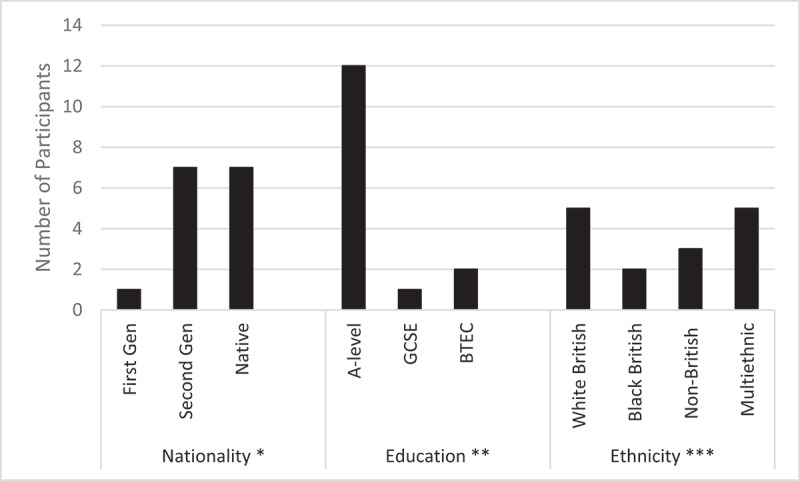
Participant demographics.
*Based on UK Government definitions. First Gen: People born abroad, first generation immigrants. Second Gen: People with at least one parent born abroad. Native: People whose parents were both born in the UK. **At age 16+ pupils begin Level 3 qualifications such as A-levels (usually 3 traditional academic subjects) or BTECs (Vocational qualifications in areas such as business or health and social care). If necessary, students can sit Level 2 qualifications such as GCSEs (General Certificate of Secondary Education. 8-10 subjects typically studied at school). ***Based on free-response and not further specified for anonymity.
Video diary procedure
Participants were invited to complete a daily video diary for two weeks. The qualitative research platform Indeemo2 was used, providing a secure App that participants downloaded to their personal mobile phones. Video diaries were chosen as they reflect the everyday communication style favoured by adolescents and participants were encouraged to use them according to their own preference and comfort. Diary instructions were broad to allow participants to set the agenda e.g. We’re really interested in your everyday experiences, how things are going for you, what was good or not so good in your day, what makes things better or worse. Participants were free to decide the time, length, duration and number of entries each day.
Diary analysis
The participants’ diaries commonly echoed the format teenagers’ favour to communicate their everyday experiences such as facetime, Snapchat or video call. Analysis therefore primarily involved spoken rather than visual content. A young advisor of the same generation and gender, with similar experiences of FE as participants, was consulted throughout the project. She confirmed the typicality of the communication preferences in the diaries, often through a similar style of voice-memo sent to the researchers. Her contribution was important during the analysis as the researchers’ position differed from that of the participants being from a different generation, having no direct experience of current FE, and not working in or involved in the school system. The young advisor’s input was therefore valuable in highlighting ways that the researchers’ perspective could influence the analysis and ensuring that the adolescent perspective was understood and closely represented. The analytic approach maintained the key principles of IPA which made it ideal for the project: its idiographic, interpretative, and inductive commitments. Each participant’s diary was analysed as a whole, to get a gestalt sense of the important aspects of their day-to-day life. This was done for each participant independently to form personal expressive themes as follows:
For the first participant, the diary was logged: spoken content was transcribed and important visual material noted e.g. Visual: feet walking down the street. Text caption: ‘my journey to school’.
A series of expressive statements capturing salient aspects of the data, verbal or otherwise, were developed, each traceable to a specific log point.
Connections and patterns across statements were explored and statements clustered into a series of personal expressive themes. These represented meaningful or important aspects of daily life expressed by the participant.
The above process was repeated for the remaining participants resulting in a set of personal expressive themes for each. A cross-case analysis was then conducted to identify five group expressive themes for all participants (Table 1).
Table 1.
Formulating the interview schedule from diary group expressive themes.
| Group Expressive Theme (from diaries) | IPA Interview Base Question | Personalised Participant & Diary Prompts* |
|
|---|---|---|---|
| Example 1 | Example 2 | ||
| Time and Productivity | In your diaries you described [Time & Productivity] can you say some more about what you meant? | [how long you spend on schoolwork] Yeah, you know, I’d spent all day doing work. I still kind of feel like inadequate about it. It’s making me feel a bit, bit anxious |
[how busy days make you feel] I hate it so much […] If I have a busy day it will affect me so much, so much and there’s nothing I can do about it |
| Rituals and Routines | In your diary, I noticed that you [Ritual/Routine] quite a lot, can you tell me some more about that? | [go boxing a lot] I didn’t really want to go to the gym […] but I’m really glad I did because now I feel, like I haven’t done any more revision or anything, but I feel a lot less stressed |
[watch TV to finish the day] I’m just currently watching Derry Girls before I go to sleep. To just like end the day good because er it was quite an anxious day. |
| Friends, Family and Social life | Something that came up a lot in your diary was [Friends/Family] - can you tell me some more about that? What is it like with your friends on a day-to-day basis? | [being with your friends] Visuals of the park. We walked her dog and we just sat and chat about life for like 2 hours. So that was really good. |
[talking to your Mum] It was really good to have like a just a nice conversation about what was going on and not having to think about it. Like all on your own |
| Ability and Success | I’d like to think about a time when you felt good about yourself or that something went well e.g. [Ability/Success] - can you tell me more about that? | [turning round a bad day] I kind of like pushed through it and realized that like just because my day started badly it didn’t have to end badly. […] I ended up having a really good day |
[being good at dancing] Visuals: Smiling. Dancing on platform of empty train station. Dark with lots of lights. |
| Fear and Failure | You described [Fear/Failure] - what was that like? Do you feel like that a lot or is it unusual? | [worries about exams] if I fail these exams after this week, then I’m I’m done for like I’m done. |
[nerves before socializing] I was feeling quite nervous just because I barely knew anyone there because we were going to different schools and I felt very out of place. |
*Due to the personalized nature of this material, examples are taken from a mixture of participants across the sample and pseudonyms have been removed.
Development of interview schedule
The five group expressive themes identified during diary analysis formed the basis of the semi-structured interview questions. To maintain idiography, the questions were personalized for each participant using their own diary content. This process is illustrated in Table 1; the group expressive theme provides the focus for the IPA interview base question, for example ‘Time & Productivity’. The base question is personalized to each participant by referring to an example from her diary; for instance, ‘how long you spend on schoolwork’ and ‘how busy days make you feel’.
The interview
The use of personally relevant examples during each participant’s interview ensured that it focused on what mattered to that individual; it was based in what she had chosen to include in her diary. Participants were shown selected extracts from their own diary during the interview, helping them to remember and reflect on specific aspects of their everyday life. This also allowed the researcher to demonstrate interest in the participant’s experiences and helped both participant and researcher develop confidence that they were understanding one another. The interviews took place at the participant’s school in a private classroom. They lasted approximately an hour, were audio-recorded and transcribed verbatim. Participants were given pseudonyms which are used throughout.
IPA analysis
Interviews were analysed following the steps described in Smith et al. (2022). The analysis was conducted on a case-by-case basis, with themes generated for each individual case, before proceeding to the identification of patterns across cases. The first case was read line-by-line and detailed exploratory notes completed. Experiential statements were generated and then clustered to form personal experiential themes (PETs). The process was completed for each case. Finally, connections between PETs were identified, leading to the formation of group experiential themes (Table 2).
Table 2.
Prevalence* of participants contributing to each theme.
| Participant Pseudonym | Sacrificing now under the weight of the future | The future is coming frighteningly fast and I’m not ready to be an adult | Don’t relax: struggling with relentless pressure and worry |
|---|---|---|---|
| Amina | √ | √ | |
| Phoebe | √ | √ | √ |
| Jada | √ | √ | |
| Nnenne | √ | ||
| Chloe | √ | √ | √ |
| Selena | √ | √ | √ |
| Tula | √ | ||
| Gabriella | √ | √ | |
| Kayleigh | √ | √ | √ |
| Dora | √ | √ | |
| Ruby | √ | √ | |
| Lavinia | √ | √ | |
| Oya | √ | ||
| Mena | √ | √ | |
| Ivy | √ | ||
| Total | 11 | 8 | 10 |
*Smith (2011) suggests that for a theme to be considered representative of the group, it must be present in at last half of the individual cases. Accordingly, group level themes contained material present in at least 8 individual participant cases. In addition to this indication of prevalence, as per Smith (2011) each theme is evidenced with data extracts from at least 3 different participants.
One member of the research team monitored each stage of the analytic process, checking the researcher’s interpretations and connections between analysis and the data. Group themes illustrating the participants’ experience of temporal and emotional challenges in daily life were generated; this paper will focus on the former.
Results
Three themes highlight the participants’ day-to-day struggle with time-related anxieties. Sacrificing now under the weight of the future, describes pressure to prepare for the future and the burden this places on the present. The future is coming frighteningly fast and I’m not ready to be an adult, captures how scarily rapid the advance of the future can feel, and - Don’t relax: struggling with relentless pressure and worry - illustrates the daily anxieties and sense of inadequacy created by living with perceived insurmountable pressure.
Sacrificing now under the weight of the future
The participants’ activities and concerns during daily life often revolved around preparing for their future. The focus on exams, university and a career felt inescapable and burdened their daily actions and choices. They described feeling under pressure to work towards the future with an almost intrusive anxiety about how day-to-day actions might impact their lives further down the line.
Amina’s concern with the detrimental impact of her studies on her future was ever-present in her daily diaries, for example:
Oh my god chemistry is so… I only picked it because I had to like, because I had biology and I had psychology and then I had chemistry and I hate chemistry so much. I just, like I can’t drop it now either. I can’t swap it out for anything so if I fail these exams after this week, then I’m, I’m done for like, I’m done.
In her subsequent interview, she spoke further about feeling compelled to choose a subject and her ongoing anxieties about the future. By this time, she had failed her exam and was trying to work out what to do:
I feel like I should’ve just stuck to what I wanted, but it was constant, he [tutor] kept saying, ‘you guys need to do things to help plan for your future’. That makes sense, but at the same time, you can’t really do a subject that you don’t enjoy, because if you don’t enjoy it, you’re not going to do well in it. So, I should’ve stuck to that, but it’s a bit too late. […] I don’t know. It’s scary because I feel like my future could be affected by it.
Amina describes an inescapable ‘constant’ pressure to think about the future; a repeated, harrying message – ‘he kept saying’. Persuaded to forfeit her preferred subject for one she disliked, she is left struggling to engage or do well. Tension between the needs of the present and the demands of the future create a difficult bind for Amina. Planning ahead feels sensible and important (and has been encouraged by an adult in an advisory role) but taking a potentially hated subject means struggling in the present. The real sting in the tail for Amina is that, despite her regret at prioritizing the future, its threat remains a powerful source of anxiety, and she is frightened that she has done permanent damage, and it might be ‘a bit too late’ to get back on track.
The idea that an intractable path to the future could be set in motion at school, and the pressures and conflicts this caused, were also evident in Phoebe’s interview. She discussed her feelings towards a language class she attended at weekends:
I’ve started to not like it, because I feel like I could be doing my time at other places. Maybe I’m thinking I want to go edit at home, which isn’t always great. But that’s what I want. […] I already speak Japanese quite well, so do I want to just be sitting in a lesson? But my mum’s like ‘this will be good for you in the future. Don’t worry. You’ll thank me’. I’m like, ‘Will I?’ But I’m sure I will, but we’ll see.
The expression ‘doing my time’ brings an obvious association with imprisonment, echoing the inescapable pressure and restriction described by Amina. For Phoebe, the idea that struggling now is worthwhile for her future creates tension and confusion. Is the activity a pointless waste of time ‘just’ sitting in a lesson or something more meaningful? She worries that sacrificing what she enjoys (editing) won’t be worth it in the long run. Neglecting the now for the sake of the future has a sting in the tail for Phoebe. It is endorsed by her mother who promises – ‘you in the future’ - will see the benefits. Phoebe’s final remarks hint at scepticism and potential resentment, the confidence of ‘I’m sure’, laced with a sliver of a threat ‘we’ll see … ’.
Adults weren’t the only source of pressure concerning the future. Selena described something more intuited:
It’s like a better [version] of myself, like self-assured and kind of just want to do better with myself and have like a good future and like a successful future I’d really want. I think that’s practically it. I’m not scared of really, in a way, what other people think, but or like my parents because they support me no matter what, but it’s like I don’t know, it’s just from me. I just feel like worried about all my grades and what’s going to happen to my future, that’s what I think about.
Unlike the other participants who identify adults, teachers, parents, as complicit in this pressure, Selena feels it as an internal compulsion: ‘just from me’. Her instinctive acceptance speaks to how normalized it has become to feel that the future is fragile and needs constant vigilance to preserve. For Selena, grades not only signify academic performance, they metre out possibility. Grades are needed to maintain hope that life could be fulfilling in the future, but they can also diminish or destroy potential, restricting the possibility of her future self. With so much at stake, she is acutely aware that ‘all my grades’ matter regardless of subject or significance, resulting in a pressure far greater than the sum of its parts.
Jada’s diary illustrates the degree to which this type of thinking seems widely accepted and promoted:
Going to school um you know they, they tell you, you know, that you have to go to Uni and you have to do this and that and the other and you get into like ‘the’ job. The one job for your career
Gabriella’s anxieties about working hard enough to protect her future were exacerbated by the sense that time felt limited:
It used to be the stress because I thought, ‘Ohh I’m 17 I’m like I should actually be getting a move on with my life’ […], but I was having a talk with somebody […] he was saying like I have so much time and people they don’t even figure out what they’re doing in their life to like they’re in, they’re 20 years old. [.] It felt like a big relief like off my shoulders. Yeah, just a big relief. Like a revelation.
Gabriella describes concern about doing enough to work towards her future. The importance of getting a move on towards the future pressurizes her present, even at 17 years old. This pressure feels like an uncomfortable weight upon her, imparting the same feelings of restriction in the present to which the other participants alluded. The suggestion from an older friend that many people don’t figure out their lives until ‘they’re 20 years old’ represents a complete about-turn in perspective. It feels revelatory, as if someone has lifted the world from her shoulders, helping her escape the pressure that Amina, Phoebe and Selena could not.
For all participants, the notion that the primary purpose of school is to prepare for the future, even at the expense of life in the present, is pervasive. But these messages are slippery, their destructive potential easy to overlook. As indicated by Amina, they encourage something that on the surface seems so reasonable and ‘makes sense’. However, the result is Phoebe wishing her weekends away at 17, Amina frightened that she has permanently messed up her life and Selena worried that test results at the age of 16 might prevent her from being a good version of herself.
The future is coming frighteningly fast and I’m not ready to be an adult
The forward-oriented focus which seemed to dominate the participants’ lives meant that the future was always looming and never far from their attention. It seemed to be approaching at a terrifying speed and adulthood felt frighteningly imminent. There was a sense of everything going too quickly and of hurtling towards a future for which they were unprepared. Nnenne expressed the feeling of the world moving past her:
I feel like its cos everything’s just going so fast for me, like I feel like September [the start of the school year] was literally last month yeah everything’s kind of moving so fast and I’m just not moving at the pace everyone is moving.
Nnenne talks about the alarming pace at which time seems to be moving and her inability to keep up. She sees this as a personal failing. Compared to ‘everyone’, she is slow and unsure because ‘everything’s just going so fast for me’. Nnenne’s description emphasizes the sheer speed at which things appear to be changing and the seemingly unstoppable momentum of time. It gives the impression of someone left behind alone, a person stranded in the middle of the motorway with the traffic rushing past; confused, disoriented, unhappy.
For Kayleigh, the challenges began the moment she started sixth form:
Going from being babied in school in year 11 to sixth form just being thrown into it, like they sort of expect you to know what to do and everything’s a lot harder, the actual course is a lot harder and they sort of expect you to know how to find universities and find courses and find what you want to do with your life.
Kayleigh describes the move to sixth form as like being ‘thrown’, from a state of innocence into a world of challenges. This transition feels not only fast but also potentially brutal, the ‘babied’ infant hurled into a place where ‘everything’s harder’. To make things worse, the demand to have life goals mapped out only heightens the strain of this fast and furious advance towards adulthood.
For most participants, speeding towards a future one does not feel ready or equipped for was frightening. Amina described this explicitly in the context of her ongoing worries about her failed exam:
It’s scary. I only have two years until I leave and get into university. It’s already been a whole year, so I have one year left. But I think because I’m retaking another subject, I still have those two years.
The limited time between now and the future worries Amina and the focus on the next stage of life seems to speed things up. Getting into university is important but also means leaving things behind. The advance towards this change feels rapid and frightening. Indeed, for Amina, retaking the first year of A-levels seems to provide welcome relief, enabling her to reclaim precious time.
Although Phoebe expected to perform well in her exams, she also elected to retake her first year:
I didn’t feel prepared for university, whether it was knowledge-wise for school or just daily life, doing laundry and stuff. So, I was like the best thing is to redo, and it’s the best thing I’ve done. I’m really happy I did it […] Miss [her teacher] said, ‘Oh, it’s going to be really hard. I don’t think you understand. Because your friends aren’t there, you’re going to want to even drop out’.
Phoebe’s fears about the fast approach of the future outweigh her teacher’s concerns. Like Amina, she sees the move to university as a sharp point of change from one stage of life to the next and feels unprepared. This is a new world where everything from the practicalities of laundry to the requirements of education seem foreign. By putting the brakes on, Phoebe delays this moment and the feeling of relief is such that, although she is repeating academically, she sees it as an accomplishment; ‘the best thing I’ve done’
The sense of a fast-approaching future shaped how the participants thought about the long term. They saw themselves on a trajectory towards the future that sped up as feelings of unpreparedness grew. This was frightening and influenced their decisions, such as retaking a school year or trying to slow down.
The pressure of needing to get ready for the future also impacted how their day-to-day life was experienced in the shorter term. Each day was associated with a sense of urgency concerning how time was spent. The pressure exerted on time each day is the subject of the third theme.
Don’t relax: struggling with relentless pressure and worry
With the rapid approach of the future demanding preparation, the pressure to use time wisely became ever-present in the participants’ daily lives. There never seemed to be enough time and this, coupled with the demands of school, left them feeling anxious and inadequate. Much of the participants’ discussion involved exams and tests which they took throughout the school year. Take Selena, who felt persistently stressed:
I always have, like, anxiety, like, when any, like, a minor test, even […]. Like, oh, what if I don’t do as good. […] That is, like, giving, like, a lot of pressure now because - how am I supposed to cram in three months’ worth of knowledge into a test in two weeks, that I’ve just moved in? That’s probably why intensity is worse. In a way like, your like heart races. I think you’re thinking of the worst, the consequences. I feel like, ‘Oh, my God!’.
The acute awareness of time constraints mean that even minor tests create feelings of extreme pressure. Describing it as seemingly impossible, Selena’s anxiety creates physical and mental overdrive and her heart races as she anticipates ‘the worst, […] consequences’. Her description pushes the emotional and bodily discomfort into the present as she attempts to ‘cram’ herself full to bursting with information while time constricts around her.
This impression of pressure which builds up and tightens, and the sheer amount of time and effort it demands, is also evident for Chloe who took extracurricular music exams as well as school assessments:
I just try to do as much as I can. And like unless I’m like really tired and I know that I’ve been working for a long, but I feel like even if I’m working for a few hours, I feel like it’s not enough for some reason, I just feel like, yeah, because there’s just so much work to get through. And like then I’ll start to like repeat stuff I’m revising, like going over and over and over. I’m just like, is it ever enough?
Chloe describes a sentiment, echoed by many of the participants, that the need to keep working is insatiable. No matter how much they do, it never feels like enough, creating an ongoing cycle of inadequacy and stress . Like Selena, Chloe describes struggling with the volume of ‘so much work’ and of pushing uncomfortably to capacity; ‘as much as I can’. Although there are moments when she recognizes that she has been ‘working for a long’ time, this thought is instantly overridden by another: ‘it’s not enough’. For Chloe, the notion of having done enough is beyond comprehension. Like Selena, she describes going into overdrive, repeating revision of the same content ‘over and over’, a response to an extreme, perhaps impossible demand.
Relentlessness also characterized Dora’s experience of day-to-day pressures. Even when doing ballet after a day’s work, she remains concerned with being ‘productive’:
I was revising. And although I was revising the whole day, I kept thinking, oh, I could be doing a bit more now. But then I did just tell myself, look, this is ballet. You’re still doing something productive. And also, you can’t be working 24–7.
Dora describes needing to persuade herself to stop working, so prohibited is relaxation. Like Chloe, the feeling of never having done enough is difficult to shake; she could always ‘be doing a bit more’. After a full day of revision, Dora can only coax herself to stop and assuage her nagging guilt by reasoning that she is switching to another worthwhile activity.
For Ruby, the feelings of not doing enough are associated with such inadequacy that she is unable to see any achievement; her hard work and effort become ‘nothing’.
I’ve not done enough. I’ve been revising, I think I definitely said this in the diary a lot. And I still feel like it now, even after a day of revision, a day of school, a day of revision after school, I still feel like I’ve done nothing. And it’s such a weird feeling it’s like, all right, well, I’ve done nothing, I’ve achieved nothing, I’ve done nothing all day. But it’s like I’ve done so much. Like, I’ve been sitting there for hours but I’ve done nothing.
Although Ruby’s exams have finished, the feeling of not having done enough remains. Her sense of trying to manage insurmountable extremes is evident; on the one hand, she knows the amount of work and time she has devoted has been relentless, yet this is set against the feeling of having done and achieved nothing for the whole day. Like Dora, she attempts to reason with herself, trying to untangle feeling tired and having ‘done so much’ from the berating anxiety that ‘I’ve done nothing’. The overall sense of exhausting relentlessness is exacerbated by her self-critical evaluation that her feelings are nonsensical and ‘weird’. Ruby said the pressure to do enough overtook everything else in her life, something she disliked but felt unable to prevent: ‘Honestly, um school’s like my whole life. Like not in a good way. I don’t want it to be, but it’s like, it’s very, I don’t really have room for anything else.’
It is not only the lack of time and volume of schoolwork that feels relentless for the participants, the on-going sense of not doing enough, means feelings of inadequacy are a persistent experience in day-to-day life. In Ruby’s case this leaves no ‘room for anything else’.
As Kayleigh explains, the end of exams brings no respite, only concern about the next stage of the future, which has just come one step closer:
They’re good grades [her GCSE exams] so I’m quite happy with it […] I’m like oh summer’s soon I can just relax, but then I’m like ‘Oh no, after that you’ve got year 13 you’ve got actual A levels’. […] We finish exams and now we have to think about UCAS and uni and stuff so they’re sort of drilling universities at us now so I guess it’s sort of one stress to the next stress kind of thing.
Like the other participants, Kayleigh describes being unable to stop feeling stressed. For the others, the sense of pressure and need to keep working was often described over the course of each day, but for Kayleigh the feeling has a far longer life span. Exams are finished and she is pleased with her results, yet thoughts of relaxation are quickly overtaken by fear of what comes ‘after that’. She describes her present self being bored into by the demands of the future that are drilled ‘at us now’, the relentlessness being given moment by an acute awareness of what comes next and the need to be prepared.
Kayleigh describes her school experience as a succession of stresses. Like the others, her life revolves around progression through school towards university, employment and to one single future. Each step is dependent on the one before and involves the risk of destroying the one which follows.
Taken as a whole, the three themes highlight how the considerable emphasis placed on preparing for the future creates a task that feels urgent but has no end point. Efforts and achievements have little worth in the present because the pay off, like the future, is always still to come. This makes it hard to have a sense of accomplishment now. As Phoebe indicates in the first theme, the answer to ‘is it enough?’ or ‘is it good enough?’ can only ever be ‘we’ll see’. As a result, the participants fall into cycles of worry, inadequacy and overwork, and struggle to appreciate the present in any other way. In these circumstances day-to-day life doesn’t allow a moment for relaxation.
Discussion
This study uniquely highlights that adolescent girls’ daily lives are disproportionately consumed with preparing for and worrying about the future. This has substantial impact on their experience of the present, placing them under a constant feeling of time pressure, which negatively affects their mental health. The negative impact of future-oriented thinking on wellbeing has not previously been recognized and emphasis on working towards the future in school-based wellbeing initiatives and educational policy makes this insight especially significant.
For the participants, everyday life was dominated by a multi-layered anxiety concerning time and its passing with several concerning repercussions.
Sacrificing now under the weight of the future captured the way use of time in the present was structured around preparation for the future. Literature exploring adolescent time use predominantly considers how long young people spend on activities evaluated by adults as having implications for health and wellbeing. Time using screens or social media (Marsh et al., 2024; Siebers et al., 2022), being sedentary or active (Sampasa-Kanyinga et al., 2020), and sleep duration (Hisler et al., 2020) are popular topics.
In contrast, participants evaluated their time primarily in terms of its perceived value for the future. This meant that the same activity could be deemed a guilty escape or a worthwhile, permissible engagement. Dora justified spending time on ballet instead of school work by reasoning that it was ‘still doing something productive’. With their focus firmly set on the future, the pressure to be productive was continuous, rendering the duration of their efforts largely irrelevant. No matter how long Chloe studied, it still felt ‘like it’s not enough for some reason’. How the girls thought about time had more relevance than any particular activity. It was extremely forceful in shaping their everyday experiences and engagements, and the way they felt about themselves and their lives.
This is notable given the prevailing discourses around future orientation and productivity in contemporary social and research cultures where both are regarded as desirable (Fan, 2025; Hipson et al., 2021). The scarcity of time and the pressure to manage it efficiently are central to modern sociopolitical narratives, which prioritize speed and productivity (Gregg, 2018). Within this framework, leisure becomes entangled with work as activities are increasingly compressed in the pursuit of doing more in less time (Sugarman & Thrift, 2020). Consistent with this, the participants in this study needed to justify even relaxing activities as ‘productive’. Time off school work was sanctioned as a means to work better and more.
In educational research, cultivation of future-oriented thinking is commonly explored with a view to increasing student motivation, interest, achievement, and study time (Brown & Jones, 2004; Burns et al., 2021; Destin & Oyserman, 2010; Lizzio & Wilson, 2004; Mello & Worrell, 2006; Peetsma, 2000). This study, however, highlights the negative impact of future-orientated thinking on adolescent wellbeing, bringing a new perspective to the area. For these participants, the future overshadowed the present, instilling enduring stress, fear and an inability to live in the now. Their willingness to sacrifice the present for future outcomes, as reflected in this theme may have important wellbeing implications. Research involving older students has demonstrated that the sacrifice of emotional and/or leisure needs in the attainment of future goals is associated with increased psychological distress (Holding et al., 2020). Indeed, adolescents may be especially vulnerable to making these kinds of sacrifices when future thinking is prioritized. According to Carstensen (2006), adolescents are particularly vulnerable to the perception of time as limited and prioritizing future goals at the expense of present-day wellbeing.
A second impact of emphasis on the future, described in The future is coming frighteningly fast and I’m not ready to be an adult, involved participants’ feelings of being flung forward through time or the future rapidly advancing. Research on future time perspective (FTP), which examines individuals’ orientation towards the future, has consistently revealed gender differences (Greene & DeBacker, 2004). Compared to males, adolescent females tend to view feared possible selves as more likely, while ascribing more importance to their hoped-for selves (Knox et al., 2000). In addition, their FTPs do not extend as far into the future as those of males (Greene & DeBacker, 2004). This shorter outlook is associated with a heightened sense that the future is approaching rapidly and a diminished sense of control over life (Hilpert et al., 2012; Shell & Husman, 2001; Simons et al., 2004). Consistent with this, in our study participants’ anxieties around the speed of futures’ advance were described as involving a diminished sense of control or agency and lack of confidence in evaluating day-to-day activities.
The findings reported here provide novel insight into the everyday time perspective of adolescent girls and its psychological impact. Given the well-documented mental health and wellbeing concerns within this group, this may be an important area for research to pursue. Evidence suggests that a higher frequency of thinking about the future or past, rather than the present, is associated with increased anxiety, particularly among adolescent girls, a relationship that warrants further attention (Finan et al., 2022)
In the theme Don’t relax: struggling with relentless pressure and worry, the girls specified pressure in their everyday lives related to the requirements of school. Exams and career-related academic decisions placed heavy demands on their time so regardless of how many hours they put in, they never felt they had done enough and were often left with the anxious feeling of having accomplished nothing.
The effects of school stress on well-being have been explored in the context of mental health (Ahn et al., 2023; Bortes et al., 2021; Wuthrich et al., 2020). Results are mixed suggesting that an increasingly demanding education system is responsible for well-being declines (West & Sweeting, 2003) but that levels of school stress are unrelated to changes in the education system (Löfstedt et al., 2020) and have remained mainly stable over time (Högberg, 2021). Nevertheless, recent evidence suggests educational pressures impact girls differently; girls are more likely than boys to prioritize school and invest more time and effort in schoolwork, potentially leading to higher stress (Garcia, 2025). Stress in adolescent girls has also been associated with self-originating demands such as their own striving to succeed, a phenomena that is proposed to be heightened for older girls (Spencer et al., 2018).
In contrast, for the participants in this study, school stress was bound up in their pressurized experience of time leaving them feeling unproductive, anxious and inadequate. They were engaged in an ongoing effort to prevent damage to the future, rather than a quest for success. Unlike the measures of academic pressure described, demands of school were experienced as woven into a broader whole-life anxiety. In their eyes, a bad grade had far greater implications than indicating a moment of imperfection, it could cement a trajectory towards a bad life in the future and bring about a bad future self.
Strengths and limitations
The type of results sought using in-depth qualitative methods are different from those generated in experimental or large-scale studies and do not confer generalizability equivalent to quantitative work. Instead, findings are credible and confirmable, offering important utility for understanding the stressors of the participant group.
With this distinction in mind, the findings should be considered within the following limitations. Participants were all recruited from state-funded London Sixth Forms situating findings in a particular context. Post-16 provision in London differs from the rest of the country, more schools offer sixth form places and sixth forms tend to be larger and far more ethnically diverse (UCL Institute of Education, 2020). However, funding per pupil is 90% lower in state compared to private schools (Institute for Fiscal Studies, 2023) and while London schools are generally associated with higher levels of achievement, at post-16 this declines notably (UCL Institute of Education, 2020). Findings, therefore, may not be transferable to adolescents in very different circumstances such as more highly resourced private sixth-forms, or localities where further education provision is more limited. Furthermore, the study reflects the perspectives of young people who have experience of girlhood or identify as female, and findings may not be relevant to other gender groups.
However, the methodological value of using video-diaries with interviews does not share such restriction, and research adopting a similar approach to consider the experiences of other groups is encouraged. Indeed, a key strength of this study is its use of an inductive approach to understand adolescents’ everyday lives, evidenced by the new insights generated. This approach offers potential value for research with adolescents, particularly, those whose perspectives may be misrepresented or excluded through dominant discourses or agendas. The diary material itself was illuminating. Future work foregrounding visual analysis such as Day et al. (2024) could also be beneficial, particularly for topics or participant groups where verbalization is difficult.
Recommendations
Issues for adolescent wellbeing commonly foregrounded by researchers such as the ‘staggering’ accumulation of work on social media use (Valkenburg et al., 2022, p. 1), may well be important, but the primary challenges highlighted by young people in this study involved time-related pressure and emphasis on preparing for the future. This indicates the need to further investigate the role of focus on the future in adolescent wellbeing. Furthermore, it is recommended that researchers consider the use of inductive participatory methods to better pinpoint those aspects of young people’s lives that matter to them.
A core theme of programmes implemented in school settings aimed at primary prevention of psychological illness is helping adolescents ‘have a sense of purpose and future-oriented goals’ (Keyes & Platt, 2024, p. 400; Werner-Seidler et al., 2021). Evidence on the efficacy of such programmes is mixed (Andrews et al., 2023). The findings reported here point to the clinical value of school counsellors and adolescent mental health practitioners gaining insight into the stressors experienced by adolescents in relation to their future. Young people should be helped to develop a more balanced approach to demands on their time, recognize their needs and worth in the present, and see the future more flexibly. Similarly, Mental Health Support Teams involved in developing whole-school wellbeing approaches should consider encouraging activities that provide present-day fulfilment and help adolescents appreciate the here and now.
Conclusion
This study draws attention to the pressures and anxieties surrounding emphasis on the future experienced by adolescent girls in the context of school. Importantly, the findings paint a strong picture of life lacking breathing space, where ultimately, because so much energy and time is devoted to securing an adult future, there is limited time to be a teenage girl. The power of time-perspective revealed in this study, combined with its recognized significance in the literature, suggests the need for greater sensitivity to this matter in policy development and application, given the prominence of school and school life as vehicle for well-being interventions and initiatives.
In sum, it may be that encouraging orientation to the future has suffered from over-enthusiastic empirical and pedagogical pursuit. Research concerning future thinking has focussed mainly on its motivational, goal-orienting and educational utility, particularly as a means to facilitate academic engagement (Pawlak & Moustafa, 2023). Meanwhile, future-oriented thinking is being built into curricula at earlier and earlier ages with Governments advising career guidance begin well before adolescence (Board of the Governors of the European Schools, 2020; UK: Department for Education, 2023; OECD Career Readiness project, 2017; U.S. Department of Education, 2022).
The findings in this study highlight the need for a greater focus on the value of the present for its own sake and a greater priority and space made within the educational curriculum for activities that have no specific future currency but help adolescent girls enjoy and relate to their current life-stage. Thinking about the future has a role in growing up, but as adults we know that many varied aspects of life have value, and that serendipity can be the source of great joy. Our study indicates the need to stop insisting that the main imperative of an adolescent’s day-to-day life should be to secure her future, and step outside the notion, promoted particularly in educational contexts, that ‘The knowledge and skills we gain today would have little value if we did not use them at some point in the future’ (Husman et al., 2015, p. 131). Otherwise, the message we continue to impart is that life as a teenage girl today has no intrinsic worth.
Acknowledgments
We would like to thank the study participants for their time and invaluable role in this work. We also thank the school and college staff who supported this research and facilitated participant involvement. Finally, we gratefully acknowledge the insights of Minnie Offord-Aresti who acted as advisor on the project.
Funding Statement
This work was supported by the Birkbeck/Wellcome Institutional Strategic Support Fund under Grant code [101053].
Notes
The descriptors girl and girls were used as they are common parlance particularly in the UK education system from which participants were recruited. We acknowledge these terms might be variously understood, for example, as subjective self-identifiers, as a discursive construct, or as a stage in life of a person of a particular sex. We used the term for its everyday flexible application, without further definition, allowing young people for whom it was meaningful to indicate interest in participation.
This app was chosen as it provided GDPR compliant secure data storage and management of uploaded diaries as well as anonymous logins meaning participants diary data was not associated with their personal details.
Disclosure statement
No potential conflict of interest was reported by the author(s).
References
- Ahn, J. S., Plamondon, A., & Ratelle, C. F. (2023). Different ways to support and thwart autonomy: Parenting profiles and adolescents’ career decision-making. Journal of Family Psychology, 37(2), 161–26. 10.1037/fam0000982 [DOI] [PubMed] [Google Scholar]
- Al-Dajani, N., Horwitz, A. G., & Czyz, E. K. (2022). Does coping reduce suicidal urges in everyday life? Evidence from a daily diary study of adolescent inpatients. Depression and Anxiety, 39(6), 496–503. 10.1002/da.23253 [DOI] [PMC free article] [PubMed] [Google Scholar]
- Alderson, P. (2001). Research by children. International Journal of Social Research Methodology, 4(2), 139–153. 10.1080/13645570120003 [DOI] [Google Scholar]
- Anderson, M., Faverio, M., & Gottfried, J. (2023). Teens. Social Media and Technology. https://www.pewresearch.org/internet/2023/12/11/teens-social-media-and-technology-2023/ [Google Scholar]
- Andrews, J. L., Birrell, L., Chapman, C., Teesson, M., Newton, N., Allsop, S., McBride, N., Hides, L., Andrews, G., Olsen, N., Mewton, L., & Slade, T. (2023). Evaluating the effectiveness of a universal eHealth school-based prevention programme for depression and anxiety, and the moderating role of friendship network characteristics. Psychological Medicine, 53(11), 5042–5051. 10.1017/S0033291722002033 [DOI] [PubMed] [Google Scholar]
- Arslan, G., & Coşkun, M. (2020). Student subjective wellbeing, school functioning, and psychological adjustment in high school adolescents: A latent variable analysis. Journal of Positive School Psychology, 4(2), Article 2. 153–164. 10.47602/jpsp.v4i2.231 [DOI] [Google Scholar]
- Avedissian, T., & Alayan, N. (2021). Adolescent well-being: A concept analysis. International Journal of Mental Health Nursing, 30(2), 357–367. 10.1111/inm.12833 [DOI] [PubMed] [Google Scholar]
- Awan, F., & Gauntlett, D. (2013). Young people’s uses and understandings of online social networks in their everyday lives. Young, 21(2), 111–132. 10.1177/1103308813477463 [DOI] [Google Scholar]
- Bengtsson, S., & Johansson, S. (2022). The meanings of social media use in everyday life: Filling empty slots, everyday transformations, and mood management. Social Media + Society, 8(4). 10.1177/20563051221130292 [DOI] [Google Scholar]
- Board of the Governors of the European Schools . (2020). Careers guidance. (Nos. 2020-01-D-29). https://www.eursc.eu/BasicTexts/2017-09-D-27-en-7.pdf
- Bortes, C., Ragnarsson, S., Strandh, M., & Petersen, S. (2021). The bidirectional relationship between subjective well-being and academic achievement in adolescence. Journal of Youth and Adolescence, 50(5), 992–1002. 10.1007/s10964-021-01413-3 [DOI] [PMC free article] [PubMed] [Google Scholar]
- Brown, W. T., & Jones, J. M. (2004). The substance of things hoped for: A study of the future orientation, minority status perceptions, academic engagement, and academic performance of black high school students. Journal of Black Psychology, 30(2), 248–273. 10.1177/0095798403260727 [DOI] [Google Scholar]
- Buchanan, C. M., Romer, D., Wray-Lake, L., & Butler-Barnes, S. T. (2023). Editorial: Adolescent storm and stress: A 21st century evaluation. Frontiers in Psychology, 14(1257641). 10.3389/fpsyg.2023.1257641 [DOI] [PMC free article] [PubMed] [Google Scholar]
- Burns, E. C., Martin, A. J., & Collie, R. J. (2021). A future time perspective of secondary school students’ academic engagement and disengagement: A longitudinal investigation. Journal of School Psychology, 84, 109–123. 10.1016/j.jsp.2020.12.003 [DOI] [PubMed] [Google Scholar]
- Campbell, O. L. K., Bann, D., & Patalay, P. (2021). The gender gap in adolescent mental health: A cross-national investigation of 566, 829 adolescents across 73 countries. SSM - Population Health, 13, 100742. 10.1016/j.ssmph.2021.100742 [DOI] [PMC free article] [PubMed] [Google Scholar]
- Carstensen, L. L. (2006). The influence of a sense of time on human development. Science, 312(5782), 1913–1915. 10.1126/science.1127488 [DOI] [PMC free article] [PubMed] [Google Scholar]
- Colizzi, M., Lasalvia, A., & Ruggeri, M. (2020). Prevention and early intervention in youth mental health: Is it time for a multidisciplinary and trans-diagnostic model for care? International Journal of Mental Health Systems, 14(1), 23. 10.1186/s13033-020-00356-9 [DOI] [PMC free article] [PubMed] [Google Scholar]
- Copeland, W. E., Alaie, I., Jonsson, U., & Shanahan, L. (2021). Associations of childhood and adolescent depression with adult psychiatric and functional outcomes. Journal of the American Academy of Child & Adolescent Psychiatry, 60(5), 604–611. 10.1016/j.jaac.2020.07.895 [DOI] [PMC free article] [PubMed] [Google Scholar]
- Cosma, A., Stevens, G., Martin, G., Duinhof, E. L., Walsh, S. D., Garcia-Moya, I., Költő, A., Gobina, I., Canale, N., Catunda, C., Inchley, J., & de Looze, M. (2020). Cross-National time trends in adolescent mental well-being from 2002 to 2018 and the explanatory role of schoolwork pressure. Journal of Adolescent Health, 66(6, Supplement), S50–S58. 10.1016/j.jadohealth.2020.02.010 [DOI] [PMC free article] [PubMed] [Google Scholar]
- Crane, S., & Broome, M. E. (2017). Understanding ethical issues of research participation from the perspective of participating children and adolescents: A systematic review. Worldviews on evidence-Based Nursing, 14(3), 200–209. 10.1111/wvn.12209 [DOI] [PMC free article] [PubMed] [Google Scholar]
- Danielsson, A. T., & Berge, M. (2020). Using video-diaries in educational research exploring identity: Affordances and constraints. International Journal of Qualitative Methods, 19, 1609406920973541. 10.1177/1609406920973541 [DOI] [Google Scholar]
- Day, W., Larkin, M., & Shaw, R. (2024). Combining collaging, phenomenology and photographs to meaningfully interact with participants’ creative self-representations. Methods in Psychology, 10, 100135. 10.1016/j.metip.2024.100135 [DOI] [Google Scholar]
- Demant, J., & Østergaard, J. (2007). Partying as everyday life: Investigations of teenagers’ leisure life. Journal of Youth Studies, 10(5), 517–537. 10.1080/13676260701594828 [DOI] [Google Scholar]
- Department for Education . (2023). Careers guidance and access for Education and training providers: Statutory guidance for Schools and guidance for further Education colleges and sixth form colleges. https://assets.publishing.service.gov.uk/media/63b69f3fe90e077246c83323/Careers_guidance_and_access_for_education_and_training_providers_.pdf
- Destin, M., & Oyserman, D. (2010). Incentivizing education: Seeing schoolwork as an investment, not a chore. Journal of Experimental Social Psychology, 46(5), 846–849. 10.1016/j.jesp.2010.04.004 [DOI] [PMC free article] [PubMed] [Google Scholar]
- Eide, T., Faugli, A., Kufas, E., & Eilertsen, G. (2020). Mental health as perceived by Norwegian adolescents living with parental somatic illness: Living in an earthquake zone. International Journal of Qualitative Studies on Health and well-Being, 15(1), 1783064. 10.1080/17482631.2020.1783064 [DOI] [PMC free article] [PubMed] [Google Scholar]
- Einberg, E.-L., Lidell, E., & Clausson, E. K. (2015). Awareness of demands and unfairness and the importance of connectedness and security: Teenage girls’ lived experiences of their everyday lives. International Journal of Qualitative Studies on Health and Well-Being, 10(1), 27653. 10.3402/qhw.v10.27653 [DOI] [PMC free article] [PubMed] [Google Scholar]
- Eriksson, K., & Strimling, P. (2023). Gender differences in competitiveness and fear of failure help explain why girls have lower life satisfaction than boys in gender equal countries. Frontiers in Psychology, 14. 10.3389/fpsyg.2023.1131837 [DOI] [PMC free article] [PubMed] [Google Scholar]
- Essau, C. A., Lewinsohn, P. M., Seeley, J. R., & Sasagawa, S. (2010). Gender differences in the developmental course of depression. Journal of Affective Disorders, 127(1), 185–190. 10.1016/j.jad.2010.05.016 [DOI] [PMC free article] [PubMed] [Google Scholar]
- Essau, C. A., rer. soc, Conradt, J., Petermann, F., & Phil. (2000). Frequency, comorbidity, and psychosocial impairment of anxiety disorders in German adolescents. Journal of Anxiety Disorders, 14(3), 263–279. 10.1016/S0887-6185(99)00039-0 [DOI] [PubMed] [Google Scholar]
- Fan, Y. (2025). The effect of mindful planning on the academic Productivity of adolescents. Interdisciplinary Humanities and Communication Studies, 1(2), Article 2. 10.61173/dzrq5j49 [DOI] [Google Scholar]
- Finan, L. J., Moon, J., Kaur, M., Gard, D., & Mello, Z. R. (2022). Trepidation and time: An examination of anxiety and thoughts and feelings about the past, present, and future among adolescents. Applied Developmental Science, 26(2), 238–251. 10.1080/10888691.2020.1778476 [DOI] [Google Scholar]
- Fledderjohann, J., Erlam, J., Knowles, B., & Broadhurst, K. (2021). Mental health and care needs of British children and young people aged 6-17. Children and Youth Services Review, 126, 106033. 10.1016/j.childyouth.2021.106033 [DOI] [Google Scholar]
- Gómez-López, M., Viejo, C., & Ortega-Ruiz, R. (2019, (1772). Psychological well-being during adolescence: Stability and association with romantic relationships. Frontiers in Psychology, 10. 10.3389/fpsyg.2019.01772 [DOI] [PMC free article] [PubMed] [Google Scholar]
- González-Ceballos, I., Palma, M., Serra, J. M., & Esteban-Guitart, M. (2021). Meaningful learning experiences in everyday life during pandemics. A qualitative study. Frontiers in Psychology, 12, 12. 10.3389/fpsyg.2021.670886 [DOI] [PMC free article] [PubMed] [Google Scholar]
- Greene, B. A., & DeBacker, T. K. (2004). Gender and orientations toward the future: Links to motivation: Educational psychology review. Educational Psychology Review, 16(2), 91–120. 10.1023/B:EDPR.0000026608.50611.b4 [DOI] [Google Scholar]
- Gregg, M. (2018). Counterproductive time management in the knowledge economy. Duke University Press. [Google Scholar]
- Grist, R., Cliffe, B., Denne, M., Croker, A., & Stallard, P. (2018). An online survey of young adolescent girls’ use of the internet and smartphone apps for mental health support. British Journal of Psychiatry Open, 4(4), 302–306. 10.1192/bjo.2018.43 [DOI] [PMC free article] [PubMed] [Google Scholar]
- Guo, J., Basarkod, G., Perales, F., Parker, P. D., Marsh, H. W., Donald, J., Dicke, T., Sahdra, B. K., Ciarrochi, J., Hu, X., Lonsdale, C., Sanders, T., & Del Pozo Cruz, B. (2022). The equality paradox: Gender equality intensifies male advantages in adolescent subjective well-being. Personality and Social Psychology Bulletin, 50(1), 147–164. 10.1177/01461672221125619 [DOI] [PubMed] [Google Scholar]
- Haraldsson, K., Lindgren, E.-C., Hildingh, C., & Marklund, B. (2010). What makes the everyday life of Swedish adolescent girls less stressful: A qualitative analysis. Health Promotion International, 25(2), 192–199. 10.1093/heapro/dap061 [DOI] [PubMed] [Google Scholar]
- Haraldsson, K., Lindgren, E.-C., Mattsson, B., Fridlund, B., & Marklund, B. (2011). Adolescent girls’ experiences of underlying social processes triggering stress in their everyday life: A grounded theory study. Stress and Health: Journal of the International Society for the Investigation of Stress, 27(2), e61–70. 10.1002/smi.1336 [DOI] [PubMed] [Google Scholar]
- Health and Social Care Committee . (2021). Children and young people’s mental health. No. 8. UK Parliament. https://publications.parliament.uk/pa/cm5802/cmselect/cmhealth/17/report.html [Google Scholar]
- Hedin, L., Höjer, I., & Brunnberg, E. (2012). Jokes and routines make everyday life a good life-on ‘doing family’ for young people in foster care in Sweden. European Journal of Social Work, 15(5), 613–628. 10.1080/13691457.2011.579558 [DOI] [Google Scholar]
- Hilpert, J. C., Husman, J., Stump, G. S., Kim, W., Chung, W.-T., & Duggan, M. A. (2012). Examining students’ future time perspective: Pathways to knowledge building. Japanese Psychological Research, 54(3), 229–240. 10.1111/j.1468-5884.2012.00525.x [DOI] [Google Scholar]
- Hipson, W. E., Coplan, R. J., Dufour, M., Wood, K. R., & Bowker, J. C. (2021). Time alone well spent? A person-centered analysis of adolescents’ solitary activities. Social Development, 30(4), 1114–1130. 10.1111/sode.12518 [DOI] [Google Scholar]
- Hisler, G., Twenge, J. M., & Krizan, Z. (2020). Associations between screen time and short sleep duration among adolescents varies by media type: Evidence from a cohort study. Sleep Medicine, 66, 92–102. 10.1016/j.sleep.2019.08.007 [DOI] [PubMed] [Google Scholar]
- Högberg, B. (2021). Educational stressors and secular trends in school stress and mental health problems in adolescents. Social Science & Medicine, 270, 113616. 10.1016/j.socscimed.2020.113616 [DOI] [PubMed] [Google Scholar]
- Holding, A. C., St-Jacques, A., Jérémie, V.-F., Frank, K., & Koestner, R. (2020). Sacrifice-but at what price? A longitudinal study of young adults’ sacrifice of basic psychological needs in pursuit of career goals. Motivation and Emotion, 44(1), 99–115. 10.1007/s11031-019-09777-7 [DOI] [Google Scholar]
- Husman, J., Brem, S. K., Banegas, S., Duchrow, D. W., & Haque, S. (2015). Learning and future time perspective: The promise of the future - rewarding in the present. In Stolarski M., Fieulaine N., & van Beek W. (Eds.), Time perspective Theory; review, research and application (pp. 131–141). Springer International Publishing. 10.1007/978-3-319-07368-2_8 [DOI] [Google Scholar]
- Institute for Fiscal Studies . (2023). Tax, Private school fees and state school spending. https://ifs.org.uk/publications/tax-private-school-fees-and-state-school-spending
- Jefferies, A. (2015). Video diaries: A discussion of their use for researching the learner experience in higher education. International Journal of Learning Technology, 10(3), 237. 10.1504/IJLT.2015.072359 [DOI] [Google Scholar]
- Karadzhov, D. (2021). Expanding the methodological repertoire of participatory research into homelessness: The utility of the mobile phone diary. Qualitative Social Work, 20(3), 813–831. 10.1177/1473325020913904 [DOI] [Google Scholar]
- Kaur, H., Saukko, P., & Lumsden, K. (2018). Rhythms of moving in and between digital media: A study on video diaries of young people with physical disabilities. Mobilities, 13(3), 397–410. 10.1080/17450101.2017.1355349 [DOI] [Google Scholar]
- Kennedy, M. (2020). ‘If the rise of the TikTok dance and e-girl aesthetic has taught us anything, it’s that teenage girls rule the internet right now’: TikTok celebrity, girls and the coronavirus crisis. European Journal of Cultural Studies, 23(6), 1069–1076. 10.1177/1367549420945341 [DOI] [Google Scholar]
- Keyes, K. M., & Platt, J. M. (2024). Annual research review: Sex, gender, and internalizing conditions among adolescents in the 21st century - trends, causes, consequences. Journal of Child Psychology and Psychiatry, 65(4), 384–407. 10.1111/jcpp.13864 [DOI] [PMC free article] [PubMed] [Google Scholar]
- Kirby, P. (2004). A Guide to actively involving young people in research: For researchers, research commissioners, and managers. INVOLVE. https://www.invo.org.uk/wp-content/uploads/2012/01/InvolvingYoungPeople2004.pdf [Google Scholar]
- Kirk-Wade, E., Garratt, K., & Long, R. (2023). Support for children and Young people’s mental health (England). https://commonslibrary.parliament.uk/research-briefings/cbp-7196/
- Knox, M., Funk, J., Elliott, R., & Bush, E. G. (2000). Gender differences in adolescents’ possible selves. Youth & Society, 31(3), 287–309. 10.1177/0044118X00031003002 [DOI] [Google Scholar]
- Krokstad, S., Weiss, D. A., Krokstad, M. A., Rangul, V., Kvaløy, K., Ingul, J. M., Bjerkeset, O., Twenge, J., & Sund, E. R. (2022). Divergent decennial trends in mental health according to age reveal poorer mental health for young people: Repeated cross-sectional population-based surveys from the HUNT study, Norway. BMJ Open, 12(5), e057654. 10.1136/bmjopen-2021-057654 [DOI] [PMC free article] [PubMed] [Google Scholar]
- Lagerløv, P., Rosvold, E. O., Holager, T., & Helseth, S. (2016). How adolescents experience and cope with pain in daily life: A qualitative study on ways to cope and the use of over-the-counter analgesics. BMJ Open, 6(3), e010184. 10.1136/bmjopen-2015-010184 [DOI] [PMC free article] [PubMed] [Google Scholar]
- Lancet Public Health . (2024). Investing in adolescent health and wellbeing. Lancet Public Health, 9(9), e635. 10.1016/S2468-2667(24)00193-2 [DOI] [PubMed] [Google Scholar]
- Larkin, K., & Jorgensen, R. (2016). ‘I hate Maths: Why do we need to do Maths?’ Using iPad video diaries to investigate attitudes and emotions towards Mathematics in year 3 and year 6 students. International Journal of Science and Mathematics Education, 14(5), 925–944. 10.1007/s10763-015-9621-x [DOI] [Google Scholar]
- Larkin, M., Watts, S., & Clifton, E. (2006). Giving voice and making sense in interpretative phenomenological analysis. Qualitative Research in Psychology, 3(2), 102–120. 10.1191/1478088706qp062oa [DOI] [Google Scholar]
- Larsson, M., Sundler, A. J., & Ekebergh, M. (2013). Beyond self-rated health: The adolescent girl’s lived experience of health in Sweden. The Journal of School Nursing, 29(1), 71–79. 10.1177/1059840512446151 [DOI] [PubMed] [Google Scholar]
- Lessard, L. M., & Puhl, R. M. (2021). Adolescent academic worries amid COVID-19 and perspectives on pandemic-related changes in teacher and peer relations. School Psychology, 36(5), 285–292. 10.1037/spq0000443 [DOI] [PubMed] [Google Scholar]
- Lev-On, A., & Lowenstein-Barkai, H. (2019). Viewing diaries in an age of new media: An exploratory analysis of mobile phone app diaries versus paper diaries. Methodological Innovations, 12(1), 2059799119844442. 10.1177/2059799119844442 [DOI] [Google Scholar]
- Lizzio, A., & Wilson, K. (2004). First-year students’ perceptions of capability. Studies in Higher Education, 29(1), 109–128. 10.1080/1234567032000164903 [DOI] [Google Scholar]
- Llamas-Díaz, D., Cabello, R., Megías-Robles, A., & Fernández-Berrocal, P. (2022). Systematic review and meta-analysis: The association between emotional intelligence and subjective well-being in adolescents. Journal of Adolescence, 94(7), 925–938. 10.1002/jad.12075 [DOI] [PubMed] [Google Scholar]
- Löfstedt, P., García-Moya, I., Corell, M., Paniagua, C., Samdal, O., Välimaa, R., Lyyra, N., Currie, D., & Rasmussen, M. (2020). School satisfaction and school pressure in the WHO European region and North America: An analysis of time trends (2002–2018) and patterns of Co-occurrence in 32 countries. Journal of Adolescent Health, 66(6), S59–S69. 10.1016/j.jadohealth.2020.03.007 [DOI] [PubMed] [Google Scholar]
- Loh, C. E., Sun, B., & Lim, F. V. (2023). ‘Because I’m always moving’: A mobile ethnography study of adolescent girls’ everyday print and digital reading practices. Learning, Media and Technology, 48(4), 612–631. 10.1080/17439884.2023.2209325 [DOI] [Google Scholar]
- Lundström, M. (2013). Using video diaries in studies concerning scientific literacy. Electronic Journal of Science Education, 17(3). https://files.eric.ed.gov/fulltext/EJ1188363.pdf [Google Scholar]
- Marquez, J., & Long, E. (2021). A global decline in adolescents’ subjective well-being: A comparative study exploring patterns of change in the life satisfaction of 15-year-old students in 46 countries. Child Indicators Research, 14(3), 1251–1292. 10.1007/s12187-020-09788-8 [DOI] [PMC free article] [PubMed] [Google Scholar]
- Marsh, S., Chu, J. T. W., & Calder, A. J. (2024). ‘I tried to take my phone off my daughter, and i got hit in the face’: A qualitative study of parents’ challenges with adolescents’ screen use and a toolbox of their tips. BMC Public, 24(1), 217. 10.1186/s12889-024-17690-z [DOI] [PMC free article] [PubMed] [Google Scholar]
- Mello, Z. R., & Worrell, F. C. (2006). The relationship of time perspective to age, gender, and academic achievement among academically talented adolescents. Journal for the Education of the Gifted, 29(3), 271–289. 10.1177/016235320602900302 [DOI] [Google Scholar]
- Mohan, A., Kostelecky, S. M., Sivakumar, A., Khalil, M., & Clark, H. (2022). Improving adolescent wellbeing is an urgent global priority. BMJ, 379, o2551. 10.1136/bmj.o2551 [DOI] [PMC free article] [PubMed] [Google Scholar]
- Moreno, M. A., & Radesky, J. (2023). Putting forward a new narrative for adolescent media: The American Academy of pediatrics center of Excellence on social media and Youth mental health. Journal of Adolescent Health, 73(2), 227–229. 10.1016/j.jadohealth.2023.04.027 [DOI] [PubMed] [Google Scholar]
- Mulholland, P., & Parker, R. (2024). Understanding mental health in schools from the perspective of young people. Pastoral Care in Education, 42(1), 4–24. 10.1080/02643944.2022.2148174 [DOI] [Google Scholar]
- Neely, E., Walton, M., & Stephens, C. (2014). Young people’s food practices and social relationships. A thematic synthesis. Appetite, 82, 50–60. 10.1016/j.appet.2014.07.005 [DOI] [PubMed] [Google Scholar]
- Newby, H., Hagell, A., Marsh, A. D., & Guthold, R. (2022). Opportunities to advance measurement of adolescent wellbeing: Building on a new conceptual framework. BMJ, 379, e068955. 10.1136/bmj-2021-068955 [DOI] [PMC free article] [PubMed] [Google Scholar]
- NHS Digital . (2017). Mental health of children and young people in England (Mental health of children and young people surveys). Official statistics survey. https://digital.nhs.uk/data-and-information/publications/statistical/mental-health-of-children-and-young-people-in-england/2017/2017
- NHS Digital . (2022). Mental health of children and young people in England 2022-wave 3 follow up to the 2017 survey (Mental Health of Children and Young People Surveys). https://digital.nhs.uk/data-and-information/publications/statistical/mental-health-of-children-and-young-people-in-england/2022-follow-up-to-the-2017-survey [Google Scholar]
- NHS England . (2023). Mental health of children and young people in england, 2023-wave 4 follow up to the 2017 survey. https://digital.nhs.uk/data-and-information/publications/statistical/mental-health-of-children-and-young-people-in-england/2023-wave-4-follow-up/part-1-mental-health [Google Scholar]
- OECD Career Readiness project . (2017). Australia: BECOME career Education programme. https://www.oecd.org/education/career-readiness/Example%20of%20Practice%20-%20Australia,%20BECOME.pdf
- Øen, G., Kvilhaugsvik, B., Eldal, K., & Halding, A.-G. (2018). Adolescents’ perspectives on everyday life with obesity: A qualitative study. International Journal of Qualitative Studies on Health and well-being, 13(1), 1479581. 10.1080/17482631.2018.1479581 [DOI] [PMC free article] [PubMed] [Google Scholar]
- Patton, G. C., Sawyer, S. M., Santelli, J. S., Ross, D. A., Afifi, R., Allen, N. B., Arora, M., Azzopardi, P., Baldwin, W., Bonell, C., Kakuma, R., Kennedy, E., Mahon, J., McGovern, T., Mokdad, A. H., Patel, V., Petroni, S., Reavley, N., Taiwo, K., … & Viner, R. M. (2016). Our future: A lancet commission on adolescent health and wellbeing. Lancet, 387(10036), 2423–2478. 10.1016/S0140-6736(16)00579-1 [DOI] [PMC free article] [PubMed] [Google Scholar]
- Pawlak, S., & Moustafa, A. A. (2023). A systematic review of the impact of future-oriented thinking on academic outcomes. Frontiers in Psychology, 14, 1190546. 10.3389/fpsyg.2023.1190546 [DOI] [PMC free article] [PubMed] [Google Scholar]
- Peetsma, T. T. D. (2000). Future time perspective as a predictor of school investment. Scandinavian Journal of Educational Research, 44(2), 177–192. 10.1080/713696667 [DOI] [Google Scholar]
- Reinhardt, M., Horváth, Z., Morgan, A., & Kökönyei, G. (2020). Well-being profiles in adolescence: Psychometric properties and latent profile analysis of the mental health continuum model - A methodological study. Health and Quality of Life Outcomes, 18(1), 95. 10.1186/s12955-020-01332-0 [DOI] [PMC free article] [PubMed] [Google Scholar]
- Sampasa-Kanyinga, H., Colman, I., Goldfield, G. S., Janssen, I., Wang, J., Podinic, I., Tremblay, M. S., Saunders, T. J., Sampson, M., & Chaput, J.-P. (2020). Combinations of physical activity, sedentary time, and sleep duration and their associations with depressive symptoms and other mental health problems in children and adolescents: A systematic review. International Journal of Behavioral Nutrition and Physical Activity, 17(1), 72. 10.1186/s12966-020-00976-x [DOI] [PMC free article] [PubMed] [Google Scholar]
- Santomauro, D. F., Herrera, A. M. M., Shadid, J., Zheng, P., Ashbaugh, C., Pigott, D. M., Abbafati, C., Adolph, C., Amlag, J. O., Aravkin, A. Y., Bang-Jensen, B. L., Bertolacci, G. J., Bloom, S. S., Castellano, R., Castro, E., Chakrabarti, S., Chattopadhyay, J., Cogen, R. M., Collins, J. K., … & Ferrari, A. J. (2021). Global prevalence and burden of depressive and anxiety disorders in 204 countries and territories in 2020 due to the COVID-19 pandemic. Lancet, 398(10312), 1700–1712. 10.1016/S0140-6736(21)02143-7 [DOI] [PMC free article] [PubMed] [Google Scholar]
- Schwartz, K. D., Exner-Cortens, D., McMorris, C. A., Makarenko, E., Arnold, P., Van Bavel, M., Williams, S., & Canfield, R. (2021). COVID-19 and Student well-being: Stress and mental health during return-to-school. Canadian Journal of School Psychology, 36(2), 166–185. 10.1177/08295735211001653 [DOI] [PMC free article] [PubMed] [Google Scholar]
- Shell, D. F., & Husman, J. (2001). The multivariate dimensionality of personal control and future time perspective beliefs in achievement and self-regulation. Contemporary Educational Psychology, 26(4), 481–506. 10.1006/ceps.2000.1073 [DOI] [PubMed] [Google Scholar]
- Siebers, T., Beyens, I., Pouwels, J. L., & Valkenburg, P. M. (2022). Social media and distraction: An experience sampling study among adolescents. Media Psychology, 25(3), 343–366. 10.1080/15213269.2021.1959350 [DOI] [Google Scholar]
- Simons, J., Vansteenkiste, M., Lens, W., & Lacante, M. (2004). Placing motivation and future time perspective theory in a temporal perspective: Educational psychology review. Educational Psychology Review, 16(2), 121–139. 10.1023/B:EDPR.0000026609.94841.2f [DOI] [Google Scholar]
- Smith, J. A. (2011). Evaluating the contribution of interpretative phenomenological analysis. Health Psychology Review, 5(1), 9–27. 10.1080/17437199.2010.510659 [DOI] [Google Scholar]
- Smith, J. A., Flowers, P., & Larkin, M. (2022). Interpretative phenomenological analysis: Theory, method and research (2nd ed.). SAGE. https://uk.sagepub.com/en-gb/eur/interpretative-phenomenological-analysis/book250130 [Google Scholar]
- Spångberg, J., Månsson, J., Törrönen, J., & Samuelsson, E. (2023). Making sense of gambling. Swedish youth navigating between risk and responsibility. International Gambling Studies, 23(1), 57–74. 10.1080/14459795.2022.2077977 [DOI] [Google Scholar]
- Spencer, R., Walsh, J., Liang, B., Mousseau, A. M. D., & Lund, T. J. (2018). Having it all? A qualitative examination of affluent adolescent girls’ perceptions of stress and their quests for success. Journal of Adolescent Research, 33(1), 3–33. 10.1177/0743558416670990 [DOI] [Google Scholar]
- Stänicke, L. I., Kurseth, P. O., & Bekkhus, M. (2023). ‘Everything turned upside down’: A thematic analysis of adolescents’ experiences of everyday life during COVID-19 restrictions. Scandinavian Journal of Public Health, 51(5), 692–703. 10.1177/14034948231152272 [DOI] [PMC free article] [PubMed] [Google Scholar]
- Steen, P. B., Poulsen, P. H., Andersen, J. H., & Biering, K. (2020). Subjective social status is an important determinant of perceived stress among adolescents: A cross-sectional study. BMC Public, 20(1), 396. 10.1186/s12889-020-08509-8 [DOI] [PMC free article] [PubMed] [Google Scholar]
- Sugarman, J., & Thrift, E. (2020). Neoliberalism and the psychology of time. Journal of Humanistic Psychology, 60(6), 807–828. 10.1177/0022167817716686 [DOI] [Google Scholar]
- Tebbe, E. A., & Budge, S. L. (2022). Factors that drive mental health disparities and promote well-being in transgender and nonbinary people. Nature Reviews Psychology, 1(12), 694–707. 10.1038/s44159-022-00109-0 [DOI] [PMC free article] [PubMed] [Google Scholar]
- Toh, S. H., Howie, E. K., Coenen, P., & Straker, L. M. (2019). “From the moment I wake up I will use it … every day, very hour”: A qualitative study on the patterns of adolescents’ mobile touch screen device use from adolescent and parent perspectives. BMC Pediatrics, 19(1), 30. 10.1186/s12887-019-1399-5 [DOI] [PMC free article] [PubMed] [Google Scholar]
- UCL Institute of Education . (2020). London’s Post-16 Trajectories. https://www.london.gov.uk/sites/default/files/londons_post-16_trajectories_0.pdf [Google Scholar]
- U.S. Department of Education . (2022). U.S. Department of Education launches new initiative to support career-connected learning and increase job pathways for Young Americans. https://www.ed.gov/news/press-releases/us-department-education-launches-new-initiative-support-career-connected-learning-and-increase-job-pathways-young-americans
- Valkenburg, P. M., Meier, A., & Beyens, I. (2022). Social media use and its impact on adolescent mental health: An umbrella review of the evidence. Current Opinion in Psychology, 44, 58–68. 10.1016/j.copsyc.2021.08.017 [DOI] [PubMed] [Google Scholar]
- van Bohemen, S., den Hertog, L., & van Zoonen, L. (2018). Music as a resource for the sexual self: An exploration of how young people in the Netherlands use music for good sex. Poetics, 66, 19–29. 10.1016/j.poetic.2017.12.001 [DOI] [Google Scholar]
- Werner-Seidler, A., Spanos, S., Calear, A. L., Perry, Y., Torok, M., O’Dea, B., Christensen, H., & Newby, J. M. (2021). School-based depression and anxiety prevention programs: An updated systematic review and meta-analysis. Clinical Psychology Review, 89, 102079. 10.1016/j.cpr.2021.102079 [DOI] [PubMed] [Google Scholar]
- West, P., & Sweeting, H. (2003). Fifteen, female and stressed: Changing patterns of psychological distress over time. Journal of Child Psychology and Psychiatry, 44(3), 399–411. 10.1111/1469-7610.00130 [DOI] [PubMed] [Google Scholar]
- Wiens, V., Soronen, K., Kyngäs, H., & Pölkki, T. (2021). Enhancing adolescent girls’ well-being in the arctic-finding what motivates spending time in nature. International Journal of Environmental Research and Public Health, 18(4), Article 4. 2052. 10.3390/ijerph18042052 [DOI] [PMC free article] [PubMed] [Google Scholar]
- Woodgate, R. L., Tennent, P., & Zurba, M. (2017). Navigating ethical challenges in qualitative research with children and Youth through sustaining mindful presence. International Journal for Qualitative Methods, 16(1), 1–11. 10.1177/160940691769 [DOI] [Google Scholar]
- Wuthrich, V. M., Jagiello, T., & Azzi, V. (2020). Academic stress in the final years of school: A systematic literature review. Child Psychiatry & Human Development, 51(6), 986–1015. 10.1007/s10578-020-00981-y [DOI] [PubMed] [Google Scholar]
- Yoon, Y., Eisenstadt, M., Lereya, S. T., & Deighton, J. (2023). Gender difference in the change of adolescents’ mental health and subjective wellbeing trajectories. European Child & Adolescent Psychiatry, 32(9), 1569–1578. 10.1007/s00787-022-01961-4 [DOI] [PMC free article] [PubMed] [Google Scholar]
- Zaidman-Zait, A., & Dotan, A. (2017). Everyday stressors in deaf and hard of hearing adolescents: The role of coping and pragmatics. The Journal of Deaf Studies and Deaf Education, 22(3), 257–268. 10.1093/deafed/enw103 [DOI] [PubMed] [Google Scholar]
- Zheng, H., Cooke, E. M., Li, K., & Zheng, Y. (2023). Capturing hassles and uplifts in adolescents’ daily lives: Links with physical and mental well-being. Journal of Youth and Adolescence, 52(1), 177–194. 10.1007/s10964-022-01682-6 [DOI] [PubMed] [Google Scholar]