



Abstract
Individual differences in executive functions (or executive control abilities) predict variation in creative thinking ability. Relatedly, propensity for mind-wandering—or task unrelated thought—has been gaining attention among creativity scholars, but its effects on creativity remain unclear. The present study conceptually replicates and extends recent laboratory and experience-sampling work to assess the links between individual differences in divergent thinking, executive control abilities (working memory capacity and attention control), and measures of mind-wandering collected in both contexts. SEM analyses indicated that executive control factors weakly predicted divergent thinking scores, mainly due to their role in filtering out uncreative ideas rather than generating highly novel ones. Lab-based measures of mind-wandering didn’t significantly correlate with overall creative thinking, challenging the idea that mind-wandering uniformly enhances creativity, but they were positively linked to highly creative divergent thinking scores. Daily-life measures of mind-wandering, meanwhile, did not provide stronger predictive insights into creative thinking than lab measures. Finally, exploratory analyses found that divergent thinking scores based on highly creative responses were positively associated with episodes of more fantastical, unrealistic mind-wandering, or “daydreaming.” We end our investigation with a call for greater theoretical precision and some hypotheses to guide future work. [Data, scripts, and preprint: https://osf.io/at5gx/]
Keywords: creativity, divergent thinking, mind wandering, executive control, individual differences, working memory capacity, attention control
Demands for creative solutions to the challenges of modern life are of increasing interest to policy makers, business professionals, and scientists (e.g., Gottschling et al., 2021; Sternberg, 2021; Wai & Lovett, 2021). Moreover, at the individual level, people’s ability to respond to situations in novel and useful ways enables successful everyday problem solving and is likely instrumental to living a healthy and fulfilling life (Conner et al., 2018). Some people are nonetheless much more successful than others with creative and novel idea generation, or “divergent thinking,” whether it’s in the arts, science, business, or other fields.
Recent evidence suggests that individual differences in executive functioning related to attention control and working memory might predict normal variation in creative-thinking ability (Benedek et al., 2014; Palmiero et al. 2022). Propensity for mind-wandering—often operationalized as task-unrelated thought (TUT)—has also emerged as a related variable of interest among creativity researchers, but the potential benefits versus harms of mind-wandering to divergent thinking have been the subject of debate. The present study conceptually replicates and extends recent laboratory and ecological work (see especially Frith et al., 2021; Zeitlen et al., 2022) assessing the individual-differences associations among divergent thinking (measured by “alternative uses” laboratory tasks), executive control abilities (measured by performance tasks of attention and working memory), and measures of TUT propensity collected in the laboratory and during daily-life activities using experience sampling.
Executive Control and Creative Cognition
In a recent narrative review on divergent thinking and core executive functions, Palmiero et al. (2022) described executive functioning as “a multidimensional construct, defined as a family of top-down cognitive abilities” (p. 342; see also Miyake & Friedman, 2012). Executive control of attention, or attention control, comprises the processes by which people direct and regulate their conscious focus to solve novel problems, overcome habitual or inappropriate responses, and ignore distracting information (e.g., Burgoyne & Engle, 2020; Kane et al., 2016; Mashburn et al., in press; Zelazo et al., 2004). Working memory capacity (WMC) is a related and partially overlapping construct encompassing the memorial and attentional processes involved in maintaining and updating information for ready access during complex cognitive activities (e.g., Engle, 2002; Shipstead et al., 2014; Stedron et al., 2005; Unsworth & Spillers, 2010).
Given that divergent thinking has typically been measured in this literature with alternative-uses tasks, in which subjects generate novel and creative uses for a particular object (e.g., a brick), attention control and WMC might benefit performance in multiple ways (e.g., Beaty & Silvia, 2012; De Dreu et al., 2012; Palmiero et al. 2022; Zabelina et al., 2019). Attention control might support divergent thinking by preventing common uses of the target object from (repeatedly) coming to mind, by facilitating shifting of focus away from recalled common uses and toward more productive mental-search strategies, or simply by keeping environmental distractions or irrelevant thoughts from derailing ongoing idea generation. WMC might be used during divergent thinking to maintain partial solutions to the problem during idea manipulation, to retrieve relevant information or strategies from long-term memory, to enable reflection on the quality of retrieved ideas, or simply to keep the goal of the task accessible enough to exert control over thought and behavior. Although WMC and attention control measures frequently correlate positively with divergent thinking performance (e.g., Benedek et al., 2014; De Dreu et al., 2012; Frith et al., 2021; Oberauer et al., 2008), null and mixed findings have also been reported (e.g., Dygert & Jarosz, 2020; Lin & Lien, 2013; Smeekens & Kane, 2016), suggesting that executive processes might contribute to some components of creative cognition but not others.
Based on the claimed positive association between executive control and divergent thinking, it may be surprising that some theorists suggest that mind-wandering may also support divergent thinking. Mind-wandering propensity typically correlates negatively with attention control and WMC: People who score higher on tests of executive control typically report fewer TUTs during laboratory tasks and challenging daily-life activities (see Kane & McVay, 2012). If good executive control typically leads to less mind-wandering, then how might TUTs lead to better divergent thinking? Anecdotes suggest that people sometimes come to highly creative solutions to longstanding problems suddenly, without apparent effort, at moments when they were not even attempting to solve the problem (e.g., Mullis, 1998; Poincaré, 1910). Such reports suggest that executive control may be helpful during only some stages of divergent thinking, whereas mind-wandering (and a lack of control) may be helpful during others.
How Cognitive Theories of Creativity Might Accommodate Mind-Wandering
The debate over whether mind-wandering might facilitate creative ideation is rooted not just in anecdotes, but also in theorized cognitive mechanisms of creativity. Early theories of creativity, such as the associative theory, defined individual differences in creative cognition according to the organization of concepts, from conceptually close to conceptually distant, in a person’s semantic knowledge (Mednick, 1962). In this view, the semantic organization of knowledge serves as the foundation for creative idea generation, because it facilitates making novel associations between seemingly unrelated or conceptually distant concepts, including drawing concepts from different domains or fields. Individual differences in semantic organization also lead to variations in three cognitive processes: priming (what is at the forefront of one’s conscious thought), retrieval (what can be accessed quickly from long-term memory), and flexible thinking (how easy it is to shift between perspectives or concepts). When concepts are efficiently organized in semantic knowledge, creative ability flourishes: Ideas become more accessible, readily connectable, and efficient to sort through.
People who differ in creative ability should also show differences in semantic network organization. First, the readily available concepts that come to mind for people with lower creative ability should reflect more limited associations between ideas that are more repetitive, conventional, and predictable than are those for people with higher creative ability. Then, when ideas must be retrieved quickly, people lower in creativity should struggle more to shift through their semantic space to produce viable ideas and to navigate around mental blocks to explore alternative paths; people higher in creativity should demonstrate more fluent idea generation and overcome impasses more readily. Finally, flexible thinking should be hindered in less creative people because their semantic networks are more rigid, thus frustrating the adaptation to novel problems, constraining idea generation within conventional boundaries, and blocking the ability to shift between disparate categories and blend ideas across domains. The semantic networks of highly creative people, in contrast, should allow for adaptability, conceptual blending, and freedom from conventional limitations.
Many studies have tested the predictions of Mednick’s associative theory. Brown (1973) and Mednick (1964), for example, initially studied associative processes through performance on word-association tasks: The disparity in learning between strong and weak word-association pairs was less pronounced in more creative than less creative people. Relatedly, associative abilities (measured, for example, using word-association tasks) account for about half of the individual-differences variance in divergent thinking performance (Benedek et al., 2012). Associative theory has been most recently examined through modeling connectivity differences in semantic-network path structures between people of higher versus lower creative ability (for a review, see Beaty & Kenett, 2023). For example, when modeling the path lengths and clustering of relatedness judgments of semantic concepts, the semantic associations in more creative subjects show shorter path lengths between unrelated concepts and less rigid semantic memory networks (Benedek et al., 2017; Christensen et al., 2018; Kenett et al., 2014; Kenett & Faust, 2019; Rossmann & Fink, 2010). Extending from Mednick’s (1962) associative theory and these more recent advancements, it could be hypothesized that TUTs aid creative cognition by allowing (or encouraging) attention to flow to more distantly related concepts in semantic memory.
More recently, theories of creative cognition have put executive processes, viewed broadly, at the center of creative thinking (Barr et al., 2015; Beaty et al., 2016; Preiss, 2022). In this approach, top-down cognitive control fosters creativity via many pathways, such as enabling complex idea generation strategies, inhibiting obvious ideas that come to mind quickly, and selectively searching and retrieving knowledge, among others (e.g., Beaty et al., 2016; Benedek et al., 2012; Silvia, 2015). These high-level executive processes interact with low-level associative processes, so this approach sees executive and associative aspects of creative thought as integrated rather than opposed (Beaty & Kenett, 2023; Beaty et al., 2016). As a result, this approach doesn’t offer any additional, straightforward prediction about how mind-wandering might affect creative thought, although it would emphasize the importance of attention control in guiding how people generate, judge, and refine their creative ideas that were produced via associated processes.
Mixed Empirical Findings on TUTs and Divergent Thinking
Creative thought involves a complex interplay of associative and controlled-attentional processes (Beaty & Kenett, 2023; Benedek et al., 2012), so mind-wandering could be expected to facilitate creative cognition, at least under some situations or during some stages of processing. Below we review relevant studies that assessed TUT rates using experience-sampling probes during ongoing tasks or activities (rather than using retrospective questionnaire assessments of mind-wandering propensity) and measured divergent thinking performance using alternative-uses-like tasks.
Modern research on the ostensible connection between TUTs and divergent thinking traces to a widely cited study by Baird et al. (2012), who used an incubation design to assess whether momentary mind-wandering might facilitate creative thinking. Incubation effects are studied in the laboratory by having experimental subjects stop working on a creative problem to briefly switch to another task before returning to the initial creative problem; “incubation” is said to occur if creative output increases post-switch, relative to post-switch performance of control subjects who do not take an incubation break. Of relevance to Baird et al. (2012), a meta-analysis had found that incubation-break tasks that imposed a low cognitive load produced larger incubation benefits than did higher-load (more difficult) tasks or rest breaks without a task (Sio & Ormerod, 2009); as well, the mind-wandering literature had indicated that people report more TUTs during easier than harder tasks (see Smallwood & Schooler, 2006).
Baird et al. (2012) tested whether divergent thinking would benefit from the TUTs elicited by low-load incubation tasks. Subjects first generated novel uses for two objects for 2 min each (e.g., a brick, a paperclip) and then were randomized into one of four conditions: no incubation break, incubation rest break (with no task), incubation with low-load task, incubation with high-load task; all but the no-break group took a 12 min incubation break, after which they completed a questionnaire about their TUTs during the break. All groups then generated novel uses for the two initial objects and two additional objects (e.g., a knife, a tire) in a random order for 2 min each. Subjects in the low-load group reported more TUTs during incubation than did subjects in the high-load group, and they showed a greater increase in creative uses generated for the repeated objects than did all the other groups (i.e., they produced more unique responses not given by other subjects). Mind-wandering during incubation therefore appeared to improve creative thinking.
Subsequent research identified problems with the Baird et al. (2012) conclusions and has mostly failed to replicate the findings. Smeekens and Kane (2016), for example, argued that the uniqueness score for divergent thinking from Baird et al. (2012) had been criticized as a poor measure of creativity (Silvia et al., 2008), that retrospective post-incubation TUT reports were prone to error, and that the correlated outcomes of TUT reports and divergent-thinking scores could not support causal claims (i.e., that increased mind-wandering caused increased creativity). In three studies, Smeekens and Kane (2016) probed for TUTs during several different incubation tasks, rated divergent thinking output for creativity, and failed to find a positive correlation between incubation TUT rates and post-incubation creativity scores (or pre-to-post improvement in scores).
Teng and Lien (2022) similarly reported no association between incubation TUT rate and pre-to-post incubation increase in uniqueness of divergent thinking responses, whereas Yamoaka and Yukawa (2019) found no difference in the uniqueness or creativity of post-incubation divergent thinking between subjects who reported more versus fewer TUTs on a post-incubation questionnaire. Steindorf et al. (2020) attempted to conceptually replicate aspects of both Baird et al. (2012) and Smeekens and Kane (2016) and found that low-load incubation did not increase divergent-thinking scores compared to no incubation, and neither incubation TUT rate nor post-incubation retrospective TUT reports correlated with divergent-thinking scores. Finally, Murray et al. (2021) more directly replicated the Baird et al. (2012) method and, although they found that low-load incubation increased TUT rates relative to high-load incubation, it did not lead more creative divergent thinking (and subjects with higher TUT rates were not more creative than those with lower TUT rates).
Studies taking less similar methodological approaches have also yielded negative results. In an incubation context, Yang and Wu (2022) had subjects complete a 60 min incubation period between divergent-thinking attempts, but half the subjects had their mind-wandering minimized by presenting them with punishing visual and audio feedback following incubation-task performance errors and TUT reports. Although the punished subjects reported fewer TUTs than controls, the two group’s divergent-thinking responses did not differ in uniqueness. Outside of the incubation context, Hao et al. (2015) measured TUTs during a 20-min divergent thinking task, and Frith et al. (2021) measured TUT rates in two stand-alone tasks, and both correlated TUT rates with divergent-thinking performance. Hao et al. (2015) found that subjects reporting fewer TUTs produced significantly more original divergent-thinking responses than did those reporting more TUTs, and Frith et al. (2021) similarly found a non-significant negative correlation between TUT rate and creativity of divergent thinking (whereas attention-control performance measures correlated significantly positively with creativity).
Going Beyond Laboratory TUT Rates in Exploring Divergent Thinking?
The totality of empirical evidence does not favor a positive association between the propensity for TUTs and creative responding in divergent thinking tasks. Does this indicate that mind-wandering is unrelated to creative thinking? Not necessarily. Mind-wandering is a complex and multi-faceted construct that may be operationalized in many ways and studied in many contexts (see Christoff et al., 2016; Seli et al. 2018a, 2018b). Perhaps operationalizing mind-wandering as reports of TUTs during laboratory tasks is not ideal for creativity research (Christoff et al., 2016); that is, maybe only some varieties of mind-wandering—such as more freely flowing, unconstrained thoughts—facilitate creativity (Girn et al., 2020; Irving et al., 2022). Or, maybe laboratory contexts that require concentrated focus aren’t sensitive to the kinds of positive-constructive mind-wandering experiences that might support creative cognition (e.g., Agnoli et al., 2018; McMillan et al., 2013). Indeed, some researchers argue that the extent to which thoughts are freely moving and unconstrained in form, rather than off-task in content, should determine their association with creativity (e.g., Irving et al., 2022; Murray et al., 2021). Others suggest that the extent to which thoughts are fantastical, playful, and imaginative in content, rather than simply off-task and potentially mundane in content, should determine their association with divergent thinking (e.g., Zedelius et al., 2020). Finally, given that laboratory and daily-life assessments of mind-wandering may have different causes and correlates (Kane et al., 2017), still others have asked whether ecologically valid assessments of mind-wandering during everyday activities might shed more light on creative thinking than do TUT rates derived from short laboratory tasks that are unusually challenging or boring (e.g., Gable et al., 2019; Zedelius et al., 2020; Zeitlen et al., 2022).
In fact, alternative conceptions of mind-wandering, beyond TUT, have led to more positive results (although not universally positive). Teng and Lien (2022), for example, found that post-incubation increases in one dimension of divergent-thinking performance—a flexibility score reflecting the extent to which subjects generated unusual uses from more distinct semantic categories—correlated positively with participants’ post-incubation ratings of how diverse their mind-wandering content had been during incubation (mind-wandering diversity was not correlated, however, with divergent thinking originality ratings). As well, their subjects reported whether each of their TUTs were intentional, and the proportion of intentional TUTs correlated positively with post-incubation increase in the originality of divergent-thinking responses.
In terms of conceptualizing mind-wandering as freely moving thought, several recent studies have assessed its prediction of creative cognition, with inconsistent results. Irving and colleagues (2022) examined the association of freely moving thoughts recorded during boring or engaging incubation periods with divergent thinking. During a 3 min incubation period, freely moving thought (measured from three thought probes) predicted the number of divergent-thinking ideas generated after the engaging incubation task, but not their originality. No such effects were seen following a boring incubation task. A. P. Smith et al. (2022) examined freely moving thought rates in three contexts: during incubation, during divergent-thinking trials, or during a stand-alone task. They found that rates of freely moving thought correlated negatively with divergent-thinking creativity ratings, regardless of the measurement context. Only the rate of switching between freely moving and constrained thoughts yielded a weak, positive correlation with divergent thinking creativity. Finally, Raffaelli et al. (2023) examined freely moving thought during think-aloud rest periods, in addition to during a divergent thinking task; specifically, raters coded subjects’ spoken-aloud thoughts during rest for how often the content transitioned, and at the end of the rest period (and at the end of divergent thinking), subjects rated how freely moving their thoughts had been. Both the number of coded content transitions during rest and the post-rest freely-moving ratings correlated positively with originality scores in divergent thinking. However, this study had a small sample size for correlational analyses (ns < 80 for most analyses), and freely moving thoughts during the divergent-thinking task itself correlated as strongly with divergent-thinking performance as did freely moving thoughts during rest, suggesting that “mind-wandering” may not have driven these findings. Taken together, then, the limited literature on freely moving thought might suggest some connection of mind-wandering to creativity, but findings are mixed.
Finally, we consider research on mind-wandering and creativity using daily-life experience-sampling or diary assessments. In a daily-diary study of physicists and professional writers, Gable et al. (2019) examined the frequency of creative idea generation during episodes of mind-wandering compared to periods of on-task activity. Although participants reported that nearly a fifth of their creative ideas were generated while thinking about something else (i.e., mind-wandering) and while not working on problem-solving, most creative ideas were generated while on-task (i.e., while intentionally working on and thinking about the problem). Further, ideas generated during mind-wandering weren’t judged to be significantly more creative or important than were ideas generated during other times (only ideas generated during “Aha!” experiences were). Zedelius and colleagues (2020) had undergraduate subjects complete, in the lab, two divergent thinking tasks and a trait questionnaire about their engagement in six different types of daydreaming, as well as providing daily-diary self-reports (outside the lab) of creative behavior and daydreaming. None of the trait daydreaming factors correlated significantly with divergent thinking performance, and the study did not report whether daily-life daydreaming predicted divergent thinking. Most recently, Zeitlen et al. (2022) found that rates of mind-wandering recorded with experience-sampling probes in everyday life were not associated with divergent thinking performance in the lab (or with self-reported creative achievement, or momentarily thinking about a creative project in daily life).
An increasing number of studies have been investigating the possible link between divergent thinking and either alternative conceptions of mind-wandering (beyond TUT) measured in the lab, or daily-life experiences of mind-wandering measured outside the lab. Support for such a link, however, remains limited and inconsistent.
The Present Research: Goals and Questions
WMC, attention control, and mind-wandering are all implicated in contemporary thought on creative idea production. However, the relations between each of these executive-control constructs and creative cognition are not yet well established and, for mind-wandering, are hotly debated. Some research (Frith et al., 2021; Murray et al., 2021; Smeekens & Kane, 2016; Steindorf et al., 2020) suggests that mind-wandering inhibits the creative process (or is irrelevant to it), but other studies suggest its positive contribution (Baird et al., 2012; Irving et al., 2022; Tan et al., 2022; Teng & Lien, 2022;). As noted above, better progress might be made by measuring different facets or dimensions of mind-wandering beyond TUT, as well as measuring propensity for mind-wandering beyond the laboratory, in everyday life circumstances.
The present study, in addition to offering a conceptual replication of Frith et al. (2021) by examining how lab-based measures of executive control and mind-wandering relate to divergent thinking in a large undergraduate sample, speaks to Zeiten et al. (2022) by examining the association of divergent thinking with daily-life mind-wandering rates as measured with experience sampling methods. It also presents exploratory analyses offering a preliminary examination of other laboratory measures of mind-wandering experiences, particularly those involving fantastical daydreaming, and their potential correlations with divergent thinking. Finally, the present study includes an alternative measure of divergent thinking creativity that might offer greater sensitivity to the potential advantages of TUTs.
This work was guided by the following research questions: (1) How strongly is divergent thinking associated with WMC, attentional control, and TUT rate measured in the laboratory? (2) How does considering daily-life TUT propensities provide additional information for this model? (3) Does considering subjects’ rate of fantastical, unrealistic TUTs in a laboratory setting provide stronger evidence for a positive association between mind-wandering and creative cognition? (4) Are divergent thinking measures that emphasize participants’ most creative ideas, rather than their average idea quality, more sensitive to individual differences in executive control and mind-wandering?
Methods
The executive control and mind-wandering measures used here were taken from Kane et al. (2016) and Kane et al. (2017); the laboratory subjects reported on by Kane et al. (2016) also completed two divergent thinking tasks that were not analyzed for that article and are the focus of the present work. Those prior articles describe how we determined our sample sizes, as well as all data exclusions and all included measures (following Simmons et al., 2012). The study received ethics approval from the Institutional Review Board at UNC Greensboro (UNCG; protocol 10–0412).
Subjects
As reported in Kane et al. (2016), 541 UNCG undergraduates completed the first of three laboratory sessions, 492 completed the second, and 472 completed the third; the divergent thinking measures were collected in the third session. The originally reported demographic information for these subjects is below:
Sixty-six percent of our 541 analyzed subjects self-identified as female and 34% as male (5 missing cases), with a mean age of 19 years (sd = 2; 2 missing cases). Also by self-report, the racial composition of the sample was 49% White (European/Middle Eastern descent); 34% Black (African/Caribbean descent); 7% Multiracial; 4% Asian; <1% Native American/Alaskan Native; 0% Native Hawaiian/Pacific Islander; 4% Other (4 missing cases). Finally, self-reported ethnicity, asked separately, was 7% Latino/Hispanic (1 missing case).
(Kane et al., 2016, pp. 1026–1027)
As reported in Kane et al. (2017), 274 of these subjects completed an additional daily-life experience sampling protocol. Here is the originally reported demographic information for this subset of subjects:
We collected usable experience-sampling data from 274 subjects (188 female, 81 male, 5 with unreported gender), ages 18 to 35 years (M = 18.74, SD = 1.79; n = 273) after dropping 2 subjects’ data…The self-reported racial distribution of the sample (n = 271) was 44% African American, 42% White, 3% Asian, 0% Native American or Alaskan Native, 0% Native Hawaiian or Pacific Islander, 6% multiracial, and 6% other; in response to a separate question, 8% of the sample (n = 272) reported being Latino or Hispanic.
(Kane et al., 2017, pp. 1273)
The present study analyzes the data from the 467 subjects who completed all three laboratory sessions (for our analyses of laboratory predictors of divergent thinking performance) and from the 266 subjects who completed the daily-life protocol and all three laboratory sessions (for our analyses of daily-life and laboratory predictors of divergent thinking performance).
Tasks and Measures
Kane et al. (2016) described the laboratory cognitive tasks used as predictors here, as well as their scoring and dependent measures, whereas Kane et al. (2017) described the relevant daily-life mind-wandering measure. We therefore provide only brief descriptions of the relevant measures here. We provide more detailed information, however, about the divergent thinking tasks that are central for the current study. Across the three experimental sessions reported in Kane et al. (2016), subjects completed at least one measure of each construct and at least one probed task (with the exception of the two divergent thinking measures, which were both completed in the third session).
WMC
Subjects completed six WMC measures. Four complex span tasks (operation, reading, symmetry, and rotation spans) presented sequences of to-be-remembered items (e.g., letters; spatial locations in a matrix) of varying set sizes for immediate serial recall; prior to the presentation of each memory item, an unrelated processing task required a yes/no response prior to a deadline (e.g., a mathematical equation that was correct or incorrect; an abstract pattern that was vertically symmetrical or not). Two memory-updating tasks (an updating counters task and a running span task) required subjects to maintain an evolving set of stimuli (numbers or letters) of varying set sizes and to abandon no-longer relevant stimuli from the memory set. Across all WMC tasks, higher scores reflected more accurate recall (i.e., higher proportion-correct scores).
Attention Control (Failures)
Five tasks required subjects to override a prepotent response in favor of a goal-appropriate one; Kane et al. (2016) characterized these as “attention restraint” tasks. Subjects completed two antisaccade tasks (that required identifying pattern-masked stimuli [either arrows or letters] presented to the opposite side of an attention-attracting cue; the dependent variable for each was error rate), a go/no-go SART task (that required withholding a key-press response on a minority of semantic-classification trials [animal stimuli appeared on 89% of trials while vegetables appeared on 11%]; dependent variables were d’ and intrasubject standard deviation in RT [RTsd]), and two Stroop-like tasks, a spatial Stroop and a number Stroop (that both required ignoring a salient stimulus dimension in favor of responding to another stimulus dimension; the dependent variable for spatial Stroop was the residual of the incongruent trial error rate regressed on the congruent trial error rate, and for number Stroop was the M RT on incongruent trials). For most of the attention control measures (other than SART dʹ), higher scores reflected worse performance (i.e., greater error rate, longer or more variable RTs).
TUT Rates
TUT rates were calculated from subjects’ responses to thought probes that appeared in five tasks. The letter flanker task presented 12 probes (following 8.3% of total trials), 4 after congruent trials, 2 after neutral trials, 2 after stimulus-response (S-R) conflict trials, 2 after stimulus-stimulus (S-S) conflict trials, and 2 after trials with a set of mixed flankers. The SART presented 45 probes following no-go target trials (6.6% of total trials). The number Stroop task presented 20 probes in the second block of the task, all following incongruent trials (13% of block 2 trials). The arrow flanker task presented 20 probes across two task blocks, 4 in the first block and 16 in the second (10.4% of total trials). Finally, the 2-back task presented 15 probes (following 6.3% of trials).
Each probe presented 8 response options and subjects selected the one that most closely reflected the content of their immediately preceding thoughts by pressing the corresponding number key: 1) “the task” (thoughts about the task stimuli or goals), 2) “task experience/performance” (evaluative thoughts about one’s task performance, 3) “everyday things” (thoughts about normal life concerns and activities), 4) “current state of being” (thoughts about one’s physical, cognitive, or emotional states), 5) “personal worries” (worried thoughts), 6) “daydreams” (fantastical, unrealistic thoughts), 7) “external environment” (thoughts about environmental stimuli), and 8) “other” (thoughts not fitting other categories). As in Kane et al. (2016), here we defined TUTs as response options 3–8. In exploratory analyses, we will define daydreaming-focused TUTs as corresponding to response option 6.
Daily-Life Mind-wandering
As reported in Kane et al. (2017), subjects completed a 7-day experience sampling protocol, in which they were randomly signaled throughout eight stratified time blocks during the day (once per 90 min time window between noon and midnight) by a study-supplied device to complete a questionnaire about their immediately preceding thoughts and their current psychological and physical context. The first item of each questionnaire asked participants whether they were mind-wandering (i.e., thinking about something other than their ongoing activity) at the time of the signal, for a yes or no response. For the current analyses, we took the rate of each subject’s mind-wandering (yes) responses across all the signals to which each subject responded (each subject’s denominator was individualized because not all subjects responded to all signals throughout the week).
Divergent Thinking
Subjects completed two alternative uses tasks to measure divergent thinking, one asking for creative uses for a knife and the other for a brick. The knife task was the second task in the third laboratory session, and the brick task was the ninth and final task in that session. The instructions for the two tasks were identical, aside from the target-cue item (brick or knife). Specifically, subjects were encouraged to think up unique and clever ways to use an everyday object; that is, they were explicitly instructed to “be creative” (e.g., Nusbaum et al., 2014):
Certainly there are many common and everyday ways to use a [knife/brick]. But for this task, we want you to list all of the unusual and uncommon uses that you can invent or think of. Try to think creatively, and try to come up with clever uses for a [knife/brick] that are not like any uses that you’ve ever seen or heard of before. Your goal is to try to develop such original and clever uses for a [knife/brick] that few other UNCG students will come up with the same ideas as you.
After typing each response, subjects hit the ENTER key to record it. Subjects had 3 min to generate responses for each task.
We followed guidelines for subjective scoring of creativity measures as detailed by Silvia et al. (2008). For each response, six raters (four of the present authors [RRB, MSW, RAB, and MJK], a graduate student who is not a co-author, and an undergraduate research assistant who is not a co-author) determined how creative/original the response was on a scale of 1 (not at all creative) to 5 (highly creative). Raters holistically scored the creativity of individual responses based on three facets: how uncommon (but appropriate1) they are, how different from everyday ideas they are, and how clever the response was. Raters received the individual responses from all subjects for a given task (e.g., all brick responses) in different alphabetized orders, starting with the first letter of the response (e.g., Rater 1 saw A–Z; Rater 2 saw Z–A etc.). This prevented later items from being biased and scored differently across raters. Raters were blinded to which responses came from which participants (and whether any of multiple responses came from any single participant) and blinded to all other task measures from each participant.
We instructed raters to read through the entire list of items before rating to check for nonsensical responses (which did not receive a score) and to bulk score uncreative items (e.g., “to build a house” for Brick, or “to cut an apple” for Knife); all responses judged to reflect the intended use of the object received a score of 1 (e.g., build a brick walkway; use a knife to slice bread), and all responses judged to reflect unintended but common uses of the object received a score of 2 (e.g., using a brick as a doorstop; scraping muddy shoe soles with a knife). We further instructed raters to use the whole rating scale. Following completion of scoring, raters were asked to sort the file by ratings to ensure the range was used and to calibrate accordingly if there was an imbalance of scores. Intraclass correlations, calculated using the irr package (Gamer & Lemon, 2019), among the raters suggested adequate reliability and consistency (ICCBrick = .896, 95% CI [.880, .910]; ICCKnife = .935, 95% CI [.925, .944]), consistent with previous work (Silvia et al., 2008).2
The primary dependent measure for the creativity measures was each subject’s average item rating for each rater, for each task. Thus, for each divergent thinking task, there were six rater-specific indicator scores contributing to each latent variable for Brick and Knife (five scores in the case of Brick, as there were only five Brick raters). As a secondary measure, which we thought might be more sensitive to variation in executive abilities, TUT propensity, or both, we instead used the number of 4 or 5 ratings each subject received from each rater, for each task. Many approaches to divergent thinking scoring have noted that the “better responses” (as selected by linguistic features, rater scores, or the participants) are often stronger predictors (Gonthier & Besançon, 2022; Reiter-Palmon et al., 2019; Runco, 1986; Silvia, 2008; Yu et al., 2023), usually because the common, early responses drag down the average creativity level. If good executive control affects subjects’ metacognitions about their creativity and their discernment about their output, it might be less associated with their maximal (most creative) scores than with their average scores, which are pulled down by noncreative output. Moreover, if TUTs—or some other dimensions of mind-wandering—help subjects produce some especially creative ideas, then this might be best reflected in their highest-rated output rather than their average output.
Results
We present our results in several sections. The first focuses on the relations between laboratory measures of executive control, including TUT rates, and divergent thinking scores (both average and most creative), which uses the full sample of subjects from Kane et al. (2016). The subsequent section uses the reduced sample of subjects from Kane et al. (2017), who additionally had experience-sampling measures of daily-life mind-wandering rate. The final section considers the association between divergent thinking and only TUTs reported as having fantastical, unrealistic content (“daydreams”). Data and analysis scripts are available via the Open Science Framework (https://osf.io/at5gx/).
Before conducting analyses, we screened for and removed multivariate outliers in each dataset using the Routliers package (Delacre & Klein, 2019). We identified 10 multivariate outliers in the full lab dataset, resulting in a final sample of 457 (these were not identified or dropped from the original Kane et al. [2016] dataset). In the daily-life dataset, there were 2 multivariate outliers, leaving the final sample at 264. Unless otherwise stated, all latent variable models were run using the lavaan package (Rosseel, 2012).
Descriptive Measures
Table 1 provides the descriptive measures for the divergent thinking variables of interest from the full sample’s laboratory assessments (descriptive measures and reliabilities for the executive measures from the full sample are provided in Kane et al., 2016, Table 4). Table 2 provides the bivariate correlations involving the average creativity ratings from the divergent thinking tasks. As with the full sample reported by Kane et al. (2016), cross-task correlations were moderate to strong within each ostensible predictor construct (WMC, Attention Control [failures], and TUT rate), indicating convergent validity, and were weaker between constructs, indicating discriminant validity. For the divergent thinking tasks, raters showed strong intercorrelations across Brick average scores (Mdn r = .54) and Knife average scores (Mdn r = .74), indicating good agreement in the average scoring within each task (consistent with the intraclass correlations reported above) and, moreover, raters showed moderate correlations across Brick and Knife scores for individual subjects (Mdn r = .28), indicating that the raters reliably captured individual differences in average divergent thinking performance.
Table 1.
Descriptive Statistics of Divergent Thinking Measures for Full lab sample
| Mean | SD | Min | Max | Skew | Kurtosis | N | |
|---|---|---|---|---|---|---|---|
| AVERAGE DIVERGENT THINKING RATINGS | |||||||
| KNIFE R1 | 2.44 | 0.58 | 1.00 | 5.00 | 0.09 | 0.39 | 452 |
| KNIFE R2 | 1.79 | 0.43 | 1.00 | 4.00 | 0.62 | 1.32 | 452 |
| KNIFE R3 | 2.02 | 0.41 | 1.00 | 4.00 | 0.40 | 1.08 | 454 |
| KNIFE R4 | 2.02 | 0.41 | 1.00 | 3.20 | 0.16 | 0.02 | 454 |
| KNIFE R5 | 2.31 | 0.36 | 1.00 | 4.00 | 0.19 | 0.88 | 454 |
| KNIFE R6 | 1.83 | 0.48 | 1.00 | 3.40 | 0.56 | 0.18 | 452 |
| BRICK R1 | 2.75 | 0.37 | 1.00 | 4.25 | −0.52 | 1.69 | 450 |
| BRICK R2 | 1.75 | 0.37 | 1.00 | 3.50 | 0.59 | 1.05 | 450 |
| BRICK R3 | 2.10 | 0.36 | 1.00 | 3.50 | −0.05 | 0.40 | 450 |
| BRICK R4 | 1.94 | 0.39 | 1.00 | 3.50 | 0.29 | 0.27 | 450 |
| BRICK R5 | 2.03 | 0.31 | 1.00 | 3.25 | 0.23 | 0.85 | 450 |
| NUMBER OF 4/5 DIVERGENT THINKING RATINGS | |||||||
| KNIFE R1 | 0.78 | 1.06 | 0.00 | 7.00 | 1.86 | 4.63 | 443 |
| KNIFE R2 | 0.12 | 0.37 | 0.00 | 2.00 | 3.04 | 9.14 | 443 |
| KNIFE R3 | 0.23 | 0.49 | 0.00 | 2.00 | 2.02 | 3.30 | 443 |
| KNIFE R4 | 0.19 | 0.50 | 0.00 | 4.00 | 2.99 | 11.10 | 443 |
| KNIFE R5 | 0.34 | 0.60 | 0.00 | 4.00 | 1.98 | 5.12 | 443 |
| KNIFE R6 | 0.36 | 0.67 | 0.00 | 4.00 | 2.05 | 4.41 | 443 |
| BRICK R1 | 1.47 | 1.55 | 0.00 | 11.00 | 1.70 | 4.87 | 439 |
| BRICK R2 | 0.28 | 0.60 | 0.00 | 5.00 | 3.01 | 13.39 | 439 |
| BRICK R3 | 0.38 | 0.71 | 0.00 | 5.00 | 2.52 | 8.98 | 439 |
| BRICK R4 | 0.47 | 0.82 | 0.00 | 5.00 | 2.33 | 6.78 | 439 |
| BRICK R5 | 0.38 | 0.64 | 0.00 | 3.00 | 1.60 | 1.97 | 439 |
Notes. KNIFE = creative uses for a knife task; BRICK = creative uses for a brick task; R1–R6 = divergent thinking raters 1–6.
Table 4.
Zero-order correlations for the subsample who completed the daily-life experience sampling study.
| Variable | 1 | 2 | 3 | 4 | 5 | 6 | 7 | 8 | 9 | 10 | 11 | 12 | 13 | 14 | 15 | 16 | 17 | 18 | 19 | 20 | 21 | 22 | 23 | 24 | 25 | 26 | 27 | 28 | 29 |
|---|---|---|---|---|---|---|---|---|---|---|---|---|---|---|---|---|---|---|---|---|---|---|---|---|---|---|---|---|---|
| 1 OPERSPAN | 1 | ||||||||||||||||||||||||||||
| 2 READSPAN | 0.56 | 1 | |||||||||||||||||||||||||||
| 3 SYMSPAN | 0.39 | 0.31 | 1 | ||||||||||||||||||||||||||
| 4 ROTSPAN | 0.48 | 0.31 | 0.62 | 1 | |||||||||||||||||||||||||
| 5 RUNNSPAN | 0.43 | 0.32 | 0.23 | 0.21 | 1 | ||||||||||||||||||||||||
| 6 COUNTERS | 0.29 | 0.17 | 0.32 | 0.30 | 0.42 | 1 | |||||||||||||||||||||||
| 7 ANTI-ARROW | −0.22 | −0.08 | −0.26 | −0.39 | −0.23 | −0.30 | 1 | ||||||||||||||||||||||
| 8 ANTI-LETTER | −0.14 | −0.07 | −0.27 | −0.24 | −0.21 | −0.32 | 0.56 | 1 | |||||||||||||||||||||
| 9 SART d’ | 0.10 | 0.13 | 0.23 | 0.15 | 0.15 | 0.20 | −0.25 | −0.36 | 1 | ||||||||||||||||||||
| 10 SART RTSD | −0.14 | −0.15 | −0.30 | −0.21 | −0.21 | −0.21 | 0.26 | 0.38 | −0.61 | 1 | |||||||||||||||||||
| 11 S-STROOP | 0.00 | 0.02 | −0.12 | −0.22 | −0.04 | −0.11 | 0.23 | 0.17 | −0.23 | 0.27 | 1 | ||||||||||||||||||
| 12 N-STROOP | −0.11 | 0.03 | −0.15 | −0.16 | −0.06 | −0.15 | 0.25 | 0.23 | −0.20 | 0.23 | 0.17 | 1 | |||||||||||||||||
| 13 LETTER FLANKER TUTS | 0.13 | 0.08 | −0.11 | 0.03 | 0.13 | 0.01 | 0.07 | 0.15 | −0.22 | 0.32 | 0.21 | 0.15 | 1 | ||||||||||||||||
| 14 SART TUTS | 0.04 | −0.12 | −0.11 | −0.07 | 0.06 | −0.03 | 0.07 | 0.12 | −0.19 | 0.31 | 0.11 | 0.17 | 0.45 | 1 | |||||||||||||||
| 15 N-STROOP TUTS | −0.09 | −0.13 | −0.03 | −0.03 | −0.06 | −0.05 | 0.14 | 0.14 | −0.26 | 0.23 | 0.06 | 0.24 | 0.34 | 0.46 | 1 | ||||||||||||||
| 16 ARROW FLANKER TUTS | −0.05 | −0.09 | −0.01 | 0.00 | −0.05 | −0.07 | 0.08 | 0.16 | −0.21 | 0.20 | 0.02 | 0.25 | 0.37 | 0.40 | 0.69 | 1 | |||||||||||||
| 17 2-BACK TUTS | −0.02 | −0.01 | −0.03 | −0.10 | −0.14 | −0.13 | 0.26 | 0.19 | −0.28 | 0.33 | 0.30 | 0.13 | 0.31 | 0.42 | 0.43 | 0.38 | 1 | ||||||||||||
| 18 DAILY LIFE TUTs | −0.02 | −0.04 | −0.02 | 0.04 | −0.01 | 0.01 | 0.02 | 0.02 | −0.04 | −0.02 | −0.04 | 0.07 | 0.03 | 0.11 | 0.05 | 0.09 | 0.02 | 1 | |||||||||||
| 19 KNIFE R1 | 0.03 | 0.08 | 0.06 | 0.00 | 0.09 | 0.04 | −0.07 | −0.02 | 0.04 | −0.06 | −0.07 | 0.10 | −0.04 | 0.00 | −0.05 | 0.04 | −0.08 | 0.00 | 1 | ||||||||||
| 20 KNIFE R2 | 0.05 | 0.07 | 0.05 | 0.00 | 0.05 | 0.04 | −0.04 | −0.04 | 0.06 | −0.03 | −0.06 | 0.10 | −0.01 | 0.02 | 0.00 | 0.03 | −0.07 | 0.03 | 0.83 | 1 | |||||||||
| 21 KNIFE R3 | 0.02 | 0.05 | 0.02 | −0.08 | 0.09 | 0.06 | 0.01 | 0.01 | 0.01 | −0.06 | −0.04 | 0.07 | −0.10 | 0.00 | 0.03 | 0.04 | −0.06 | 0.04 | 0.83 | 0.80 | 1 | ||||||||
| 22 KNIFE R4 | 0.03 | −0.01 | 0.05 | −0.09 | 0.07 | 0.05 | −0.03 | −0.01 | 0.03 | −0.03 | −0.07 | 0.04 | −0.05 | 0.02 | 0.00 | 0.03 | −0.06 | 0.00 | 0.84 | 0.80 | 0.87 | 1 | |||||||
| 23 KNIFE R5 | −0.06 | −0.02 | 0.01 | 0.03 | 0.08 | 0.08 | −0.05 | −0.01 | 0.02 | 0.04 | −0.08 | 0.11 | −0.05 | 0.10 | −0.01 | −0.01 | −0.09 | 0.06 | 0.70 | 0.65 | 0.64 | 0.64 | 1 | ||||||
| 24 KNIFE R6 | −0.03 | 0.05 | 0.09 | −0.01 | 0.06 | 0.02 | −0.03 | 0.00 | 0.07 | −0.01 | −0.03 | 0.01 | −0.05 | −0.01 | −0.04 | 0.01 | −0.03 | 0.01 | 0.80 | 0.76 | 0.76 | 0.77 | 0.64 | 1 | |||||
| 25 BRICK R1 | 0.10 | 0.09 | 0.02 | 0.06 | 0.03 | 0.06 | −0.06 | −0.13 | 0.08 | −0.02 | −0.05 | 0.03 | −0.01 | 0.06 | 0.00 | 0.00 | 0.00 | 0.02 | 0.30 | 0.27 | 0.22 | 0.27 | 0.29 | 0.24 | 1 | ||||
| 26 BRICK R2 | 0.12 | 0.10 | 0.08 | 0.13 | 0.04 | 0.10 | −0.10 | −0.13 | 0.03 | 0.03 | −0.02 | −0.08 | 0.06 | 0.04 | 0.04 | −0.06 | −0.01 | −0.03 | 0.21 | 0.18 | 0.19 | 0.26 | 0.25 | 0.19 | 0.49 | 1 | |||
| 27 BRICK R3 | 0.05 | 0.04 | 0.13 | 0.10 | 0.04 | 0.09 | −0.13 | −0.17 | 0.06 | −0.04 | −0.05 | −0.02 | −0.04 | 0.00 | 0.00 | −0.04 | −0.01 | −0.02 | 0.32 | 0.33 | 0.28 | 0.33 | 0.31 | 0.26 | 0.62 | 0.59 | 1 | ||
| 28 BRICK R4 | 0.10 | 0.04 | 0.10 | 0.06 | 0.02 | 0.06 | −0.13 | −0.18 | 0.11 | −0.06 | −0.01 | −0.03 | −0.01 | 0.01 | 0.01 | −0.08 | 0.00 | 0.00 | 0.29 | 0.33 | 0.27 | 0.33 | 0.29 | 0.25 | 0.60 | 0.69 | 0.87 | 1 | |
| 29 BRICK R5 | 0.13 | −0.04 | 0.07 | 0.06 | −0.01 | 0.14 | −0.13 | −0.15 | 0.20 | −0.07 | −0.04 | −0.07 | 0.00 | 0.00 | −0.05 | −0.06 | 0.01 | −0.13 | 0.12 | 0.09 | 0.08 | 0.20 | 0.14 | 0.16 | 0.40 | 0.41 | 0.36 | 0.41 | 1 |
Notes. OPERSPAN = operation span; READSPAN = reading span; SYMMSPAN = symmetry span; ROTASPAN = rotation span; RUNNSPAN = running span; COUNTERS = updating counters; ANTI-ARROW = antisaccade with arrow stimuli; ANTI-LETTER = antisaccade with letter stimuli; SART = sustained attention to response task; RTSD = intrasubject standard deviation in RT from SART; S-Stroop = spatial Stroop; N-Stroop = number Stroop; TUTs = rate of task-unrelated thoughts from task; KNIFE = average creativity rating for uses of a knife; BRICK = average creativity rating for uses of a brick; R1–R6 = divergent thinking raters 1–6.
Table 2.
Zero-order correlations of full lab sample
| Variable | 1 | 2 | 3 | 4 | 5 | 6 | 7 | 8 | 9 | 10 | 11 | 12 | 13 | 14 | 15 | 16 | 17 | 18 | 19 | 20 | 21 | 22 | 23 | 24 | 25 | 26 | 27 | 28 |
|---|---|---|---|---|---|---|---|---|---|---|---|---|---|---|---|---|---|---|---|---|---|---|---|---|---|---|---|---|
| 1 OPERSPAN | 1 | |||||||||||||||||||||||||||
| 2 READSPAN | 0.59 | 1 | ||||||||||||||||||||||||||
| 3 SYMSPAN | 0.42 | 0.39 | 1 | |||||||||||||||||||||||||
| 4 ROTSPAN | 0.42 | 0.33 | 0.54 | 1 | ||||||||||||||||||||||||
| 5 RUNNSPAN | 0.46 | 0.38 | 0.28 | 0.21 | 1 | |||||||||||||||||||||||
| 6 COUNTERS | 0.36 | 0.23 | 0.34 | 0.27 | 0.39 | 1 | ||||||||||||||||||||||
| 7 ANTI-ARROW | −0.25 | −0.19 | −0.30 | −0.37 | −0.27 | −0.33 | 1 | |||||||||||||||||||||
| 8 ANTI-LETTER | −0.20 | −0.16 | −0.32 | −0.22 | −0.25 | −0.33 | 0.59 | 1 | ||||||||||||||||||||
| 9 SART d’ | 0.19 | 0.22 | 0.22 | 0.16 | 0.23 | 0.20 | −0.28 | −0.38 | 1 | |||||||||||||||||||
| 10 SART RTSD | −0.17 | −0.19 | −0.23 | −0.14 | −0.23 | −0.21 | 0.28 | 0.37 | −0.63 | 1 | ||||||||||||||||||
| 11 S-STROOP | −0.04 | −0.06 | −0.10 | −0.20 | −0.11 | −0.09 | 0.21 | 0.19 | −0.20 | 0.19 | 1 | |||||||||||||||||
| 12 N-STROOP | −0.16 | −0.02 | −0.18 | −0.17 | −0.11 | −0.20 | 0.28 | 0.23 | −0.13 | 0.20 | 0.08 | 1 | ||||||||||||||||
| 13 LETTER FLANKER TUTS | 0.09 | 0.00 | −0.10 | 0.01 | 0.03 | −0.01 | 0.06 | 0.13 | −0.20 | 0.18 | 0.14 | 0.09 | 1 | |||||||||||||||
| 14 SART TUTS | −0.03 | −0.15 | −0.10 | −0.02 | −0.05 | −0.07 | 0.04 | 0.13 | −0.23 | 0.29 | 0.08 | 0.10 | 0.52 | 1 | ||||||||||||||
| 15 N-STROOP TUTS | −0.05 | −0.12 | −0.04 | −0.04 | −0.12 | −0.03 | 0.11 | 0.13 | −0.21 | 0.19 | 0.06 | 0.17 | 0.35 | 0.45 | 1 | |||||||||||||
| 16 ARROW FLANKER TUTS | 0.00 | −0.08 | −0.02 | 0.03 | −0.10 | −0.04 | 0.06 | 0.15 | −0.19 | 0.16 | 0.05 | 0.16 | 0.39 | 0.43 | 0.67 | 1 | ||||||||||||
| 17 2-BACK TUTS | −0.07 | −0.10 | −0.07 | −0.16 | −0.21 | −0.14 | 0.21 | 0.19 | −0.28 | 0.27 | 0.28 | 0.13 | 0.33 | 0.38 | 0.44 | 0.41 | 1 | |||||||||||
| 18 KNIFE R1 | 0.05 | 0.07 | 0.08 | −0.01 | 0.08 | 0.06 | −0.12 | −0.10 | 0.02 | −0.03 | −0.09 | 0.04 | −0.01 | 0.02 | −0.01 | 0.04 | −0.05 | 1 | ||||||||||
| 19 KNIFE R2 | 0.03 | 0.03 | 0.04 | 0.00 | 0.06 | 0.06 | −0.04 | −0.09 | 0.03 | −0.01 | −0.09 | 0.08 | 0.03 | 0.05 | 0.03 | 0.01 | −0.04 | 0.81 | 1 | |||||||||
| 20 KNIFE R3 | 0.03 | 0.04 | 0.07 | 0.00 | 0.08 | 0.08 | −0.05 | −0.05 | 0.01 | −0.04 | −0.08 | 0.01 | −0.06 | 0.03 | 0.02 | 0.01 | −0.03 | 0.78 | 0.74 | 1 | ||||||||
| 21 KNIFE R4 | 0.03 | 0.00 | 0.07 | −0.04 | 0.05 | 0.07 | −0.06 | −0.05 | 0.01 | −0.01 | −0.08 | 0.01 | −0.03 | 0.03 | 0.02 | 0.04 | −0.01 | 0.83 | 0.78 | 0.87 | 1 | |||||||
| 22 KNIFE R5 | −0.04 | −0.04 | 0.00 | 0.01 | 0.09 | 0.05 | −0.03 | −0.02 | 0.00 | 0.05 | −0.07 | 0.07 | −0.01 | 0.09 | 0.01 | 0.02 | −0.02 | 0.64 | 0.59 | 0.59 | 0.63 | 1 | ||||||
| 23 KNIFE R6 | 0.01 | 0.07 | 0.10 | 0.04 | 0.09 | 0.03 | 0.00 | −0.04 | 0.06 | −0.02 | −0.07 | 0.01 | −0.04 | −0.01 | −0.01 | 0.00 | −0.02 | 0.74 | 0.75 | 0.69 | 0.74 | 0.57 | 1 | |||||
| 24 BRICK R1 | 0.11 | 0.12 | 0.04 | 0.09 | 0.02 | 0.06 | −0.12 | −0.08 | 0.11 | −0.03 | −0.04 | 0.03 | −0.02 | 0.00 | 0.02 | 0.03 | −0.03 | 0.28 | 0.23 | 0.24 | 0.28 | 0.23 | 0.23 | 1 | ||||
| 25 BRICK R2 | 0.15 | 0.13 | 0.07 | 0.07 | 0.06 | 0.08 | −0.15 | −0.06 | 0.05 | 0.01 | −0.01 | −0.07 | −0.03 | −0.04 | 0.01 | −0.03 | 0.01 | 0.26 | 0.21 | 0.25 | 0.30 | 0.29 | 0.24 | 0.53 | 1 | |||
| 26 BRICK R3 | 0.06 | 0.09 | 0.08 | 0.09 | 0.07 | 0.05 | −0.17 | −0.09 | 0.04 | −0.04 | −0.04 | −0.02 | −0.02 | −0.01 | 0.03 | −0.01 | −0.03 | 0.35 | 0.31 | 0.33 | 0.36 | 0.28 | 0.28 | 0.67 | 0.63 | 1 | ||
| 27 BRICK R4 | 0.10 | 0.10 | 0.06 | 0.07 | 0.03 | 0.04 | −0.19 | −0.08 | 0.08 | −0.05 | −0.01 | −0.02 | −0.03 | −0.02 | 0.02 | −0.05 | 0.01 | 0.31 | 0.30 | 0.32 | 0.35 | 0.27 | 0.28 | 0.67 | 0.71 | 0.88 | 1 | |
| 28 BRICK R5 | 0.14 | 0.11 | −0.04 | −0.02 | 0.05 | 0.06 | −0.05 | −0.04 | 0.06 | −0.01 | 0.04 | −0.02 | 0.01 | 0.01 | 0.02 | 0.01 | 0.02 | 0.18 | 0.15 | 0.18 | 0.19 | 0.17 | 0.16 | 0.61 | 0.54 | 0.50 | 0.55 | 1 |
Notes. OPERSPAN = operation span; READSPAN = reading span; SYMMSPAN = symmetry span; ROTASPAN = rotation span; RUNNSPAN = running span; COUNTERS = updating counters; ANTI-ARROW = antisaccade with arrow stimuli; ANTI-LETTER = antisaccade with letter stimuli; SART = sustained attention to response task; RTSD = intrasubject standard deviation in RT from SART; S-Stroop = spatial Stroop; N-Stroop = number Stroop; TUTs = rate of task-unrelated thoughts from task; KNIFE = average creativity rating for uses of a knife; BRICK = average creativity rating for uses of a brick; R1–R6 = divergent thinking raters 1–6.
Measurement Model of Divergent Thinking
We first tested whether a hierarchical structure fit the divergent thinking data (e.g., Frith et al., 2021; Silvia et al., 2008). To do this, we modeled first-order latent variables for both the brick and knife tasks based on individual raters’ average scores. Given that most of the raters scored both brick and knife responses, and that raters may have similar scoring tendencies (or biases) for each task, we included residual correlations amongst raters (i.e., a residual correlation for Rater 1 Brick and Rater 1 Knife; note that one rater scored only the Knife task). Since there were only two first-order factors, we also constrained these Brick and Knife factors to load equally onto the second-order Divergent Thinking variable for model identification. This hierarchical model adequately fit the data, χ2(38) = 204.83, CFI =.959, TLI = .941, RMSEA [90% CI] = .098 [.085, .111], SRMR = .034. As seen in Figure 1, all raters loaded significantly onto their respective task factors. As well, both first-order factors loaded significantly onto the higher-order factor.
Figure 1.
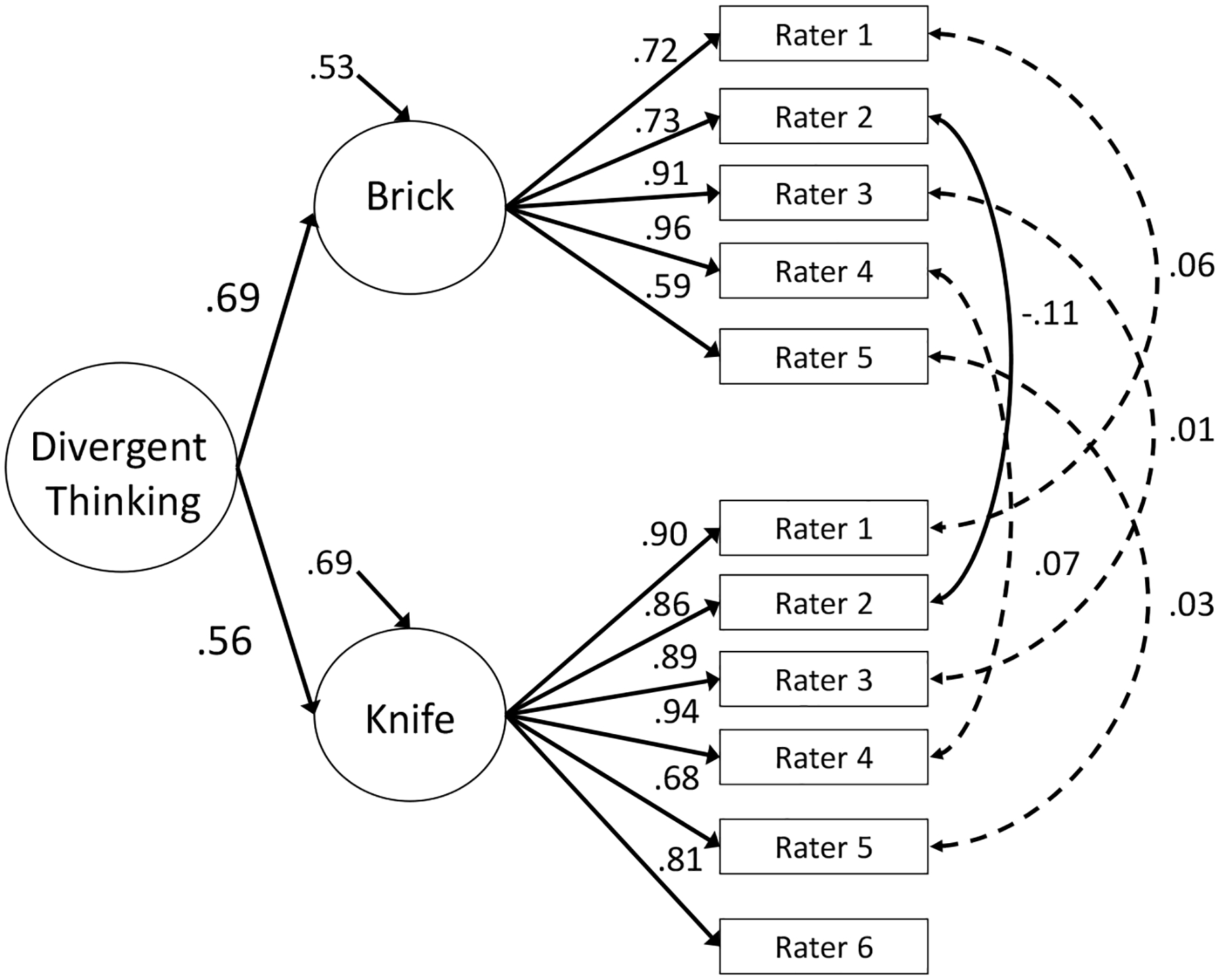
Measurement model for the divergent thinking construct (average scores). Brick = unusual uses for a brick task; Knife = unusual uses for a knife task. Dotted arrows represent non-significant paths.
Confirmatory Factor Analysis of the Cognitive Correlates of Divergent Thinking
Our next analysis focused on the relations between our executive control constructs and divergent thinking, all measured in the laboratory. Specifically, we conducted a confirmatory factor analysis including latent factors for each cognitive ability construct and the divergent thinking hierarchical construct presented above. This model provided an adequate fit to the data, χ2(333) = 681.68, CFI =.943, TLI = .936, RMSEA = .048 [.043, .053], SRMR = .046. Figure 2 displays the model (factor loadings for the manifest variables are presented in Table 5). Both WMC and attention control (failures) correlated modestly with higher divergent thinking scores, with higher ability scores associated with more creative divergent thinking responses. TUT rates during the laboratory tasks, however, did not correlate significantly with divergent thinking creativity ratings (path estimate = −.002).
Figure 2.

Confirmatory factor analysis of the cognitive correlates of divergent thinking average scores. WMC = working memory capacity; Attention Control = attention control (failures); TUT rate = task-unrelated thought rate; Brick = unusual uses for a brick task; Knife = unusual uses for a knife task. Dotted arrows represent non-significant paths. Factor loadings for manifest variables are presented in Table 5. The path estimate between TUT rate and Divergent thinking (−.00), is negative when expressed to three decimal places.
Table 5.
Standardized Factor Loadings (and Standard Errors) for Latent Variable Models
| Construct and Measure | Model Name | ||
|---|---|---|---|
| Full Lab Divergent Thinking CFA | Full Lab Divergent Thinking Bifactor | ESM Divergent Thinking CFA | |
| WMC/WMC resid | |||
| OPERSPAN | .66 (.04) | .74 (.07) | .60 (.06) |
| READSPAN | .54 (.05) | .61 (.07) | .42 (.07) |
| SYMSPAN | .61 (.04) | .39 (.06) | .55 (.07) |
| ROTSPAN | .53 (.05) | .35 (.06) | .58 (.07) |
| RUNSPAN | .61 (.04) | .44 (.06) | .59 (.07) |
| UPDATING | .59 (.04) | .30 (.06) | .60 (.06) |
| Attention Control | |||
| ANTI-LETTER | .75 (.03) | .70 (.05) | |
| ANTI-ARROW | .73 (.04) | .67 (.05) | |
| SART d’ | −.50 (.05) | −.50 (.06) | |
| SART RTSD | .49 (.05) | .55 (.06) | |
| S-STROOP | .28 (.06) | .34 (.07) | |
| N-STROOP | .35 (.05) | .37 (.07) | |
| TUT/TUT resid | |||
| SART TUT | .63 (.04) | .60 (.05) | .65 (.06) |
| N-STROOP TUTS | .69 (.04) | .69 (.05) | .66 (.05) |
| ARROW FLANKER TUTS | .67 (.04) | .68 (.05) | .60 (.06) |
| LETTER FLANKER TUTS | .52 (.05) | .48 (.05) | .51 (.07) |
| N-BACK TUTS | .64 (.04) | .53 (.05) | .66 (.05) |
| Common Executive | |||
| OPERSPAN | −.32 (.05) | ||
| READSPAN | −.26 (.05) | ||
| SYMSPAN | −.44 (.05) | ||
| ROTSPAN | −.41 (.05) | ||
| RUNSPAN | −.38 (.05) | ||
| UPDATING | −.45 (.05) | ||
| ANTI-LETTER | .74 (.03) | ||
| ANTI-ARROW | .74 (.04) | ||
| SART d’ | −.49 (.05) | ||
| SART RTSD | .49 (.05) | ||
| S-STROOP | .30 (.05) | ||
| N-STROOP | .35 (.05) | ||
| SART TUT | .19 (.05) | ||
| N-STROOP TUTS | .21 (.05) | ||
| ARROW FLANKER TUTS | .18 (.05) | ||
| LETTER FLANKER TUTS | .18 (.05) | ||
| N-BACK TUTS | .34 (.05) | ||
| Brick | |||
| RATER 1 | .72 (.03) | .72 (.03) | .66 (.04) |
| RATER 2 | .73 (.02) | .73 (.02) | .71 (.03) |
| RATER 3 | .91 (.01) | .91 (.01) | .90 (.02) |
| RATER 4 | .96 (.01) | .96 (.01) | .96 (.02) |
| RATER 5 | .59 (.03) | .59 (.03) | .47 (.05) |
| Knife | |||
| RATER 1 | .90 (.01) | .90 (.01) | .92 (.01) |
| RATER 2 | .86 (.01) | .86 (.01) | .89 (.02) |
| RATER 3 | .89 (.01) | .89 (.01) | .91 (.01) |
| RATER 4 | .94 (.01) | .94 (.02) | .93 (.01) |
| RATER 5 | .68 (.03) | .68 (.01) | .72 (.03) |
| RATER 6 | .81 (.02) | .81 (.03) | .85 (.02) |
Note. ESM = experience sampling measurement; OPERSPAN = operation span; READSPAN = reading span; SYMMSPAN = symmetry span; ROTASPAN = rotation span; RUNNSPAN = running span; COUNTERS = updating counters; ANTI-ARROW = antisaccade with arrow stimuli; ANTI-LETTER = antisaccade with letter stimuli; SART = sustained attention to response task; RTSD = intrasubject standard deviation in RT from SART; S-Stroop = spatial Stroop; N-Stroop = number Stroop; TUTs = rate of task-unrelated thoughts from task. R1–R6 = divergent thinking raters 1–6.
Bifactor Model of Cognitive Correlates of Divergent Thinking
Following conceptually from the model tested by Frith et al. (2021), we next assessed whether the variance common to all our executive control measures, or the residual variance shared among the WMC tasks or among TUT rates, predicted divergent thinking scores. To do so, we created a bifactor model in which all cognitive indicators loaded onto a common executive control factor, indicating variance shared across the indicator measures. We also specified residual (orthogonal) WMC and TUT rate factors, indicating unique variance to WMC and TUT rates, after accounting for the general executive factor variance.
The bifactor model adequately fit the data, χ2(325) = 647.10, CFI =.948, TLI = .939, RMSEA = .047 [.041, .052], SRMR = .043. The resulting structural model is displayed in Figure 3 (factor loadings are presented in Table 5). Consistent with Frith et al. (2021), divergent thinking ability was significantly predicted by general executive failures (β = −.20, p = .006). Further, neither of the specific (residual) factors significantly predicted divergent thinking: residual WMC (β = .07, p = .369), residual TUT rate (β = .07, p = .352). Thus, the associations of WMC and attention control with divergent thinking scores are due to their shared executive-control-related variance.
Figure 3.

Bifactor model of executive control correlates of divergent thinking scores. Executive control = variance common to all working memory capacity (WMC), attention control, and task-unrelated thought (TUT) rate indicators; WMCresid = variance shared among WMC task scores after accounting for shared executive control variance; TUTresid = variance shared among TUT rates after accounting for shared executive control variance; Brick = unusual uses for a brick task; Knife = unusual uses for a knife task. Dotted arrows = nonsignificant paths. Factor loadings for manifest variables are presented in Table 5.
Confirmatory Factor Analysis Including Daily-Life Mind-wandering Rate
Our next analysis included only the subsample of subjects who completed the daily-life experience-sampling study reported in Kane et al. (2017), in addition to the laboratory tasks reported by Kane et al. (2016). We used the laboratory-task data, including divergent thinking, from these 264 subjects and added the manifest variable for their daily-life TUT rate. Descriptive statistics for the divergent thinking measures are reported in Table 3 and correlations among the measures are reported in Table 4.
Table 3.
Descriptive statistics of Divergent Thinking measures and daily life mind wandering for subsample of subjects completing the daily-life experience sampling study.
| M | SD | Min | Max | Skew | Kurtosis | N | |
|---|---|---|---|---|---|---|---|
| DAILY LIFE TUTS | 0.32 | 0.16 | 0.02 | 0.97 | 0.74 | 0.61 | 266 |
| AVERAGE DIVERGENT THINKING RATING | |||||||
| KNIFE R1 | 2.44 | 0.60 | 1.00 | 5.00 | 0.17 | 0.59 | 263 |
| KNIFE R2 | 1.80 | 0.44 | 1.00 | 4.00 | 0.73 | 1.90 | 263 |
| KNIFE R3 | 2.03 | 0.44 | 1.00 | 4.00 | 0.42 | 1.02 | 265 |
| KNIFE R4 | 2.02 | 0.43 | 1.00 | 3.20 | 0.14 | −0.10 | 263 |
| KNIFE R5 | 2.29 | 0.37 | 1.00 | 3.29 | −0.07 | −0.12 | 265 |
| KNIFE R6 | 1.83 | 0.52 | 1.00 | 3.40 | 0.47 | −0.24 | 265 |
| BRICK R1 | 2.76 | 0.37 | 1.00 | 3.75 | −0.79 | 2.22 | 261 |
| BRICK R2 | 1.74 | 0.35 | 1.00 | 3.14 | 0.40 | 0.58 | 261 |
| BRICK R3 | 2.11 | 0.35 | 1.00 | 3.00 | −0.31 | 0.38 | 261 |
| BRICK R4 | 1.95 | 0.37 | 1.00 | 2.87 | 0.04 | −0.12 | 261 |
| BRICK R5 | 2.07 | 0.38 | 1.00 | 4.00 | 2.01 | 8.59 | 261 |
| NUMBER OF 4/5 DIVERGENT THINKING RATING | |||||||
| KNIFE R1 | 0.88 | 1.27 | 0.00 | 9.00 | 2.39 | 8.58 | 265 |
| KNIFE R2 | 0.15 | 0.45 | 0.00 | 3.00 | 3.54 | 14.36 | 265 |
| KNIFE R3 | 0.28 | 0.59 | 0.00 | 3.00 | 2.33 | 5.39 | 265 |
| KNIFE R4 | 0.43 | 0.79 | 0.00 | 5.00 | 2.35 | 6.68 | 265 |
| KNIFE R5 | 0.25 | 0.63 | 0.00 | 4.00 | 2.97 | 9.54 | 265 |
| KNIFE R6 | 0.34 | 0.57 | 0.00 | 3.00 | 1.55 | 2.02 | 265 |
| BRICK R1 | 1.69 | 1.72 | 0.00 | 11.00 | 1.87 | 5.11 | 261 |
| BRICK R2 | 0.31 | 0.58 | 0.00 | 4.00 | 2.20 | 6.58 | 261 |
| BRICK R3 | 0.42 | 0.75 | 0.00 | 5.00 | 2.38 | 7.52 | 261 |
| BRICK R4 | 0.55 | 0.90 | 0.00 | 5.00 | 2.21 | 5.84 | 261 |
| BRICK R5 | 0.39 | 0.63 | 0.00 | 3.00 | 1.55 | 1.93 | 261 |
Notes. R1–R6 = divergent thinking raters 1–6.
Subjects reported TUTs at 32% of the daily-life thought probes, on average, with considerable variation around that mean (SD = 16%; Min = 2%; Max = 97%). Daily-life TUT rates, moreover, correlated much less strongly with the laboratory-task TUT rates (Mdn r = .05) than the laboratory-task TUT rates correlated with each other (Mdn r = .41). Finally, daily-life TUT rates showed almost no correlation with any of the rater-specific scores for either divergent thinking task (Mdn r = .00).
As shown in Appendix A (Figure A1), the hierarchical measurement model of divergent thinking also fit the data from this subsample of subjects who completed the daily life assessment. We therefore conducted a CFA including latent factors for WMC, attention control (failures), laboratory-task TUT rate, and a manifest variable for daily-life TUT rate, along with the hierarchical divergent thinking construct. This model provided an adequate fit to the data, χ2(357) = 528.18, CFI =.951, TLI = .944, RMSEA [90% CI] = .043 [.035, .050], SRMR = .053. The resulting model is displayed in Figure 4 (factor loadings of manifest variables are presented in Table 5).
Figure 4.

Confirmatory factor analysis of the cognitive correlates of divergent thinking, for the subject subsample who completed the daily-life experience sampling study.. WMC = working memory capacity; Attention Control = attention control (failures); TUT rate = task-unrelated thought rate from laboratory tasks; Daily-Life TUT rate = task-unrelated thought rate during daily-life experience sampling; Brick = unusual uses for a brick task; Knife = unusual uses for a knife task. Dotted arrows represent non-significant paths. Factor loadings for manifest variables are presented in Table 5.
In this reduced sample, WMC did not correlate significantly with divergent thinking creativity ratings (p = .070), although the association was in the same direction with a comparable effect size to the full-sample model. Attention control (failures) did again correlate significantly, but modestly, with divergent thinking scores. TUT rates measured during laboratory tasks and in daily-life were weakly and nonsignificantly correlated with each other, and both showed near-zero, nonsignificant correlations with divergent thinking.
Scoring Divergent Thinking for Highly Creative Responses
Modeling creativity as an average rating across generated ideas will penalize subjects who produce some uncreative ideas, even if they also produce some highly creative ideas. Averaging all ratings, then, might conflate creative output with idea discernment (or metacognition about creativity). Perhaps the increased mind-wandering that comes with poorer attention control really does allow people better access to more creative ideas, but if that poorer attention control also causes those people to blurt out obvious responses before landing upon more novel ones, its benefit is functionally negated.
As an alternative scoring method to capture primarily peak creativity rather than discernment, then, we counted the total number of highly creative responses (ideas rated as a 4 or 5) for each rater for each subject; these scores reflect the frequency of a subject’s highly creative ideas independent of their worst ideas. We followed the same multivariate outlier procedure as before, with highly creative responses as the divergent thinking measure rather than average ratings. Our multivariate outlier screening identified 21 outliers who were removed before performing analyses using highly creative responses (this resulted in different Ns reported in Tables 1 and 3).
We used the same modeling approach in examining the relationship between (highly creative) Divergent Thinking and executive abilities in both the lab and daily-life samples. Descriptive statistics for these measures are presented in Tables 1 and 3 for the lab and the reduced daily-life samples, respectively. Zero-order correlations between the cognitive measures and these highly creative response scores are presented in Tables 6 and 7 for the lab and daily-life samples, respectively. Despite the high (positive) skewness and kurtosis of the highly creative scores, they correlated strongly across raters and moderately across brick and knife tasks.3
Table 6.
Zero-order correlations of full lab sample using the number of highly creative responses from divergent thinking tasks (number of creativity ratings of 4 or 5)
| Variable | 1 | 2 | 3 | 4 | 5 | 6 | 7 | 8 | 9 | 10 | 11 | 12 | 13 | 14 | 15 | 16 | 17 | 18 | 19 | 20 | 21 | 22 | 23 | 24 | 25 | 26 | 27 | 28 |
|---|---|---|---|---|---|---|---|---|---|---|---|---|---|---|---|---|---|---|---|---|---|---|---|---|---|---|---|---|
| 1 OPERSPAN | 1 | |||||||||||||||||||||||||||
| 2 READSPAN | 0.57 | 1 | ||||||||||||||||||||||||||
| 3 SYMSPAN | 0.39 | 0.32 | 1 | |||||||||||||||||||||||||
| 4 ROTSPAN | 0.48 | 0.32 | 0.61 | 1 | ||||||||||||||||||||||||
| 5 RUNNSPAN | 0.42 | 0.31 | 0.24 | 0.20 | 1 | |||||||||||||||||||||||
| 6 COUNTERS | 0.29 | 0.18 | 0.32 | 0.29 | 0.42 | 1 | ||||||||||||||||||||||
| 7 ANTI-ARROW | −0.21 | −0.09 | −0.25 | −0.37 | −0.24 | −0.29 | 1 | |||||||||||||||||||||
| 8 ANTI-LETTER | −0.14 | −0.08 | −0.26 | −0.23 | −0.23 | −0.31 | 0.57 | 1 | ||||||||||||||||||||
| 9 SART d’ | 0.10 | 0.15 | 0.22 | 0.14 | 0.15 | 0.19 | −0.24 | −0.34 | 1 | |||||||||||||||||||
| 10 SART RTSD | −0.14 | −0.16 | −0.30 | −0.20 | −0.21 | −0.21 | 0.25 | 0.37 | −0.60 | 1 | ||||||||||||||||||
| 11 S-STROOP | 0.01 | 0.00 | −0.08 | −0.20 | −0.03 | −0.06 | 0.21 | 0.17 | −0.16 | 0.20 | 1 | |||||||||||||||||
| 12 N-STROOP | −0.11 | 0.02 | −0.14 | −0.16 | −0.05 | −0.14 | 0.24 | 0.22 | −0.20 | 0.23 | 0.15 | 1 | ||||||||||||||||
| 13 LETTER FLANKER TUTS | 0.13 | 0.08 | −0.10 | 0.03 | 0.12 | 0.01 | 0.07 | 0.15 | −0.22 | 0.31 | 0.22 | 0.15 | 1 | |||||||||||||||
| 14 SART TUTS | 0.04 | −0.13 | −0.10 | −0.07 | 0.06 | −0.02 | 0.06 | 0.12 | −0.18 | 0.31 | 0.12 | 0.16 | 0.45 | 1 | ||||||||||||||
| 15 N-STROOP TUTS | −0.08 | −0.14 | −0.02 | −0.03 | −0.07 | −0.04 | 0.13 | 0.13 | −0.25 | 0.23 | 0.06 | 0.24 | 0.34 | 0.46 | 1 | |||||||||||||
| 16 ARROW FLANKER TUTS | −0.05 | −0.09 | −0.01 | 0.01 | −0.05 | −0.07 | 0.08 | 0.16 | −0.21 | 0.20 | −0.01 | 0.24 | 0.36 | 0.39 | 0.68 | 1 | ||||||||||||
| 17 2-BACK TUTS | −0.02 | −0.02 | −0.02 | −0.09 | −0.14 | −0.12 | 0.26 | 0.18 | −0.27 | 0.33 | 0.26 | 0.13 | 0.31 | 0.42 | 0.43 | 0.37 | 1 | |||||||||||
| 18 KNIFE R1 4/5 | −0.01 | −0.05 | −0.01 | 0.04 | −0.01 | 0.02 | 0.02 | 0.02 | −0.02 | −0.03 | 0.03 | 0.07 | 0.04 | 0.11 | 0.05 | 0.08 | 0.02 | 1 | ||||||||||
| 19 KNIFE R2 4/5 | −0.03 | 0.04 | 0.05 | 0.04 | 0.07 | 0.10 | −0.02 | −0.04 | 0.02 | 0.00 | 0.08 | −0.04 | 0.05 | −0.04 | −0.02 | 0.08 | −0.03 | 0.02 | 1 | |||||||||
| 20 KNIFE R3 4/5 | 0.04 | 0.09 | 0.01 | 0.01 | 0.07 | 0.18 | −0.06 | −0.03 | 0.10 | −0.07 | −0.01 | 0.04 | 0.03 | 0.00 | 0.05 | 0.06 | −0.03 | −0.08 | 0.43 | 1 | ||||||||
| 21 KNIFE R4 4/5 | −0.09 | 0.06 | 0.01 | −0.04 | 0.08 | 0.11 | 0.02 | −0.06 | −0.03 | −0.03 | 0.00 | 0.06 | 0.02 | 0.01 | 0.06 | 0.00 | −0.08 | 0.03 | 0.50 | 0.42 | 1 | |||||||
| 22 KNIFE R5 4/5 | −0.11 | −0.05 | 0.05 | −0.06 | 0.09 | 0.10 | −0.06 | −0.07 | 0.04 | −0.03 | −0.01 | 0.00 | 0.02 | 0.00 | 0.02 | 0.08 | −0.02 | −0.01 | 0.48 | 0.42 | 0.36 | 1 | ||||||
| 23 KNIFE R6 4/5 | 0.08 | 0.00 | 0.08 | 0.04 | 0.11 | 0.10 | −0.08 | −0.07 | −0.05 | −0.02 | 0.00 | −0.05 | 0.04 | 0.05 | 0.05 | 0.05 | 0.00 | −0.09 | 0.59 | 0.42 | 0.58 | 0.51 | 1 | |||||
| 24 BRICK R1 4/5 | −0.04 | −0.02 | 0.02 | 0.04 | 0.09 | 0.07 | 0.00 | 0.04 | −0.06 | 0.07 | 0.03 | 0.10 | 0.00 | 0.13 | 0.08 | 0.08 | 0.07 | 0.00 | 0.42 | 0.39 | 0.28 | 0.43 | 0.43 | 1 | ||||
| 25 BRICK R2 4/5 | 0.08 | 0.11 | 0.06 | 0.01 | 0.10 | 0.04 | −0.09 | −0.08 | 0.18 | −0.13 | −0.01 | −0.05 | 0.01 | 0.06 | 0.00 | −0.02 | 0.03 | 0.01 | 0.31 | 0.39 | 0.25 | 0.21 | 0.32 | 0.29 | 1 | |||
| 26 BRICK R3 4/5 | 0.14 | 0.10 | 0.09 | 0.00 | 0.11 | 0.06 | −0.05 | −0.10 | 0.05 | 0.00 | −0.09 | −0.06 | 0.07 | 0.04 | −0.04 | −0.06 | −0.07 | −0.01 | 0.25 | 0.27 | 0.12 | 0.10 | 0.23 | 0.32 | 0.52 | 1 | ||
| 27 BRICK R4 4/5 | 0.08 | 0.11 | 0.06 | −0.02 | 0.03 | 0.06 | −0.12 | −0.15 | 0.10 | −0.09 | −0.09 | −0.07 | −0.04 | 0.00 | 0.08 | −0.01 | 0.02 | −0.02 | 0.27 | 0.23 | 0.18 | 0.09 | 0.28 | 0.23 | 0.52 | 0.48 | 1 | |
| 28 BRICK R5 4/5 | 0.05 | 0.07 | 0.07 | −0.03 | −0.02 | 0.03 | −0.10 | −0.14 | 0.08 | −0.09 | −0.08 | −0.12 | −0.06 | −0.02 | 0.10 | −0.01 | 0.01 | 0.04 | 0.24 | 0.20 | 0.16 | 0.09 | 0.27 | 0.22 | 0.54 | 0.50 | 0.91 | 1 |
Notes. OPERSPAN = operation span; READSPAN = reading span; SYMMSPAN = symmetry span; ROTASPAN = rotation span; RUNNSPAN = running span; COUNTERS = updating counters; ANTI-ARROW = antisaccade with arrow stimuli; ANTI-LETTER = antisaccade with letter stimuli; SART = sustained attention to response task; RTSD = intrasubject standard deviation in RT from SART; S-Stroop = spatial Stroop; N-Stroop = number Stroop; TUTs = rate of task-unrelated thoughts from task; KNIFE = number of creativity ratings of 4 or 5 for uses of a knife; BRICK = number of creativity ratings of 4 or 5 for uses of a brick; R1–R6 = divergent thinking raters 1–6.
Table 7.
Zero-order correlations for the subsample who completed the daily-life experience sampling study using the number of highly creative responses from divergent thinking tasks (number of creativity ratings of 4 or 5).
| Variable | 1 | 2 | 3 | 4 | 5 | 6 | 7 | 8 | 9 | 10 | 11 | 12 | 13 | 14 | 15 | 16 | 17 | 18 | 19 | 20 | 21 | 22 | 23 | 24 | 25 | 26 | 27 | 28 | 29 |
|---|---|---|---|---|---|---|---|---|---|---|---|---|---|---|---|---|---|---|---|---|---|---|---|---|---|---|---|---|---|
| 1 OPERSPAN | 1 | ||||||||||||||||||||||||||||
| 2 READSPAN | 0.56 | 1 | |||||||||||||||||||||||||||
| 3 SYMSPAN | 0.39 | 0.31 | 1 | ||||||||||||||||||||||||||
| 4 ROTSPAN | 0.48 | 0.31 | 0.62 | 1 | |||||||||||||||||||||||||
| 5 RUNNSPAN | 0.43 | 0.32 | 0.23 | 0.21 | 1 | ||||||||||||||||||||||||
| 6 COUNTERS | 0.29 | 0.17 | 0.32 | 0.30 | 0.42 | 1 | |||||||||||||||||||||||
| 7 ANTI-ARROW | −0.22 | −0.08 | −0.26 | −0.39 | −0.23 | −0.30 | 1 | ||||||||||||||||||||||
| 8 ANTI-LETTER | −0.14 | −0.07 | −0.27 | −0.24 | −0.21 | −0.32 | 0.56 | 1 | |||||||||||||||||||||
| 9 SART d’ | 0.10 | 0.13 | 0.23 | 0.15 | 0.15 | 0.20 | −0.25 | −0.36 | 1 | ||||||||||||||||||||
| 10 SART RTSD | −0.14 | −0.15 | −0.30 | −0.21 | −0.21 | −0.21 | 0.26 | 0.38 | −0.61 | 1 | |||||||||||||||||||
| 11 S-STROOP | 0.00 | 0.02 | −0.12 | −0.22 | −0.04 | −0.11 | 0.23 | 0.17 | −0.23 | 0.27 | 1 | ||||||||||||||||||
| 12 N-STROOP | −0.11 | 0.03 | −0.15 | −0.16 | −0.06 | −0.15 | 0.25 | 0.23 | −0.20 | 0.23 | 0.17 | 1 | |||||||||||||||||
| 13 LETTER FLANKER TUTS | 0.13 | 0.08 | −0.11 | 0.03 | 0.13 | 0.01 | 0.07 | 0.15 | −0.22 | 0.32 | 0.21 | 0.15 | 1 | ||||||||||||||||
| 14 SART TUTS | 0.04 | −0.12 | −0.11 | −0.07 | 0.06 | −0.03 | 0.07 | 0.12 | −0.19 | 0.31 | 0.11 | 0.17 | 0.45 | 1 | |||||||||||||||
| 15 N-STROOP TUTS | −0.09 | −0.13 | −0.03 | −0.03 | −0.06 | −0.05 | 0.14 | 0.14 | −0.26 | 0.23 | 0.06 | 0.24 | 0.34 | 0.46 | 1 | ||||||||||||||
| 16 ARROW FLANKER TUTS | −0.05 | −0.09 | −0.01 | 0.00 | −0.05 | −0.07 | 0.08 | 0.16 | −0.21 | 0.20 | 0.02 | 0.25 | 0.37 | 0.40 | 0.69 | 1 | |||||||||||||
| 17 2-BACK TUTS | −0.02 | −0.01 | −0.03 | −0.10 | −0.14 | −0.13 | 0.26 | 0.19 | −0.28 | 0.33 | 0.30 | 0.13 | 0.31 | 0.42 | 0.43 | 0.38 | 1 | ||||||||||||
| 18 DAILY LIFE TUTs | −0.02 | −0.04 | −0.02 | 0.04 | −0.01 | 0.01 | 0.02 | 0.02 | −0.04 | −0.02 | −0.04 | 0.07 | 0.03 | 0.11 | 0.05 | 0.09 | 0.02 | 1 | |||||||||||
| 19 KNIFE R1 4/5 | 0.03 | 0.08 | 0.06 | 0.00 | 0.09 | 0.04 | −0.07 | −0.02 | 0.04 | −0.06 | −0.07 | 0.10 | −0.04 | 0.00 | −0.05 | 0.04 | −0.08 | 0.00 | 1 | ||||||||||
| 20 KNIFE R2 4/5 | 0.05 | 0.07 | 0.05 | 0.00 | 0.05 | 0.04 | −0.04 | −0.04 | 0.06 | −0.03 | −0.06 | 0.10 | −0.01 | 0.02 | 0.00 | 0.03 | −0.07 | 0.03 | 0.83 | 1 | |||||||||
| 21 KNIFE R3 4/5 | 0.02 | 0.05 | 0.02 | −0.08 | 0.09 | 0.06 | 0.01 | 0.01 | 0.01 | −0.06 | −0.04 | 0.07 | −0.10 | 0.00 | 0.03 | 0.04 | −0.06 | 0.04 | 0.83 | 0.80 | 1 | ||||||||
| 22 KNIFE R4 4/5 | 0.03 | −0.01 | 0.05 | −0.09 | 0.07 | 0.05 | −0.03 | −0.01 | 0.03 | −0.03 | −0.07 | 0.04 | −0.05 | 0.02 | 0.00 | 0.03 | −0.06 | 0.00 | 0.84 | 0.80 | 0.87 | 1 | |||||||
| 23 KNIFE R5 4/5 | −0.06 | −0.02 | 0.01 | 0.03 | 0.08 | 0.08 | −0.05 | −0.01 | 0.02 | 0.04 | −0.08 | 0.11 | −0.05 | 0.10 | −0.01 | −0.01 | −0.09 | 0.06 | 0.70 | 0.65 | 0.64 | 0.64 | 1 | ||||||
| 24 KNIFE R6 4/5 | −0.03 | 0.05 | 0.09 | −0.01 | 0.06 | 0.02 | −0.03 | 0.00 | 0.07 | −0.01 | −0.03 | 0.01 | −0.05 | −0.01 | −0.04 | 0.01 | −0.03 | 0.01 | 0.80 | 0.76 | 0.76 | 0.77 | 0.64 | 1 | |||||
| 25 BRICK R1 4/5 | 0.10 | 0.09 | 0.02 | 0.06 | 0.03 | 0.06 | −0.06 | −0.13 | 0.08 | −0.02 | −0.05 | 0.03 | −0.01 | 0.06 | 0.00 | 0.00 | 0.00 | 0.02 | 0.30 | 0.27 | 0.22 | 0.27 | 0.29 | 0.24 | 1 | ||||
| 26 BRICK R2 4/5 | 0.12 | 0.10 | 0.08 | 0.13 | 0.04 | 0.10 | −0.10 | −0.13 | 0.03 | 0.03 | −0.02 | −0.08 | 0.06 | 0.04 | 0.04 | −0.06 | −0.01 | −0.03 | 0.21 | 0.18 | 0.19 | 0.26 | 0.25 | 0.19 | 0.49 | 1 | |||
| 27 BRICK R3 4/5 | 0.05 | 0.04 | 0.13 | 0.10 | 0.04 | 0.09 | −0.13 | −0.17 | 0.06 | −0.04 | −0.05 | −0.02 | −0.04 | 0.00 | 0.00 | −0.04 | −0.01 | −0.02 | 0.32 | 0.33 | 0.28 | 0.33 | 0.31 | 0.26 | 0.62 | 0.59 | 1 | ||
| 28 BRICK R4 4/5 | 0.10 | 0.04 | 0.10 | 0.06 | 0.02 | 0.06 | −0.13 | −0.18 | 0.11 | −0.06 | −0.01 | −0.03 | −0.01 | 0.01 | 0.01 | −0.08 | 0.00 | 0.00 | 0.29 | 0.33 | 0.27 | 0.33 | 0.29 | 0.25 | 0.60 | 0.69 | 0.87 | 1 | |
| 29 BRICK R5 4/5 | 0.13 | −0.04 | 0.07 | 0.06 | −0.01 | 0.14 | −0.13 | −0.15 | 0.20 | −0.07 | −0.04 | −0.07 | 0.00 | 0.00 | −0.05 | −0.06 | 0.01 | −0.13 | 0.12 | 0.09 | 0.08 | 0.20 | 0.14 | 0.16 | 0.40 | 0.41 | 0.36 | 0.41 | 1 |
Notes. OPERSPAN = operation span; READSPAN = reading span; SYMMSPAN = symmetry span; ROTASPAN = rotation span; RUNNSPAN = running span; COUNTERS = updating counters; ANTI-ARROW = antisaccade with arrow stimuli; ANTI-LETTER = antisaccade with letter stimuli; SART = sustained attention to response task; RTSD = intrasubject standard deviation in RT from SART; S-Stroop = spatial Stroop; N-Stroop = number Stroop; TUTs = rate of task-unrelated thoughts from task; KNIFE = number of creativity ratings of 4 or 5 for uses of a knife; BRICK = number of creativity ratings of 4 or 5 for uses of a brick; R1–R6 = divergent thinking raters 1–6.
Measurement Model of Highly Creative Divergent Thinking Scores
We first tested the measurement model of highly creative divergent thinking responses, to ensure that the hierarchical structure fit the data adequately. It did: χ2(38) = 152.22, CFI =.938, TLI = .910, RMSEA [90% CI] = .082 [.069, .096], SRMR = .061; again, all raters’ scores loaded significantly onto their respective task factor (again, note that one rater scored only the Knife task). As well, the first order Brick and Knife factors loaded significantly onto the second-order divergent thinking factor (see Figure 5). Thus, we maintained this hierarchical structure of high creativity ratings to examine associations with other variables of interest.
Figure 5.

Measurement model for the divergent thinking construct. Brick = unusual uses for a brick task; Knife = unusual uses for a knife task. Dotted arrows represent non-significant paths.
Confirmatory Factor Analysis of the Cognitive Correlates of Highly Creative Divergent Thinking Scores
We next conducted a CFA including latent factors for WMC, attention control (failures), laboratory-task TUT rate, along with the hierarchical divergent thinking construct. This model provided an adequate fit to the data, χ2(333) = 620.05, CFI =.926, TLI = .916, RMSEA [90% CI] = .044 [.039, .490], SRMR = .052. The resulting model is displayed in Figure 6 (factor loadings of manifest variables are presented in Table 8). None of the cognitive factors were significantly associated with highly creative responses (ps > .093).
Figure 6.

Confirmatory factor analysis of the cognitive correlates of highly creative divergent thinking responses. WMC = working memory capacity; Attention Control = attention control (failures); TUT rate = task-unrelated thought rate; Brick = unusual uses for a brick task; Knife = unusual uses for a knife task. Dotted arrows represent non-significant paths. Factor loadings for manifest variables are presented in Table 8.
Table 8.
Standardized Factor Loadings (and Standard Errors) for Highly Creative Response Models.
| Construct and Measure | Model Name | ||
|---|---|---|---|
| Full Lab Divergent Thinking CFA | Full Lab Divergent Thinking Bifactor | ESM Divergent Thinking CFA | |
| WMC/WMC resid | |||
| OPERSPAN | .68 (.04) | .75 (.07) | .59 (.06) |
| READSPAN | .52 (.05) | .57 (.07) | .41 (.07) |
| SYMSPAN | .61 (.04) | .40 (.06) | .55 (.07) |
| ROTSPAN | .53 (.05) | .36 (.06) | .56 (.07) |
| RUNSPAN | .60 (.04) | .45 (.06) | .59 (.07) |
| UPDATING | .61 (.04) | .32 (.06) | .61 (.06) |
| Attention Control | |||
| ANTI-LETTER | .76 (.03) | .69 (.05) | |
| ANTI-ARROW | .73 (.04) | .65 (.05) | |
| SART d’ | −.50 (.05) | −.51 (.06) | |
| SART RTSD | .51 (.05) | .57 (.06) | |
| S-STROOP | .28 (.06) | .37 (.07) | |
| N-STROOP | .35 (.05) | .37 (.07) | |
| TUT/TUT resid | |||
| SART TUT | .62 (.04) | .58 (.05) | .64 (.05) |
| N-STROOP TUTS | .70 (.04) | .70 (.05) | .67 (.05) |
| ARROW FLANKER TUTS | .66 (.04) | .67 (.05) | .62 (.06) |
| LETTER FLANKER TUTS | .50 (.05) | .46 (.05) | .49 (.07) |
| N-BACK TUTS | .65 (.04) | .56 (.05) | .68 (.05) |
| Common Executive | |||
| OPERSPAN | −.33 (.05) | ||
| READSPAN | −.26 (.05) | ||
| SYMSPAN | −.43 (.05) | ||
| ROTSPAN | −.40 (.05) | ||
| RUNSPAN | −.37 (.05) | ||
| UPDATING | −.46 (.05) | ||
| ANTI-LETTER | .75 (.03) | ||
| ANTI-ARROW | .74 (.04) | ||
| SART d’ | −.48 (.05) | ||
| SART RTSD | .49 (.05) | ||
| S-STROOP | .39 (.05) | ||
| N-STROOP | .35 (.05) | ||
| SART TUT | .19 (.05) | ||
| N-STROOP TUTS | .21 (.05) | ||
| ARROW FLANKER TUTS | .18 (.05) | ||
| LETTER FLANKER TUTS | .17 (.05) | ||
| N-BACK TUTS | .32 (.05) | ||
| Brick 4/5 | |||
| RATER 1 | .51 (.04) | .51 (.04) | .54 (.05) |
| RATER 2 | .42 (.04) | .42 (.04) | .47 (.05) |
| RATER 3 | .94 (.01) | .94 (.01) | .94 (.01) |
| RATER 4 | .97 (.01) | .97 (.01) | .97 (.01) |
| RATER 5 | .39 (.04) | .39 (.04) | .41 (.05) |
| Knife 4/5 | |||
| RATER 1 | .65 (.04) | .64 (.04) | .70 (.04) |
| RATER 2 | .59 (.04) | .59 (.04) | .64 (.05) |
| RATER 3 | .60 (.04) | .60 (.04) | .53 (.05) |
| RATER 4 | .75 (.03) | .75 (.03) | .73 (.04) |
| RATER 5 | .53 (.04) | .53 (.04) | .53 (.05) |
| RATER 6 | .60 (.04) | .60 (.04) | .62 (.05) |
Note. ESM = experience sampling measurement; OPERSPAN = operation span; READSPAN = reading span; SYMMSPAN = symmetry span; ROTASPAN = rotation span; RUNNSPAN = running span; COUNTERS = updating counters; ANTI-ARROW = antisaccade with arrow stimuli; ANTI-LETTER = antisaccade with letter stimuli; SART = sustained attention to response task; RTSD = intrasubject standard deviation in RT from SART; S-Stroop = spatial Stroop; N-Stroop = number Stroop; TUTs = rate of task-unrelated thoughts from task. R1–R6 = divergent thinking raters 1–6.
Bifactor Model of the Cognitive Correlates of Highly Creative Divergent Thinking Scores
We next created a similar bifactor model of executive control to that reported earlier. The resulting structural model fit the data adequately, χ2(325) = 588.84, CFI =.932, TLI = .921, RMSEA = .043 [.037, .048], SRMR = .050, and is displayed in Figure 7 (factor loadings are presented in Table 8). Unlike in prior models, highly creative divergent thinking scores were significantly predicted by the TUT residual factor (β = .18, p = .029). Neither the general executive control factor nor the specific WMC factor were significant predictors: general executive control (β = −.13, p = .094); residual WMC (β = −.08, p = .379). This is the first evidence we’ve produced for a significantly positive (albeit modest) association between mind-wandering propensity and creative cognition, at least for the variance that is unique to TUT rates after partialing out control-related variation.
Figure 7.

Bifactor model of executive control correlates of highly creative divergent thinking scores. Executive control = variance common to all working memory capacity (WMC), attention control, and task-unrelated thought (TUT) rate indicators; WMCresid = variance shared among WMC task scores after accounting for shared executive control variance; TUTresid = variance shared among TUT rates after accounting for shared executive control variance; Brick = unusual uses for a brick task; Knife = unusual uses for a knife task. Dotted arrows = nonsignificant paths. Factor loadings for manifest variables are presented in Table 8.
Confirmatory Factor Analysis of the Cognitive Correlates of Highly Creative Divergent Thinking in Daily-Life Subsample
We implemented the same modeling approach with the daily life sample and, as shown in the Appendix A (Figure A2), the hierarchical model adequately fit the divergent thinking data for the subsample of subjects who completed the daily-life assessment. We then conducted a confirmatory factor analysis that included latent variables of WMC, attention control, lab TUT rate, and a manifest variable of daily-life TUT rate. This model generally provided adequate fit to the data, although the TLI was just under conventional fit criteria, χ2(357) = 562.37, CFI =.908, TLI = .895, RMSEA [90% CI] = .047 [.040, .055], SRMR = .061. The resulting model is displayed in Figure 8 (factor loadings of manifest variables are presented in Table 8). In this reduced sample, none of the cognitive measures significantly predicted highly creative responses (the attention control correlation was in the similar direction as in other models, but it was not statistically significant, p = .066).
Figure 8.

Confirmatory factor analysis of the cognitive correlates of highly creative divergent thinking responses, for the subject subsample who completed the daily-life experience sampling study.. WMC = working memory capacity; Attention Control = attention control (failures); TUT rate = task-unrelated thought rate from laboratory tasks; Daily-Life TUT rate = task-unrelated thought rate during daily-life experience sampling; Brick = unusual uses for a brick task; Knife = unusual uses for a knife task. Dotted arrows represent non-significant paths. Factor loadings for manifest variables are presented in Table 8.
Do Daydream-Specific TUT Rates Predict Divergent Thinking?
As a final “good effort” attempt (Frick, 1995) to detect a positive association of mind-wandering with divergent thinking, we examined the subset of laboratory TUT reports that subjects classified as “daydreaming,” or fanciful and unrealistic thought. Zedelius et al. (2020) suggested that, whereas TUTs about personal concerns might be useful for solving everyday (more mundane) problems, perhaps more playful and fanciful (and creative) varieties of mind-wandering would be more closely linked to creative thinking and performance. Although their study did not find significant correlations between retrospective questionnaire measures of fantastical daydreaming and divergent thinking, they did not test whether fantastical TUTs probed in the moment might. We therefore considered subjects’ probe responses of “Daydreams” (response option 6 of 8), which were described to subjects as “fantasies or thoughts disconnected from reality.”
As in our previously published analyses of content-specific TUT types with these mind-wandering data (that did not include examination of divergent thinking), we treated daydreaming probe responses as zero-inflated count data (i.e., many subjects within a given task reported no daydreaming experiences; Welhaf et al., 2020, p. 109):
To accommodate these positively skewed data distributions with excessive 0 values, we treated our outcomes as raw counts rather than proportions. Although these counts also were severely skewed and zero-heavy, we could model them using zero-inflated Poisson models. These models combine the logit distribution with the Poisson distribution and assume that counts are generated by two processes (or reflect membership in one of two groups): one process that determines whether any values greater than 0 may occur at all, and a Poisson process that creates count values from 0 upwards [Footnote: The cost of this necessary strategy is that our conclusions about each thought type may not be independent of overall TUT rates. That is, subjects with generally high TUT rates might have relatively high counts in multiple content categories simply because they have more opportunities to report some form of mind-wandering content, and not because they have a specific propensity to experience those types of thought]. For example, the lifetime number of gun crimes that people commit is determined by: (a) whether people have any access to guns (without access, the count cannot exceed 0), and; (b) factors that cause people with access to guns to commit ≥ 0 gun crimes. Scores of 0 are inflated because they may come from either of two sources: people who are “certain 0s” because they could not produce the outcome (e.g., they had no gun access), as well as people who could have produced the outcome but did not (e.g., they had access but committed no offenses).
Predictor variables in zero-inflated Poisson models may be associated with the probability of being in the certain-0 group, or with the count from the Poisson component, or both. For example, being an avid hunter will negatively predict membership in the certain-0 group, but it may or may not positively predict the Poisson-component count of gun crimes…Because we measured thought content during five tasks, we took a latent-variable approach to modeling each thought type, assessing which cognitive and personality variables predicted the likelihood of being in the certain-0 group (a so-called “inflation” latent factor reflecting the logit component), and the propensity for lower versus higher counts (a latent factor reflecting the Poisson component).
Treating daydreaming probe responses as zero-inflated count data had the following implications for our analyses and modeling here (from Welhaf et al., 2020, p. 110):
We did not calculate correlations among measures, nor model them as normally distributed variables…[we ran] confirmatory factor analyses with thought-content counts modeled as zero-inflated Poisson variables…with one latent “inflation” factor for the likelihood of membership in the certain-0 group and a latent factor for the count of the Poisson component. (Factor loadings for these indicators can only be interpreted in their unstandardized form…). Unlike typical latent-variable models, these do not provide interpretable fit statistics beyond Akaike and Bayesian information criteria, which are only useful for comparing one model to another. We do not report these because our goal was not to contrast competing models but rather to estimate correlations among latent factors within a single model type for each variety of TUT.
Confirmatory Factor Analysis of the Associations Between Daydreaming-TUT Counts and Average Divergent Thinking Scores
Using Mplus version 8.3 (Muthén & Muthén, 2017), we first modeled divergent thinking abilities using the mean Brick and Knife scores for each subject (as in Figure 1) and correlated the general divergent thinking factor with the daydreaming inflation (certain-0) factor and the count factor (unstandardized factor loadings for the daydreaming variables are presented in Appendix B; N = 457). All daydream indicators loaded significantly on the count factor, but two indicators on the inflation factor (number Stroop and arrow flanker) did not load significantly (ps = .064 and .085, respectively); as expected, the inflation and count factors correlated negatively (β = −.370, p = .001). Of primary interest, the general divergent thinking factor did not correlate significantly with either the daydreaming inflation factor (β = −.117, p = .310) or the daydreaming count factor (β = .017, p = .839).
Confirmatory Factor Analysis of the Associations Between Daydreaming-TUT Counts and Highly Creative Divergent Thinking Scores
We next assessed whether subjects’ propensity for fantastical daydreaming during lab tasks might correlate with their frequency of generating highly creative divergent thinking responses. We again modeled divergent thinking abilities using the number of 4 or 5 ratings (out of 5) they earned from raters for the Brick and Knife tasks (as in Figure 6) and correlated the general divergent thinking factor with the daydreaming inflation (certain-0) factor and the count factor (unstandardized factor loadings for the daydreaming variables are presented in Appendix B; N = 446). All daydreaming indicators loaded significantly on the count factor, but the arrow flanker indicator did not load significantly onto the inflation factor (p = .066); the inflation and count factors again correlated negatively (β = −.350, p = .002). Although the general divergent thinking factor again did not correlate with the daydreaming inflation factor (β = −.053, p = .630), it did correlate significantly positively with the daydreaming count factor (β = .179, p = .022). Here, then, among people who could have reported some number of daydreaming experiences, those reporting more such experiences also produced more highly creative responses during divergent thinking. Note that daydreaming counts did not correlate with average divergent thinking scores, above.
Discussion
The present work explored the individual-differences relationships among divergent thinking, executive control, and mind-wandering rates taken from laboratory and daily-life contexts. In what constitutes our conceptual replication of Frith et al. (2021), we will start by addressing the key findings related to the associations between divergent thinking scores, executive control performance measures, and lab TUT rates (although Frith et al. [2021] measured general fluid intelligence rather than the related construct of WMC). Then, as a conceptual replication of Zeitlen et al. (2022), we will examine the implications of daily-life mind-wandering rates for creative cognition. Finally, we will discuss some novel and more exploratory findings pertaining to scoring divergent thinking output for highly creative responses and to the relationship between fanciful daydreaming propensity and divergent thinking. After discussing our findings, we will present some limitations relevant to our analyses. We end our discussion with a call for greater theoretical precision in the mind-wandering–creativity debate and provide some possible approaches to the hypothesized association between mind-wandering and creative cognition that we hope may guide the field in future work on this topic.
Executive Control and Divergent Thinking
Our initial analyses, using the full sample of participants and mirroring that of Frith et al. (2021), indicated that both performance factors of executive functioning—WMC and attentional control—were weakly, but significantly, associated with better divergent thinking scores (based on average creativity ratings of subjects’ output). Further, in a bifactor model, only the shared variance among all the executive control measures (including TUT rates), represented by the common executive factor, significantly predicted divergent thinking scores (albeit modestly, again); the residual factors, representing variation unique to WMC and unique to TUT rate, did not. These results support a limited role for focused, deliberate processes in contributing to normal variation in creative cognition and they are consistent with prior research that suggests the importance of executive control processes in creative performance (e.g., Beaty et al., 2014; Benedek et al., 2014; Frith et al., 2021).
In a second line of models, we explored the relationship between our executive control factors and highly creative responding in the divergent thinking tasks, based on the number of high creativity ratings (of 4 or 5 out of 5) that subjects’ output earned. Average creativity ratings reflect the whole of a subject’s output but are less sensitive the peaks of a subject’s creative thinking (Reiter-Palmon et al., 2019; Runco, 1986; Silvia et al., 2008). None of the executive control factors correlated significantly with divergent thinking scored this way. Moreover, in the bifactor model, the common executive factor no longer significantly predicted highly creative responses.
These findings seem to indicate a nuanced relationship between executive control and creative production. Although control abilities might play a role in overall performance on divergent thinking tasks, they may primarily do so by helping high ability subjects to avoid thinking about, or reporting, relatively uncreative ideas, rather than helping them to produce especially novel ideas. Or, perhaps good executive control may facilitate metacognitive reflection about the quality of one’s ideas before emitting them, or enable shifting away from strategies that foster response quantity (e.g., direct retrieval of uses from memory; Gilhooly et al., 2007) toward complex strategies that emphasize idea quality over quantity (Gonthier & Besançon, 2022). We note, however, that the significant executive control correlations with average divergent thinking scores were not much larger than the non-significant correlations with highly creative scores (e.g., for the common executive factor, these path estimates were −.20 versus −.13, respectively). Additional research is thus needed to confirm whether these two facets of divergent thinking output are differentially associated with cognitive ability.
Mind-wandering Propensity and Divergent Thinking
Our confirmatory factor analysis models, replicating Frith et al. (2021), also included measures of TUT rates during laboratory tasks, along with WMC and attention control factors. These in-lab TUT rates were uncorrelated with divergent thinking scores calculated using either mean ratings or the number of high-creativity ratings (with path estimates close to 0). Moreover, in the bifactor executive model, the residual TUT rate factor (independent of the shared executive-control variation across all cognitive predictors) didn’t correlate with average divergent thinking scores. These null results add to previous work challenging the Baird et al. (2012) claim that mind-wandering aids creative cognition (Frith et al., 2021; Murray et al., 2021; Smeekens & Kane, 2016; Steindorf et al., 2020). When considering only subjects’ highly creative responses to the divergent thinking tasks, however, the residual TUT rate factor from the bifactor model was a significant positive predictor (with only a modest effect size). Subjects with higher TUT rates after accounting for variation in executive control abilities tended to produce more divergent thinking responses judged to be highly creative.
We also considered whether a more ecologically valid and contextually varied assessment of mind-wandering propensity may serve as a stronger predictor of divergent thinking. Specifically, we added a daily-life TUT rate measure collected via experience sampling to our confirmatory factor analysis models. Consistent with the findings from Zeitlen et al. (2022), however, we found a null correlation with mean divergent thinking scores, as well as a null correlation with high-creativity rating scores. Measuring off-task thinking over a week in daily life did not improve its predictive power for creative cognition beyond measuring it in the laboratory.
Fanciful Mind-wandering (“Daydreaming”) and Divergent Thinking
As a final, exploratory step in our analyses, we examined the contributions of daydreaming propensity to creative cognition. We did this by taking only subjects’ TUT responses characterized as unrealistic “daydreaming” (response option 6 of 8 on each thought probe) and analyzing them as zero-inflated count data using Poisson models. Divergent thinking scores based on average creativity ratings were not associated with in-task reports of off-task daydreaming. However, divergent thinking scores based on the number of high creativity responses were correlated with daydreaming: Subjects who generated more uses for a brick and knife that were judged to be highly creative also reported more fanciful daydreaming episodes during laboratory tasks. Similar to our TUT-residual findings from our bifactor models, these results suggest that at least some aspects of mind-wandering may be modestly associated with the generation of highly creative uses for common objects.
Limitations
We view the present work as having three primary limitations, all concerning the ways that our study design should constrain conclusions. First, creative cognition is a broad construct (e.g., Green et al. 2023; Simonton, 2018), but we measured it only with two laboratory tests of divergent thinking (rather than convergent thinking or other creative tasks like story writing, or collage making); moreover, both the divergent thinking tasks were “unusual uses” tasks, and we did not sample tasks from other divergent thinking domains such as “uncommon instances” tasks (e.g., creatively generate unusual things that are round), or “consequences” tasks (e.g., creatively imagine the consequences of people no longer needing sleep), never mind non-verbal or figural tasks. Second, as noted throughout, we measured mind-wandering primarily as TUT in both the laboratory and in daily life, as well as counting instances in the laboratory of fantastical TUTs (or “daydreaming”), whereas other creativity research—some of which has shown more promising links to mind-wandering—has assessed mind-wandering as less constrained or more freely moving thought, rather than defining it according to its content. Third, and finally, our laboratory assessments of TUT were all embedded within challenging, decontextualized, and repetitive computerized tasks, which may not be most conducive to the quantity or quality of mind-wandering that may facilitate creativity; it’s also possible that, even in our daily-life assessments, we did not frequently enough catch people engaging in the kinds of activities, or the kinds of off-task thinking, that most benefits creative cognition. All these, together, suggest that we should be wary of drawing too-strong conclusions from our results here (or from any other single study of mind-wandering and creativity).
Creative Thinking and Mind-wandering: A Call for Theoretical Precision
The general idea that off-task, unconstrained, or fantastical thinking might be associated with, if not contribute to, creative thought, behavior, and accomplishments is highly intuitive and vividly illustrated by anecdotes. Scientists and laypeople, alike, are drawn to the idea. But from a scientific perspective, researchers have not always been clear about how, exactly, creativity and mind-wandering are (or ought to be) related. Indeed, the mixed results of the current study only reinforce this ambiguity. If the psychology of creativity is to make progress on this question, beyond collecting dozens of studies that use different methods and produce conflicting findings, the field must develop theories that specify the hypothesized nature of the association and that guide further empirical investigations. We list several possibilities below (only some of which are mutually exclusive), but creativity theorists could (and should) probably develop more:
Hypothesis 1. Mind-wandering is a sign, symptom, or result of creativity, not a cause: People who are creative in their behaviors and achievements may also be creative in their idle thoughts; that is, being creative might cause people to have more off-task, unconstrained, or fantastical streams of consciousness (e.g., Fox & Beaty, 2019). By this view, positive-constructive or unconstrained mind-wandering doesn’t make people more creative, but high creativity makes people mind wander more, or differently. Openness to experience—a trait with long-standing links to creativity and to imagination and vivid conscious experience, as well as mind-wandering (Kane et al., 2017; Oleynick et al., 2017; Sassenberg et al., 2023)—seems like an obvious shared source of variation.
Hypothesis 2. Mind-wandering during development facilitates or scaffolds the subsequent development of creative thinking and behavior, but it doesn’t concurrently affect adult creativity: Children who gain more early practice in off-task, unconstrained, or fantastical thinking develop habits of mind that foster and motivate the development of creative skills (e.g., Singer, 1966). Once those skills (and individual differences) are established, however, the act of, or propensity for, mind-wandering no longer has a causal effect on creative thinking, behavior, or accomplishments.
Hypothesis 3. Suitably off-task mind-wandering following a problem-solving impasse can create a mental context change that keeps prior dead-ends at bay and thereby facilitates more novel thinking: After failing to produce a suitably creative idea, engaging in mind-wandering about problem-unrelated topics can change one’s mental context enough to impair the repeated retrieval of previously generated solutions and thought patterns. Effectively disengaging from unhelpful thoughts should facilitate taking a fresh and more productive approach to a creative problem (e.g., S. M. Smith & Beda, 2020). Here, then, mind-wandering (whether it’s constrained or unconstrained, or whether it’s fantastical or realistic) doesn’t directly produce more creative ideas, but it has a causal effect by simply setting the mental stage to allow those novel ideas to become accessible.
Hypothesis 4. Unconstrained mind-wandering, during the creative process or following a problem-solving impasse, provides mental access to more remote and novel ideas than does more directed and linear thinking: The act of unconstrained thinking during the creative process leads creators to more remote, unusual, and novel ideas than does controlled or directed thinking (e.g., Irving et al., 2022). Unconstrained mind-wandering (but not simply off-task or fantastical thinking) thereby causes more creative solutions to become accessible.
Hypothesis 5. Fantastical mind-wandering that is divorced from realistic concerns, during the creative process or following a problem-solving impasse, activates similarly novel solutions to creative problems. The act of fantastical, unrealistic thinking during the creative process cues or primes other novel and remote ideas, some of which may be associated enough to the ongoing creative project to provide useful fodder for creative thinking (e.g., Zedelius et al., 2021). Fantastical mind-wandering (but not simply off-task or unconstrained thinking) thereby causes more creative ideas to become accessible.
Hypothesis 6. Unconstrained or fantastical mind-wandering, during the creative process or following a problem-solving impasse, may suggest to creators that purposefully thinking in these ways may be beneficial to making progress on their creative projects. By presenting creators with remote and unusual thoughts, incidentally unconstrained or fantastical mind-wandering may prime or encourage them to subsequently and intentionally harness less constrained or more fantastical thinking about their projects; intentionally unconstrained thinking, or directed fantastical thinking, will then cause more creative ideas to become accessible.
Hypothesis 7. Unconstrained or fantastical mind-wandering, during the creative process or following a problem-solving impasse, provides mental access to remote and novel ideas, but they are only beneficial in the context of effective metaconsciousness. Although unconstrained or fantastical thought may momentarily provide creators with access to helpfully remote or novel ideas, those fleeting thoughts can only be used if they are noticed and noted before they are forgotten. Here, then, unconstrained or fantastical mind-wandering causes creative ideas to become accessible, but if that accessibility is time-limited, then it requires sufficient metaconsciousness to harness those creative ideas to solving creative problems.
At the heart of these hypotheses (and consistent with the mixed findings presented here) is the idea that mind-wandering might play a complex and multifaceted role in the creative process, but that role is not currently obvious. Whether unconstrained, fantastical, or simply off-task in content, mind-wandering certainly has the potential to contribute to creativity in a myriad of ways. How and whether it might do so, however, particularly in relation to executive-control abilities and processes that regulate cognition and behavior, is yet to be convincingly demonstrated.
Acknowledgments
This research was supported by award number R15MH093771 from the National Institute of Mental Health. The content is solely the responsibility of the authors and does not necessarily represent the official views of the National Institute of Mental Health or the National Institutes of Health. The authors report there are no competing interests to declare. Matthew S. Welhaf is now at Washington University in St. Louis, and Rachel A. Booth is now at ThinkGen. We thank Michael McHale and Jamiyah Sturdivant for assistance in scoring divergent thinking responses. Data and analysis scripts are available via the Open Science Framework (https://osf.io/at5gx/).
Appendix A.
Figures illustrating the measurement models for the divergent thinking variables for the subset of subjects who participated in both laboratory and daily life mind wandering assessments. Figure A1 depicts the model for mean divergent thinking scores; Figure A2 depicts the model for highly creative scores (number of 4 or 5 ratings).
Figure A1.
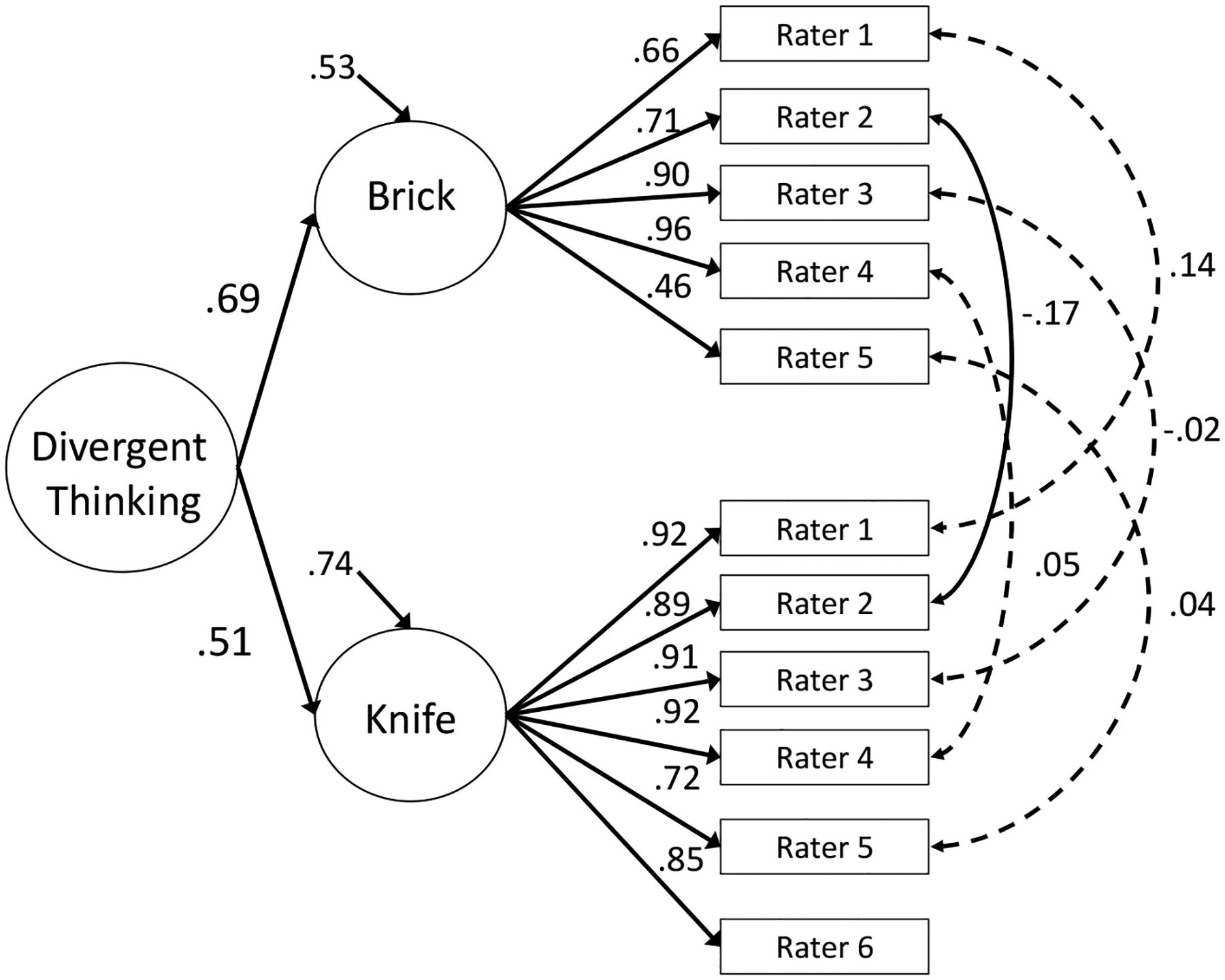
Measurement model for the divergent thinking construct, for the subject subsample who completed the daily-life experience sampling study. Brick = unusual uses for a brick task; Knife = unusual uses for a knife task. Dotted arrows represent non-significant paths. Fit statistics: χ2(38) = 101.58, CFI =.973, TLI = .961, RMSEA [90% CI] = .080 [.061, .099], SRMR = .039
Figure A2.
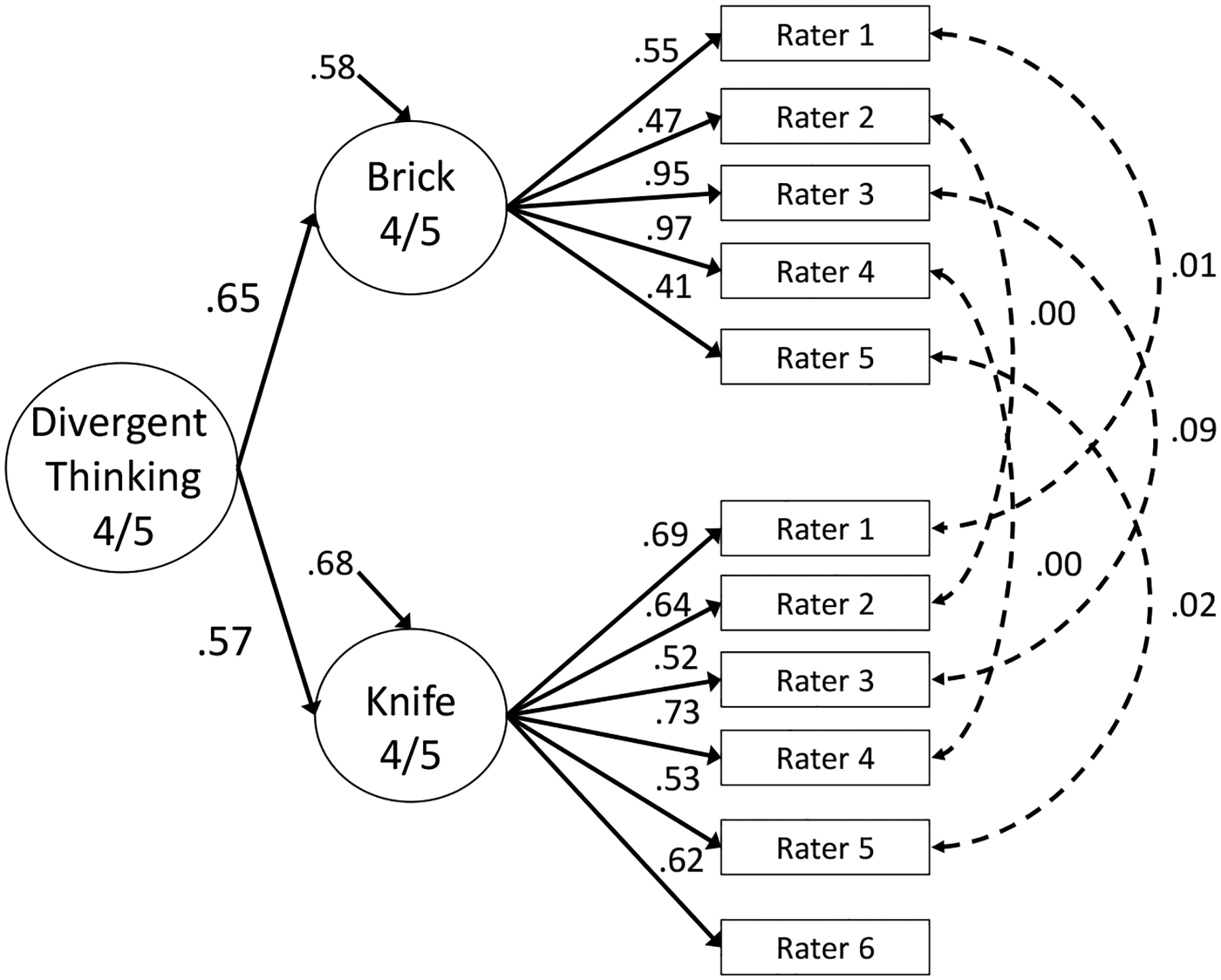
Measurement model for the divergent thinking construct using highly creative responses, for the subject subsample who completed the daily-life experience sampling study. Brick = unusual uses for a brick task; Knife = unusual uses for a knife task. Dotted arrows represent non-significant paths. Model fit statistics: χ2(38) = 97.446, CFI =.944, TLI = .920, RMSEA [90% CI] = .078 [.059, .098], SRMR = .067.
Appendix B. Unstandardized factor loadings (with standard errors) for daydreaming-report counts from each probed task, in structural models with a divergent thinking (DT) factor.
| Divergent Thinking Model | Measure | Inflation (Certain-0 Factor) | Count Factor |
|---|---|---|---|
| Mean DT Ratings | |||
| SART | 1.32 (0.51)* | 1.40 (0.19)* | |
| Number Stroop | 1.13 (0.61) | 1.88 (0.30)* | |
| Letter Flanker | 1.00 (0.00) | 1.00 (0.00) | |
| Arrow Flanker | 1.18 (0.68) | 1.43 (0.22)* | |
| 2-Back | 0.84 (0.31)* | 1.08 (0.21)* | |
| Highly Creative DT Ratings (4/5) | |||
| SART | 1.28 (0.45)* | 1.30 (0.17)* | |
| Number Stroop | 1.39 (0.69)* | 1.70 (0.25)* | |
| Letter Flanker | 1.00 (0.00) | 1.00 (0.00) | |
| Arrow Flanker | 1.40 (0.76) | 1.30 (0.19)* | |
| 2-Back | 0.92 (0.30)* | 0.96 (0.19)* | |
Note.
Factor loading is statistically significant (p < .05). For all models, factor loadings for Letter Flanker variables were fixed to 1.0.
SART = sustained attention to response task.
Footnotes
During coding, we considered appropriateness primarily in ruling out incomplete, uninterpretable, or nonsensical responses, or those that were so far removed or so abstract that they could not really be considered “uses” of the target object. Examples of responses that were treated as inappropriate during scoring of the Brick task are: “an”; “austrilla”; “drims”; “paris”; “smelly brick”; “way to get foc”.
These intraclass correlations were calculated following the elimination of data from multivariate outliers, described subsequently in Results.
Given the high skewness and kurtosis of these 4/5 counts, we also ran these models using a more robust estimation technique using Maximum Likelihood with robust (Huber-White) standard errors. The resulting model fits, factor loadings, and correlations between constructs were nearly identical to the models using only FIML estimation.
References
- Agnoli S, Vanucci M, Pelagatti C, & Corazza GE (2018). Exploring the link between mind wandering, mindfulness, and creativity: A multidimensional approach. Creativity Research Journal, 30(1), 41–53. [Google Scholar]
- Ahissar M, & Hochstein S (1993). Attentional control of early perceptual learning. Proceedings of the National Academy of Sciences, 90(12), 5718–5722. [Google Scholar]
- Baird B, Smallwood J, Mrazek MD, Kam JW, Franklin MS, & Schooler JW (2012). Inspired by distraction: Mind wandering facilitates creative incubation. Psychological Science, 23(10), 1117–1122. [DOI] [PubMed] [Google Scholar]
- Barr N, Pennycook G, Stolz JA, & Fugelsang JA (2015). Reasoned connections: A dual-process perspective on creative thought. Thinking & Reasoning, 21(1), 61–75. [Google Scholar]
- Bavelier D, & Green CS (2019). Enhancing attentional control: lessons from action video games. Neuron, 104(1), 147–163. [DOI] [PubMed] [Google Scholar]
- Beaty RE, Benedek M, Silvia PJ, & Schacter DL (2016). Creative cognition and brain network dynamics. Trends in Cognitive Sciences, 20(2), 87–95. [DOI] [PMC free article] [PubMed] [Google Scholar]
- Beaty RE, & Kenett YN (2023). Associative thinking at the core of creativity. Trends in Cognitive Sciences, 27(7), 671–683. [DOI] [PubMed] [Google Scholar]
- Beaty RE, & Silvia PJ (2012). Why do ideas get more creative across time? An executive interpretation of the serial order effect in divergent thinking tasks. Psychology of Aesthetics, Creativity, and the Arts, 6(4), 309–319. [Google Scholar]
- Beaty RE, Silvia PJ, Nusbaum EC, Jauk E, & Benedek M (2014). The roles of associative and executive processes in creative cognition. Memory & Cognition, 42(7), 1186–1197. [DOI] [PubMed] [Google Scholar]
- Benedek M, Jauk E, Sommer M, Arendasy M, & Neubauer AC (2014). Intelligence, creativity, and cognitive control: The common and differential involvement of executive functions in intelligence and creativity. Intelligence, 46, 73–83. [DOI] [PMC free article] [PubMed] [Google Scholar]
- Benedek M, Kenett YN, Umdasch K, Anaki D, Faust M, & Neubauer AC (2017). How semantic memory structure and intelligence contribute to creative thought: A network science approach. Thinking & Reasoning, 23(2), 158–183. [Google Scholar]
- Benedek M, Könen T, & Neubauer AC (2012). Associative abilities underlying creativity. Psychology of Aesthetics, Creativity, and the Arts, 6(3), 273–281. [Google Scholar]
- Brown AS (1973). An empirical verification of Mednick’s associative theory of creativity. Bulletin of the Psychonomic Society, 2(6), 429–430. [Google Scholar]
- Burgoyne AP, & Engle RW (2020). Attention control: A cornerstone of higher-order cognition. Current Directions in Psychological Science, 29(6), 624–630. [Google Scholar]
- Christensen AP, Kenett YN, Cotter KN, Beaty RE, & Silvia PJ (2018). Remotely close associations: Openness to experience and semantic memory structure. European Journal of Personality, 32(4), 480–492. [Google Scholar]
- Christoff K, Irving ZC, Fox KC, Spreng RN, & Andrews-Hanna JR (2016). Mind-wandering as spontaneous thought: a dynamic framework. Nature Reviews Neuroscience, 17(11), 718–731. [DOI] [PubMed] [Google Scholar]
- Conner TS, DeYoung CG, & Silvia PJ (2018). Everyday creative activity as a path to flourishing. Journal of Positive Psychology, 13(2), 181–189 [Google Scholar]
- De Dreu CKW, Nijstad BA, Baas M, Wolsink I, & Roskes M (2012). Working memory benefits creative insight, musical improvisation, and original ideation through maintained task-focused attention. Personality and Social Psychology Bulletin, 38(5), 656–669. [DOI] [PubMed] [Google Scholar]
- Dong Y, & Li P (2020). Attentional control in interpreting: A model of language control and processing control. Bilingualism: Language and Cognition, 23(4), 716–728. [Google Scholar]
- Dygert SK, & Jarosz AF (2020). Individual differences in creative cognition. Journal of Experimental Psychology: General, 149(7), 1249–1274. [DOI] [PubMed] [Google Scholar]
- Engle RW (2002). Working memory capacity as executive attention. Current Directions in Psychological Science, 11(1), 19–23. [Google Scholar]
- Finke RA (1996). Imagery, creativity, and emergent structure. Consciousness and Cognition, 5(3), 381–393. [DOI] [PubMed] [Google Scholar]
- Fox KC, & Beaty RE (2019). Mind-wandering as creative thinking: Neural, psychological, and theoretical considerations. Current Opinion in Behavioral Sciences, 27, 123–130. [Google Scholar]
- Frick RW (1995). Accepting the null hypothesis. Memory & Cognition, 23, 132–138. [DOI] [PubMed] [Google Scholar]
- Frith E, Kane MJ, Welhaf MS, Christensen AP, Silvia PJ, & Beaty RE (2021). Keeping creativity under control: Contributions of attention control and fluid intelligence to divergent thinking. Creativity Research Journal, 33(2), 138–157. 10.1080/10400419.2020.1855906 [DOI] [Google Scholar]
- Gable SL, Hopper EA, & Schooler JW (2019). When the muses strike: Creative ideas of physicists and writers routinely occur during mind wandering. Psychological Science, 30(3), 396–404. [DOI] [PubMed] [Google Scholar]
- Gilhooly KJ, Fioratou E, Anthony SH, & Wynn V (2007). Divergent thinking: Strategies and executive involvement in generating novel uses for familiar objects. British Journal of Psychology, 98(4), 611–625. [DOI] [PubMed] [Google Scholar]
- Girn M, Mills C, Roseman L, Carhart-Harris RL, & Christoff K (2020). Updating the dynamic framework of thought: Creativity and psychedelics. Neuroimage, 213, 116726. doi: 10.1016/j.neuroimage.2020.116726 [DOI] [PubMed] [Google Scholar]
- Gonthier C, & Besançon M (2022). It is not always better to have more ideas: Serial order and the trade-off between fluency and elaboration in divergent thinking tasks. Psychology of Aesthetics, Creativity, and the Arts. doi: 10.1037/aca0000485 [DOI] [Google Scholar]
- Green AE, Beaty RE, Kenett YN, & Kaufman JC (2023). The process definition of creativity. Creativity Research Journal. doi: 10.1080/10400419.2023.2254573 [DOI] [Google Scholar]
- Green CS, & Bavelier D (2012). Learning, attentional control, and action video games. Current Biology, 22(6), R197–R206. [DOI] [PMC free article] [PubMed] [Google Scholar]
- Gottschling J, Krieger F, & Greiff S (2021). The fight against infectious diseases: The essential role of higher-order thinking and problem-solving. Journal of Intelligence, 10(1), article 14. 10.3390/jintelligence10010014 [DOI] [Google Scholar]
- Irving ZC, McGrath C, Flynn L, Glasser A, & Mills C (2022). The shower effect: Mind wandering facilitates creative incubation during moderately engaging activities. Psychology of Aesthetics, Creativity, and the Arts. Advance online publication. 10.1037/aca0000516 [DOI] [Google Scholar]
- Kane MJ, Gross GM., Chun CA, Smeekens BS, Meier ME, Silvia PJ, & Kwapil TR (2017). For whom the mind wanders, and when, varies across laboratory and daily-life settings. Psychological Science, 28, 1271–1289. [DOI] [PMC free article] [PubMed] [Google Scholar]
- Kane MJ, & McVay JC (2012). What mind wandering reveals about executive-control abilities and failures. Current Directions in Psychological Science, 21(5), 348–354. [Google Scholar]
- Kane MJ, Meier ME, Smeekens BA, Gross GM, Chun CA, Silvia PJ, & Kwapil TR (2016). Individual differences in the executive control of attention, memory, and thought, and their associations with schizotypy. Journal of Experimental Psychology: General, 145, 1017–1048. [DOI] [PMC free article] [PubMed] [Google Scholar]
- Kenett YN, Anaki D, & Faust M (2014). Investigating the structure of semantic networks in low and high creative persons. Frontiers in Human Neuroscience, 8, 407. 10.3389/fnhum.2014.00407 [DOI] [PMC free article] [PubMed] [Google Scholar]
- Kenett YN, & Faust M (2019). A semantic network cartography of the creative mind. Trends in Cognitive Sciences, 23(4), 271–274. [DOI] [PubMed] [Google Scholar]
- Lemercier C, Pêcher C, Berthié G, Valéry B, Vidal V, Paubel PV, … & Maury B (2014). Inattention behind the wheel: How factual internal thoughts impact attentional control while driving. Safety Science, 62, 279–285. [Google Scholar]
- McMillan RL, Kaufman SB, & Singer JL (2013). Ode to positive-constructive daydreaming. Frontiers in Psychology, 4, article 626, doi: 10.3389/fpsyg.2013.00626 [DOI] [Google Scholar]
- Muthén LK, & Muthén BO (2017). Mplus: Statistical Analysis with Latent Variables: User’s Guide (Version 8). Los Angeles, CA: Authors. [Google Scholar]
- O’Bryan EM, Kraemer KM, Johnson AL, McLeish AC, & McLaughlin LE (2017). Examining the role of attentional control in terms of specific emotion regulation difficulties. Personality and Individual Differences, 108, 158–163. [Google Scholar]
- Ostafin BD, & Kassman KT (2012). Stepping out of history: Mindfulness improves insight problem solving. Consciousness and Cognition, 21(2), 1031–1036. [DOI] [PubMed] [Google Scholar]
- Palmiero M, Fusi G, Crepaldi M, Borsa VM, & Rusconi ML (2022). Divergent thinking and the core executive functions: A state-of-the-art review. Cognitive Processing 23(3), 341–366. [DOI] [PubMed] [Google Scholar]
- Preiss DD (2022). Metacognition, mind wandering, and cognitive flexibility: Understanding creativity. Journal of Intelligence, 10(3), article 69. 10.3390/jintelligence10030069 [DOI] [Google Scholar]
- Mashburn CA, Barnett MK, & Engle RW (in press). Processing speed and executive attention as causes of intelligence. Psychological Review. DOI: 10.1037/rev0000439 [DOI] [Google Scholar]
- McVay JC, & Kane MJ (2010). Does mind wandering reflect executive function or executive failure? Comment on Smallwood and Schooler (2006) and Watkins (2008). Psychological Bulletin, 136(2), 188–197. 10.1037/A0018298 [DOI] [PMC free article] [PubMed] [Google Scholar]
- Mednick S (1962). The associative basis of the creative process. Psychological Review, 69(3), 220–232. [DOI] [PubMed] [Google Scholar]
- Mednick MT, Mednick SA, & Jung CC (1964). Continual association as a function of level of creativity and type of verbal stimulus. Journal of Abnormal and Social Psychology, 69, 511–515. [Google Scholar]
- Miyake A, & Friedman NP (2012). The nature and organization of individual differences in executive functions: Four general conclusions. Current Directions in Psychological Science, 21, 8–14. [DOI] [PMC free article] [PubMed] [Google Scholar]
- Mooneyham BW, & Schooler JW (2013). The costs and benefits of mind-wandering: A review. Canadian Journal of Experimental Psychology, 67(1), 11–18. 10.1037/a0031569 [DOI] [PubMed] [Google Scholar]
- Mullis K (1998). Dancing naked in the mind field. New York, NY: Pantheon Books. [Google Scholar]
- Murray S, Liang N, Brosowsky N, & Seli P (2021). What are the benefits of mind wandering to creativity? Psychology of Creativity, Aesthetics, and the Arts. https://psycnet.apa.org/doi/10.1037/aca0000420 [Google Scholar]
- Nusbaum EC, Silvia PJ, & Beaty RE (2014). Ready, set, create: What instructing people to “be creative” reveals about the meaning and mechanisms of divergent thinking. Psychology of Aesthetics, Creativity, and the Arts, 8(4), 423–432. [Google Scholar]
- Oleynick VC, DeYoung CG, Hyde E, Kaufman SB, Beaty RE, & Silvia PJ (2017). Openness/Intellect: The core of the creative personality. In Feist GJ, Reiter-Palmon R, & Kaufman JC (Eds.), Cambridge handbook of creativity and personality research (pp. 9–27). Cambridge University Press. [Google Scholar]
- Poincaré H (1910). Mathematical creation. The Monist, 20(3), 321–335. [Google Scholar]
- Raffaelli Q, Malusa R, de Stefano N-A, Andrews E, Grilli MD, Mills C, Zabelina DL, & Andrews-Hanna JR (2023). Creative minds at rest: Creative individuals are more associative and engaged with their idle thoughts. Creativity Research Journal. 10.1080/10400419.2023.2227477 [DOI] [Google Scholar]
- Reiter-Palmon R, Forthmann B, & Barbot B (2019). Scoring divergent thinking tests: A review and systematic framework. Psychology of Aesthetics, Creativity, and the Arts, 13(2), 144–152. [Google Scholar]
- Rossmann E, & Fink A (2010). Do creative people use shorter associative pathways? Personality and Individual Differences, 49(8), 891–895. [Google Scholar]
- Runco MA (1986). Maximal performance on divergent thinking tests by gifted, talented, and nongifted children. Psychology in the Schools, 23(3), 308–315. [Google Scholar]
- Schmajuk N, Aziz DR, & Bates MJ (2009). Attentional–associative interactions in creativity. Creativity Research Journal, 21(1), 92–103. [Google Scholar]
- Sassenberg TA, Condon DM, Christensen AP, & DeYoung CG (2023). Imagination as a facet of Openness/Intellect: A new scale differentiating experiential simulation and conceptual innovation. Creativity Research Journal, 35(4), 583–595. [Google Scholar]
- Seli P, Kane MJ, Metzinger T, Smallwood J, Schacter DL, Maillet D, Schooler JW, & Smilek D (2018a). The family-resemblances framework for mind wandering remains well clad. Trends in Cognitive Sciences, 22(11), 959–961. [DOI] [PubMed] [Google Scholar]
- Seli P, Kane MJ, Smallwood J, Schacter DL, Maillet D, Schooler JW, & Smilek D (2018b). Mind wandering as a natural kind: A family-resemblances view. Trends in Cognitive Sciences, 22(6), 479–490. [DOI] [PMC free article] [PubMed] [Google Scholar]
- Shipstead Z, Lindsey DRB, Marshall RL, & Engle RW (2014). The mechanisms of working memory capacity: Primary memory, secondary memory, and attention control. Journal of Memory and Language, 72, 116–141. [Google Scholar]
- Silvia PJ (2008). Discernment and creativity: How well can people identify their most creative ideas? Psychology of Aesthetics, Creativity, and the Arts, 2(3), 139–146. [Google Scholar]
- Silvia PJ (2015). Intelligence and creativity are pretty similar after all. Educational Psychology Review, 27, 599–606. [Google Scholar]
- Silvia PJ, Winterstein BP, Willse JT, Barona CM, Cram JT, Hess KI, Martinez JL, & Richard CA (2008). Assessing creativity with divergent thinking tasks: Exploring the reliability and validity of new subjective scoring methods. Psychology of Aesthetics, Creativity, and the Arts, 2(2), 68–85. [Google Scholar]
- Simonton DK (2018). Defining creativity: Don’t we also need to define what is not creative? The Journal of Creative Behavior, 52(1), 80–90. [Google Scholar]
- Singer JL (1966). Daydreaming: An introduction to the experimental study of inner experience. New York: Random House. [Google Scholar]
- Sio UN, & Ormerod TC (2009). Does incubation enhance problem solving? A meta-analytic review. Psychological Bulletin, 135(1), 94–120. [DOI] [PubMed] [Google Scholar]
- Simmons JP, Nelson LD, & Simonsohn U (2012). A 21 word solution. Dialogue: The Official Newsletter of the Society for Personality and Social Psychology, 26, 4–7. [Google Scholar]
- Smallwood J, & Schooler JW (2006). The restless mind. Psychological Bulletin, 132, 946–958. [DOI] [PubMed] [Google Scholar]
- Smeekens BA, & Kane MJ (2016). Working memory capacity, mind wandering, and creative cognition: An individual-differences investigation into the benefits of controlled versus spontaneous thought. Psychology of Aesthetics, Creativity, and the Arts, 10(4), 389–415. 10.1037/aca0000046 [DOI] [PMC free article] [PubMed] [Google Scholar]
- Smith AP, Brosowsky N, Murray S, Daniel R, Meier ME, & Seli P (2022). Fixation, flexibility, and creativity: The dynamics of mind wandering. Journal of Experimental Psychology: Human Perception and Performance, 48(7), 689–710. [DOI] [PubMed] [Google Scholar]
- Smith SM, & Beda Z (2020). Old problems in new contexts: The context-dependent fixation hypothesis. Journal of Experimental Psychology: General, 149(1), 192. [DOI] [PubMed] [Google Scholar]
- Stedron JM, Sahni SD, & Munakata Y (2005). Common mechanisms for working memory and attention: the case of perseveration with visible solutions. Journal of Cognitive Neuroscience, 17(4), 623–631. [DOI] [PubMed] [Google Scholar]
- Steindorf L, Hammerton HA, & Rummel J (2021). Mind wandering outside the box—About the role of off-task thoughts and their assessment during creative incubation. Psychology of Aesthetics, Creativity, and the Arts, 15(4), 584. [Google Scholar]
- Sternberg RJ (2021). Transformational vs. transactional deployment of intelligence. Journal of Intelligence, 9(1), article 15. 10.3390/jintelligence9010015 [DOI] [Google Scholar]
- Tan T, Zou H, Chen C, & Luo J (2015). Mind wandering and the incubation effect in insight problem solving. Creativity Research Journal, 27(4), 375–382. [Google Scholar]
- Teng SC, & Lien YW (2022). Propensity or diversity? Investigating how mind wandering influences the incubation effect of creativity. PLoS ONE, 17(4), e0267187. [DOI] [PMC free article] [PubMed] [Google Scholar]
- Unsworth N, & Spillers GJ (2010). Working memory capacity: Attention control, secondary memory, or both? A direct test of the dual-component model. Journal of Memory and Language, 62, 392–406. [Google Scholar]
- Vannucci M, & Agnoli S (2019). Thought Dynamics: Which Role for Mind Wandering in Creativity? In Beghetto RA, Corazza GE (Eds.), Dynamic perspectives on creativity. Creativity theory and action in education, vol 4. Springer, Cham. 10.1007/978-3-319-99163-4_14 [DOI] [Google Scholar]
- Wai J, & Lovett BJ (2021). Improving gifted talent development can help solve multiple consequential real-world problems. Journal of Intelligence, 9(2), article 31. 10.3390/jintelligence9020031 [DOI] [Google Scholar]
- Yang T, & Wu G (2022). Spontaneous or deliberate: the dual influence of mind wandering on creative incubation. The Journal of Creative Behavior, 56(4), 584–600. [Google Scholar]
- Yu Y, Beaty RE, Forthmann B, Beeman M, Cruz JH, & Johnson D (2023). A MAD method to assess idea novelty: Improving validity of automatic scoring using maximum associative distance (MAD). Psychology of Aesthetics, Creativity, and the Arts. https://psycnet.apa.org/doi/10.1037/aca0000573 [Google Scholar]
- Zabelina DL, Friedman NP, & Andrews-Hanna J (2019). Unity and diversity of executive functions in creativity. Consciousness and Cognition, 68, 47–56. [DOI] [PMC free article] [PubMed] [Google Scholar]
- Zedelius CM, Protzko J, Broadway JM, & Schooler JW (2021). What types of daydreaming predict creativity? Laboratory and experience sampling evidence. Psychology of Aesthetics, Creativity, and the Arts, 15(4), 596–611. 10.1037/aca0000342 [DOI] [Google Scholar]
- Zedelius CM, & Schooler JW (2015). Mind wandering “Ahas” versus mindful reasoning: Alternative routes to creative solutions. Frontiers in Psychology, 6, article 834. [Google Scholar]
- Zeitlen DC, Silvia PJ, Kane MJ, & Beaty RE (2022). The creative mind in daily life: How cognitive and affective experiences relate to creative thinking and behavior. Psychology of Aesthetics, Creativity, and the Arts. 10.1037/aca0000537. [DOI] [Google Scholar]
- Zelazo PD, Craik FI, & Booth L (2004). Executive function across the life span. Acta Psychologica, 115(2–3), 167–183. [DOI] [PubMed] [Google Scholar]