



Abstract
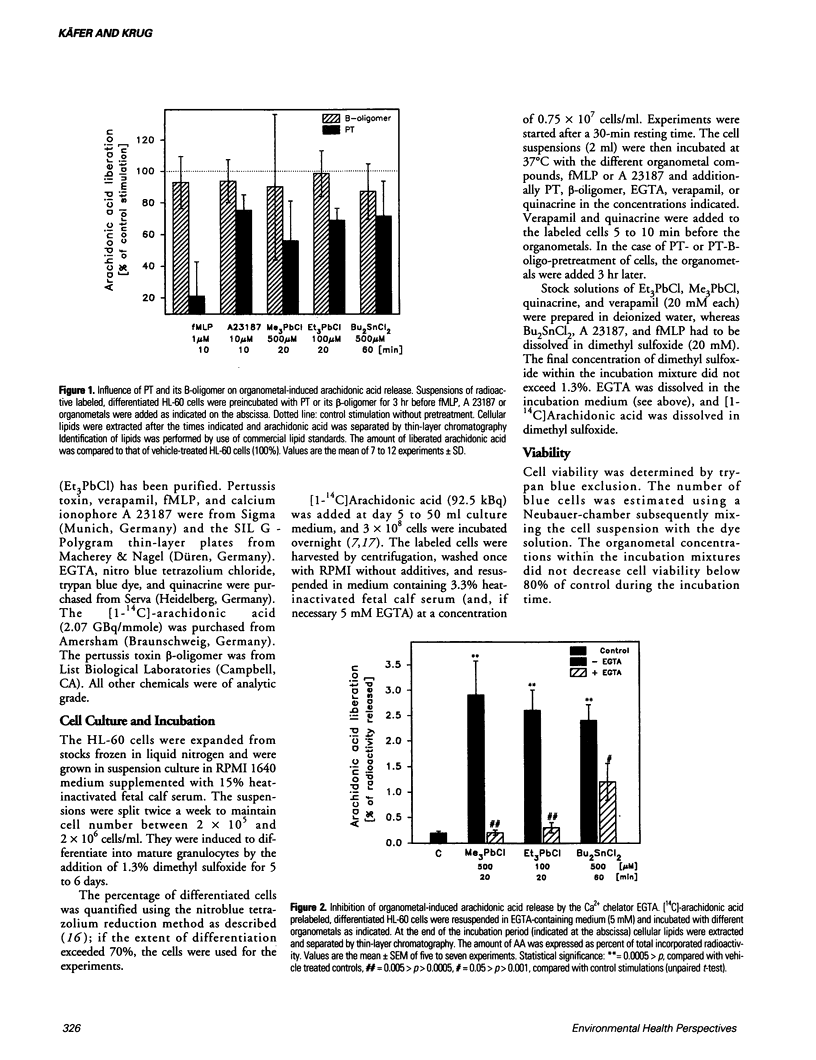
Organic lead and tin compounds stimulate an increase of free arachidonic acid (AA) in HL-60 cells. This fatty acid is involved in numerous health problems and physiological mechanisms. Three major pathways result in a liberation of AA from membrane phospholipids and there is evidence that G-proteins serve as couplers within all three pathways. Therefore we investigated the influence of pertussis toxin (PT) on the organometallic-induced AA liberation. The effect of all studied compounds (organotin and organo-lead) was diminished by PT. We conclude that the organometals activate PLA2 to some extent via a PT-sensitive pathway. The ionophor A 23187 (1-10 microM) led to an increase of free AA by raising the intracellular Ca2+ level. One of the postulated ways of AA release is via Ca2+ channel activation; phospholipases are Ca2+ dependent. Thus, we examined the necessity of free intracellular Ca2+ for the organometallic effect. The Ca2+ chelator EGTA inhibited the increase of free AA induced by organometals. This is true also for verapamil, a Ca2+ channel blocker. Quinacrine, which is thought to be an inhibitor of phospholipase A2 (PLA2), prevented the AA liberation from membrane phospholipids induced by organometals. This could be due to the inhibition of PLA2, but it could also be the result of an inhibited Ca2+ influx.
Full text
PDF


Selected References
These references are in PubMed. This may not be the complete list of references from this article.
- Axelrod J., Burch R. M., Jelsema C. L. Receptor-mediated activation of phospholipase A2 via GTP-binding proteins: arachidonic acid and its metabolites as second messengers. Trends Neurosci. 1988 Mar;11(3):117–123. doi: 10.1016/0166-2236(88)90157-9. [DOI] [PubMed] [Google Scholar]
- Baron B. M., Limbird L. E. Human platelet phospholipase A2 activity is responsive in vitro to pH and Ca2+ variations which parallel those occurring after platelet activation in vivo. Biochim Biophys Acta. 1988 Aug 19;971(1):103–111. doi: 10.1016/0167-4889(88)90166-8. [DOI] [PubMed] [Google Scholar]
- Bicknell R., Vallee B. L. Angiogenin stimulates endothelial cell prostacyclin secretion by activation of phospholipase A2. Proc Natl Acad Sci U S A. 1989 Mar;86(5):1573–1577. doi: 10.1073/pnas.86.5.1573. [DOI] [PMC free article] [PubMed] [Google Scholar]
- Billah M. M., Siegel M. I. Phospholipase A2 activation in chemotactic peptide-stimulated HL60 granulocytes: synergism between diacylglycerol and Ca2+ in a protein kinase C-independent mechanism. Biochem Biophys Res Commun. 1987 Apr 29;144(2):683–691. doi: 10.1016/s0006-291x(87)80019-0. [DOI] [PubMed] [Google Scholar]
- Bokoch G. M., Gilman A. G. Inhibition of receptor-mediated release of arachidonic acid by pertussis toxin. Cell. 1984 Dec;39(2 Pt 1):301–308. doi: 10.1016/0092-8674(84)90008-4. [DOI] [PubMed] [Google Scholar]
- Bonser R. W., Siegel M. I., Chung S. M., McConnell R. T., Cuatrecasas P. Esterification of an endogenously synthesized lipoxygenase product into granulocyte cellular lipids. Biochemistry. 1981 Sep 1;20(18):5297–5301. doi: 10.1021/bi00521a032. [DOI] [PubMed] [Google Scholar]
- Bormann B. J., Huang C. K., Mackin W. M., Becker E. L. Receptor-mediated activation of a phospholipase A2 in rabbit neutrophil plasma membrane. Proc Natl Acad Sci U S A. 1984 Feb;81(3):767–770. doi: 10.1073/pnas.81.3.767. [DOI] [PMC free article] [PubMed] [Google Scholar]
- Brooks R. C., McCarthy K. D., Lapetina E. G., Morell P. Receptor-stimulated phospholipase A2 activation is coupled to influx of external calcium and not to mobilization of intracellular calcium in C62B glioma cells. J Biol Chem. 1989 Nov 25;264(33):20147–20153. [PubMed] [Google Scholar]
- Chang J., Musser J. H., McGregor H. Phospholipase A2: function and pharmacological regulation. Biochem Pharmacol. 1987 Aug 1;36(15):2429–2436. doi: 10.1016/0006-2952(87)90512-0. [DOI] [PubMed] [Google Scholar]
- Collins S. J., Ruscetti F. W., Gallagher R. E., Gallo R. C. Normal functional characteristics of cultured human promyelocytic leukemia cells (HL-60) after induction of differentiation by dimethylsulfoxide. J Exp Med. 1979 Apr 1;149(4):969–974. doi: 10.1084/jem.149.4.969. [DOI] [PMC free article] [PubMed] [Google Scholar]
- Fernández B., Balsinde J. Receptor-mediated activation of arachidonic acid release in mouse peritoneal macrophages is linked to extracellular calcium influx. Biochem Biophys Res Commun. 1991 Oct 31;180(2):1036–1040. doi: 10.1016/s0006-291x(05)81170-2. [DOI] [PubMed] [Google Scholar]
- Flower R. Lipocortin. Biochem Soc Trans. 1989 Apr;17(2):276–278. doi: 10.1042/bst0170276. [DOI] [PubMed] [Google Scholar]
- Froissart P., Unligil P., Aubry H., Proulx P. Modulation by phorbol 12-myristate 13-acetate of arachidonic acid release from rat basophilic leukemia cells stimulated with A23187. Biochim Biophys Acta. 1989 Apr 26;1002(3):376–381. doi: 10.1016/0005-2760(89)90352-4. [DOI] [PubMed] [Google Scholar]
- Gierschik P., Sidiropoulos D., Jakobs K. H. Two distinct Gi-proteins mediate formyl peptide receptor signal transduction in human leukemia (HL-60) cells. J Biol Chem. 1989 Dec 25;264(36):21470–21473. [PubMed] [Google Scholar]
- Hecker M., Brüne B., Decker K., Ullrich V. The sulfhydryl reagent thimerosal elicits human platelet aggregation by mobilization of intracellular calcium and secondary prostaglandin endoperoxide formation. Biochem Biophys Res Commun. 1989 Mar 31;159(3):961–968. doi: 10.1016/0006-291x(89)92202-x. [DOI] [PubMed] [Google Scholar]
- Holz G. G., 4th, Rane S. G., Dunlap K. GTP-binding proteins mediate transmitter inhibition of voltage-dependent calcium channels. Nature. 1986 Feb 20;319(6055):670–672. doi: 10.1038/319670a0. [DOI] [PMC free article] [PubMed] [Google Scholar]
- Hornberger W., Patscheke H. Primary stimuli of icosanoid release inhibit arachidonoyl-CoA synthetase and lysophospholipid acyltransferase. Mechanism of action of hydrogen peroxide and methyl mercury in platelets. Eur J Biochem. 1990 Jan 12;187(1):175–181. doi: 10.1111/j.1432-1033.1990.tb15292.x. [DOI] [PubMed] [Google Scholar]
- Irvine R. F. How is the level of free arachidonic acid controlled in mammalian cells? Biochem J. 1982 Apr 15;204(1):3–16. doi: 10.1042/bj2040003. [DOI] [PMC free article] [PubMed] [Google Scholar]
- Kaever V., Goppelt-Strübe M., Resch K. Enhancement of eicosanoid synthesis in mouse peritoneal macrophages by the organic mercury compound thimerosal. Prostaglandins. 1988 Jun;35(6):885–902. doi: 10.1016/0090-6980(88)90114-1. [DOI] [PubMed] [Google Scholar]
- Komulainen H., Bondy S. C. Increased free intracellular Ca2+ by toxic agents: an index of potential neurotoxicity? Trends Pharmacol Sci. 1988 May;9(5):154–156. doi: 10.1016/0165-6147(88)90025-9. [DOI] [PubMed] [Google Scholar]
- Krug H. F., Culig H. Directed shift of fatty acids from phospholipids to triacylglycerols in HL-60 cells induced by nanomolar concentrations of triethyl lead chloride: involvement of a pertussis toxin-sensitive pathway. Mol Pharmacol. 1991 Apr;39(4):511–516. [PubMed] [Google Scholar]
- Krug H., Berndt J. Stimulation of arachidonic acid metabolism via phospholipase A2 by triethyl lead. Eur J Biochem. 1987 Jan 15;162(2):293–298. doi: 10.1111/j.1432-1033.1987.tb10599.x. [DOI] [PubMed] [Google Scholar]
- Käfer A., Zöltzer H., Krug H. F. The stimulation of arachidonic acid metabolism by organic lead and tin compounds in human HL-60 leukemia cells. Toxicol Appl Pharmacol. 1992 Sep;116(1):125–132. doi: 10.1016/0041-008x(92)90153-j. [DOI] [PubMed] [Google Scholar]
- Lewis D. L., Weight F. F., Luini A. A guanine nucleotide-binding protein mediates the inhibition of voltage-dependent calcium current by somatostatin in a pituitary cell line. Proc Natl Acad Sci U S A. 1986 Dec;83(23):9035–9039. doi: 10.1073/pnas.83.23.9035. [DOI] [PMC free article] [PubMed] [Google Scholar]
- Nakashima S., Suganuma A., Sato M., Tohmatsu T., Nozawa Y. Mechanism of arachidonic acid liberation in platelet-activating factor-stimulated human polymorphonuclear neutrophils. J Immunol. 1989 Aug 15;143(4):1295–1302. [PubMed] [Google Scholar]
- Oinuma H., Takamura T., Hasegawa T., Nomoto K., Naitoh T., Daiku Y., Hamano S., Kakisawa H., Minami N. Synthesis and biological evaluation of substituted benzenesulfonamides as novel potent membrane-bound phospholipase A2 inhibitors. J Med Chem. 1991 Jul;34(7):2260–2267. doi: 10.1021/jm00111a048. [DOI] [PubMed] [Google Scholar]
- Orrenius S., McConkey D. J., Bellomo G., Nicotera P. Role of Ca2+ in toxic cell killing. Trends Pharmacol Sci. 1989 Jul;10(7):281–285. doi: 10.1016/0165-6147(89)90029-1. [DOI] [PubMed] [Google Scholar]
- Stokke M., Hagelin E. M., Poulsson C., Patel R., Haile Y., Brørs O. Inhibition by amiloride and quinacrine of specific [3H]nitrendipine binding to rat cardiac membranes. J Pharmacol Exp Ther. 1992 Mar;260(3):1366–1372. [PubMed] [Google Scholar]
- Testi R., Pulcinelli F. M., Cifone M. G., Botti D., Del Grosso E., Riondino S., Frati L., Gazzaniga P. P., Santoni A. Preferential involvement of a phospholipase A2-dependent pathway in CD69-mediated platelet activation. J Immunol. 1992 May 1;148(9):2867–2871. [PubMed] [Google Scholar]
- Triggle D. J. Calcium-channel drugs: structure-function relationships and selectivity of action. J Cardiovasc Pharmacol. 1991;18 (Suppl 10):S1–S6. [PubMed] [Google Scholar]