



Abstract
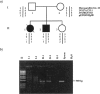
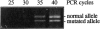
Neurofibromatosis type 1 (NF1) is caused by deletions, insertions, translocations, and point mutations in the NF1 gene, which spans 350 kb on the long arm of human chromosome 17. Although several point mutations have been described, large molecular abnormalities have rarely been characterized in detail. We describe here the molecular breakpoints of a 12-kb deletion of the NF1 gene, which is responsible for the NF1 phenotype in a kindred with two children affected because of germline mosaicism in the unaffected father, who has the mutation in 10% of his spermatozoa. The mutation spans introns 31-39, removing 12,021 nt and inserting 30 bp, of which 19 bp are a direct repetition of a sequence located in intron 31, just 4 bp before the 5' breakpoint. The 5' and 3' breakpoints contain the sequence TATTTTA, which could be involved in the generation of the deletion. The most plausible explanation for the mechanism involved in the generation of this 12-kb deletion is homologous/nonhomologous recombination. Since sperm of the father does not contain the corresponding insertion of the 12-kb deleted sequence, this deletion could have occurred within the NF1 chromosome through loop formation. RNA from lymphocytes of one of the NF1 patients showed similar levels of the mutated and normal transcripts, suggesting that the NF1-mRNA from mutations causing frame shifts of the reading frame or stop codons in this gene is not degraded during its processing. The mutation was not detected in fresh lymphocytes from the unaffected father by PCR analysis, supporting the case for true germ-line mosaicism.
Full text
PDF


Images in this article
Selected References
These references are in PubMed. This may not be the complete list of references from this article.
- Andersen L. B., Tarlé S. A., Marchuk D. A., Legius E., Collins F. S. A compound nucleotide repeat in the neurofibromatosis (NF1) gene. Hum Mol Genet. 1993 Jul;2(7):1083–1083. doi: 10.1093/hmg/2.7.1083-a. [DOI] [PubMed] [Google Scholar]
- Benz E. J., Forget B. G., Hillman D. G., Cohen-Solal M., Pritchard J., Cavallesco C., Prensky W., Housman D. Variability in the amount of beta-globin mRNA in beta0 thalassemia. Cell. 1978 Jun;14(2):299–312. doi: 10.1016/0092-8674(78)90116-2. [DOI] [PubMed] [Google Scholar]
- Cawthon R. M., Weiss R., Xu G. F., Viskochil D., Culver M., Stevens J., Robertson M., Dunn D., Gesteland R., O'Connell P. A major segment of the neurofibromatosis type 1 gene: cDNA sequence, genomic structure, and point mutations. Cell. 1990 Jul 13;62(1):193–201. doi: 10.1016/0092-8674(90)90253-b. [DOI] [PubMed] [Google Scholar]
- Chomczynski P., Sacchi N. Single-step method of RNA isolation by acid guanidinium thiocyanate-phenol-chloroform extraction. Anal Biochem. 1987 Apr;162(1):156–159. doi: 10.1006/abio.1987.9999. [DOI] [PubMed] [Google Scholar]
- Cohn D. H., Starman B. J., Blumberg B., Byers P. H. Recurrence of lethal osteogenesis imperfecta due to parental mosaicism for a dominant mutation in a human type I collagen gene (COL1A1). Am J Hum Genet. 1990 Mar;46(3):591–601. [PMC free article] [PubMed] [Google Scholar]
- Constantinou C. D., Pack M., Young S. B., Prockop D. J. Phenotypic heterogeneity in osteogenesis imperfecta: the mildly affected mother of a proband with a lethal variant has the same mutation substituting cysteine for alpha 1-glycine 904 in a type I procollagen gene (COL1A1). Am J Hum Genet. 1990 Oct;47(4):670–679. [PMC free article] [PubMed] [Google Scholar]
- Cooper D. N., Schmidtke J. Diagnosis of genetic disease using recombinant DNA. Third edition. Hum Genet. 1991 Sep;87(5):519–560. doi: 10.1007/BF00209011. [DOI] [PubMed] [Google Scholar]
- Edwards M. J., Wenstrup R. J., Byers P. H., Cohn D. H. Recurrence of lethal osteogenesis imperfecta due to parental mosaicism for a mutation in the COL1A2 gene of type I collagen. The mosaic parent exhibits phenotypic features of a mild form of the disease. Hum Mutat. 1992;1(1):47–54. doi: 10.1002/humu.1380010108. [DOI] [PubMed] [Google Scholar]
- Efstratiadis A., Posakony J. W., Maniatis T., Lawn R. M., O'Connell C., Spritz R. A., DeRiel J. K., Forget B. G., Weissman S. M., Slightom J. L. The structure and evolution of the human beta-globin gene family. Cell. 1980 Oct;21(3):653–668. doi: 10.1016/0092-8674(80)90429-8. [DOI] [PubMed] [Google Scholar]
- Heim R. A., Kam-Morgan L. N., Binnie C. G., Corns D. D., Cayouette M. C., Farber R. A., Aylsworth A. S., Silverman L. M., Luce M. C. Distribution of 13 truncating mutations in the neurofibromatosis 1 gene. Hum Mol Genet. 1995 Jun;4(6):975–981. doi: 10.1093/hmg/4.6.975. [DOI] [PubMed] [Google Scholar]
- Hoffmeyer S., Assum G., Kaufmann D., Krone W. Unequal expression of NF1 alleles. Nat Genet. 1994 Apr;6(4):331–331. doi: 10.1038/ng0494-331. [DOI] [PubMed] [Google Scholar]
- Jones C. T., McIntosh I., Keston M., Ferguson A., Brock D. J. Three novel mutations in the cystic fibrosis gene detected by chemical cleavage: analysis of variant splicing and a nonsense mutation. Hum Mol Genet. 1992 Apr;1(1):11–17. doi: 10.1093/hmg/1.1.11. [DOI] [PubMed] [Google Scholar]
- Ledbetter D. H., Rich D. C., O'Connell P., Leppert M., Carey J. C. Precise localization of NF1 to 17q11.2 by balanced translocation. Am J Hum Genet. 1989 Jan;44(1):20–24. [PMC free article] [PubMed] [Google Scholar]
- Lehrman M. A., Russell D. W., Goldstein J. L., Brown M. S. Exon-Alu recombination deletes 5 kilobases from the low density lipoprotein receptor gene, producing a null phenotype in familial hypercholesterolemia. Proc Natl Acad Sci U S A. 1986 Jun;83(11):3679–3683. doi: 10.1073/pnas.83.11.3679. [DOI] [PMC free article] [PubMed] [Google Scholar]
- Lehrman M. A., Schneider W. J., Brown M. S., Davis C. G., Elhammer A., Russell D. W., Goldstein J. L. The Lebanese allele at the low density lipoprotein receptor locus. Nonsense mutation produces truncated receptor that is retained in endoplasmic reticulum. J Biol Chem. 1987 Jan 5;262(1):401–410. [PubMed] [Google Scholar]
- Li Y., O'Connell P., Breidenbach H. H., Cawthon R., Stevens J., Xu G., Neil S., Robertson M., White R., Viskochil D. Genomic organization of the neurofibromatosis 1 gene (NF1). Genomics. 1995 Jan 1;25(1):9–18. doi: 10.1016/0888-7543(95)80104-t. [DOI] [PubMed] [Google Scholar]
- Lázaro C., Gaona A., Ravella A., Volpini V., Casals T., Fuentes J. J., Estivill X. Novel alleles, hemizygosity and deletions at an Alu-repeat within the neurofibromatosis type 1 (NF1) gene. Hum Mol Genet. 1993 Jun;2(6):725–730. doi: 10.1093/hmg/2.6.725. [DOI] [PubMed] [Google Scholar]
- Lázaro C., Gaona A., Xu G., Weiss R., Estivill X. A highly informative CA/GT repeat polymorphism in intron 38 of the human neurofibromatosis type 1 (NF1) gene. Hum Genet. 1993 Oct;92(4):429–430. doi: 10.1007/BF01247353. [DOI] [PubMed] [Google Scholar]
- Lázaro C., Ravella A., Gaona A., Volpini V., Estivill X. Neurofibromatosis type 1 due to germ-line mosaicism in a clinically normal father. N Engl J Med. 1994 Nov 24;331(21):1403–1407. doi: 10.1056/NEJM199411243312102. [DOI] [PubMed] [Google Scholar]
- Milewicz D. M., Witz A. M., Smith A. C., Manchester D. K., Waldstein G., Byers P. H. Parental somatic and germ-line mosaicism for a multiexon deletion with unusual endpoints in a type III collagen (COL3A1) allele produces Ehlers-Danlos syndrome type IV in the heterozygous offspring. Am J Hum Genet. 1993 Jul;53(1):62–70. [PMC free article] [PubMed] [Google Scholar]
- Miller S. A., Dykes D. D., Polesky H. F. A simple salting out procedure for extracting DNA from human nucleated cells. Nucleic Acids Res. 1988 Feb 11;16(3):1215–1215. doi: 10.1093/nar/16.3.1215. [DOI] [PMC free article] [PubMed] [Google Scholar]
- Neurofibromatosis. Conference statement. National Institutes of Health Consensus Development Conference. Arch Neurol. 1988 May;45(5):575–578. [PubMed] [Google Scholar]
- Rodenhiser D. I., Ainsworth P. J., Coulter-Mackie M. B., Singh S. M., Jung J. H. A genetic study of neurofibromatosis type 1 (NF1) in south-western Ontario. II. A PCR based approach to molecular and prenatal diagnosis using linkage. J Med Genet. 1993 May;30(5):363–368. doi: 10.1136/jmg.30.5.363. [DOI] [PMC free article] [PubMed] [Google Scholar]
- Viskochil D., Buchberg A. M., Xu G., Cawthon R. M., Stevens J., Wolff R. K., Culver M., Carey J. C., Copeland N. G., Jenkins N. A. Deletions and a translocation interrupt a cloned gene at the neurofibromatosis type 1 locus. Cell. 1990 Jul 13;62(1):187–192. doi: 10.1016/0092-8674(90)90252-a. [DOI] [PubMed] [Google Scholar]
- Wallace M. R., Andersen L. B., Saulino A. M., Gregory P. E., Glover T. W., Collins F. S. A de novo Alu insertion results in neurofibromatosis type 1. Nature. 1991 Oct 31;353(6347):864–866. doi: 10.1038/353864a0. [DOI] [PubMed] [Google Scholar]
- Wallace M. R., Marchuk D. A., Andersen L. B., Letcher R., Odeh H. M., Saulino A. M., Fountain J. W., Brereton A., Nicholson J., Mitchell A. L. Type 1 neurofibromatosis gene: identification of a large transcript disrupted in three NF1 patients. Science. 1990 Jul 13;249(4965):181–186. doi: 10.1126/science.2134734. [DOI] [PubMed] [Google Scholar]
- Wallis G. A., Starman B. J., Zinn A. B., Byers P. H. Variable expression of osteogenesis imperfecta in a nuclear family is explained by somatic mosaicism for a lethal point mutation in the alpha 1(I) gene (COL1A1) of type I collagen in a parent. Am J Hum Genet. 1990 Jun;46(6):1034–1040. [PMC free article] [PubMed] [Google Scholar]