



Abstract
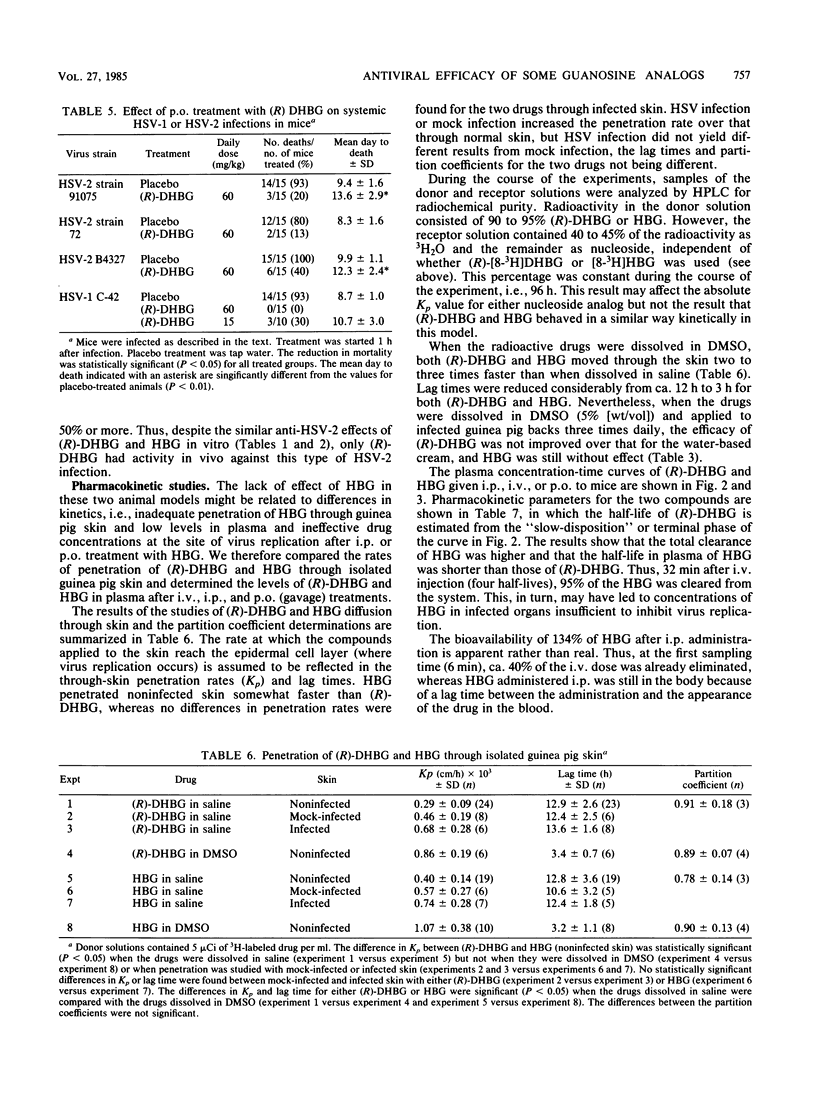
Three acyclic guanosine analogs with similar structures, the (R) and (S) forms of 9-(3,4-dihydroxybutyl)guanine and 9-(4-hydroxybutyl)guanine, were compared for antiherpes activity in vivo and in vitro. The three guanosine analogs were viral thymidine kinase-dependent inhibitors of virus multiplication. In cell cultures, (S)-9-(3,4-dihydroxybutyl)guanine was the least active of these three drugs against a variety of herpes simplex virus type 1 (HSV-1) and type 2 (HSV-2) strains. This was also the case for a certain HSV-1 or HSV-2 strain in different cell lines. In cell cultures, (R)-9-(3,4-dihydroxybutyl)guanine and 9-(4-hydroxybutyl)guanine had similar antiherpes activities. However, in vivo in cutaneous HSV-1 infections in guinea pigs treated topically and in systemic HSV-2 infections in mice treated orally or intraperitoneally, only (R)-9-(3,4-dihydroxybutyl)guanine had a therapeutic effect. The extremely short half-life in plasma and the high clearance of 9-(4-hydroxybutyl)guanine as compared with those of (R)-9-(3,4-dihydroxybutyl)guanine probably made 9-(4-hydroxybutyl)guanine inefficacious when given intraperitoneally or orally to mice infected with herpesvirus. On the other hand, no kinetic differences between (R)-9-(3,4-dihydroxybutyl)guanine and 9-(4-hydroxybutyl)guanine were observed in penetration through guinea pig skin ex vivo, and no preferential metabolism of 9-(4-hydroxybutyl)guanine in skin was noted. We deduced that high thymidine levels in guinea pig skin preferentially antagonize the antiviral effect of 9-(4-hydroxybutyl) guanine in cutaneous HSV-1 infections.
Full text
PDF




Selected References
These references are in PubMed. This may not be the complete list of references from this article.
- Alenius S., Berg M., Broberg F., Eklind K., Lindborg B., Oberg B. Therapeutic effects of foscarnet sodium and acyclovir on cutaneous infections due to herpes simplex virus type 1 in guinea pigs. J Infect Dis. 1982 Apr;145(4):569–573. doi: 10.1093/infdis/145.4.569. [DOI] [PubMed] [Google Scholar]
- Alenius S., Oberg B. Comparison of the therapeutic effects of five antiviral agents on cutaneous herpesvirus infection in guinea pigs. Arch Virol. 1978;58(4):277–288. doi: 10.1007/BF01317820. [DOI] [PubMed] [Google Scholar]
- De Clercq E. Comparative efficacy of antiherpes drugs in different cell lines. Antimicrob Agents Chemother. 1982 Apr;21(4):661–663. doi: 10.1128/aac.21.4.661. [DOI] [PMC free article] [PubMed] [Google Scholar]
- Elion G. B. Mechanism of action and selectivity of acyclovir. Am J Med. 1982 Jul 20;73(1A):7–13. doi: 10.1016/0002-9343(82)90055-9. [DOI] [PubMed] [Google Scholar]
- Harmenberg J., Wahren B., Oberg B. Influence of cells and virus multiplicity on the inhibition of herpesviruses with acycloguanosine. Intervirology. 1980;14(5-6):239–244. doi: 10.1159/000149192. [DOI] [PubMed] [Google Scholar]
- Helgstrand E., Eriksson B., Johansson N. G., Lannerö B., Larsson A., Misiorny A., Norén J. O., Sjöberg B., Stenberg K., Stening G. Trisodium phosphonoformate, a new antiviral compound. Science. 1978 Sep 1;201(4358):819–821. doi: 10.1126/science.210500. [DOI] [PubMed] [Google Scholar]
- Kern E. R., Richards J. T., Overall J. C., Jr, Glasgow L. A. Alteration of mortality and pathogenesis of three experimental Herpesvirus hominis infections of mice with adenine arabinoside 5'-monophosphate, adenine arabinoside, and phosphonoacetic acid. Antimicrob Agents Chemother. 1978 Jan;13(1):53–60. doi: 10.1128/aac.13.1.53. [DOI] [PMC free article] [PubMed] [Google Scholar]
- Larsson A., Alenius S., Johansson N. G., Oberg B. Antiherpetic activity and mechanism of action of 9-(4-hydroxybutyl)guanine. Antiviral Res. 1983 Aug;3(2):77–86. doi: 10.1016/0166-3542(83)90028-1. [DOI] [PubMed] [Google Scholar]
- Larsson A., Brännström G., Oberg B. Kinetic analysis in cell culture of the reversal of antiherpes activity of nucleoside analogs by thymidine. Antimicrob Agents Chemother. 1983 Nov;24(5):819–822. doi: 10.1128/aac.24.5.819. [DOI] [PMC free article] [PubMed] [Google Scholar]
- Larsson A., Oberg B., Alenius S., Hagberg C. E., Johansson N. G., Lindborg B., Stening G. 9-(3,4-dihydroxybutyl)guanine, a new inhibitor of herpesvirus multiplication. Antimicrob Agents Chemother. 1983 May;23(5):664–670. doi: 10.1128/aac.23.5.664. [DOI] [PMC free article] [PubMed] [Google Scholar]
- Larsson A., Tao P. Z. Phosphorylation of four acyclic guanosine analogs by herpes simplex virus type 2 thymidine kinase. Antimicrob Agents Chemother. 1984 Apr;25(4):524–526. doi: 10.1128/aac.25.4.524. [DOI] [PMC free article] [PubMed] [Google Scholar]
- Oberg B., Johansson N. G. The relative merits and drawbacks of new nucleoside analogues with clinical potential. J Antimicrob Chemother. 1984 Aug;14 (Suppl A):5–26. doi: 10.1093/jac/14.suppl_a.5. [DOI] [PubMed] [Google Scholar]
- Schnürer J., Oberg B. Inhibitory effects of foscarnet on herpesvirus multiplication in cell culture. Arch Virol. 1981;68(3-4):203–209. doi: 10.1007/BF01314573. [DOI] [PubMed] [Google Scholar]
- Spruance S. L., McKeough M. B., Cardinal J. R. Penetration of guinea pig skin by acyclovir in different vehicles and correlation with the efficacy of topical therapy of experimental cutaneous herpes simplex virus infection. Antimicrob Agents Chemother. 1984 Jan;25(1):10–15. doi: 10.1128/aac.25.1.10. [DOI] [PMC free article] [PubMed] [Google Scholar]