



Abstract
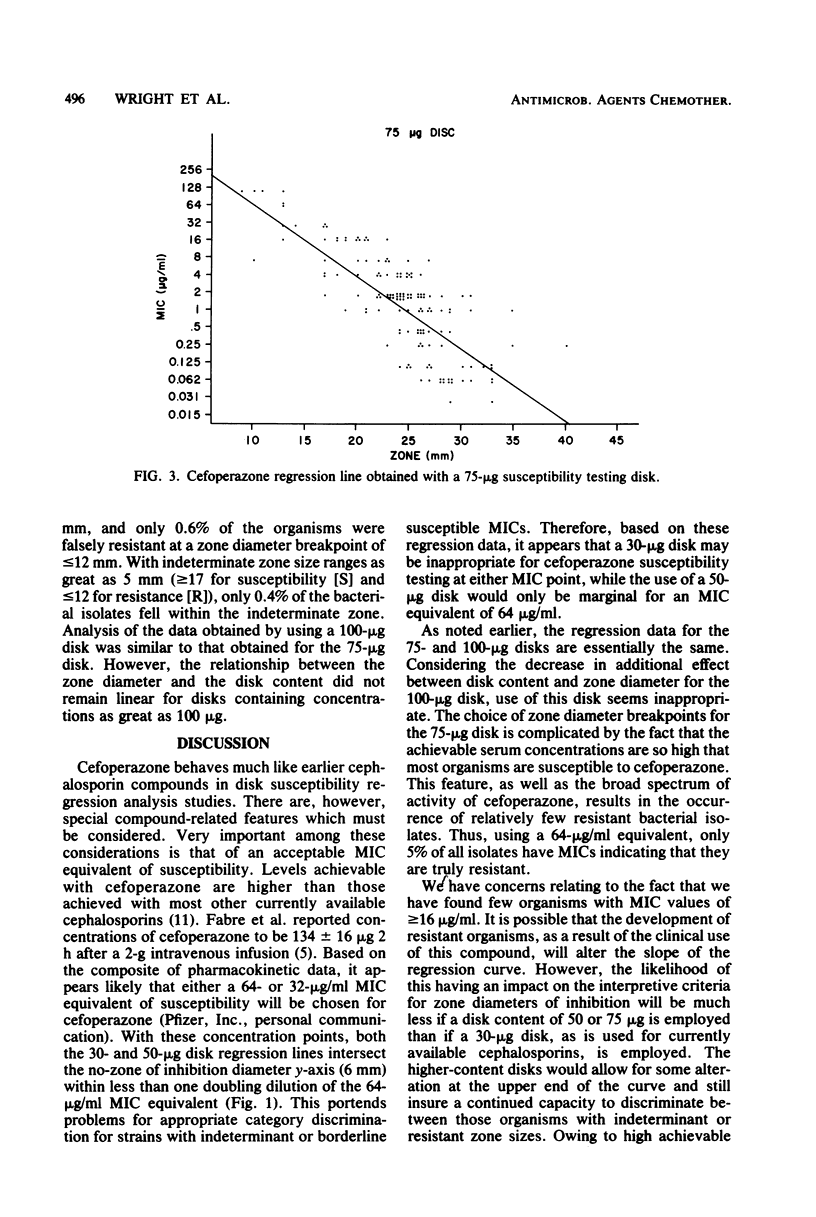
Cefoperazone agar dilution minimal inhibitory concentration (MIC) susceptibility results were compared with zones of inhibition produced by disk diffusion susceptibility testing. Disks containing 30, 50, 75, and 100 micrograms of cefoperazone were tested for purposes of regression line comparisons and error rate-bounded analysis. Results suggest that if the MIC equivalent of susceptibility is 32 micrograms/ml, either a 50-micrograms disk with zone sizes of susceptibility (S) greater than or equal to 15 mm and resistance (R) less than or equal to 12 mm or a 75-micrograms disk with zone sizes of S greater than or equal to 17 mm and R less than or equal to 14 mm may be appropriate. If the MIC equivalent of susceptibility is 64 micrograms/ml, this would dictate use of a 75-micrograms disk with zone sizes of S greater than or equal to 17 mm and R less than or equal to 12 mm. Disks containing either less than or equal to 30 or greater than or equal to 100 micrograms of cefoperazone did not adequately discriminate among susceptible and resistant bacterial strains at either the 32- or 64-micrograms/ml MIC equivalent.
Full text
PDF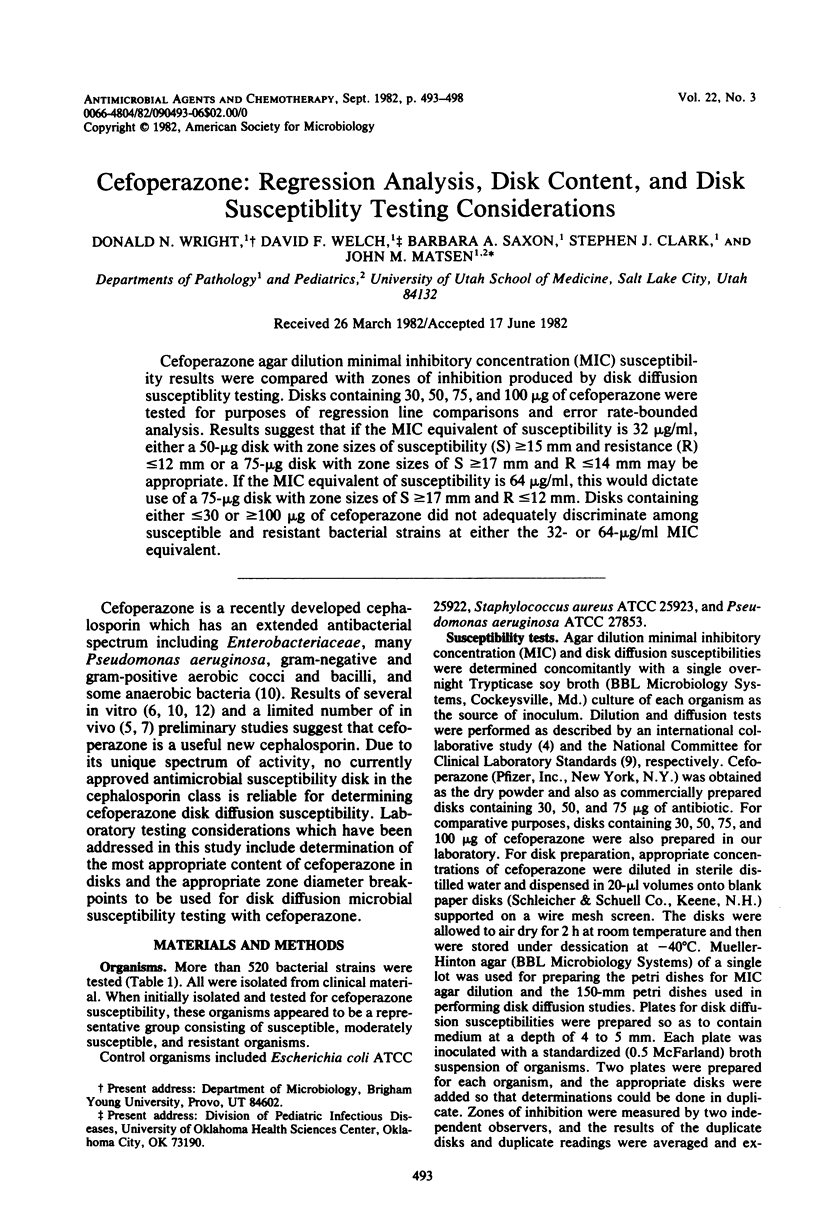




Selected References
These references are in PubMed. This may not be the complete list of references from this article.
- Aswapokee N., Aswapokee P., Neu H. C., Fu K. P. Diffusion disk susceptibility testing with cefotaxime. Antimicrob Agents Chemother. 1979 Aug;16(2):164–166. doi: 10.1128/aac.16.2.164. [DOI] [PMC free article] [PubMed] [Google Scholar]
- Barry A. L., Thornsberry C., Jones R. N., Fuchs P. C., Gavan T. L., Gerlach E. H. Reassessment of the "class" concept of disk susceptibility testing. Cephalothin disks versus minimal inhibitory concentrations with eleven cephalosporins. Am J Clin Pathol. 1978 Dec;70(6):909–913. doi: 10.1093/ajcp/70.6.909. [DOI] [PubMed] [Google Scholar]
- Hinkle A. M., LeBlanc B. M., Bodey G. P. In vitro evaluation of cefoperazone. Antimicrob Agents Chemother. 1980 Mar;17(3):423–427. doi: 10.1128/aac.17.3.423. [DOI] [PMC free article] [PubMed] [Google Scholar]
- Neu H. C., Fu K. P., Aswapokee N., Aswapokee P., Kung K. Comparative activity and beta-lactamase stability of cefoperazone, a piperazine cephalosporin. Antimicrob Agents Chemother. 1979 Aug;16(2):150–157. doi: 10.1128/aac.16.2.150. [DOI] [PMC free article] [PubMed] [Google Scholar]