


Abstract
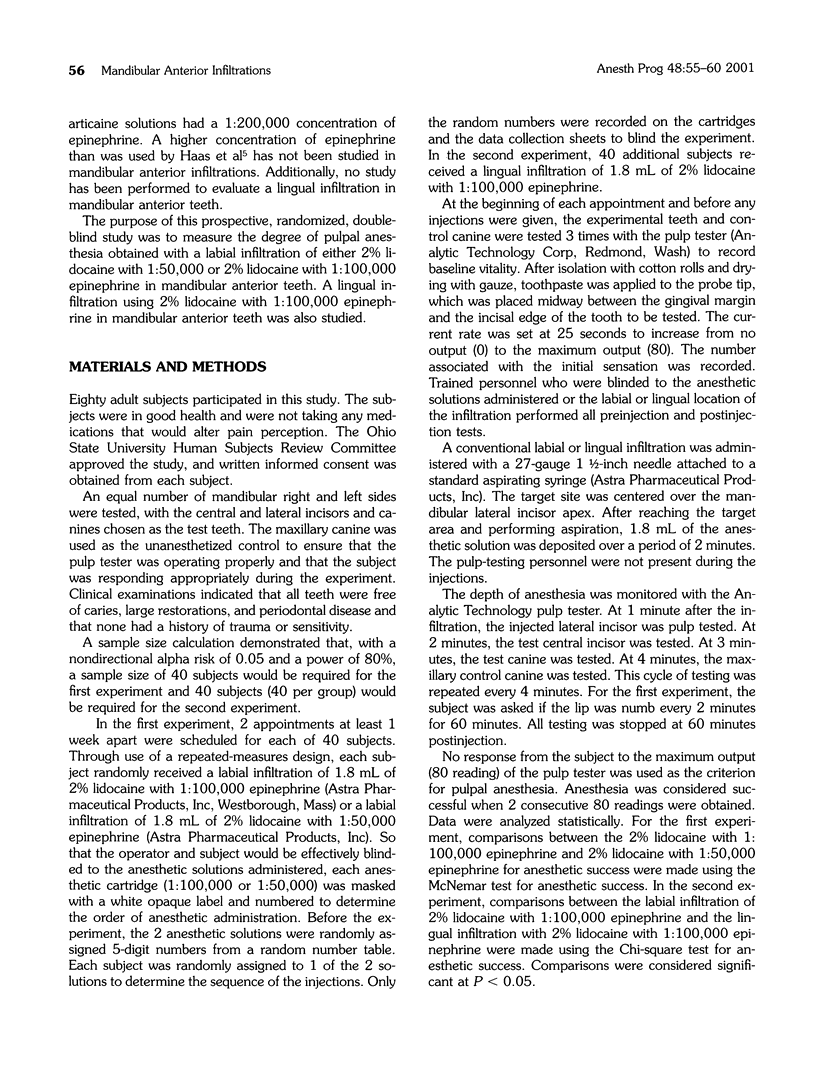
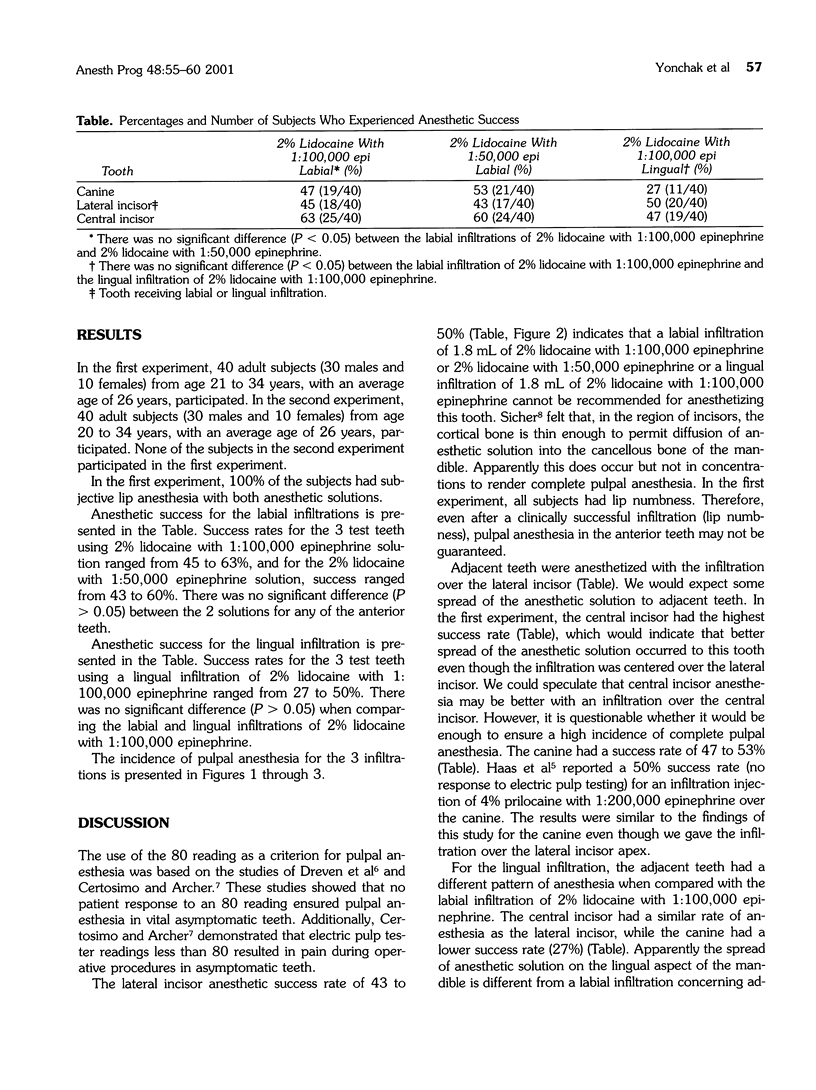
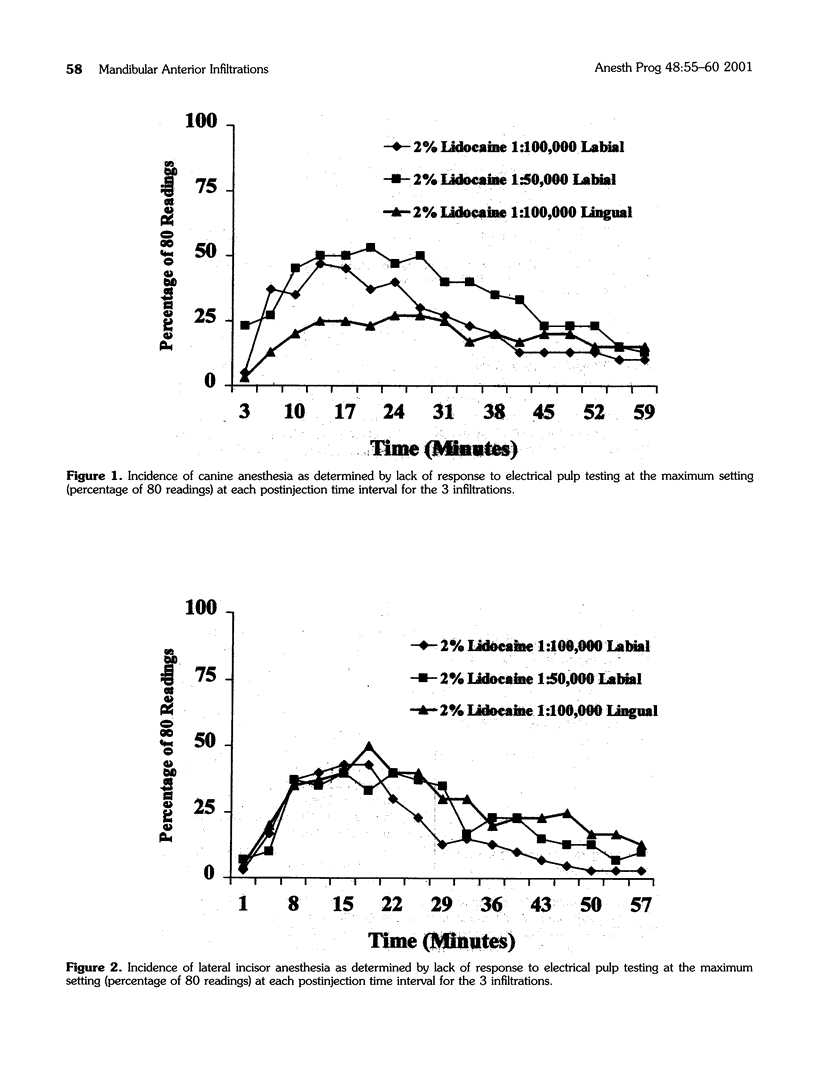
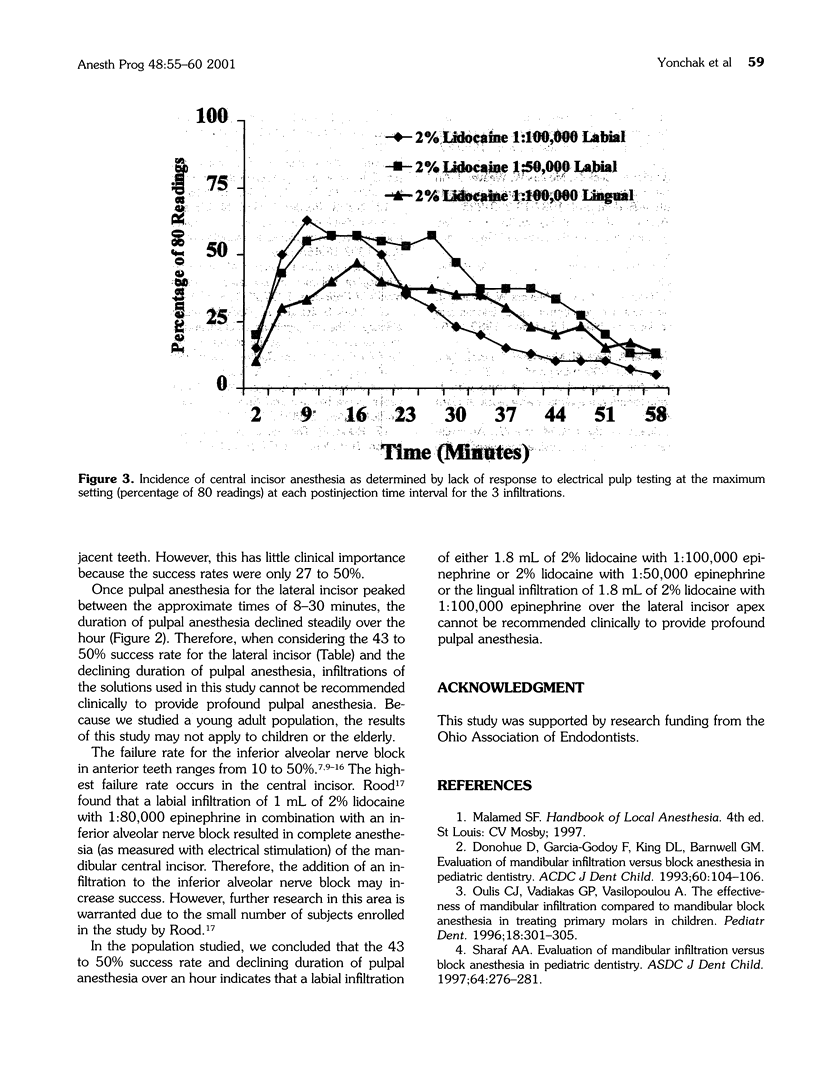
The purpose of this prospective, randomized, double-blind study was to measure the degree of anesthesia obtained with a labial infiltration of either 2% lidocaine with 1:50,000 or 2% lidocaine with 1:100,000 epinephrine in mandibular anterior teeth. Another objective was to measure the degree of anesthesia obtained with a lingual infiltration of 2% lidocaine with 1:100,000 epinephrine in mandibular anterior teeth. Through use of a repeated-measures design, 40 subjects randomly received a labial infiltration at the lateral incisor apex of either 1.8 mL of 2% lidocaine with 1:100,000 epinephrine or 1.8 mL of 2% lidocaine with 1:50,000 epinephrine at 2 separate appointments. An additional 40 subjects received a lingual infiltration at the lateral incisor apex of 1.8 mL of 2% lidocaine with 1:100,000 epinephrine. The mandibular anterior teeth were blindly pulp tested at 4-minute cycles for 60 minutes postinjection. No response from the subject to the maximum output (80 reading) of the pulp tester was used as the criterion for pulpal anesthesia. Anesthesia was considered successful when 2 consecutive 80 readings were obtained. For the 3 infiltrations, success rates for the lateral incisor ranged from 43 to 50%. Adjacent teeth had success rates of 27 to 63%. There was no significant difference (P > 0.05) in success between the labial infiltration of 2% lidocaine with 1:100,000 epinephrine and 2% lidocaine with 1:50,000 epinephrine or the lingual infiltration of 2% lidocaine with 1:100,000 epinephrine when compared with the labial infiltration of 2% lidocaine with 1:100,000 epinephrine. Duration of pulpal anesthesia declined steadily for all solutions over the 60 minutes. In conclusion, the success rate of 43-50% and declining duration of pulpal anesthesia over an hour indicates that a labial infiltration of 1.8 mL of either 2% lidocaine with 1:100,000 epinephrine or 1: 50,000 epinephrine or a lingual infiltration of 2% lidocaine with 1:100,000 epinephrine over the lateral incisor apex cannot be recommended clinically to provide profound pulpal anesthesia.
Full text
PDF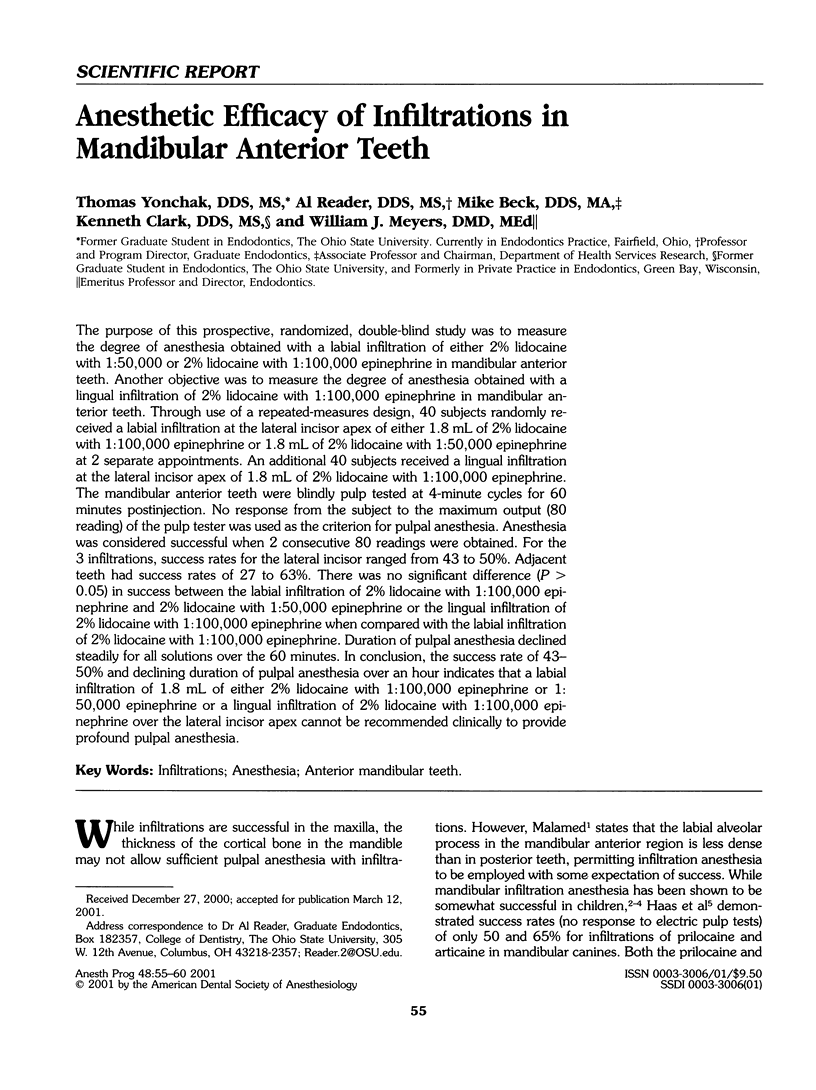
Selected References
These references are in PubMed. This may not be the complete list of references from this article.
- Certosimo A. J., Archer R. D. A clinical evaluation of the electric pulp tester as an indicator of local anesthesia. Oper Dent. 1996 Jan-Feb;21(1):25–30. [PubMed] [Google Scholar]
- Chaney M. A., Kerby R., Reader A., Beck F. M., Meyers W. J., Weaver J. An evaluation of lidocaine hydrocarbonate compared with lidocaine hydrochloride for inferior alveolar nerve block. Anesth Prog. 1991 Nov-Dec;38(6):212–216. [PMC free article] [PubMed] [Google Scholar]
- Clark S., Reader A., Beck M., Meyers W. J. Anesthetic efficacy of the mylohyoid nerve block and combination inferior alveolar nerve block/mylohyoid nerve block. Oral Surg Oral Med Oral Pathol Oral Radiol Endod. 1999 May;87(5):557–563. doi: 10.1016/s1079-2104(99)70133-2. [DOI] [PubMed] [Google Scholar]
- Dagher F. B., Yared G. M., Machtou P. An evaluation of 2% lidocaine with different concentrations of epinephrine for inferior alveolar nerve block. J Endod. 1997 Mar;23(3):178–180. doi: 10.1016/S0099-2399(97)80271-3. [DOI] [PubMed] [Google Scholar]
- Donohue D., Garcia-Godoy F., King D. L., Barnwell G. M. Evaluation of mandibular infiltration versus block anesthesia in pediatric dentistry. ASDC J Dent Child. 1993 Mar-Apr;60(2):104–106. [PubMed] [Google Scholar]
- Dreven L. J., Reader A., Beck M., Meyers W. J., Weaver J. An evaluation of an electric pulp tester as a measure of analgesia in human vital teeth. J Endod. 1987 May;13(5):233–238. doi: 10.1016/s0099-2399(87)80097-3. [DOI] [PubMed] [Google Scholar]
- Haas D. A., Harper D. G., Saso M. A., Young E. R. Comparison of articaine and prilocaine anesthesia by infiltration in maxillary and mandibular arches. Anesth Prog. 1990 Sep-Oct;37(5):230–237. [PMC free article] [PubMed] [Google Scholar]
- Hannan L., Reader A., Nist R., Beck M., Meyers W. J. The use of ultrasound for guiding needle placement for inferior alveolar nerve blocks. Oral Surg Oral Med Oral Pathol Oral Radiol Endod. 1999 Jun;87(6):658–665. doi: 10.1016/s1079-2104(99)70156-3. [DOI] [PubMed] [Google Scholar]
- Hinkley S. A., Reader A., Beck M., Meyers W. J. An evaluation of 4% prilocaine with 1:200,000 epinephrine and 2% mepivacaine with 1:20,000 levonordefrin compared with 2% lidocaine with:100,000 epinephrine for inferior alveolar nerve block. Anesth Prog. 1991 May-Jun;38(3):84–89. [PMC free article] [PubMed] [Google Scholar]
- McLean C., Reader A., Beck M., Meryers W. J. An evaluation of 4% prilocaine and 3% mepivacaine compared with 2% lidocaine (1:100,000 epinephrine) for inferior alveolar nerve block. J Endod. 1993 Mar;19(3):146–150. doi: 10.1016/s0099-2399(06)80510-8. [DOI] [PubMed] [Google Scholar]
- Nist R. A., Reader A., Beck M., Meyers W. J. An evaluation of the incisive nerve block and combination inferior alveolar and incisive nerve blocks in mandibular anesthesia. J Endod. 1992 Sep;18(9):455–459. doi: 10.1016/S0099-2399(06)80849-6. [DOI] [PubMed] [Google Scholar]
- Oulis C. J., Vadiakas G. P., Vasilopoulou A. The effectiveness of mandibular infiltration compared to mandibular block anesthesia in treating primary molars in children. Pediatr Dent. 1996 Jul-Aug;18(4):301–305. [PubMed] [Google Scholar]
- Sharaf A. A. Evaluation of mandibular infiltration versus block anesthesia in pediatric dentistry. ASDC J Dent Child. 1997 Jul-Aug;64(4):276–281. [PubMed] [Google Scholar]
- Vreeland D. L., Reader A., Beck M., Meyers W., Weaver J. An evaluation of volumes and concentrations of lidocaine in human inferior alveolar nerve block. J Endod. 1989 Jan;15(1):6–12. doi: 10.1016/S0099-2399(89)80091-3. [DOI] [PubMed] [Google Scholar]