



Abstract
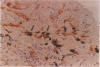
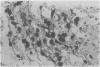
To show the clinical importance of cells containing FXIIIa in pulmonary fibrosis induced by bleomycin, the distributions of FXIIIa and collagenous components were investigated immunohistochemically in both normal lung tissues and those affected by bleomycin. In the normal tissues FXIIIa-containing cells were sparse, but they were numerous in the pulmonary fibrotic tissues, especially in the subpleural area and around the blood vessels of alveolar septa, where slight to moderate fibrosis was seen, and in the intra-alveolar fibrinous exudate. In the collagenous scar-like areas, however, these cells were fewer in number and their FXIIIa expression was depleted. These findings suggest that cells containing FXIIIa have an important role in the development of pulmonary fibrosis induced by bleomycin.
Full text
PDF

Images in this article
Selected References
These references are in PubMed. This may not be the complete list of references from this article.
- Adány R., Glukhova M. A., Kabakov A. Y., Muszbek L. Characterisation of connective tissue cells containing factor XIII subunit a. J Clin Pathol. 1988 Jan;41(1):49–56. doi: 10.1136/jcp.41.1.49. [DOI] [PMC free article] [PubMed] [Google Scholar]
- Fear J. D., Jackson P., Gray C., Miloszewski K. J., Losowsky M. S. Localisation of factor XIII in human tissues using an immunoperoxidase technique. J Clin Pathol. 1984 May;37(5):560–563. doi: 10.1136/jcp.37.5.560. [DOI] [PMC free article] [PubMed] [Google Scholar]
- Luna M. A., Bedrossian C. W., Lichtiger B., Salem P. A. Interstitial pneumonitis associated with bleomycin therapy. Am J Clin Pathol. 1972 Nov;58(5):501–510. doi: 10.1093/ajcp/58.5.501. [DOI] [PubMed] [Google Scholar]
- Mosher D. F. Cross-linking of cold-insoluble globulin by fibrin-stabilizing factor. J Biol Chem. 1975 Aug 25;250(16):6614–6621. [PubMed] [Google Scholar]
- Mosher D. F. Cross-linking of fibronectin to collagenous proteins. Mol Cell Biochem. 1984;58(1-2):63–68. doi: 10.1007/BF00240605. [DOI] [PubMed] [Google Scholar]
- Penneys N. S. Factor XIII expression in the skin: observations and a hypothesis. J Am Acad Dermatol. 1990 Mar;22(3):484–488. doi: 10.1016/0190-9622(90)70068-s. [DOI] [PubMed] [Google Scholar]
- Rennard S. I., Hunninghake G. W., Bitterman P. B., Crystal R. G. Production of fibronectin by the human alveolar macrophage: mechanism for the recruitment of fibroblasts to sites of tissue injury in interstitial lung diseases. Proc Natl Acad Sci U S A. 1981 Nov;78(11):7147–7151. doi: 10.1073/pnas.78.11.7147. [DOI] [PMC free article] [PubMed] [Google Scholar]
- Shimokado K., Raines E. W., Madtes D. K., Barrett T. B., Benditt E. P., Ross R. A significant part of macrophage-derived growth factor consists of at least two forms of PDGF. Cell. 1985 Nov;43(1):277–286. doi: 10.1016/0092-8674(85)90033-9. [DOI] [PubMed] [Google Scholar]
- Suwabe A., Takahashi K., Yasui S., Arai S., Sendo F. Bleomycin-stimulated hamster alveolar macrophages release interleukin-1. Am J Pathol. 1988 Sep;132(3):512–520. [PMC free article] [PubMed] [Google Scholar]
- Toida M., Watanabe F., Tsai C. S., Okutomi T., Tatematsu N., Oka N. Factor XIIIa-containing cells and fibrosis in oral and maxillofacial lesions: an immunohistochemical study. Oral Surg Oral Med Oral Pathol. 1989 Sep;68(3):293–299. doi: 10.1016/0030-4220(89)90214-4. [DOI] [PubMed] [Google Scholar]