



Abstract
Zika virus co-circulates with dengue in tropical and sub-tropical regions. Cases of co-infection by dengue and Zika have been reported, the implication of this co-infection for an integrated intervention program for controlling both dengue and Zika must be addressed urgently. Here, we formulate a mathematical model to describe the transmission dynamics of co-infection of dengue and Zika with particular focus on the effects of Zika outbreak by vaccination against dengue among human hosts. Our analysis determines specific conditions under which vaccination against dengue can significantly increase the Zika outbreak peak, and speed up the Zika outbreak peak timing. Our results call for further study about the co-infection to direct an integrated control to balance the benefits for dengue control and the damages of Zika outbreak.
Dengue and Zika are both vector-borne diseases in tropical and sub-tropical regions with a common vector, dengue and Zika both belong to the family Flaviviridae and genus Flavivirus. Dengue is a prevalent disease being transmitted by the bite of a mosquito infected with one of the four serotypes1,2 while Zika is an emerging disease. Zika virus was first isolated in Uganda in 19473, and there was an outbreak of Zika in Yap, Federated States of Micronesia4 in 2007, and in French Polynesia5 till 2013. By the end of January 2016, autochthonous circulation of Zika was reported in more than 20 countries or territories in South, Central, and North America and the Caribbean6,7,8,9,10,11,12, leading to the declaration of WHO that Zika virus is a global public health emergency13.
Recent clinical and experimental evidences support immunological cross-reactivity between dengue and Zika14,15,16,17. In particular, these evidences show that plasma to dengue was able to drive antibody-dependent enhancement of Zika infection. Co-circulation of multiple serotypes of dengue and dengue-Zika co-circulation have previously been reported in refs 18, 19, 20. In particular, co-infection of dengue and Zika were observed in two patients during the Zika outbreak in New Caledonia in 201418, and in two patients during the Zika outbreak in Tuparetama of Brazil in 201519. The co-circulation could be a potentially series public concern given that more than a third of the world’s population lives in countries where dengue is endemic21, with the dengue belt covering Central America, most of South America, sub-Saharan Africa, India, and South East Asia. Relevant to this co-infection is the development of vaccine products against dengue by Sanofi Pasteur, and the clinical trials by Butantan and Takeda. Thus, it is an important urgent issue for public health decision makers to know how dengue immunization program impacts Zika transmission when co-circulation becomes wide spread. Specially, under which conditions implemented dengue immunization control programs may boost the outbreak of Zika is no longer a thought-provoking issue. Developing a framework to address this issue through a mathematical model is the main objective of this study.
Much progress has been made for modelling dengue infection dynamics including the role of cross-reactive antibodies for the four different dengue serotypes as discussed in the review paper22. The dengue transmission dynamics becomes very complex because of the co-circulating serotypes in many endemic areas, and the absence of long-term cross-immunity23,24,25,26. In 1997, Feng et al.27 proposed a two-stain model with the vector population being subdivided into a susceptible class and two serotype-specific infectious classes and the host populations being described by the SIR-type model for each serotype. Esteva and Vargas28 considered a further model by including an explicit state for individuals who recovered from primary infections. Nuraini et al.29 and Sriprom et al.30 extended Esteva’s model by accounting for two separate symptomatic and asymptomatic compartments for secondary infections. A four-serotype model was considered in these papers31,32,33. Different from these previous studies, recently developed mathematical models have emphasized the evaluation of the impact of co-circulation of the four serotypes mainly among hosts34,35,36,37,38,39,40. In contrast to dengue, the epidemiology of Zika among humans remains poorly understood, despite some recent outbreaks of modelling activities41,42,43,44.
We should mention that mathematical models of co-infection of two infectious diseases among humans have been developed in many different settings45, including co-infection of HIV with TB46,47,48,49,50,51, HCV52,53, two strains of HIV54, HDV and HBV55, multi-strains of influenza56,57. To our best knowledge, our work here is the first attempt to develop a mathematical model to address the co-infection of dengue and Zika and its implication to Zika prevalence. Our purpose here is to propose a mathematical model of co-infection of dengue and Zika with particular focus on the potential impact and implication for Zika outbreak of vaccination against dengue in humans.
Preliminaries
We stratify the total human population, Nh(t), into:
S(t): the number of humans susceptible to both dengue and Zika at time t;
Id(a, t): the number of dengue-infected humans with infection age a at time t, who can also be infected by Zika virus and move to Idz(a, b, t);
Iz(b, t): the number of Zika-infected humans with infection age b at time t, who can also be infected by dengue and move to Idz(a, b, t);
Idz(a, b, t): the number of dengue and Zika-infected humans with dengue infection age a and Zika infection age b at time t;
Rd(t): the number of humans recovered from dengue at time t, who can also be infected by Zika and move to  ;
;
Rz(t): the number of humans recovered from Zika at time t, who can also be infected by dengue and move to  ;
;
 : the number of Zika-infected humans with Zika-infection age b, at time t, who are immune to dengue;
 : the number of dengue-infected humans with dengue-infection age a, at time t, who are immune to Zika;
Rdz(t): the number of humans recovered from dengue and Zika at time t, who can neither be infected by dengue nor Zika.
Mosquito population Nm is divided into Sm, Imd, Imz, Imdz, representing the density of mosquitos who are susceptible, infected with dengue only, infected with Zika only, infected with both dengue and Zika. The transmission diagram of co-infection of dengue and Zika among humans and mosquitos is shown in Fig. 1.
Figure 1. Transmission diagram.

We start with an intuitive view about the effects of vaccination against dengue among humans on the outbreak of Zika through a very simple static transmission model illustrated in Fig. 2. Here the susceptible humans (S) can be infected with Zika virus via three different routes, namely
Figure 2. Sub-flow diagram of Zika infection among humans.
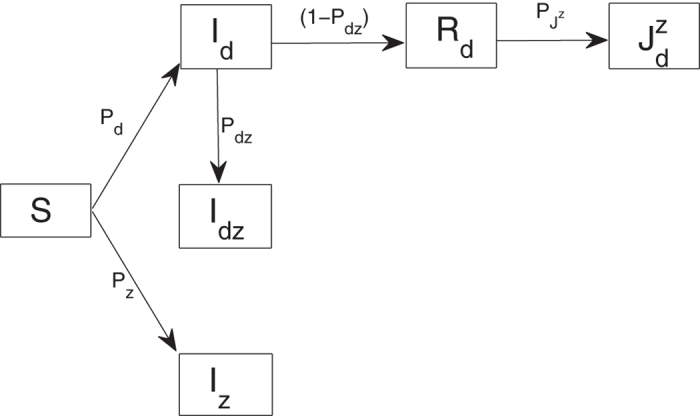
Here, we assume that the susceptible humans (S) are infected by dengue with a ratio of Pd on average and by Zika with a ratio of Pz on average. We further assume that the class Id will be infected with Zika at a ratio of Pdz while the other part will recover to Rd. Moreover, we assume that the individuals in compartment Rd can be further infected with Zika at a ratio of  .
.
 |
Let the initial number of susceptible humans (S) be S0. If we do not inoculate against dengue, then the final average number of humans infected with Zika virus through the above three routes (i.e. Iz, Idz,  ) can be calculated as
 |
Therefore, the total number of humans infected with Zika virus should be
 |
Now we assume that the coverage rate of dengue vaccine is Pc and the efficacy rate of dengue vaccine is P0. Then the effective coverage rate of dengue vaccine is Pv = P0Pc. The portion of susceptible humans successfully inoculated with dengue vaccine will directly transfer to the compartment Rd. Therefore, the final average numbers of Iz, Idz and  become
 |
Then, the total number of humans infected with Zika virus after vaccination against dengue should be
 |
Comparing equation (2) with equation (4), we can see that with the implementation of vaccination of dengue the final numbers of Iz and Idz decrease while the final number of  increases. To determine whether the total number of humans infected with Zika is increased or not, we let
 |
where  is the ratio at which the part of the susceptible humans inoculated with dengue vaccine are infected with Zika,
  is the total ratio at which the susceptible humans are infected with Zika through the above mentioned three routes described in (1). It follows from equation (6) that if
  (i.e.
(i.e.  , as shown in the red region of Fig. 3(A)), then the higher ratio the susceptible humans are inoculated with dengue vaccine, the more the total number of humans are infected with Zika virus compared with the case without dengue vaccination, as shown in Fig. 3(B,C); if
  (i.e.
(i.e.  , as shown in the green region of Fig. 3(A)), inoculating dengue vaccine can decrease relatively the total number of humans infected with Zika virus, as shown in Fig. 3(B,D). This discussion, based on a static infection outcome analysis, suggests a likely scenario that, under certain conditions, vaccination against dengue can significantly boost the outbreak of Zika. Our analysis below is to theoretically and numerically examine these conditions with our proposed transmission dynamics model.
Figure 3.

(A) Schematic scenarios which show that vaccination against dengue can increase the total number of Zike infections if the parameters Pz and  are located in the red region while it can decrease the total number of Zika infections in the green region; (B) The relationship of the total number of Zika infections to the ratio
  with or without vaccination against dengue. Here, Pz = 0.3 and Pv = 0.7; (C) The relationship of ΔZ to the effective coverage rate of dengue vaccine Pv while the parameters Pz and
  are chosen in the red region of (A) with Pz = 0.3; (D) The relationship of ΔZ to the effective coverage rate of dengue vaccine Pv while the parameters Pz and
  are chosen in the green region of (A) with Pz = 0.3. Other parameters in (A–D) are fixed as Pd = 0.3, Pdz = 0.1, S0 = 100000.
Model formulation
We assume a SI-type model for dengue and Zika co-infection for the mosquito population. The model equations for mosquitos give
 |
Here, Λ is the recruitment rate of mosquitos, and the definitions for other parameters are listed in Table 1. We assume SIR-type model for dengue and Zika co-infection in human population and formulate the following age-structured model to describe the dynamics of co-infection of dengue and Zika among humans:
Table 1. Definitions of the parameters.
| Parameters | Definitions |
|---|---|
| c | Biting rate bites (per mosquito per day) (day−1) |
| βd | Mosquito (with dengue) -to-human transmission probability |
| βz | Mosquito (with Zika) -to-human transmission probability |
| βdz | Mosquito (with both) -to-human transmission probability |
| β1d | Mosquito (with dengue) -to-human (with Zika) transmission probability |
| β1z | Mosquito (with Zika) -to-human (with dengue) transmission probability |
| β1dz | Mosquito (with both) -to-human (with dengue) transmission probability |
| β1zd | Mosquito (with both) -to-human (with Zika) transmission probability |
| βrd | Mosquito (with dengue) -to-human (with Zika immune) transmission probability |
| βrz | Mosquito (with Zika) -to-human (with dengue immune) transmission probability |
| βrdz | Mosquito (with both virus) -to-human (with dengue immune) transmission probability |
| βrzd | Mosquito (with both virus) -to-human (with Zika immune) transmission probability |
| ηd | Human (with dengue) -to-mosquito transmission probability |
| ηz | Human (with Zika) -to-mosquito transmission probability |
| ηdz | Human(with both) -to-mosquito transmission probability |
| ηjd | Human (with dengue infection but Zika immune) -to-mosquito transmission probability |
| ηjz | Human (with Zika infection but dengue immune) -to-mosquito transmission probability |
| η1d | Human (with dengue infection) -to-mosquito (with Zika infection) transmission probability |
| η1z | Human (with Zika infection) -to-mosquito (with dengue infection) transmission probability |
| η1dz | Human (with both virus) -to-mosquito (with dengue infection) transmission probability |
| η1zd | Human (with both virus) -to-mosquito (with Zika infection) transmission probability |
| μm | Mosquito mortality rate (day−1) |
| dm | Mosquito disease -related mortality rate (day−1) |
 |
Here γd(a) is the recover rate at which individuals in the compartment Id with dengue-infection age a recover to the class Rd, γz(b) denotes the recover rate at which individuals in the class Iz with Zika-infection age b move to the compartment Rz,  represents the recover rate at which individuals in the class
  with Zika-infection age b recover to the compartment Rdz, and
  is the recover rate at which individuals in the class
  with dengue-infection age a move to compartment Idz, γdz(a, b) denotes the recover rate at which individuals in the class Idz with time-since-infection a for dengue and time-since-infection b for Zika recover to the compartment Rdz directly, γdz(a) represents the recover rate at which individuals in the class Idz transit to the compartment
  due to recovery of dengue, and γdz(b) is the recover rate at which individuals in the class Idz transit to the compartment
  due to recovery of Zika. The definitions for other parameters independent of infection ages are given in Table 1. Here, the condition Idz(0, 0, t) = 0 means that the susceptible individuals can not be infected with dengue and Zika in the same time.
We assume that
 |
and
 |
Define  , i.e. the total number of humans who are infected with dengue at time t, and can further be infected by Zika. Then, we have
 |
Further, if we assume that the recover rate γd(a) is independent of dengue-infection age a, that is, γd, we have  . Then formula (9) yields
 |
Similarly, if the recover rate γz(b) is independent of Zika-infection age b, the total number of humans infected with Zika, given by  , reads
 |
With similar calculation, we can get the derivative of the compartment Idz(t) as follows:
 |
Also, when we assume that the recover rates γdz(a, b), γdz(a) and γdz(b) are all constants, denoted by  and
and  , respectively, then formula (12) gives
 |
Moreover, define the total number of humans who are immune to dengue but infected with Zika as  and the total number of humans who are immune to Zika but infected with dengue as
  . By assuming the recover rates
  and
and  being independent of infection ages (i.e.,
  and
and  ), we easily obtain that
 |
and
 |
Based on the above assumptions and discussions, the double age-structured model is reduced to the following ODE model:
 |
We call model (16) with model (7) as system S*. It follows from model (16) that the total number of humans Nh(t) is a constant, denoted by Nh. Let  and Imd = Imz = Imdz = 0. Then we can show that system S* has a disease-free equilibrium, which gives
 |
Using the next generation matrix introduced in papers58,59, we can calculate the basic reproduction number for system S*, denoted by R0 (see electronic supplementary information for details). This is the spectral radius of the next generation matrix and given by
 |
Here,  and
and  are the basic reproduction numbers for the dengue-only model and Zika-only model, respectively. Consequently, when Rz > 1 (Rd > 1), then there is an outbreak of Zika (dengue) while the number of Zika (dengue) infections will directly decrease to zero if Rz < 1 (Rd < 1).
Main Results
In this section, we carry out numerical simulations for the dynamic system S* in order to examine effect of dengue vaccination on the outbreak of Zika. In our simulations, we vary three parameters βdz, βrz and Λ, and fix all the other parameter values as follows:
 |
Let the initial values IV(0) for system S* be given by
 |
Let the effective coverage rate of vaccination against dengue among humans be Pv. When inoculating dengue vaccine to humans at the outset of the outbreak of dengue and Zika, the initial conditions of model S* become as  with
with  while other vector components remaining unchanged.
We first simulate system S* by fixing the parameters βdz and βrz as 0.18 and 0.05, respectively. We examine the variation of  with parameter Λ with or without inoculating dengue vaccine, as shown in Fig. 4. As we can see, when the parameter Λ varies in the interval from 10000 to 1000000 vaccination against dengue can lead to two opposite results for the outbreak of Zika. That is, when Λ is relatively low, the effect of dengue vaccine on the outbreak of Zika is not noticeable. However, if Λ increases to relatively large, vaccination against dengue among humans will significantly boost the outbreak of Zika with a much higher outbreak peak compared with that without vaccination. The lower and upper bounds of this parameter value are determined from intensive numerical simulations to clearly illustrate these two opposite scenarios. In particular, we plot solutions to system S* (shown in Figs 5 and 6) with Λ being fixed as 10000 and 1000000 (the lower and higher boundary value of the interval of Λ chosen in Fig. 4), respectively. Figures 5(H) and 6(H) demonstrate these two opposite situations: dengue vaccination results in the number of human infected with Zika either decline or increase. It follows from Figs 5 and 6 that vaccination against dengue among humans will always reduce the number of humans infected with dengue (including the compartments Id,
  , and Idz), and hence leads to a reduction in the total number of humans infected with dengue (i.e.
  ). However, vaccination against dengue may increase the number of individuals in the compartment
  . This explains the two opposite results about the effects of the dengue vaccination on the Zika outbreak. Note that when Λ = 1000000, with which vaccination against dengue can significantly boost the Zika outbreak, we can calculate that Rd = Rz = 2.82, within the range of basic reproduction numbers for dengue and Zika in the literatures42,60,61,62,63,64.
Figure 4. The value of  in time and with respect to the recruitment rate of mosquitos Λ being varied in the interval [10000, 1000000].
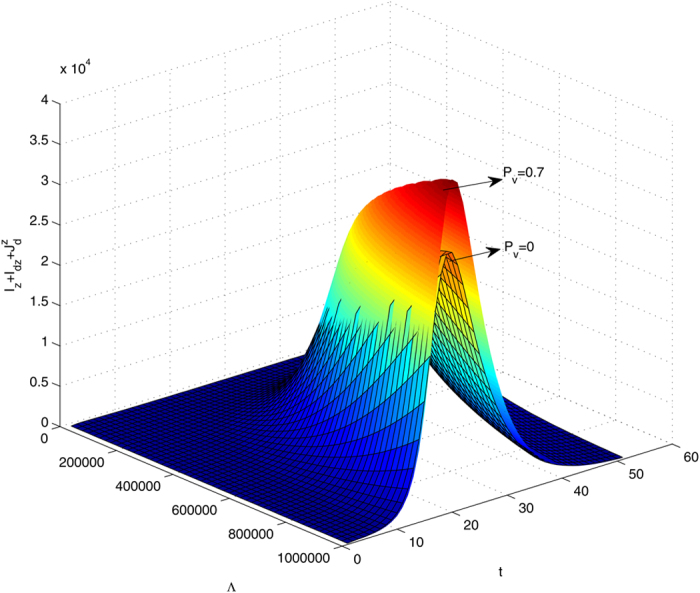
The mesh surface represents the solutions without inoculating dengue vaccine to susceptible humans while the other one are the solutions when the susceptible humans are inoculated with dengue vaccine at a ratio of 0.7. Parameters βdz and βrz are fixed as 0.18, 0.05, respectively.
Figure 5. Solutions to system S* with the solid curves being the solutions without vaccination and the dashed curves being the solutions with inoculating the dengue vaccine at the ratio of Pv = 0.7.

Here, βdz = 0.18, βrz = 0.05, Λ = 10000.
Figure 6. Solutions of model S* with the solid lines being the solutions without vaccination and the dashed lines being the solutions after inoculating the dengue vaccine at the ratio of Pv = 0.7.

Here we fixed Λ = 1000000 and all the other parameters as the same as those in Fig. 5.
Further, we examine the effects of the effective coverage rate Pv on the outbreak of Zika. Fix parameters βdz = 0.05, βrz = 0.18, Λ = 10000 and let the parameter Pv vary, Fig. 7(A) shows that a higher effective coverage rate of vaccination can result in a much higher peak of the outbreak of Zika. Moreover, if we choose Λ = 1000000, then we observe that with a higher rate of vaccination against dengue not only the peak of the outbreak of Zika can be significantly increased, but also the Zika outbreak peak much earlier, as shown in Fig. 7(B).
Figure 7.

Solutions of  for (A) βdz = 0.05, βrz = 0.18, Λ = 10000 and (B) βdz = 0.05, βrz = 0.18, Λ = 1000000. The accumulated number of humans infected with Zika for (C) βdz = 0.18, βrz = 0.18, Λ = 10000 and (D) βdz = 0.18, βrz = 0.05, Λ = 10000.
Considering the number of the accumulated Zika infections, we obtained two similar opposite results. Figure 7(C) shows that with a higher rate of vaccination against dengue the number of accumulated Zika infections will increase significantly, while Fig. 7(D) illustrates that vaccination against dengue may reduce the number of the accumulated Zika infections. In Fig. 7(D) we assumed that βrz = βz = 0.05 while in Fig. 7(C) we assumed that 0.18 = βrz > βz = 0.05 based on the emerging clinical evidence of enhancement14,15,16,17. Comparisons between these scenarios clearly indicate, under the conditions reflected by the parameter values, that dengue vaccination may indeed lead to significant increase in Zika infections.
Conclusion and Discussion
There are increasing evidence of co-infection of dengue and Zika. Due to similar transmission routes with the same host species, some intervention strategies such as vector control are effective for curbing both dengue and Zika. However, other interventions such as vaccination against one virus may be harmful to the control of another, specially when enhancement occurs to favor the spread of the virus not covered with vaccine. Our study examined the implication of this enhancement for Zika outbreaks when vaccination against dengue in humans is applied. We initially formulated a very simple static transmission model to give an intuitive illustration that vaccination against dengue among humans may significantly boost Zika transmission among the population.
In order to theoretically verify this illustration, we then proposed a dynamic model to describe the dynamics of co-infection of dengue and Zika. More specifically, we developed a novel model with double age-structures for dengue and Zika, extending the general age-structure model65,66,67 by incorporating compartments with specific dengue-infection and Zika-infection age. Under certain stage-specific homogenetical assumptions about the virus dynamics characteristics, we simplified our double age-structured model to an ODE model, for which the basic reproduction number can be calculated.
We also numerically investigated the dynamics of model S* and obtained some observations which are in agreement with the conclusions from the analysis of our static transmission model in Section 2. Figure 4 shows that vaccination against dengue among humans may result in the total number of humans infected with Zika virus decline or increase, depending on the parameter Λ, the recruitment rate of mosquitos. In particular, it significantly enlarges the peak of the outbreak of Zika when Λ is relatively large. It follows from Figs 5 and 6 that this enlarged outbreak of Zika by vaccination against dengue is due to multiple factors. Vaccination against dengue can reduce the numbers of Iz and Idz while it always increases the number of  . Thus the balance of increase in the number of
  and decrease in the number of Iz and Idz determines whether the total number of infected with Zika increase or not. Further, we observed that a higher rate of vaccination against dengue can also results in a higher and earlier peak of the outbreak of Zika, as shown in Fig. 7(A,B). Comparing Fig. 7(B) with Fig. 7(A), we observe that the conclusion that vaccination against dengue can boost Zika outbreak remains true for a wide range of mosquito index values (when the recruitment rate of mosquito decreases from 1000000 to 10000). This conclusion is also shown in Fig. S2 (electronic supplementary information) when the mosquito mortality rate μm varies. Comparison between Fig. 7(B) and Fig. 7(A) however also shows that reducing the mosquito indices can significantly decrease the magnitude of Zika outbreak as the number of Zika cases at the peak time can be reduced substantially. Therefore, given the simultaneous impact on both dengue and Zika outbreaks, vector control should be always implemented regardless of the availability of vaccine. Figure 7(C,D) further confirm that the accumulated Zika infections may be greater for a greater rate of vaccination of dengue vaccine to human. Sensitive analyses show that parameters βz, βdz, Λ and μm can significantly affect the outbreak of Zika, in terms of both the accumulated Zika infections and the daily number of Zika infections (see electronic supplementary information for details).
Most existing studies on the multi-serotype models of vector-host transmission of dengue focus on the importance of subsequent infections with different dengue serotypes. It was assumed that the patients can be subsequently infected by another serotypes after recovering from one serotype. In our consideration of dengue-Zika co-infection, we extended these models by adding a new compartment of humans as well as mosquitos infected by both of Zika and dengue simultaneously. From our numerical analysis, the parameter βdz (i.e. the transmission rate of the compartment of mosquitos infected with dengue and Zika to susceptible humans), which is related to the newly added compartment Imdz, can have important influences on the dynamics of the co-infection model. For the models of co-infection of HIV with TB and HCV, a SI-type model is usually assumed as the basic model for each disease. In comparison with these models, our model with SIR-type for humans is different to handle the asymmetric vector-host interaction as discussed in ref. 27, and to allow recovered (or vaccinated) individuals from one virus to have higher risk of infection by another. Our analysis indicates that with a big recruitment rate of mosquitos Λ vaccination against dengue among humans can significantly boost the Zika outbreak (as shown in Fig. 6(H)), and cause the Zika outbreak peak coming early with a bigger mosquito to humans transmission rate βrz and lower βdz (as shown in Fig. 7(B)). It is important to note that a safe, effective and affordable dengue vaccine against the four strains offers an important tool to reach the WHO goal of reducing dengue morbidity by at least 25% and mortality by at least 50% by 202068. The first dengue vaccine, Dengvaxiar(CYD-TDV) (developed by Sanofi Pasteur), was licensed in Mexico in 201569; and two dengue vaccine candidates (developed by Butantan and Takeda) entered the Phase III trails in early 201670,71,72. Our study should not serve as a discouragement to the development of these dengue vaccine products, but rather we determine conditions under which dengue vaccination can contribute to the prevention and control of dengue without inducing significant increase in Zika infection.
Most published works focus on the benefits of the control strategies (such as treatments for only one or both diseases) to both diseases involved in the co-infection. For example, Derouich and Boutayeb73 considered a model of two subsequent infections of dengue at separate time intervals with continuous vaccination. They concluded that vaccination can be a control strategy for dengue. However, with consideration of co-infection and the current development of dengue vaccine, our results suggest that additional study on co-infection is urgently and critically needed.
Additional Information
How to cite this article: Tang, B. et al. Implication of vaccination against dengue for Zika outbreak. Sci. Rep. 6, 35623; doi: 10.1038/srep35623 (2016).
Supplementary Material
Acknowledgments
This project was supported by the National Natural Science Foundation of China (NSFC, 11571273, 11631012(YX)), by the Fundamental Research Funds for the Central Universities (08143042 (YX)), by the Canada Research Chair Program, the Natural Sciences and Engineering Research Council of Canada (JW), and the International Development Research Center (Ottawa, Canada, 104519-010).
Footnotes
Author Contributions B.T., Y.X. and J.W. designed the study and carried out the analysis. B.T. performed numerical simulations. B.T., Y.X. and J.W. contributed to writing the paper.
References
- Kautner I., Robinson M. J. & Kuhnle U. Dengue virus infection: Epidemiology, pathogenesis, clinical presentation, diagnosis, and prevention. J. Pediatr. 131, 516–524 (1997). [DOI] [PubMed] [Google Scholar]
- Halstead S. B. Dengue. The Lancet 370, 1644–1652 (2007). [DOI] [PubMed] [Google Scholar]
- Dick G. W., Kitchen S. F. & Haddow A. J. Zika virus (I). Isolations and serological specificity. Trans. R. Soc. Trop. Med. Hyg. 46, 509–520 (1952). [DOI] [PubMed] [Google Scholar]
- Johnson A. J. et al. Genetic and serologic properties of Zika virus associated with an epidemic, Yap State, Micronesia, 2007. Emerg. Infect. Dis. 14, 1232–1239 (2008). [DOI] [PMC free article] [PubMed] [Google Scholar]
- Cao-Lormeau V. M. et al. Zika virus, French Polynesia, South Pacific, 2013. Emerg. Infect. Dis. 20, 1085–1086 (2014). [DOI] [PMC free article] [PubMed] [Google Scholar]
- Musso D. & Gubler D. J. Zika Virus. Clin. Microbiol. Rev. 29(3), 487–524 (2016). [DOI] [PMC free article] [PubMed] [Google Scholar]
- Campos G. S., Bandeira A. C. & Sardi S. I. Zika virus outbreak, Bahia, Brazil. Emerg. Infect. Dis. 21, 1885–1886 (2015). [DOI] [PMC free article] [PubMed] [Google Scholar]
- Zanluca C., Melo V. C., Mosimann. A. L., Santos G. I., Santos C. N. & Luz K. First report of autochthonous transmission of Zika virus in Brazil. Mem. Inst. Oswaldo. Cruz. 110, 569–572 (2015). [DOI] [PMC free article] [PubMed] [Google Scholar]
- Enfissi A., Codrington J., Roosblad J., Kazanji M. & Rousset D. Zika virus genome from the Americas. Lancet 387, 227–228 (2016). [DOI] [PubMed] [Google Scholar]
- World Health Organization. Zika virus outbreaks in the Americas. Wkly Epidemiol. Rec. 90, 609–616 (2015). [PubMed] [Google Scholar]
- European Center for Disease Prevention and Control. Zika virus disease epidemic: potential association with microcephaly and Guillain- Barré syndrome (first update). European Centre for Disease Prevention and Control, Stockholm, Sweden (2016). [Google Scholar]
- Hennessey M., Fischer M. & Staples J. E. Zika virus spreads to new areas-region of the Americas, May 2015-January 2016. MMWR Morb. Mortal. Wkly Rep. 65, 55–58 (2016). [DOI] [PubMed] [Google Scholar]
- Gulland A. Zika virus is a global public health emergency, declares WHO. BMJ 352, i657 (2016). [DOI] [PubMed] [Google Scholar]
- Priyamvada L. et al. Human antibody responses after dengue virus infection are highly cross-reactive to Zika virus. Proc. Natl. Acad. Sci. USA 113(28), 7852–7857 (2016). [DOI] [PMC free article] [PubMed] [Google Scholar]
- Dejnirattisai W. et al. Dengue virus sero-cross-reactivity drives antibody dependent enhancement of infection with zika virus. Nat. Immunol. doi: 10.1038/ni.3515 (2016). [DOI] [PMC free article] [PubMed] [Google Scholar]
- Charles A. S. & Christofferson R. C. Utility of a dengue-derived monoclonal antibody to enhance Zika infection in vitro. PLOS Currents Outbreaks doi: 10.1371/currents.outbreaks.4ab8bc87c945eb41cd8a49e127082620 (2016). [DOI] [PMC free article] [PubMed] [Google Scholar]
- Paul L. M. et al. Dengue virus antibodies enhance Zika virus infection. bioRxiv doi: http://dx.doi.org/10.1101/050112 (2016). [DOI] [PMC free article] [PubMed] [Google Scholar]
- Dupont-Rouzeyrol M. et al. Co-infection with Zika and Dengue Viruses in 2 Patients, New Caledonia, 2014. Emerg. Infect. Dis. 21(2), 381–382 (2015). [DOI] [PMC free article] [PubMed] [Google Scholar]
- Pessôa R. et al. Investigation Into an Outbreak of Dengue-like Illness in Pernambuco, Brazil, Revealed a Cocirculation of Zika, Chikungunya, and Dengue Virus Type 1. Medicine 95(12), e3201 (2016). [DOI] [PMC free article] [PubMed] [Google Scholar]
- Vinodkumar C. S. et al. Episode of coexisting infections with multiple dengue virus serotypes in central Karnataka, India. J. Infect. Public Health 6, 302–306 (2013). [DOI] [PubMed] [Google Scholar]
- Gulland A. WHO urges countries in dengue belt to look out for Zika. BMJ 352, i595 (2016). [DOI] [PubMed] [Google Scholar]
- Andraud M., Hens N., Marais C. & Beutels P. Dynamic Epidemiological Models for Dengue Transmission: A Systematic Review of Structural Approaches. PLoS ONE 7(11), e49085 (2012). [DOI] [PMC free article] [PubMed] [Google Scholar]
- Kouri G. et al. Reemergence of dengue in Cuba: a 1997 epidemic in Santiago de Cuba. Emerg. Infect. Dis. 4, 89–92 (1998). [DOI] [PMC free article] [PubMed] [Google Scholar]
- Sierra B. et al. Secondary heterologous dengue infection risk: Disequilibrium between immune regulation and inflammation? Cell Immunol. 262, 134–140 (2010). [DOI] [PubMed] [Google Scholar]
- Wichmann O. et al. Risk factors and clinical features associated with severe dengue infection in adults and children during the 2001 epidemic in Chonburi, Thailand. Trop. Med. Int. Health 9, 1022–1029 (2004). [DOI] [PubMed] [Google Scholar]
- Nogueira R. M. et al. Dengue epidemic in the stage of Rio de Janeiro, Brazil, 1990-1: cocirculation of dengue 1 and dengue 2 serotypes. Epidemiol. Infect. 111, 163–170 (1993). [DOI] [PMC free article] [PubMed] [Google Scholar]
- Feng Z. & Velasco-Hernández J. X. Competitive exclusion in a vector-host model for the dengue fever. J. Math. Biol. 35, 523–544 (1997). [DOI] [PubMed] [Google Scholar]
- Esteva L. & Vargas C. Coexistence of different serotypes of dengue virus. J. Math. Biol. 46, 31–47 (2003). [DOI] [PubMed] [Google Scholar]
- Nuraini N., Soewono E. & Sidarto K. A. Mathematical Model of Dengue Disease Transmission with Severe DHF Compartment. Bull. Malays. Math. Sci. Soc. 30, 143–157 (2007). [Google Scholar]
- Sriprom M., Barbazan P. & Tang I. M. Destabilizing effect of the host immune status on the sequential transmission dynamic of the dengue virus infection. Math. Comput. Model. 45, 1053–1066 (2007). [Google Scholar]
- Wearing H. J. & Rohani P. Ecological and immunological determinants of dengue epidemics. Proc. Natl. Acad. Sci. USA 103, 11802–11807 (2006). [DOI] [PMC free article] [PubMed] [Google Scholar]
- Hu K. et al. The effect of antibody-dependent enhancement,cross immunity,and vector population on the dynamics of dengue fever. J. Theor. Biol. 319, 62–74 (2013). [DOI] [PubMed] [Google Scholar]
- Knerer G., Currie C. S. M. & Brailsford S. C. Impact of combined vector-control and vaccination strategies on transmission dynamics of dengue fever: a model-based analysis. Health Care Manag. Sci. 18, 205–217 (2015). [DOI] [PubMed] [Google Scholar]
- Billings L. et al. Instabilities in multiserotype disease models with antibody-dependent enhancement. J. Theor. Biol. 246, 18–27 (2007). [DOI] [PubMed] [Google Scholar]
- Billings L., Fiorillo A. & Schwartz I. B. Vaccinations in disease models with antibody-dependent enhancement. Math. Biosci. 211, 265–281 (2008). [DOI] [PubMed] [Google Scholar]
- Bianco S. & Shaw L. B. Asymmetry in the presence of migration stabilizes multistrain disease outbreaks. Bull. Math. Biol. 73, 248–260 (2011). [DOI] [PMC free article] [PubMed] [Google Scholar]
- Wikramaratna P. S., Simmons C. P., Gupta S. & Recker M. The Effects of Tertiary and Quaternary Infections on the Epidemiology of Dengue. PLoS ONE 5, e12347 (2010). [DOI] [PMC free article] [PubMed] [Google Scholar]
- Bianco S., Shaw L. B. & Schwartz I. B. Epidemics with multistrain interactions: The interplay between cross immunity and antibody-dependent enhancement. Chaos 19, 043123–043129 (2009). [DOI] [PMC free article] [PubMed] [Google Scholar]
- Bennett S. N. et al. Epidemic Dynamics Revealed in Dengue Evolution. Mol. Biol. Evol. 27, 811–818 (2010). [DOI] [PMC free article] [PubMed] [Google Scholar]
- Lourenco J. & Recker M. Viral and epidemiological determinants of the invasion dynamics of novel dengue genotypes. PLoS Negl. Trop. Dis. 4, e894 (2010). [DOI] [PMC free article] [PubMed] [Google Scholar]
- Kucharski A. J. et al. Transmission dynamics of Zika virus in island populations: a modelling analysis of the 2013–14 French Polynesia outbreak. PLoS Negl. Trop. Dis. 10(5), e0004726 (2016). [DOI] [PMC free article] [PubMed] [Google Scholar]
- Gao D. Z. et al. Prevention and control of Zika fever as a mosquito-borne and sexually transmitted disease. arXiv:1604.04008 (2016). [DOI] [PMC free article] [PubMed]
- Funk S. et al. Comparative analysis of dengue and Zika outbreaks reveals differences by setting and virus. bioRxiv doi: http://dx.doi.org/10.1101/043265 (2016). [DOI] [PMC free article] [PubMed]
- Moreno V., Espinoza B. & Bichara D. Role of short-term dispersal on the dynamics of Zika virus. arXiv:1603.00442v3 (2016). [DOI] [PMC free article] [PubMed]
- Gao D. Z., Porco T. C. & Ruan S. G. Coinfection dynamics of two diseases in a single host population. J. Math. Anal. Appl. 442(1), 171–188 (2016). [DOI] [PMC free article] [PubMed] [Google Scholar]
- Sharomi O., Podder C. N., Gumel A. B. & Song B. J. Mathematical analysis of the transmission dynamics of HIV/TB coinfection in the presence of treatment. Math. Biosci. Eng. 5(1), 145–174 (2008). [DOI] [PubMed] [Google Scholar]
- Kapitanov G. A double age-structured model of the co-infection of tuberculosis and HIV. Math. Biosci. Eng. 12(1), 23–40 (2015). [DOI] [PubMed] [Google Scholar]
- Pinto C. M. A. & Carvalho A. R. M. New findings on the dynamics of HIV and TB coinfection models. Appl. Math. Comput. 242, 36–46 (2014). [Google Scholar]
- Silva C. J. & Rorres D. F. M. A TB-HIV/AIDS coinfection model and optimal control treatment. Discrete Contin. Dyn. Syst. 35(9), 4639–4663 (2015). [Google Scholar]
- Bacaër N. et al. Modeling the joint epidemics of TB and HIV in a South African township. J. Math. Biol. 57, 557–593 (2015). [DOI] [PubMed] [Google Scholar]
- Martcheva M. & Pilyugin S. S. The role of coinfection in multidisease dynamics. SIAM J. Appl. Math. 66, 843–872 (2006). [Google Scholar]
- Moualeu D. P., Mbang J., Ndoundam R. & Bowong S. Modeling and analysis of HIV and hepatitis C co-infections. J. Biol. Syst. 19(4), 1–41 (2011). [Google Scholar]
- Carvalho A. R. M. & Pinto C. M. A. A coinfection model for HIV and HCV. Biosystems 124, 46–60 (2014). [DOI] [PubMed] [Google Scholar]
- Bhunu C. P., Garira W. & Magombedzem G. Mathematical Analysis of a Two Strain HIV/AIDS Model with Antiretroviral Treatment. Acta Biotheor. 57, 361–381 (2009). [DOI] [PubMed] [Google Scholar]
- Packer A., Forde J., Hews S. & Kuang Y. Mathematical models of the interrelated dynamics of hepatitis D and B. Math. Biosci. 247, 38–46 (2014). [DOI] [PubMed] [Google Scholar]
- Merler S., Poletti P., Ajelli M., Caprile B. & Manfredi P. Coinfection can trigger multiple pandemic waves. J. Theor. Biol. 254, 499–507 (2008). [DOI] [PMC free article] [PubMed] [Google Scholar]
- Prosper O. et al. Modeling control strategies for concurrent epidemics of seasonal and pandemic H1N1 infuenza. Math. Biosci. Eng. 8, 141–170 (2011). [DOI] [PubMed] [Google Scholar]
- Diekmann O. & Heesterbeek J. A. P. Mathematical Epidemiology of Infectious Diseases: Model Building, Analysis and Interpretation. Wiley, Chichester (2000). [Google Scholar]
- Van den Driessche P. & Watmough J. Reproduction numbers and subthreshold endemic equilibria for compartmental models of disease transmission. Math. Biosci. 180, 29–48 (2002). [DOI] [PubMed] [Google Scholar]
- Chowell G. et al. Estimation of the reproduction number of dengue fever from spatial epidemic data. Math. Biosci. 208, 571–589 (2007). [DOI] [PubMed] [Google Scholar]
- Massad E., Burattini M. N., Coutinho F. A. & Lopez L. F. Dengue and the risk of urban yellow fever reintroduction in Sao Paulo State, Brazil. Rev. Saude Publica 37(4), 477–484 (2003). [DOI] [PubMed] [Google Scholar]
- Nishiura H. et al. Preliminary estimation of the basic reproduction number of Zika virus infection during Colombia epidemic, 2015-2016. Travel Med. Infect. Dis. 14(3), 274–276 (2016). [DOI] [PubMed] [Google Scholar]
- Chowell G. et al. Using Phenomenological Models to Characterize Transmissibility and Forecast Patterns and Final Burden of Zika Epidemics. PLoS Currents Outbreaks doi: 10.1371/currents.outbreaks.f14b2217c902f453d9320a43a35b9583 (2016). [DOI] [PMC free article] [PubMed] [Google Scholar]
- Nishiura H. et al. Transmission potential of Zika virus infection in the South Pacific. Int. J. Infect. Dis. 45, 95–97 (2016). [DOI] [PubMed] [Google Scholar]
- Martcheva M., Pilyugin S. S. & Holt R. D. Subthreshold and superthreshold coexistence of pathogen variants: The impact of host age-structure. Math. Biosci. 207, 58–77 (2007). [DOI] [PubMed] [Google Scholar]
- Rupnow M. F., Shachter R. D., Owens D. K. & Parsonnet J. A dynamic transmission model for predicting trends in Helicobacter pylori and associated diseases in the United States. Emerg. Infect. Dis. 6(3), 228–237 (2000). [DOI] [PMC free article] [PubMed] [Google Scholar]
- Qesmi R., ElSaadany S., Heffernan J. M. & Wu J. H. A hepatitis B and C virus model with age since infection that exhibits backward bifurcation. SIAM J. Appl. Math. 71, 1509–1530 (2011). [Google Scholar]
- WHO. http://www.who.int/immunization/research/development/dengue_q_and_a/en/ (accessed 23/08/2016) (2016).
- Sanofi. http://hugin.info/152918/R/1975899/723110.PDF (2015).
- Kirkpatrick B. D. et al. The live attenuated dengue vaccine tv003 elicits complete protection against dengue in a human challenge model. Sci. Transl. 8(330), 330ra36 (2016). [DOI] [PubMed] [Google Scholar]
- Osorio J. E., Wallace D. & Stinchcomb D. T. A recombinant, chimeric tetravalent dengue vaccine candidate based on a dengue virus serotype 2 backbone. Expert Rev. Vaccines 15(4), 497–508 (2016). [DOI] [PubMed] [Google Scholar]
- Halstead S. B. & Aguiar M. Dengue vaccines: Are they safe for travelers? Travel Med. Infect. Dis. 14(4), 378–383 (2016). [DOI] [PubMed] [Google Scholar]
- Derouich M. & Boutayeb A. Dengue fever: Mathematical modelling and computer simulation. Appl. Math. Comput. 177, 528–544 (2006). [Google Scholar]
Associated Data
This section collects any data citations, data availability statements, or supplementary materials included in this article.