



Abstract
Objectives:
Infections caused by Legionella are the leading cause of waterborne disease outbreaks in the United States. We investigated a large outbreak of Legionnaires’ disease in New York City in summer 2015 to characterize patients, risk factors for mortality, and environmental exposures.
Methods:
We defined cases as patients with pneumonia and laboratory evidence of Legionella infection from July 2 through August 3, 2015, and with a history of residing in or visiting 1 of several South Bronx neighborhoods of New York City. We describe the epidemiologic, environmental, and laboratory investigation that identified the source of the outbreak.
Results:
We identified 138 patients with outbreak-related Legionnaires’ disease, 16 of whom died. The median age of patients was 55. A total of 107 patients had a chronic health condition, including 43 with diabetes, 40 with alcoholism, and 24 with HIV infection. We tested 55 cooling towers for Legionella, and 2 had a strain indistinguishable by pulsed-field gel electrophoresis from 26 patient isolates. Whole-genome sequencing and epidemiologic evidence implicated 1 cooling tower as the source of the outbreak.
Conclusions:
A large outbreak of Legionnaires’ disease caused by a cooling tower occurred in a medically vulnerable community. The outbreak prompted enactment of a new city law on the operation and maintenance of cooling towers. Ongoing surveillance and evaluation of cooling tower process controls will determine if the new law reduces the incidence of Legionnaires’ disease in New York City.
Keywords: Legionnaires’ disease, outbreak, cooling tower
Legionnaires’ disease is a pneumonia caused by the genus Legionella that occurs predominantly in people who are older, have impaired immunity, have a history of tobacco use, or have abnormal pulmonary function.1 The incubation period is 2 to 10 days, and initial symptoms are nonspecific, including fever, chills, myalgia, and headache. The age-adjusted incidence of Legionnaires’ disease increased 286% in the United States (from 0.4 per 100 000 population in 2000 to 1.6 in 2014) and 316% in New York City (from 0.6 per 100 000 population in 2000 to 2.5 in 2014).2,3 Many factors likely contributed to the increase. The aging population and people with chronic illness who live longer have created a larger population that is susceptible to the disease. Electronic laboratory reporting was phased in during the 2002-2009 period and may have contributed to increased reporting. Whether the number of environmental Legionella sources has increased or conditions favoring transmission have changed is not known.
Legionella are environmental bacteria that live in fresh and brackish water ecosystems but also can inhabit human-made water systems, such as hot water plumbing, showerheads, faucets, hot tubs, and cooling towers. Infection of humans occurs through inhalation of contaminated aerosols and, less frequently, aspiration of contaminated water.4 Person-to-person transmission was not suspected or documented until a single case report appeared in 2016.5 Legionnaires’ disease is most often diagnosed in the United States by urine antigen test; physicians infrequently order culture, which is important for linking human disease to an environmental source.6 Connecting people with Legionnaires’ disease to environmental sources is further complicated by the number of potential reservoirs and the need for special processing and media for culture. In addition, growth on culture plates may be difficult to detect because of competition from other environmental organisms.
In July 2015, the New York City Department of Health and Mental Hygiene (DOHMH) detected an increase in cases of Legionnaires’ disease in the South Bronx. The purpose of our investigation was to describe patient demographic characteristics, comorbidities, and environmental exposures, and implement control measures.
Methods
Investigation
Physicians and clinical laboratories are required to report positive Legionella test results to DOHMH. For each investigation, epidemiologists review patient medical records, interview the patient (or the patient’s proxy) to determine if the report meets the Council of State and Territorial Epidemiologists/Centers for Disease Control and Prevention national case definition for legionellosis,7 and identify risk factors and potential exposures.
Two methods are used to identify clusters that could be community outbreaks of reportable diseases. Each week, the historical limits method compares case volume in the most recent 4-week period with comparable data from the previous 5 years at the city, borough, and neighborhood levels.8 A daily spatiotemporal cluster detection method is based on the space-time permutation scan statistic9,10 and computes a “recurrence interval,” which is the number of days of surveillance required for the expected number of clusters at least as unusual as the observed cluster to be equal to 1 by chance. Additionally, an automated daily algorithm compares the building identification number (ie, a unique code for every structure in New York City) assigned to the patient’s address with a list of health care and congregate living facilities to identify concerning events not already detected by epidemiologists.11 We used a multifocused cluster test with the space-time permutation scan statistic to assess clustering of cases of Legionnaires’ disease around cooling towers to guide environmental sampling.12 After the outbreak was detected, DOHMH monitored emergency department visits for pneumonia using a syndrome derived from International Classification of Diseases codes and chief complaint keywords.13
We defined an outbreak-associated case of Legionnaires’ disease as a patient meeting the national case definition for Legionnaires’ disease, modified to include Legionella pneumophila serogroup 1 (Lp1) DNA detected by real-time polymerase chain reaction (PCR) in postmortem specimens, in either a resident of 1 of 7 South Bronx ZIP codes (ie, the outbreak zone) or in a person who worked in or visited the outbreak zone during the 10 days before his or her onset date (or collection date of the earliest confirmatory test if onset date was unknown) between July 2 and August 3, 2015. We used Legionella subtyping, as described hereinafter, to refine the case definition. We defined deaths from Legionnaires’ disease as (1) patients meeting the case definition whose death was attributed to Legionnaires’ disease within 30 days of the diagnosis date or (2) patients meeting the outbreak definition in which the Office of the Chief Medical Examiner listed Legionella pneumonia as the immediate cause of death.
To enhance case finding and encourage prompt medical evaluation, DOHMH issued a press release on July 29, 2015, and conducted media interviews. We sent electronic messages about the outbreak, symptoms of Legionnaires’ disease, appropriate antimicrobial treatment, and the importance of culturing respiratory specimens specifically for Legionella to physicians and other health care providers in New York City on July 29 and updated information on August 2.14,15 DOHMH requested the Office of the Chief Medical Examiner to obtain tissue specimens from deceased patients with known Legionnaires’ disease without respiratory cultures and from unattended patients whose deaths were potentially caused by Legionnaires’ disease.
We summarized patient demographic and clinical characteristics. We calculated adjusted odds ratios (aORs) and 95% confidence intervals (CIs) using multivariable logistic regression and the mid-P exact method to assess the relationship between fatality and comorbidities, smoking status, and number of days from onset to diagnosis.16 Odds ratios were adjusted for age and sex. We evaluated 2 possible interaction terms: (1) diabetes and alcoholism and (2) smoking and chronic obstructive pulmonary disease (COPD). We performed statistical analyses using SAS version 9.4.17 We conducted this investigation as part of public health practice. As such, institutional review board review was waived.
Environmental Source Identification
We prioritized cooling tower sampling in the outbreak zone per the location of patients with Legionnaires’ disease and the multifocused cluster test. Although the city had no complete official registry of cooling towers at the time, we identified cooling towers in the area by examining city records of water credit and construction permit applications, in addition to publicly available satellite imagery. When sampling cooling towers, we collected 500-mL aliquots of water in sterile containers treated with sodium thiosulfate (0.5 mL of a 0.1N solution) to neutralize the chlorine in the sample. We sampled from locations in the cooling tower that were thought to be most representative of the water vapor generated. If the cooling tower basin was safe to access, we collected a swab of biofilm. An order to immediately remediate was issued to owners of cooling towers that tested positive for Legionella by real-time PCR. An order to decontaminate all cooling towers within 14 days was issued to all New York City building owners on August 6, 2015.
Laboratory
The New York State Department of Health Wadsworth Center and the New York City Public Health Laboratory processed and tested water samples for the presence of Legionella. The Wadsworth Center used a previously described real-time PCR that was updated and expanded to include an Lp1 target.18,19 Use of PCR allowed for the rapid screening of samples to prioritize culture and cooling tower remediation. The assay detects and differentiates Legionella species, L pneumophila, and Lp1 DNA and uses an internal control to assess for inhibitory substances in the sample. Samples in which L pneumophila DNA was detected were processed and cultured at the Public Health Laboratory with standard microbiological methods. Isolates were identified as Lp1 through direct fluorescent antibody staining (M-Tech, Milton, Georgia) and subsequently subtyped via standard methods of pulsed-field gel electrophoresis (PFGE) based on Streptomyces fimbriatus (Sfi I) restriction enzyme and whole-genome sequencing single-nucleotide polymorphism analysis.20 Clinical isolates were sent to the Public Health Laboratory and Wadsworth Center by hospital laboratories and were confirmed and serogrouped by direct fluorescent antibody staining or real-time PCR; all Lp1 isolates were subtyped with PFGE and whole-genome sequencing. PFGE subtyping was performed at the Public Health Laboratory and Wadsworth Center with identical methods.
Results
Investigation
DOHMH was initially alerted on July 17, 2015, when the daily spatiotemporal cluster detection analysis identified 8 reports of Legionnaires’ disease centered in the South Bronx with a radius of 1.6 miles (recurrence interval = 1.4 years). Of the 8 reports, 2 were from a single South Bronx census tract. The next week, a Bronx hospital called to report an increase in cases of Legionnaires’ disease among emergency department visits and admissions. On July 27, the historical limits method signaled for 2 South Bronx neighborhoods comprising 7 ZIP codes. The number of cases in each neighborhood exceeded the historical mean by 7.6 and 24.5 standard deviations.
Patient Characteristics
In total, 138 patients met the outbreak case definition of Legionnaires’ disease, and 128 (93%) were hospitalized. Illness onset peaked on July 26, and the last patient linked to the outbreak became ill on August 3, 2015 (Figure 1). Sixteen (12%) patients died, including 5 who died in their homes. Emergency department pneumonia syndrome visits in the outbreak zone peaked in late July and returned to near baseline in early August (Figure 2).
Figure 1.

Outbreak of Legionnaires’ disease, by date, South Bronx, New York City, July 2 to August 3, 2015 (n = 132). The date of illness onset was obtained from patient interviews and was missing for 6 patients who were unable or refused to be interviewed.
Figure 2.
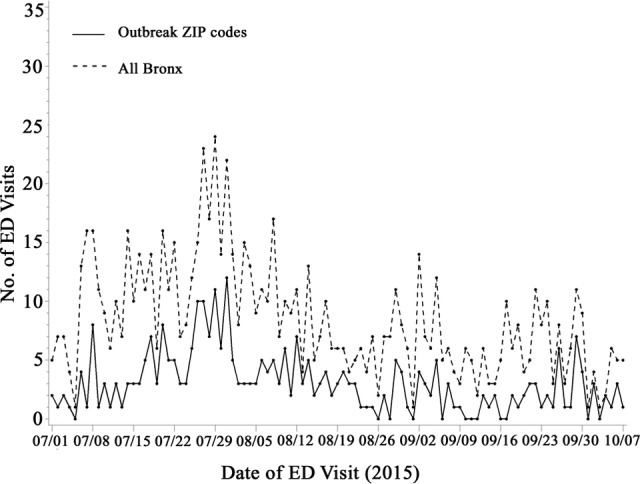
Emergency department (ED) visits for pneumonia syndrome in the Bronx and Legionnaires’ disease outbreak zone, New York City, July 1 to October 7, 2015. Keywords included pneumonia, Legionella, Legionnaires’ disease; International Classification of Diseases, Ninth Revision, Clinical Modification diagnosis codes 480-486.
The median age of patients was 55 (range, 29-90), and 86 (62%) patients were men. Seventy-eight (57%) patients were non-Hispanic black, 4 (3%) non-Hispanic white, 54 (39%) Hispanic, and 2 (1%) of unknown race/ethnicity (Table). The most commonly reported symptoms were fever (117 of 132, 89%), cough (97 of 130, 75%), and shortness of breath (70 of 130, 54%). A total of 107 (78%) patients had ≥1 chronic health condition—defined as alcoholism, asthma, cancer, COPD, diabetes, human immunodeficiency virus (HIV) infection, immunosuppressive therapy (chemotherapy, radiation, steroids), organ transplants, and renal disease requiring dialysis. Diabetes was present in 43 (31%), alcoholism in 40 (29%), HIV infection in 24 (17%), and COPD in 14 (10%) patients. Of 138 patients, 46 (33%) had >1 chronic health condition, and 20 (14%) had >2 chronic health conditions. Seventy-five percent of patients (98 of 130) reported a history of smoking cigarettes, and 57% (78 of 136) were current smokers. Of the 11 patients without a chronic health condition, 6 were either current smokers or former smokers. Of the 24 HIV-infected patients, 20 (83%) had a CD4 count ≥200 cells per mm3, and 15 (63%) had a suppressed viral load (<200 copies per mL).
Table.
Characteristics of patients with outbreak-related Legionella pneumophila serogroup 1, Bronx, New York City, 2015
| Characteristic | No. (%) or No. (Range) |
|---|---|
| Median age, y | 55 (29-90) |
| Age group, y | |
| 25-44 | 25 (18) |
| 45-64 | 85 (61) |
| 65-74 | 21 (15) |
| ≥75 | 8 (6) |
| Male | 86 (62) |
| Race/ethnicity | |
| Non-Hispanic black | 78 (57) |
| Non-Hispanic white | 4 (3) |
| Hispanic (all races) | 54 (39) |
| Unknown race/ethnicity | 2 (1) |
| Presenting symptoms | |
| Fever | 117 of 132 (89) |
| Cough | 97 of 130 (75) |
| Shortness of breath | 70 of 130 (54) |
| Chills | 62 of 129 (48) |
| Diarrhea | 52 of 132 (39) |
| Myalgia | 44 of 123 (36) |
| Headache | 43 of 128 (34) |
| Change in mental status | 20 of 126 (16) |
| Residence | |
| County of the Bronx, outbreak zone | 108 (78) |
| County of the Bronx, non-outbreak zone | 16 (12) |
| Other New York City counties | 9 (7) |
| Other New York State counties | 2 (1) |
| Non-New York State residents | 3 (2) |
| Hospitalized | 128 of 138 (93) |
| Median length of hospital stay, New York City residents, d | 5 (1-48) |
| Median time from onset to diagnosis, d | |
| All patients with known onset (n = 132) | 5 (0-21) |
| Before public announcement on July 29, 2015 (n = 118) | 5 (0-21) |
| On or after public announcement on July 29, 2015 (n = 14) | 1 (0-7) |
| Comorbidity | |
| Any chronic health condition (excludes other category) | 107 (78) |
| Alcoholism | 40 (29) |
| Asthma | 29 (21) |
| Cancer | 12 (9) |
| COPD (includes chronic bronchitis and emphysema) | 14 (10) |
| Diabetes mellitus (type I and II) | 43 (31) |
| HIV infection | 24 (17) |
| Immunosuppressive therapy (chemotherapy, radiation, steroids) | 15 (11) |
| Organ transplant | 2 (1) |
| Renal disease requiring dialysis | 4 (3) |
| Other chronic health conditions reported (excluding listed categories)a | 20 (14) |
| Smoking, current | 78 of 136 (57) |
| Smoking, current or past | 98 of 130 (75) |
| Died | 16 (12) |
Abbreviations: COPD, chronic obstructive pulmonary disease; HIV, human immunodeficiency virus.
aCardiovascular disease (n = 11), complement deficiency (n = 1), epilepsy (n = 1), hepatitis C (n = 3), psychiatric disorder (n = 2), obesity (n = 3), and substance abuse (n = 8). Note that some patients had multiple conditions.
The multivariable logistic regression model exploring factors associated with death during the outbreak, adjusted for age and sex, included alcoholism (aOR = 3.9; 95% CI, 1.2-13.4), diabetes (aOR = 3.2; 95% CI, 0.9-11.7), and COPD (aOR = 4.0; 95% CI, 0.8-17.9). The associations of current or ever smoking and death were not significant in bivariate analyses. Diabetes was not an effect modifier of the association between alcoholism and death.
Of 128 hospitalized patients, the median length of stay was 5 days (range, 1-48). Of the 132 patients with complete data, the median time from symptom onset to diagnosis was 5 days (range, 0-21). For the 117 patients with illness onset before the public notification on July 29, the median time from onset to diagnosis was 5 days; for the 15 patients with illness onset on or after the public notification, the median time was 1 day. Twenty-six patients (19%) were confirmed by culture as Lp1. All outbreak-associated culture-positive patients had an indistinguishable PFGE pattern (designated O-1). Twenty-six patient isolates were indistinguishable by whole-genome sequencing. One patient, initially considered as part of the outbreak, had a whole-genome sequence with 3 single-nucleotide polymorphisms and was excluded. One patient who had onset during the outbreak, PFGE pattern O-1, and an indistinguishable whole-genome sequence initially denied being in the outbreak zone. Upon reinterview, the patient was determined to have been exposed and was included as outbreak associated.
Patient Exposures
A total of 108 patients (78%) resided in the outbreak zone. Of the remaining 30 patients, 16 resided in other Bronx ZIP codes, 9 in other New York City counties, 2 in other New York State counties, and 3 in other states. Patient interviews did not reveal an association with a single building or other common source of Legionella exposure; however, 37 of 121 patients recalled visiting a 3-block area of the main thoroughfare that included building A in the 10 days before illness onset. The next-most frequent location, recalled by 19 patients, was a subway hub 0.6 miles west of building A.
Several events helped focus the investigation on 1 potential cooling tower source. On July 28, DOHMH received a physician inquiry about a cluster of respiratory illnesses among residents of a supportive housing residence for people with medical needs, including HIV infection, and the building identification number analysis identified 2 reports of Legionnaires’ disease from this building. On July 29, the Centers for Disease Control and Prevention notified DOHMH about a traveler who had been diagnosed with Legionnaires’ disease and had spent part of the incubation period at a hotel in the South Bronx (building A). Building A was located less than a block away from the supportive housing residence, and the cooling tower, which was not previously known to city agencies, was detected through satellite imagery. The multifocused cluster test identified 3 cooling towers in South Bronx, including the one at building A, as having unusual case clustering of Legionnaires’ disease around them with recurrence intervals >1 million years, including 1.36 million years for building A. By the end of the outbreak, Legionnaires’ disease had been diagnosed in 2 guests of building A, 3 residents of the nearby supportive housing building, and 1 worker from a building across the street from building A. The attack rate of Legionnaires’ disease for the census tract that included building A was 356 per 100 000 population, more than double the rate of the next-highest census tract (Figure 3).
Figure 3.

Crude attack rates of Legionnaires’ disease by census tract and cooling towers testing positive for Legionella pneumophila serogroup 1 (Lp1), Bronx, New York City, July 2 to August 3, 2015. Circles indicate buildings with cooling towers in which Lp1 was isolated. All buildings have 1 cooling tower except for building F, which has 2 cooling towers. DNA subtyping performed through pulsed-field gel electrophoresis: olive circles indicate buildings with cooling towers having the O-1 strain, which was indistinguishable from 26 patient isolates; white circles indicate buildings with cooling towers that had non–O-1 strains (ie, not related to patient isolates). Abbreviation: PFGE, pulsed-field gel electrophoresis.
Environmental Source Identification
The environmental investigation began on July 28, 2015. During the next 3 weeks, 55 cooling towers from 46 buildings in the outbreak zone were identified, inspected, and sampled. PCR results were available within 24 to 36 hours. Lp1 DNA was detected by real-time PCR in water samples from 21 cooling towers and successfully cultured from 14 (Figure 3). Molecular subtyping of the 14 Lp1 isolates revealed that water collected from the cooling tower at building A had PFGE pattern O-1, which was indistinguishable from the 26 clinical isolates (Figure 4). One other sample—from a cooling tower on the roof of building B, a homeless shelter—also had PFGE pattern O-1. This cooling tower was the eighth-most likely source identified by the multifocused cluster test, with a recurrence interval of 71 127 years. Compared with building A, the cluster signal around building B included fewer cases (33 vs 56) and fewer days of the outbreak (14 vs 26). The attack rate of Legionnaires’ disease in the census tract containing building B was 58 per 100 000 population. The remaining 12 Lp1 culture-positive cooling towers had non–O-1 PFGE patterns (Figure 4).
Figure 4.
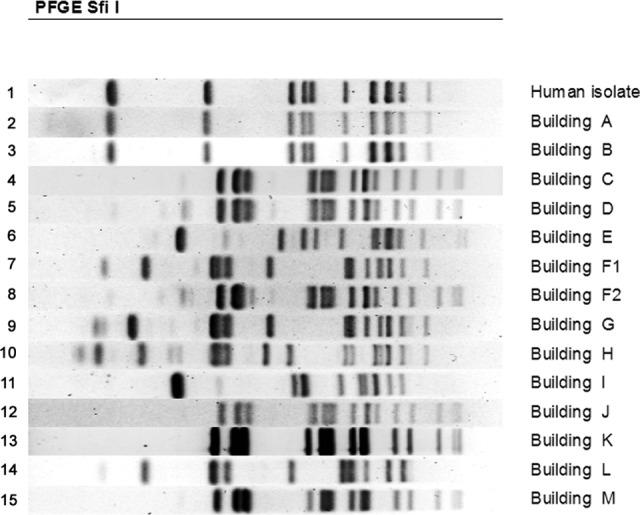
Molecular subtyping of outbreak-associated Legionella pneumophila serogroup 1 patients and environmental isolates, Bronx, New York City, 2015. Pulsed-field gel electrophoresis (PFGE) with restriction enzyme Streptomyces fimbriatus (Sfi I). Lane 1 is a representative human isolate, and lanes 2 to 15 are the 14 cooling tower isolates from the South Bronx outbreak zone.
Whole-genome sequencing of the 14 Lp1 cooling tower isolates revealed the Building A strain to be indistinguishable from the 26 outbreak-associated clinical isolates. Six additional cases of Legionnaires’ disease diagnosed in 2015 had PFGE pattern O-1 and underwent whole-genome sequencing. All differed from the outbreak strain by 1 to 3 single-nucleotide polymorphisms. No Lp1 culture obtained from any patient during the investigation matched to the strain from building B per whole-genome sequencing. Three isolates from separate environmental samples obtained from the cooling tower on building B had the same single-nucleotide polymorphism difference, thereby making a sequence misread error statistically unlikely.
Discussion
A large outbreak of Legionnaires’ disease resulted in severe illness and death in a New York City neighborhood. Epidemiologic, environmental, and laboratory investigations implicated a hotel cooling tower as the likely source of the outbreak. We relied on innovative statistical methods that analyzed electronically reported clinical laboratory data to detect this outbreak. Although the outbreak was detected promptly by public health standards, the rapid decline in cases suggests that the implicated cooling tower may have stopped dispersing Lp1-containing aerosols before the order to decontaminate was issued. This phenomenon was observed in other outbreaks21,22 and likely due to the complex dynamics of Legionella ecology in human-made aquatic systems. Although delays in Legionnaires’ disease outbreak recognition can be minimized through automated statistical algorithms applied to surveillance data, some delays will persist because of the long incubation period, lack of physician suspicion, unavailability of rapid tests for non-Lp1, and patients postponing seeking health care. Although patients sought health care more rapidly after our public notification, maintaining such awareness year-round among the general population would be difficult and unlikely to produce much benefit given the low incidence of Legionnaires’ disease. The outbreak response was expedited with a real-time PCR-based assay to screen water samples collected from cooling towers for the presence of Lp1 DNA. Previous outbreak investigations relied on culture, which, if successful, can take several weeks to identify and subtype. Using real-time PCR allowed us to rapidly screen, prioritize, and focus control efforts on potential outbreak sources.
The prevalence of diabetes, HIV infection, and alcoholism among patients in the outbreak was higher than in other large community outbreaks of Legionnaires’ disease.23–27 Per the American Community Survey, 41% of the estimated 360 000 residents in the outbreak zone had incomes below the federal poverty level.28 Compared with residents in the rest of New York City, residents in the outbreak zone had a higher prevalence of self-reported diabetes (17% vs 11%) and asthma (20% vs 12%),29 and the proportion living with HIV/AIDS was nearly double that of New York City (2.6% vs 1.4%).30,31 The population’s medical vulnerability likely contributed to the magnitude of the outbreak. This outbreak highlights the need for broad health policies and targeted health services to alleviate conditions (eg, diabetes, tobacco use, substance use, HIV infection) that disproportionately burden impoverished neighborhoods.
Limitations
A major limitation of many outbreak investigations of Legionnaires’ disease is the large proportion of patients diagnosed by culture-independent methods. Although the percentage of patients with positive Legionella cultures during the outbreak was high when compared with previous Legionnaires’ disease investigations, we were unable to confirm that every epidemiologically associated case was caused by the outbreak strain and linked to the cooling tower on building A. One patient who met the outbreak case definition was later excluded, and one who was not initially considered part of the outbreak was reinterviewed and included according to whole-genome sequencing results. PFGE pattern O-1 was initially detected in a Bronx resident in 2007, and 11 clinical isolates from 2007 to 2013 with this PFGE pattern underwent whole-genome sequencing. However, none were an identical match to the current outbreak strain, differing by 2 to 4 single-nucleotide polymorphisms. The limited number of Bronx Legionella isolates that we examined during this investigation appeared to be highly conserved, and whole-genome sequencing proved to be a powerful and useful tool to discriminate among isolates where PFGE could not.
Based on historical surveillance data in New York City, we expected to see slightly more than 1 Legionnaires’ disease case per day citywide during July; thus, some cases without culture could represent background incidence from other Legionella sources. It is also possible that additional outbreak-associated cases in nearby neighborhoods were not recognized as part of this outbreak, because we do not know how far contaminated aerosols may have drifted. Evidence supporting the cooling tower of building A, rather than that of building B, as the source of the outbreak included (1) the presence of disease in guests of building A and residents of the neighboring housing facility, (2) the absence of people with Legionnaires’ disease residing in building B, (3) no human isolate matched by whole-genome sequencing to the isolate from building B’s cooling tower, (4) the results of the multifocused cluster test, and (5) the elevated rate of Legionnaires’ disease in the census tract containing building A.
Conclusion
After the outbreak, New York City enacted legislation to require the registration, inspection, maintenance, and annual certification of cooling towers and other aerosol-producing engineering devices.32 The effectiveness of the new law will be evaluated through routine inspections of cooling towers to gauge if process controls reduce microbial growth and Legionella colonization and by monitoring for a decrease in incidence of Legionnaires’ disease.
Acknowledgments
We acknowledge the following people for their contributions to the outbreak investigation and response: Chief Gary Ortalano; Deputy Chief Andres LaSalle; Captain Nancy Martinez; Sergeants Lester Lloyd, Brenda Williams, and David Wilson; Detectives Carlos Basora and Fabiola Urdina; Officers Natalie Archibald, Devon Beaumont, William Ellerbe, Alaaldin Elmohands, Kenneth Hartley, Carlos Martinez, Lisa McBride, George Perry, Carla Redix, Fernandito Rivera, and Nicholas Williams (New York City Department of Health and Mental Hygiene Health Police); Munerah Ahmed, Nadine Alexander, Mark Allen, Minakshi Amin, Omar Anderson, Sara Archie, Charles Asumeng, Josephine Atamian, Iris Atkinson-Kirkland, Kari Auer, Andriana Azarias, Nona Backer, Desiree Ballantine, Kimani Barley, Rebecca Baron, Edwin Barona, Diego Bastidas, Chris Beattie, John Beatty, Marc Beckford, Myrna Beckles, Ed Beiner, Ted Belgrave, Aaron Belisle, Francisco Beltran, Sheila Benjamin, Narenta Bici, Janice Blake, Freddie Bolston, Philip Bores, Christine Borges, Michael Brian, Cherylle Brown, Candacy Browne, Michael Bruen, Margarette Brun, Taryn Burke, Joe Burzynski, Timothy Caban, Carlos Cacho, William Camacho, Alfred Carpenter, Crystal Carr, Farah Carrion, Cathleen Casey, James Chan, Ryan Chan, Tamara Cheeseboro, Askold Chemych, Judy Chen, Jacqueline Chew, Ludwin Chicaiza, Joanne Choi, Josetta Christian, Nancy Clark, Sabrina Clowney, Michelle Cockburn, Gaye Cohen, Eric Colchamiro, Jessica Cole, Maria Colon, Sarah Conderino, Roseann Costarella, Karen Crowe, Calvert Cruickshank, Manda Dabovic, Leslyn Daligadu, Ayman Danial, Abigail D’Anjou, Renato Dasilva, Roshni Davers, Anthony Davidson, Georgia Davidson, Rachel Davis, Arlene De Grasse, Paloma De La Cruz, April Dejesus, Kiana Derico, Katelynn Devinney, Glenda Downs, Courtney Drayer, Melissa D’Souza, Carol Ducan, Betty Duggan, Louis Duplan, Bob Edman, Amegnona Ekon, Ayman Elsheemy, Carlos Espada, Anthony Faciane, Monique Fairclough, Farooq Faizi, Diana Faustin, Pauline Ferrante, Darryl Fields, Melanie Firestone, Dan Fisher, Levi Fishman, Franklin Flores, Mary Foote, Mary Ford, Robert Ford, Elaine Francis, Diandra Lee Fraser, Sam Friedman, Julie Friesen, Lawrence Fung, Gavin Garrett, Marc Garrison, Tanya Geiz, Erich Giebelhaus, Wayne Glasscock, Laura Goodman, Tasharee Grant, Victoria Grimshaw, Stanford Guan, Sabrina Guerre-Douglas, Jaime Gutierrez, Angel Guzman, Charon Gwynn, Tamer Hadi, Tamara Hamilton, Saeed Hayat, Sharon Heath, Lisa Heine, Jarred Hill, Morgan Hills, Joseph Hines, Chandra Holder, Valerie Holland, Cory Hood, Mark Horberg, Arturo Hughes, Jeffrey Hunter, Chris Huskey, Dameon James, Briana Jefferson, Eleonora Jimenez-Levi, Andre Johannes, Paula Johnson, Raymond Johnson, Dewayne Jolly, Arlene Jon, Sharon Joseph, Linda Joyner, Davida Judelson, Dorothy Kamenshine, Jennifer Karr, Maura Kennelly, Matt Khaled, Amina Khawja, Youngran Kim, Mary King, Paul Koobrak, Daghan Koyuncu, Namrata Kumar, Jason Kunz, Roshin Kurian, Brian Lackey, Joe Laco, Si Lai, Sin Jin Lai, Sabrina Lakhami, Frank Lane, Kathryn Lane, William Lang, Jenna Larsen, Andres LaSalle, Andrea Lasker, Tanya LaTortue, Meredith Laureno, Tinesha Leftenant, Amanda Levy, Veronica Lewin, Huan Li, Lan Li, Grant Ligon, Dakai Liu, Jian Liu, Haddie Lizasuain, Benjamin Lockspeiser, Danielle Lucas-Sollecito, Eric Luchs, Elizabeth Lurie, Andrea Lyman, Ray Lynch, Jennifer MacGregor, Timothy Mack, Jasbir Madan, Beth Maldin, Elliot Marcus, Carol Marquez, Aydde Martinez, Ahsan Masood, Thomas Matte, Aletha Maybank, Ella Mazo, Jonathan McAteer, Latoya McBride, Michael McCollum, Karla McFarlane, Sean McFarlane, Kevin McGrath, Gwendolyn McKenzie, Paul McNamee, Roy Meade, Simon Medhin, Hansel Medina, Camilio Mejia, Nichole Melendez, Chris Miller, Sam Miller, Susan Miller, Danielle Mills, Catherine Miranda, Imtiaz Mohammed, Tim Mohammed, F. Daisy Momen, Emilio Monegro, Eric Moore, Miranda Moore, Robert Moore, Abdul Munshi, Abdulrashid Munshi, Christa Myers, Kathryn Tannert Niang, Ray Nieves, Jennifer Norton, June O’Garro, Angela O’Haire, Carolyn Olson, Olatoun Olusoji, Elizabeth Ortiz, Lyz Ortiz, Rosemary Osorio, Jacquelyn Osoro, Emiko Otsubo, Teresa Paparone, Chris Paquet, Jacob Paternostro, Robert Van Pelt, Joseph Peltzman, Richard Perez, Mohini Persaud, Carlos Pesantes, Grant Pezeshki, Carolina Pichardo, Francoise Pickart, Jennifer Pierre, Margaret Piggot, Robert Pirillo, Margaret Pletnikoff, Joseph Polak, Marina Politis, Mike Porter, Jeanine Prudhomme, Darrin Pruitt, George Puthumana, Joanna Quinn, Ingrid Ramalakhan, Robert Ramirez, Maytal Rand, Marisa Raphael, Ann Marie Reagan, Susan Resnick, Glen Revan, Bianca Rivera, Errol Robinson, Zeneta Romney-Thomas, Carla Rossi, Nina Rothschild, Sandy Rozza, Carrie Sadovnik, Rashleigh Sampson, Massara Sanou, Michele Sawicki, Andrew Schroeder, Bettina Seifert, Brenda Senyana, Hannah Seoh, Amy Shah, Altaf Shaikh, Dmitry Shapsis, Elise Shin, Steven Shu, Kwamaine Silcott, Thomas Simo, Ghitrie Singh, Sarah Sisco, Elton Small, Lorraine Smith, Travis Smith, Tim Snuggs, Judi Rich Soehren, James Soracchi, Maria Soto, Lesley Stalvey, Laura Stella, Francine Stephen, Fitzberth Stephens, Renee Stewart, Colin Stimmler, Isaac Suggs, Sitty Tahir, Sheba Taylor-Medina, Bun Tha, Anna Thomas, Elizabeth Thomas, Valerie Thomas, Tyesha Thompson, Lily Tom, Amita Toprani, Brian Toro, Alejandra Tovar, Orlin Trochev, Margaret Tullai, Lennon Turner, Maggie Veatch, Amina Velazquez, Erica Velez, Meiling Viera, Arti Virkud, Laurie Van Vynck, Donald B. Walker, Elika Walker, Kate Washburn, Gary Washington, Chris Williams, Marsha Williams, Eliza Wilson, Robert Wilson, Iris Winter, Darryl Wong, Melissa Wong, Ricky Wong, Yankau Wong, Wei Xia, Liying Xing, Weiling Xu, Yaping “Grace“ Xu, David Yang, Leo Yao, Mohammad Younis, Julian Yuen, Max Zarate-Bermudez, Ronda Zawel, Lisa Zhang, Xin Zhou, Georgia Zis, and Jane Zucker (New York City Department of Health and Mental Hygiene Incident Command activation); Omoruyi K. Aghedo, Robert Bellach, Sarina Santore, Wayne Schneider, and Matthew Smith (Westchester County); Oluwatoyim Akindele and Andy Tse (New York State); Alison P. Albert, Micah Bass, David Daigle, Joseph Laco, Gayle E. Langley, Jason McDonald, Danielle S. Mills, John Sarisky, Jonas Winchell, and Max A. Zarate-Bermudez (Centers for Disease Control and Prevention); Michael Levi and Andrea Littleton (Montefiore Medical Center); Alan Antenucci, Wendy Archinal, Dianna Bopp, Dominick Centurioni, Karen Chave, Amy Chiefari, Jocelyn Cole, Maureen Conlon, Michelle Dickinson, Jo Ann Dopp, Nellie Dumas, Christina Egan, Colleen Flood, Karen Greene, Dawn Grock, Tanya Halse, Anna Kidney, Brian Kilpatrick, Christopher Knight, Donna Kohlerschmidt, Melissa Leisner, Ronald Limberger, Deb May, William McDaniels, Alok Mehta, Mark Meola, Kara Mitchell, Lisa Mingle, Geetha Nattanmai, Rebecca O’Donnell, Teresa Passaretti, Michael Perry, James Salvinski, Amy Saylors, Joseph Schwendemen, Jayanti Sekhar, Matthew Shudt, Kenneth Swensen, Lisa Thompson, Patrick Van Roey, Colleen Walsh, Danielle Wroblewski, Zhen Zheng, and Yan Zhu (Wadsworth Center, New York State Department of Health); and Janet E. Stout (Special Pathogens Laboratory, University of Pittsburgh).
Authors’ Note: The authors are members of the South Bronx Legionnaires’ Disease Investigation Team. Their collaborators include the following: Jasmine Abdelnabi, Joel Ackelsberg, Ann Afordi, Tracy Agerton, Shama Ahuja, Lisa Alleyne, Erlinda Amoroso, Kazue Anan, Mike Antwi, Sharon Balter, Oxiris Barbot, Jennifer Baumgartner, Fazlul Chowdhury, Sandhya Clark, Gretchen Culp, Paula Del Rosso, Catherine Dentinger, Steve Di Lonardo, Marie Dorsinville, Andrew Faciano, Ana Maria Fireteanu, Megan Halbrook, Mary Huynh, Muhammad Iftekharuddin, Daryl Johnson, Kimberly Johnson, Liza King, Marcelle C. Layton, Rachael Lazar, David Lee, Ellen Lee, Yin Ling Leung, Ying Lin, Robert Mathes, Natasha McIntosh, Giselle Merizalde, Michelle Middleton, Beth Nivin, John Novak, Daniel Osuagwu, Hilary Parton, Preeti Pathela, Jose Poy, Vasudha Reddy, Inessa Rubenstein, Kelly Saunders, Renee Stewart, Alaina Stoute, Rajmohan Sunkara, Lisa Trieu, Benjamin Tsoi, HaeNa Waechter, Marie Wong, and Winfred Wu (New York City Department of Health and Mental Hygiene); Katherine McCubbin (New York City Office of the Chief Medical Examiner); Anupama Menon (Bronx Lebanon Hospital Center); Belinda Ostrowsky (Montefiore Medical Center); Arsenia Golfo, Suraiya Jahan, and Yekaterina Sitnitskaya (Lincoln Hospital Medical Center); Laurel Garrison, Natalia A. Kozak-Muiznieks, Jasen M. Kunz, Preeta Kutty, Anna C. Llewellyn, Claressa Lucas, Jeffrey W. Mercante, Matthew Moore, Brian Raphael, and Matthew Westercamp (Centers for Disease Control and Prevention).
The findings and conclusions in this article are those of the authors and do not necessarily represent the official position of the Centers for Disease Control and Prevention.
Declaration of Conflicting Interests: The author(s) declared no potential conflicts of interest with respect to the research, authorship, and/or publication of this article.
Funding: The author(s) received no financial support for the research, authorship, and/or publication of this article.
References
- 1. Cuhna BA, Burillo A, Bouza E. Legionnaires’ disease. Lancet. 2016;387:376–385. [DOI] [PubMed] [Google Scholar]
- 2. Garrison LE, Kunz JM, Cooley LA, et al. Vital signs: deficiencies in environmental control identified in outbreaks of Legionnaires’ disease—North America, 2000-2014. MMWR Morb Mortal Wkly Rep. 2016;65(22):576–584. [DOI] [PubMed] [Google Scholar]
- 3. City of New York. Epiquery: New York City interactive health data. http://nyc.gov/health/epiquery. Accessed December 12, 2016.
- 4. Whiley H, Keegan AK, Fallowfield H, Ross K. Uncertainties associated with assessing the public health risk from Legionella . Front Microbiol. 2014;5:501. [DOI] [PMC free article] [PubMed] [Google Scholar]
- 5. Correia AM, Ferreira JS, Borges V, et al. Probable person-to-person transmission of Legionnaires’ disease. N Engl J Med. 2016;374(5):497–498. [DOI] [PubMed] [Google Scholar]
- 6. Mercante JW, Winchell JM. Current and emerging Legionella diagnostics for laboratory and outbreak investigations. Clin Microbiol Rev. 2015;28(1):95–133. [DOI] [PMC free article] [PubMed] [Google Scholar]
- 7. Council of State and Territorial Epidemiologists. Public health reporting and national notification for legionellosis. http://c.ymcdn.com/sites/www.cste.org/resource/resmgr/PS/09-ID-45.pdf. Position statement 09-ID-45. Published 2010. Accessed April 20, 2016.
- 8. Levin-Rector A, Wilson EL, Fine AD, Greene SK. Refining historical limits method to improve disease cluster detection, New York City, New York, USA. Emerg Infect Dis. 2015;21(2):265–272. [DOI] [PMC free article] [PubMed] [Google Scholar]
- 9. Kulldorff M, Heffernan R, Hartman J, Assunçao R, Mostashari F. A space-time permutation scan statistic for disease outbreak detection. PloS Med. 2005;2(3):e59. [DOI] [PMC free article] [PubMed] [Google Scholar]
- 10. Greene SK, Peterson ER, Kapell D, Fine AD, Kulldorff M. Daily reportable disease spatiotemporal cluster detection, New York City, New York, USA, 2014-2015. Emerg Infect Dis. 2016;22(10):1808–1812. [DOI] [PMC free article] [PubMed] [Google Scholar]
- 11. Levin-Rector A, Nivin B, Yeung A, Fine AD, Greene SK. Building-level analyses to prospectively detect influenza outbreaks in long-term care facilities: New York City, 2013-2014. Am J Infect Control. 2015;43(8):839–843. [DOI] [PubMed] [Google Scholar]
- 12. Kulldorff M. Focused cluster tests. In: SaTScan User Guide for Version 9.4. http://www.satscan.org/techdoc.html. Accessed July 30, 2015.
- 13. Heffernan R, Mostashari F, Das D, et al. System descriptions: New York City syndromic surveillance systems. MMWR Morb Mortal Wkly Rep. 2004;53(suppl):23–27. [PubMed] [Google Scholar]
- 14. New York City Department of Health and Mental Hygiene. 2015 alert 21: increase in Legionnaires’ disease in the Bronx. https://a816-health30ssl.nyc.gov/sites/NYCHAN/Lists/AlertUpdateAdvisoryDocuments/HAN_LegionellaSouthBronx.pdf. Published July 29, 2015. Accessed April 20, 2016.
- 15. New York City Department of Health and Mental Hygiene. 2015 alert 24: update. Clinical management of respiratory illness in the South Bronx. https://a816-health30ssl.nyc.gov/sites/NYCHAN/Lists/AlertUpdateAdvisoryDocuments/HAN%20-%20LegClinical.pdf. Published August 2, 2015. Accessed April 20, 2016.
- 16. Agresti A. Exact inference for categorical data: recent advances and continuing controversies. Stat Med. 2001;20(17-18):2709–2722. [DOI] [PubMed] [Google Scholar]
- 17. SAS Institute Inc. SAS/STAT Version 9.4. Cary, NC: SAS Institute Inc; 2012. [Google Scholar]
- 18. Nazarian EJ, Bopp DJ, Saylors A, Limberger RJ, Musser KA. Design and implementation of a protocol for the detection of Legionella in clinical and environmental samples. Diagn Microbiol Infect Dis. 2008;62(2):125–132. [DOI] [PubMed] [Google Scholar]
- 19. Mérault N, Rusniok C, Jarraud S, et al. Specific real-time PCR for simultaneous detection and identification of Legionella pneumophila serogroup 1 in water and clinical samples. Appl Environ Microbiol. 2011;77(5):1708–1717. [DOI] [PMC free article] [PubMed] [Google Scholar]
- 20. Taylor AJ, Lappi V, Wolfgang WJ, et al. Characterization of foodborne outbreaks of Salmonella enterica serovar Enteritidis with whole-genome sequencing single nucleotide polymorphism-based analysis for surveillance and outbreak detection. J Clin Microbiol. 2015;53(10):3334–3340. [DOI] [PMC free article] [PubMed] [Google Scholar]
- 21. Sabrià M, García-Nuñez M, Pedro-Botet ML, et al. Presence and chromosomal subtyping of Legionella species in potable water systems in 20 hospitals of Catalonia, Spain. Infect Control Hosp Epidemiol. 2001;22(11):673–676. [DOI] [PubMed] [Google Scholar]
- 22. Shivaji T, Sousa Pinto C, San Bento A, et al. A large community outbreak of Legionnaires’ disease in Vila Franca de Xira, Portugal, October to November 2014. Euro Surveill. 2014;19(50):20991. [DOI] [PubMed] [Google Scholar]
- 23. Irons JF, Dunn MJ, Kefala K, et al. The effect of a large Legionnaires’ disease outbreak in Southwest Edinburgh on acute and critical care services. QJM. 2013;106(12):1087–1094. [DOI] [PubMed] [Google Scholar]
- 24. Jansà JM, Caylà JA, Ferrer D, et al. An outbreak of Legionnaires’ disease in an inner city district: importance of the first 24 hours in the investigation. Int J Tuberc Lung Dis. 2002;6(9):831–838. [PubMed] [Google Scholar]
- 25. Ferré MR, Arias C, Oliva JM, et al. A community outbreak of Legionnaires’ disease associated with a cooling tower in Vic and Gurb, Catalonia (Spain) in 2005. Eur J Clin Microbiol Infect Dis. 2009;28(2):153–159. [DOI] [PubMed] [Google Scholar]
- 26. Sonder GJ, van den Hoek JA, Bovée LP, et al. Changes in prevention and outbreak management of Legionnaires’ disease in the Netherlands between two large outbreaks in 1999 and 2006. Euro Surveill. 2008;13(38):pii18983. [PubMed] [Google Scholar]
- 27. Hugosson A, Hjorth M, Bernander S, et al. A community outbreak of Legionnaires’ disease from an industrial cooling tower: assessment of clinical features and diagnostic procedures. Scand J Infect Dis. 2007;39(3):217–224. [DOI] [PubMed] [Google Scholar]
- 28. US Census Bureau. American Community Survey 5-year dataset, 2010-2014. http://www.census.gov/programs-surveys/acs/news/data-releases/2014/release.html#par_textimage_9. Accessed April 20, 2016.
- 29. New York City Department of Health and Mental Hygiene. New York Community Health Survey, 2012-2014. https://www1.nyc.gov/site/doh/data/data-sets/community-health-survey-public-use-data.page. Accessed April 20, 2016.
- 30. HIV Epidemiology and Field Services Program. HIV Surveillance Annual Report, 2014. New York, NY: New York City Department of Health and Mental Hygiene; 2015. [Google Scholar]
- 31. New York City Office of City Planning. Current population estimates. http://www1.nyc.gov/site/planning/data-maps/nyc-population/current-future-populations.page. Accessed December 7, 2015.
- 32. New York City Rules. Cooling towers—new Chapter 8 in Title 24 of the rules of the City of New York to establish rules for maintenance of cooling towers. http://rules.cityofnewyork.us/content/cooling-towers-new-chapter-8-title-24-rules-city-new-york-establish-rules-maintenance. Accessed April 20, 2016.