


Abstract
Background
This review is an update of a review published in 2011, itself a major update of previous reviews published in 2005 and 2000, investigating the effects of gabapentin in chronic neuropathic pain (pain due to nerve damage). Antiepileptic drugs are used to manage chronic neuropathic pain and fibromyalgia.
Objectives
To assess the analgesic efficacy and adverse effects of gabapentin in chronic neuropathic pain and fibromyalgia.
Search methods
We identified randomised trials of gabapentin for chronic neuropathic pain or fibromyalgia by searching the databases MEDLINE (1966 to March 2014), EMBASE (1980 to 2014 week 10), and CENTRAL in The Cochrane Library (Issue 3 of 12, 2014). We obtained clinical trial reports and synopses of published and unpublished studies from Internet sources, and searched Clinicaltrials.gov. Searches were run originally in 2011 and the date of the most recent search was 17 March 2014.
Selection criteria
Randomised, double‐blind studies reporting the analgesic and adverse effects of gabapentin in neuropathic pain or fibromyalgia with assessment of pain intensity, pain relief, or both, using validated scales. Participants were adults.
Data collection and analysis
Three review authors independently extracted efficacy and adverse event data, examined issues of study quality, and assessed risk of bias. We performed analysis using three tiers of evidence. First tier evidence derived from data meeting current best standards and subject to minimal risk of bias (outcome equivalent to substantial pain intensity reduction, intention‐to‐treat analysis without imputation for dropouts; at least 200 participants in the comparison, 8 to 12 weeks duration, parallel design), second tier from data that failed to meet one or more of these criteria and were considered at some risk of bias but with adequate numbers in the comparison, and third tier from data involving small numbers of participants that were considered very likely to be biased or used outcomes of limited clinical utility, or both.
For efficacy, we calculated the number needed to treat to benefit (NNT), concentrating on at least 50% pain intensity reduction, and Initiative on Methods, Measurement and Pain Assessment in Clinical Trials (IMMPACT) definitions of at least moderate and substantial benefit. For harm we calculated number needed to treat for harm (NNH) for adverse effects and withdrawal. Meta‐analysis was undertaken using a fixed‐effect model. We emphasised differences between conditions now defined as neuropathic pain, and other conditions like masticatory pain, complex regional pain syndrome type 1 (CRPS‐1), and fibromyalgia.
Main results
Seven new studies with 1919 participants were added. Another report (147 participants) provided results for a study already included, but which previously had no usable data. A further report (170 participants) used an experimental formulation of intrathecal gabapentin. Thirty‐seven studies (5633 participants) studied oral gabapentin at daily doses of 1200 mg or more in 12 chronic pain conditions; 84% of participants were in studies of postherpetic neuralgia, painful diabetic neuropathy or mixed neuropathic pain. There was no first tier evidence.
Second tier evidence for the outcome of at least 50% pain intensity reduction, considered valuable by patients with chronic pain, showed that gabapentin was significantly better than placebo in postherpetic neuralgia (34% gabapentin versus 21% placebo; NNT 8.0, 95% CI 6.0 to 12) and painful diabetic neuropathy (38% versus 21%, NNT 5.9, 95% CI 4.6 to 8.3). There was insufficient information in other pain conditions to reach any reliable conclusion. There was no obvious difference between standard gabapentin formulations and recently‐introduced extended‐release or gastro‐retentive formulations, or between different doses of gabapentin.
Adverse events occurred significantly more often with gabapentin. Persons taking gabapentin could expect to have at least one adverse event (62%), withdraw because of an adverse event (11%), suffer dizziness (19%), somnolence (14%), peripheral oedema (7%), and gait disturbance (9%). Serious adverse events (3%) were no more common than with placebo.
There were insufficient data for direct comparisons with other active treatments, and only third tier evidence for other painful conditions.
Authors' conclusions
There was no top tier evidence that was unequivocally unbiased. Second tier evidence, with potentially important residual biases, showed that gabapentin at doses of 1200 mg or more was effective for some people with some painful neuropathic pain conditions. The outcome of at least 50% pain intensity reduction is regarded as a useful outcome of treatment by patients, and the achievement of this degree of pain relief is associated with important beneficial effects on sleep interference, fatigue, and depression, as well as quality of life, function, and work. About 35% achieved this degree of pain relief with gabapentin, compared with 21% for placebo. Over half of those treated with gabapentin will not have worthwhile pain relief. Results might vary between different neuropathic pain conditions, and the amount of evidence for gabapentin in neuropathic pain conditions except postherpetic neuralgia and painful diabetic neuropathy, and in fibromyalgia, is very limited.
The levels of efficacy found for gabapentin are consistent with those found for other drug therapies in postherpetic neuralgia and painful diabetic neuropathy.
Keywords: Adult, Humans, Amines, Amines/adverse effects, Amines/therapeutic use, Analgesics, Analgesics/adverse effects, Analgesics/therapeutic use, Chronic Disease, Chronic Pain, Chronic Pain/drug therapy, Cyclohexanecarboxylic Acids, Cyclohexanecarboxylic Acids/adverse effects, Cyclohexanecarboxylic Acids/therapeutic use, Fibromyalgia, Fibromyalgia/drug therapy, Neuralgia, Neuralgia/drug therapy, Randomized Controlled Trials as Topic, gamma‐Aminobutyric Acid, gamma‐Aminobutyric Acid/adverse effects, gamma‐Aminobutyric Acid/therapeutic use
Gabapentin for chronic neuropathic pain and fibromyalgia in adults
Neuropathic pain is pain coming from damaged nerves. It differs from pain messages carried along healthy nerves from damaged tissue (a fall, cut, or arthritic knee). Neuropathic pain is treated by different medicines than pain from damaged tissue. Medicines like paracetamol or ibuprofen are not effective in neuropathic pain, while medicines that are sometimes used to treat depression or epilepsy can be very effective in some people with neuropathic pain. Our understanding of fibromyalgia (a condition of persistent, widespread pain and tenderness, sleep problems, and fatigue) is poor, but fibromyalgia can respond to the same medicines as neuropathic pain.
Gabapentin was developed to treat epilepsy, but it is now used to treat various forms of chronic pain. On 17 March 2014 we performed searches to look for clinical trials where gabapentin was used to treat neuropathic pain or fibromyalgia. We found that 5633 participants had been involved in 37 studies of reasonable quality. They tested gabapentin against placebo for four weeks or more. Studies lasting only one or two weeks are unhelpful when pain can last for years.
Only two conditions had useful amounts of data ‐ postherpetic neuralgia (chronic pain following shingles) and painful diabetic neuropathy (where nerves are damaged in diabetes). Gabapentin helped 3 or 4 people in 10 by reducing their pain by at least half, while with placebo only 2 in 10 had this result.
With gabapentin 6 people in 10 can expect to have some adverse events, including dizziness (2 in 10), somnolence (1 or 2 in 10), peripheral oedema (1 in 10), and gait disturbance (1 in 10). Serious adverse events (1 in 33) were no more common than with placebo. One person in 10 withdrew because of adverse events. Persons taking gabapentin can expect to have at least one adverse event (6 in 10), or stop taking gabapentin because of an adverse event (about 1 in 10).
Gabapentin is helpful for some people with chronic neuropathic pain or fibromyalgia. It is not possible to know beforehand who will benefit and who will not. Current knowledge suggests that a short trial is the best way of telling.
Summary of findings
Summary of findings for the main comparison.
| Gabapentin compared with placebo for neuropathic pain and fibromyalgia | ||||||
|
Patient or population: adults with postherpetic neuralgia or painful diabetic neuropathy Settings: community Intervention: gabapentin ≥ 900 mg daily Comparison: placebo | ||||||
| Outcome | Probable outcome with intervention | Probable outcome with placebo | NNT or NNH and/or relative effect (95% CI) | No of participants | Quality of the evidence (GRADE) | Comments |
| Postherpetic neuralgia: gabapentin ≥ 1800 mg daily or gabapentin encarbil 1200 mg daily | ||||||
| At least 50% reduction in pain or equivalent | 340 in 1000 | 210 in 1000 | RR 1.6 (1.3 to 1.9) NNT 8.0 (6.0 to 12) |
1816 (6 studies) |
Moderate | Imputation method used (LOCF) and small study size could influence results to reduce gabapentin efficacy. Range of doses and dosing regimens pooled to obtain these results, so no guidance regarding efficacy or harm of particular doses |
| IMMPACT definition ‐ any substantial pain benefit | 340 in 1000 | 200 in 1000 | RR 1.7 (1.4 to 2.0) NNT 6.8 (5.4 to 9.3) |
2045 (7 studies) |
Moderate | |
| Patient Global Impression of Change much or very much improved | 390 in 1000 | 290 in 1000 | RR 1.3 (1.2 to 1.5) NNT 9.7 (6.9 to 16) |
2013 (7 studies) |
Moderate | |
| IMMPACT definition ‐ any at least moderate pain benefit | 440 in 1000 | 270 in 1000 | RR 1.6 (1.4 to 1.8) NNT 5.7 (4.6 to 7.5) |
2045 (7 studies) |
Moderate | |
| Painful diabetic neuropathy | ||||||
| At least 50% reduction in pain or equivalent | 380 in 1000 | 210 in 1000 | RR 1.9 (1.5 to 2.3) NNT 5.9 (4.6 to 8.3) |
1277 (6 studies) |
Moderate | Imputation method used (LOCF) and small study size could influence results to reduce gabapentin efficacy. Range of doses and dosing regimens pooled to obtain these results, so no guidance regarding efficacy or harm of particular doses |
| IMMPACT definition ‐ any substantial pain benefit | 380 in 1000 | 210 in 1000 | RR 1.9 (1.5 to 2.3) NNT 5.9 (4.6 to 8.3) |
1277 (6 studies) |
Moderate | |
| Patient Global Impression of Change much or very much improved | 500 in 1000 | 300 in 1000 | RR 1.7 (1.4 to 2.0) NNT 4.9 (3.6 to 7.6) |
695 (5 studies) |
Moderate | |
| IMMPACT definition ‐ any at least moderate pain benefit | 520 in 1000 | 370 in 1000 | RR 1.4 (1.3 to 1.6) NNT 6.6 (4.9 to 9.9) |
1439 (7 studies) |
Moderate | |
| All conditions ‐ pooled data | ||||||
| Adverse event withdrawals | 110 in 1000 | 79 in 1000 | RR 1.4 (1.1 to 1.7) NNH 31 (20 to 66) |
4448 (22 studies) |
High | Unlikely new research would change this finding |
| Serious adverse events | 32 in 1000 | 28 in 1000 | RR 1.2 (0.83 to 1.7) | 3952 (19 studies) |
Moderate | Small number of events but no suggestion of difference |
| Death | 3 in max 3603 exposed | 5 in max 2377 exposed | not calculated | not calculated | Low | Few events, relatively short duration for drug possibly taken over periods of years |
| GRADE Working Group grades of evidence High quality: Further research is very unlikely to change our confidence in the estimate of effect. Moderate quality: Further research is likely to have an important impact on our confidence in the estimate of effect and may change the estimate. Low quality: Further research is very likely to have an important impact on our confidence in the estimate of effect and is likely to change the estimate. Very low quality: We are very uncertain about the estimate. | ||||||
LOCF: last observation carried forward; NNT: number needed to treat for an additional beneficial effect: NNH: number needed to treat for an additional harmful effect; RR: risk ratio
Background
This is an update of a Cochrane review published in 2011. That review was an update of a previous Cochrane review titled 'Gabapentin for acute and chronic pain' (Wiffen 2005), which itself was an extension to a review previously published in The Cochrane Library on 'Anticonvulsant drugs for acute and chronic pain' (Wiffen 2000). The effects of gabapentin in established acute postoperative pain have been published as a separate review in 2010 (Straube 2010).
The decision to split the review in 2011 was undertaken after discussions with the Editor‐in‐Chief of The Cochrane Collaboration at a meeting in Oxford in early 2009. That meeting was in response to controversy in the United States of America (USA) over the effectiveness of gabapentin as an analgesic (Landefeld 2009) together with calls for the 2005 review to be updated with the inclusion of unpublished information made available through litigation (Vedula 2009). It was agreed to update the review by splitting the earlier one into two components: this review looking at the role of gabapentin in chronic neuropathic pain (including neuropathic pain of any cause, and fibromyalgia), and a second one to determine the effects of gabapentin in acute postoperative pain (Straube 2010). Other reviews may examine gabapentin in chronic musculoskeletal pain. After the review published in 2005, unpublished data were released by the licence holders of the first gabapentin product to be marketed, and these data were included in the 2011 review. This latest update has an expanded background, in line with other reviews of antiepileptic drugs used to treat neuropathic pain and fibromyalgia, and includes three new studies for oral gabapentin plus additional information on an already included study. We have also identified a number of ongoing studies.
The original chronic pain review on oral gabapentin included 14 studies with 1392 participants in 13 reports. The 2011 update involved 29 studies in 29 reports with 3571 participants. In this update we consider 33 studies in 34 reports, involving 4388 participants taking oral gabapentin.
Description of the condition
The 2011 International Association of the Study of Pain definition of neuropathic pain is "pain caused by a lesion or disease of the somatosensory system" (Jensen 2011) based on an earlier consensus meeting (Treede 2008). Neuropathic pain may be caused by nerve damage, but is often followed by changes in the central nervous system (CNS) (Moisset 2007). It is complex (Apkarian 2011; Tracey 2011), and neuropathic pain features can be found in patients with joint pain (Soni 2013). Moreover, neuropathic pain and fibromyalgia patients experience similar sensory phenomena (Koroschetz 2011).
Neuropathic pain tends to be chronic and may be present for months or years. Fibromyalgia is defined as widespread pain for longer than three months with pain on palpation at 11 or more of 18 specified tender points (Wolfe 1990), and is frequently associated with other symptoms such as poor sleep, fatigue, and depression. More recently, a definition of fibromyalgia has been proposed based on symptom severity and the presence of widespread pain (Wolfe 2010). The cause, or causes, are not well understood, but it has features in common with neuropathic pain, including changes in the CNS. Many people with these conditions are significantly disabled with moderate or severe pain for many years.
In primary care in the UK the incidences, per 100,000 person years observation, have been reported as 28 (95% CI 27 to 30) for postherpetic neuralgia, 27 (26 to 29) for trigeminal neuralgia, 0.8 (0.6 to 1.1) for phantom limb pain and 21 (20 to 22) for painful diabetic neuropathy (Hall 2008). They appear to be increasing over time (Hall 2013). Estimates vary between studies, often because of small numbers of cases. The incidence of trigeminal neuralgia has been estimated at 4 in 100,000 per year (Katusic 1991; Rappaport 1994), while more recently, a study of facial pain in The Netherlands found incidences per 100,000 person years of 12.6 for trigeminal neuralgia and 3.9 for postherpetic neuralgia (Koopman 2009). A systematic review of chronic pain demonstrated that some neuropathic pain conditions, such as painful diabetic neuropathy, can be more common, with prevalence rates up to 400 per 100,000 person years (McQuay 2007) illustrating how common the condition was as well as its chronicity. The prevalence of neuropathic pain was reported as being 3.3% in Austria (Gustorff 2008), 6.9% in France (Bouhassira 2008), as high as 8% in the UK (Torrance 2006), and about 7% in a systematic review of studies published since 2000 (Moore 2013a). Some forms of neuropathic pain, such as diabetic neuropathy and post surgical chronic pain (which is often neuropathic in origin) are increasing (Hall 2008). Fibromyalgia is common, especially in women, with an all‐age prevalence of 12%, and a female to male ratio of 6:1 (McNally 2006).
Neuropathic pain and fibromyalgia are known to be difficult to treat effectively, with only a minority of individuals experiencing a clinically relevant benefit from any one intervention. A multidisciplinary approach is now advocated, with pharmacological interventions being combined with physical interventions, cognitive interventions, or both. Conventional analgesics are usually not effective (Tölle 2013). Some patients may derive some benefit from a topical lidocaine patch or low concentration topical capsaicin, though evidence for the benefits is uncertain (Derry 2012; Khaliq 2007). High concentration topical lidocaine may benefit some patients with postherpetic neuralgia (Derry 2013). Treatment is more usually by so‐called unconventional analgesics such as antidepressants like duloxetine and amitriptyline (Lunn 2009; Moore 2012a; Sultan 2008) or antiepileptics like gabapentin or pregabalin (Moore 2009a; Wiffen 2013a). An overview of treatment guidelines points out some general similarities, but also differences in approach (O'Connor 2009). The proportion of patients who achieve worthwhile pain relief (typically at least 50% pain intensity reduction (Moore 2013b)) is small, generally 10% to 25% more than with placebo, with the number needed to treat for an additional beneficial outcome (NNTB) usually between 4 and 10. The finding of low treatment success rates with analgesics is common across a range of acute and chronic pain conditions (Moore 2013b).
Chronic painful conditions comprise five of the 11 top‐ranking conditions for years lived with disability in 2010 (Vos 2012), and are responsible for considerable loss of quality of life, employment, and increased health costs (Moore 2013a).
Description of the intervention
Gabapentin is licensed for the treatment of peripheral and central neuropathic pain in adults in the UK at doses up to 3.6 grams (3600 mg) daily. It is given orally, usually as tablets or capsules, but sometimes as an oral solution (50 mg/ml). Guidance suggests that gabapentin treatment can be started at a dose of 300 mg per day for treating neuropathic pain. Based on individual patient response and tolerability, the dosage may be increased by 300 mg per day until pain relief is experienced or adverse effects make taking the drug intolerable (EMC 2009). US marketing approval for gabapentin was granted in 2002 for postherpetic neuralgia; in Europe, the label was changed to include peripheral neuropathic pain in 2006. Gabapentin has the trade name Neurontin, and is also available as generic products in some parts of the world.
Gabapentin has a half‐life of five to seven hours. It is absorbed through a saturable transport system, so that absorption is not linear, and the transporter is found only in the proximal small bowel. This means that the drug needs to be administered at least three times daily, and may result in plasma trough levels. Two new formulations have attempted to improve the availability of the drug. The first is an extended release, gastro‐retentive formulation, designed to provide continuous delivery at the optimal site of absorption over 8 to 10 hours (Sang 2013). The second uses an extended‐release prodrug (gabapentin encarbil) that is absorbed through a high capacity transport system found throughout the intestine, and then undergoes rapid hydrolysis to gabapentin. It is claimed to provide sustained, dose‐proportional gabapentin exposure (Backonja 2011), and can be administered twice daily.
Gabapentin can also be formulated as an aqueous solution for injection. This formulation is not available commercially or licensed for treatment of any type of neuropathic pain or fibromyalgia.
How the intervention might work
Gabapentin is thought to act by binding to calcium channels and modulating calcium influx. This mode of action confers antiepileptic, analgesic and sedative effects. The most recent research indicates that gabapentin acts by blocking new synapse formation (Barres 2009).
Why it is important to do this review
Gabapentin is widely prescribed for neuropathic pain and it is common practice in some countries to aim for the maximum tolerated dose. There is growing controversy over whether this practice is justified by experimental evidence from double‐blind randomised trials.
The original review of antiepileptic drugs for neuropathic pain has been withdrawn (Wiffen 2010, originally published in 2005), and split into reviews for individual drugs, including carbamazepine (Wiffen 2011a), lamotrigine (Wiffen 2011b), topiramate (Wiffen 2013b) pregabalin (Moore 2009a), valproic acid (Gill 2011), phenytoin (Birse 2012), and clonazepam (Corrigan 2012). These separate reviews for individual drugs use more stringent criteria of validity, which include the level of response obtained, the duration of study and method of imputation of missing data (Moore 2012a).
There have been several changes in how the efficacy of both conventional and unconventional treatments is assessed in chronic painful conditions. The outcomes used today are better defined, particularly with new criteria for what constitutes moderate or substantial benefit (Dworkin 2008); older trials may only report participants with 'any improvement'. Newer trials tend to be larger, avoiding problems from the random play of chance. Newer trials also tend to be longer, up to 12 weeks, and longer trials provide a more rigorous and valid assessment of efficacy in chronic conditions. New standards have evolved for assessing efficacy in neuropathic pain, we are now applying stricter criteria for inclusion of trials and assessment of outcomes, and we are more aware of problems that may affect our overall assessment.
To summarise, some of the recent insights into studies in neuropathic pain and chronic pain more generally that make a new review necessary, over and above including more trials, are the following:
Pain relief results tend to have a U‐shaped distribution rather than a bell‐shaped distribution, with participants either achieving very good levels of pain relief, or little or none. This is the case for acute pain (Moore 2005a), fibromyalgia (Straube 2010), and arthritis (Moore 2009b); in all cases average results usually describe the actual experience of almost no‐one in the trial. Continuous data expressed as averages should be regarded as potentially misleading, unless it can be proved to be suitable. Systematic reviews now frequently report results for responders (Lunn 2009; Moore 2010a; Straube 2008; Sultan 2008).
This means we have to depend on dichotomous results usually from pain changes or patient global assessments. The IMMPACT group has helped with their definitions of minimal, moderate, and substantial improvement (Dworkin 2008). In arthritis, trials shorter than 12 weeks, and especially those shorter than eight weeks, overestimate the effect of treatment (Moore 2009b); the effect is particularly strong for less effective analgesics. What is not always clear is how withdrawals are reported. Withdrawals can be high in some chronic pain conditions (Moore 2005b; Moore 2010b).
The proportion with at least moderate benefit can be small, falling from 60% with an effective medicine in arthritis, to 30% in fibromyalgia (Moore 2009b; Straube 2008; Sultan 2008). A Cochrane Review of pregabalin in neuropathic pain and fibromyalgia demonstrated different response rates for different types of chronic pain (higher in diabetic neuropathy and postherpetic neuralgia and lower in central pain and fibromyalgia) (Moore 2009a). This indicates that different neuropathic pain conditions should be treated separately from one another, and that pooling should not be done unless there are good grounds for doing so.
Finally, individual patient analyses indicate that patients who get clinically useful pain relief (moderate or better) have major benefits in many other outcomes, affecting quality of life in a major way (Hoffman 2010; Moore 2010c). A good response to pain predicts good effects for other troublesome symptoms like sleep, fatigue and depression.
These are by no means the only issues of trial validity that have been raised recently. A summary of what constitutes evidence in trials and reviews in chronic pain has been published (Moore 2010d). This review has attempted to address all of them, so that the review is consistent with current best practice.
This Cochrane review concentrates on evidence in ways that make both statistical and clinical sense. Studies included and analysed meet a minima of reporting quality (blinding, randomisation), validity (duration, dose and timing, diagnosis, outcomes, etc.), and size (ideally a minimum of 500 participants in a comparison with the number needed to treat to benefit (NNT) of four or greater (Moore 1998)).
This review covers chronic neuropathic pain and fibromyalgia, concentrating for efficacy on dichotomous responder outcomes. We consider conditions individually, as there is evidence of different effects in different neuropathic pain conditions for some interventions like pregabalin (Moore 2009a), though less so for others (Lunn 2009). The review also considers additional risks of bias. These include issues of withdrawal (Moore 2010b), size (Moore 1998; Nuesch 2010), and duration (Moore 2010a) in addition to standard risks of bias. In this 2014 update we emphasise the difference between first tier and second tier evidence, and also emphasise the differences between conditions now defined as neuropathic pain, and other conditions like masticatory pain, CRPS‐1, and fibromyalgia.
The review is one of a series, and will be included in an overview of antiepileptic drugs for neuropathic pain and fibromyalgia (Wiffen 2013a).
Objectives
To assess the analgesic efficacy and adverse effects of gabapentin in chronic neuropathic pain and fibromyalgia.
Methods
Criteria for considering studies for this review
Types of studies
We included studies if they were randomised controlled trials (RCTs) with double‐blind (participant and observers) assessment of participant‐reported outcomes, following two weeks of treatment or longer, although the emphasis of the review was on studies of six weeks or longer. Full journal publication was required, with the exception of extended abstracts of otherwise unpublished clinical trials (for example detailed information from PDFs of posters that typically include all important details of methodology used and results obtained), otherwise unpublished clinical trial reports obtained from clinicaltrials.gov or similar sources, or clinical trial reports disclosed during the course of legal proceedings.
We did not include short abstracts (usually meeting reports with inadequate or no reporting of data). We excluded studies of experimental pain, case reports, and clinical observations.
Types of participants
We included adult participants aged 18 years and above. Participants could have one or more of a wide range of chronic neuropathic pain conditions including (but not limited to):
painful diabetic neuropathy (PDN);
postherpetic neuralgia (PHN);
trigeminal neuralgia;
phantom limb pain;
postoperative or traumatic neuropathic pain
cancer‐related neuropathy;
HIV‐neuropathy;
spinal cord injury;
and
complex regional pain syndrome type 1 (CRPS‐1);
fibromyalgia.
We also included studies of participants with more than one type of neuropathic pain. We analysed results according to the primary condition.
Types of interventions
Gabapentin in any dose, by any route, administered for the relief of neuropathic pain or fibromyalgia, and compared to placebo, no intervention or any other active comparator. We did not include studies using gabapentin to treat pain resulting from the use of other drugs.
Types of outcome measures
Studies had to report pain assessment as either a primary or secondary outcome.
We anticipated that studies would use a variety of outcome measures, with the majority of studies using standard subjective scales (numerical rating scale (NRS) or visual analogue scale (VAS)) for pain intensity or pain relief, or both. We were particularly interested in Initiative on Methods, Measurement, and Pain Assessment in Clinical Trials (IMMPACT) definitions for moderate and substantial benefit in chronic pain studies (Dworkin 2008). These are defined as at least 30% pain relief over baseline (moderate), at least 50% pain relief over baseline (substantial), much or very much improved on Patient Global Impression of Change (PGIC) (moderate), and very much improved on PGIC (substantial). These outcomes are different from those set out in the earlier review (Wiffen 2005), concentrating as they do on dichotomous outcomes where pain responses do not follow a normal (Gaussian) distribution. People with chronic pain desire high levels of pain relief, ideally more than 50%, and with pain not worse than mild (O'Brien 2010).
We include a 'Summary of findings' table as set out in the Cochrane Pain, Palliative and Supportive Care Group author guide (AUREF 2012). The 'Summary of findings' table includes outcomes of at least 30% and at least 50% pain intensity reduction, PGIC, adverse event withdrawals, serious adverse events and death.
Primary outcomes
Patient‐reported pain intensity reduction of 30% or greater
Patient‐reported pain intensity reduction of 50% or greater
Patient‐reported global impression of clinical change (PGIC) much or very much improved
Patient‐reported global impression of clinical change (PGIC) very much improved
Secondary outcomes
Any pain‐related outcome indicating some improvement
Withdrawals due to lack of efficacy
Participants experiencing any adverse event
Participants experiencing any serious adverse event
Withdrawals due to adverse events
Specific adverse events, particularly somnolence and dizziness
These outcomes were not eligibility criteria for this review, but are outcomes of interest within whichever studies are included.
Search methods for identification of studies
Electronic searches
We ran the searches for the original review in 2011. For this update, the following databases were searched:
Cochrane Central Register of Controlled Trials (CENTRAL) (2014, Issue 3) in The Cochrane Library;
MEDLINE (via Ovid) (1966 to 17 March 2014);
EMBASE (via Ovid) (1980 to 17 March 2014);
Clinicaltrials.gov (on 17 March 2014).
See Appendix 1 for the CENTRAL search strategy, Appendix 2 for the MEDLINE search strategy, and Appendix 3 for the EMBASE search strategy.
There were no language restrictions.
Searching other resources
We searched reference lists of retrieved articles and reviews for any additional studies. We searched the Pharmaceutical Research and Manufacturers of America (PhRMA) clinical study results database (www.clinicalstudyresults.org) and the World Health Organization (WHO) International Clinical Trials Registry Platform (apps.who.int/trialsearch/) for trial results of gabapentin in painful conditions, and information about ongoing studies.
Data collection and analysis
Selection of studies
All potentially relevant studies identified by the search were read independently by two review authors to determine eligibility, and agreement reached by discussion. The studies were not anonymised in any way before assessment. All publications that could not clearly be excluded by screening the title and abstract were obtained in full and read (Figure 1).
Figure 1.

Study flow diagram.
Data extraction and management
Three review authors extracted data (RAM, PW, SD) using a standard data extraction form, and agreed data before entry into RevMan (RevMan 2012) or any other analysis method. Data extracted included information about the pain condition and number of participants treated, drug and dosing regimen, study design, study duration and follow up, analgesic outcome measures and results, withdrawals and adverse events (participants experiencing any adverse event, or serious adverse event).
Assessment of risk of bias in included studies
We used the 'Risk of bias' tool to assess the likely impact on the strength of the evidence of various study characteristics relating to methodological quality (randomisation, allocation concealment and blinding), study validity (duration, outcome reporting, and handling of missing data), and size (Appendix 4).
We also scored each report independently for quality using a three‐item scale (Jadad 1996) that considers randomisation, blinding and reporting of withdrawals. We then met to agree a 'consensus' score for each report. Low quality scores of two (out of a maximum of five) and below have been associated with greater estimates of efficacy than studies of higher quality (Khan 1996). Quality scores were not used to weight the results in any way.
Measures of treatment effect
We used dichotomous data to calculate risk ratio (RR) with 95% confidence intervals (CI) using a fixed‐effect model unless significant statistical heterogeneity was found (see below). We calculated the number needed to treat for an additional beneficial outcome (NNT) as the reciprocal of the absolute risk reduction (ARR) (McQuay 1998). For unwanted effects, the NNT becomes the number needed to treat for an additional harmful outcome (NNH) and is calculated in the same manner. We did not use continuous data in analyses.
The following terms are used to describe adverse outcomes in terms of harm or prevention of harm:
When significantly fewer adverse outcomes occurred with gabapentin than with control (placebo or active) we use the term the number needed to treat to prevent one event (NNTp).
When significantly more adverse outcomes occurred with gabapentin compared with control (placebo or active) we use the term the number needed to harm or cause one event (NNH).
Unit of analysis issues
The control treatment arm would be split between active treatment arms in a single study if the active treatment arms were not combined for analysis.
Dealing with missing data
We used intention‐to‐treat (ITT) analysis wherever possible. The ITT population consisted of participants who were randomised, took the assigned study medication and provided at least one post‐baseline assessment. Missing participants were assigned zero improvement (baseline observation carried forward (BOCF)) where this could be done. We were aware that imputation methods might be problematical and examined trial reports for information about them.
Assessment of heterogeneity
We dealt with clinical heterogeneity by combining studies that examined similar conditions. We assessed statistical heterogeneity visually (L'Abbe 1987) and with the use of the I2 statistic.
Assessment of reporting biases
The aim of this review was to use dichotomous data of known utility (Moore 2009b). The review did not depend on what the authors of the original studies chose to report or not report, though clearly there were difficulties with studies failing to report any dichotomous results. Continuous data, which probably poorly reflect efficacy and utility, were extracted and used only when useful for illustrative purposes.
We undertook no statistical assessment of publication bias.
We looked for effects of possible enrichment, either complete or partial, in enrolment of participants into the studies. Enrichment typically means including participants known to respond to a therapy, and excluding those known not to respond, or to suffer unacceptable adverse effects, though for gabapentin no significant effects have been shown from partial enrichment (Straube 2008). Enriched enrolment randomised withdrawal studies, known to produce higher estimates of efficacy, would not be pooled (McQuay 2008).
Data synthesis
We considered individual painful conditions separately because placebo response rates with the same outcome can vary between conditions, as can the drug‐specific effects (Moore 2009a). We planned to use a fixed‐effect model for meta‐analysis, but no pooling of data was possible. We have included a ‘Summary of findings’ table according to recommendations described in Chapter 10 of the Cochrane Handbook for Systematic Reviews of Interventions (Higgins 2011).
We analysed data for each painful condition in three tiers, according to outcome and freedom from known sources of bias.
The first tier uses data meeting current best standards, where studies report the outcome of at least 50% pain intensity reduction over baseline (or its equivalent), without the use of last observation carried forward (LOCF) or other imputation method for dropouts, report an ITT analysis, last eight or more weeks, have a parallel‐group design, and have at least 200 participants (preferably at least 400) in the comparison (Moore 2010a; Moore 2012b). These top‐tier results are reported first.
The second tier uses data from at least 200 participants but where one or more of the above conditions is not met (eg reporting at least 30% pain intensity reduction, using LOCF or a completer analysis, or lasting four to eight weeks).
The third tier of evidence relates to data from fewer than 200 participants, or where there are expected to be significant problems because, for example, of very short duration studies of less than four weeks, where there is major heterogeneity between studies, or where there are shortcomings in allocation concealment, attrition, or incomplete outcome data. For this third tier of evidence, no data synthesis is reasonable, and may be misleading, but an indication of beneficial effects might be possible.
Subgroup analysis and investigation of heterogeneity
We planned for all analyses to be according to individual painful condition, because placebo response rates with the same outcome can vary between conditions, as can the drug‐specific effects (Moore 2009a). We also planned subgroup analysis according to dose of gabapentin and duration of study if sufficient data were available.
Sensitivity analysis
We planned no sensitivity analyses because the evidence base was known to be too small to allow reliable analysis. Performing analyses that might inform on which patients were most likely to benefit from gabapentin treatment would require efficacy data together with detailed assessment of the exact nature and type of neuropathic pain at the individual patient level (Tölle 2013). No such data were expected to be available.
The 2011 review included three studies using a new gastroretentive formulation of gabapentin, two of which provided efficacy data. At that time we judged that there was no obvious difference from the standard oral formulation. Results now available from the third study, together with those in two new studies using the gastroretentive formulation and a prodrug formulation may make a sensitivity analysis based on formulation sensible if sufficient data were available.
Results
Description of studies
In the split update of the original review (Moore 2011), and for this update we made no attempt to contact authors or manufacturers of gabapentin. Clinical trial reports or synopses from previously unpublished studies became available as a result of legal proceedings in the USA. In the previous update, an author confirmed that one study was randomised but could provide no additional data (Perez 2000).
Included studies
The original chronic pain review included 14 studies with 1392 participants in 13 reports. The 2011 update involved 29 studies in 29 reports with 3571 participants. For this 2014 update we have added seven new studies of oral gabapentin with 1919 participants (Backonja 2011; Harden 2013; Mishra 2012; NCT00475904; Rauck 2013a; Sang 2013; Zhang 2013) and another publication (Sandercock 2012) that provided results for a study of oral gabapentin that was already included but did not provide usable data (Sandercock 2009); this more recent publication becomes the primary reference. We also identified a small study, with 170 participants, using an experimental formulation of injected (intrathecal) gabapentin (Rauck 2013b).
In this update we considered 37 studies in 38 reports examining oral gabapentin, involving 5633 participants (Figure 1). A number of chronic painful conditions were studied:
Postherpetic neuralgia (PHN); 10 studies, 2575 participants (Backonja 2011; Chandra 2006; Harden 2013; Irving 2009; NCT00475904; Rice 2001; Rowbotham 1998; Sang 2013; Wallace 2010; Zhang 2013).
Painful diabetic neuropathy (PDN); nine studies, 1604 participants (Backonja 1998; CTR 945‐1008; CTR 945‐224; Gorson 1999; Morello 1999; Perez 2000; Rauck 2013a; Sandercock 2012; Simpson 2001).
Mixed neuropathic pain; four studies, 532 participants (Gilron 2005; Gilron 2009; Rauck 2013b; Serpell 2002).
Spinal cord injury pain; three studies, 65 participants (Levendoglu 2004; Rintala 2007; Tai 2002).
Nerve injury pain; one study, 120 participants (Gordh 2008).
Phantom limb pain; two studies, 43 participants (Bone 2002; Smith 2005).
Cancer‐related neuropathic pain; three studies, 356 participants (Caraceni 2004; Mishra 2012; Rao 2007).
HIV painful sensory neuropathy; one study, 26 participants (Hahn 2004).
Small fibre sensory neuropathy; one study, 54 participants (Ho 2009).
and
Masticatory myalgia; one study, 50 participants (Kimos 2007).
Complex regional pain syndrome type I (CRPS‐1); one study, 58 participants (van de Vusse 2004).
Fibromyalgia; one study, 150 participants (Arnold 2007).
More than four fifths (84%) of the participants (4711) were enrolled in studies of PHN, PDN, or mixed neuropathic pain. The other nine neuropathic pain conditions were studied in 922 participants, with the largest numbers in cancer‐related neuropathic pain (356 participants), fibromyalgia (150) and nerve injury pain (120).
Four studies (Irving 2009; Sandercock 2012; Sang 2013; Wallace 2010) used a gastroretentive, extended release formulation of gabapentin, and four others (Backonja 2011; Harden 2013; Rauck 2013a; Zhang 2013) used an extended release prodrug, gabapentin encarbil.
Twenty‐three studies had a parallel‐group design and 14 had a cross‐over design (Bone 2002; Gilron 2005; Gilron 2009; Gordh 2008; Gorson 1999; Harden 2013; Ho 2009; Levendoglu 2004; Morello 1999; Rao 2007; Rintala 2007; Smith 2005; Tai 2002; van de Vusse 2004). We used whatever data were available from the cross‐over studies, including first period or multiple periods, though there are major issues with what constitutes the ITT denominator where there are significant withdrawals.
Parallel‐group trials were larger than cross‐over trials. The 23 parallel‐group studies involved 4563 participants (mean 207, median 162 participants, range 26 to 452), while the 14 cross‐over studies involved 1041 participants (mean 74, median 39 participants, range 7 to 400). Not all studies reported the results on an ITT basis, and this was particularly the case for cross‐over studies with multiple comparisons.
Twenty‐three studies either described enrolment processes that were not enriched, or had no exclusion criteria that would raise the possibility of enrichment (Straube 2008). Eight studies were partially enriched (Caraceni 2004; Irving 2009; Rice 2001; Sandercock 2012; Sang 2013; Serpell 2002) or had previous treatment with gabapentin or pregabalin as an exclusion criterion, which may have led to enrichment (Arnold 2007; Wallace 2010). Two studies enriched for tolerance to gabapentin, but not response (Backonja 2011; Harden 2013), which is probably equivalent to partial enrichment. Participants were treated with gabapentin encarbil, a prodrug of gabapentin; it is analysed alongside the other studies, but with a view to sensitivity analysis. One study had complete enrichment (Ho 2009).
Three studies reported using baseline observation carried forward (BOCF) imputation for the primary outcome (Sandercock 2012; Sang 2013; Wallace 2010), sometimes alongside last observation carried forward (LOCF) analyses, and one reported using BOCF imputation for the responder analyses (Rauck 2013b). Twenty‐five studies either made no mention of an imputation method for missing data (18) or declared use of LOCF (11). Others performed analyses on completers only (Rintala 2007; van de Vusse 2004), one presented results without imputation (Rao 2007), and in one we could not decide how data had been treated (Ho 2009).
Details of all eligible studies are given in the 'Characteristics of included studies' table.
Excluded studies
Several other studies were considered but excluded for various reasons. These included open studies (Arai 2010; Dallocchio 2000; Jean 2005; Kasimcan 2010; Keskinbora 2007; Ko 2010; NCT00634543; Salvaggio 2008; Sator‐Katzenschlager 2005; Tanenberg 2011; Yaksi 2007), studies in chronic conditions not considered for this review (McCleane 2001; Pandey 2002; Pandey 2005; Sator‐Katzenschlager 2005; Yaksi 2007), acute treatment of herpes zoster (Berry 2005; Dworkin 2009), and trials in surgery to prevent chronic phantom pain (Nikolajsen 2006). Two did not have an appropriate comparator (NCT01263132; NCT01623271). We also excluded an n‐of‐1 study in chronic neuropathic pain (Yelland 2009) with complete enrichment, high withdrawals, and short (two‐week) treatment periods because this design is rare and interpretation very difficult. Details of excluded studies are given in the 'Characteristics of excluded studies' table.
Searches also identified several ongoing studies (Fleckstein 2009; IRCT201212019014N14; NCT00674687; NCT00904202).
Risk of bias in included studies
Reporting quality was largely good. On the five point Oxford Scale (Jadad 1996) addressing randomisation, blinding, and withdrawals, one study scored 2/5 points, four 3/5 points, 11 4/5 points, and 21 5/5 points. Studies with scores of 3/5 and above are considered unlikely to be subject to major systematic bias (Khan 1996). Points were lost mainly for inadequate descriptions of randomisation. The risk of bias assessments (Figure 2; Figure 3) emphasised this, with adequate sequence generation and allocation concealment being most often inadequately reported. Additional risk of bias also derived from studies being small, reporting unhelpful outcomes, rarely describing how efficacy data were handled on withdrawal, and being of short duration.
Figure 2.
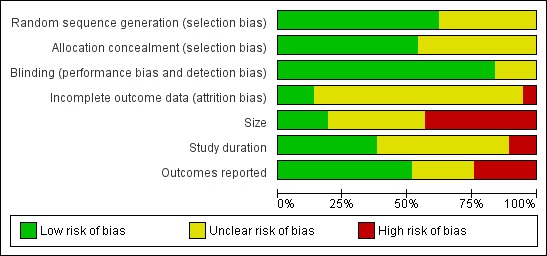
Methodological quality graph: review authors' judgements about each methodological quality item presented as percentages across all included studies.
Figure 3.
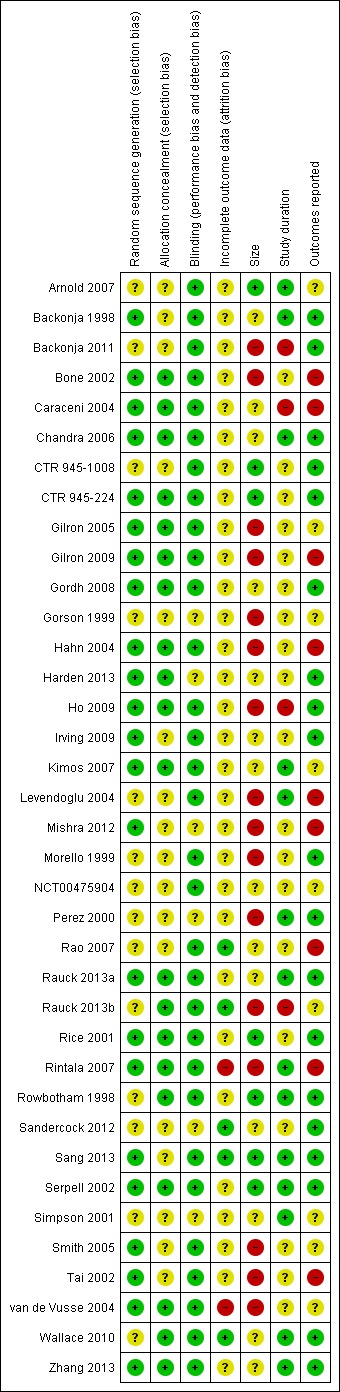
Methodological quality summary: review authors' judgements about each methodological quality item for each included study.
Effects of interventions
See: Table 1
Appendix 5 contains details of withdrawals, efficacy, and adverse events in the individual studies.
Efficacy
Efficacy results are reported where data are available, or where there is sufficient information to justify analysis, defined as information from 200 participants or more, ideally from at least two studies.
First tier evidence
There was no first tier evidence of efficacy.
Second tier evidence
Second tier evidence was available for analyses of postherpetic neuralgia (PHN), painful diabetic neuropathy (PDN), and mixed neuropathic pain. The evidence was second tier mainly because of imputation using the LOCF method following withdrawal.
Analyses 1.1 to 1.5 show results for the following outcomes: at least 50% reduction in pain (Analysis 1.1; Figure 4); PGIC very much improved (Analysis 1.2; Figure 5); PGIC much or very much improved (Analysis 1.3; Figure 6); IMMPACT outcome of substantial improvement in pain (Analysis 1.4; Figure 7); IMMPACT outcome of at least moderate improvement in pain (Analysis 1.5; Figure 8).
Analysis 1.1.
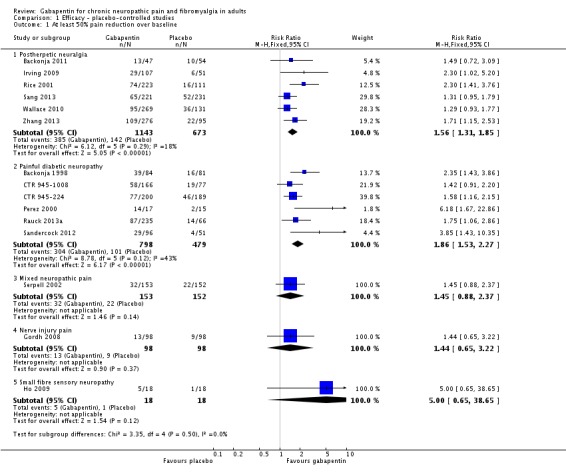
Comparison 1 Efficacy ‐ placebo‐controlled studies, Outcome 1 At least 50% pain reduction over baseline.
Figure 4.

Forest plot of comparison: 1 All placebo‐controlled studies, outcome: 1.1 At least 50% pain reduction over baseline.
Analysis 1.2.

Comparison 1 Efficacy ‐ placebo‐controlled studies, Outcome 2 Very much improved.
Figure 5.

Forest plot of comparison: 1 All placebo‐controlled studies, outcome: 1.2 Very much improved.
Analysis 1.3.
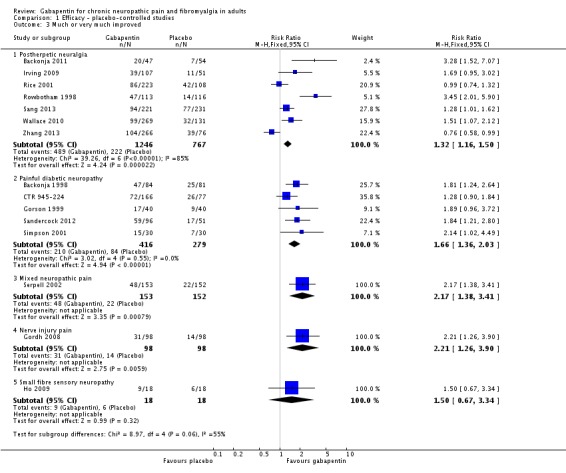
Comparison 1 Efficacy ‐ placebo‐controlled studies, Outcome 3 Much or very much improved.
Figure 6.

Forest plot of comparison: 1 All placebo‐controlled studies, outcome: 1.3 Much or very much improved.
Analysis 1.4.

Comparison 1 Efficacy ‐ placebo‐controlled studies, Outcome 4 IMMPACT outcome of substantial improvement.
Figure 7.

Forest plot of comparison: 1 All placebo‐controlled studies, outcome: 1.4 IMMPACT outcome of substantial improvement.
Analysis 1.5.

Comparison 1 Efficacy ‐ placebo‐controlled studies, Outcome 5 IMMPACT outcome of at least moderate improvement.
Figure 8.

Forest plot of comparison: 1 All placebo‐controlled studies, outcome: 1.5 IMMPACT outcome of at least moderate improvement.
Postherpetic neuralgia (PHN)
Of the 10 studies in PHN, eight (Backonja 2011; Irving 2009; NCT00475904; Rice 2001; Rowbotham 1998; Sang 2013; Wallace 2010; Zhang 2013) had a placebo control, and two (Chandra 2006; Harden 2013) an active control only. All eight placebo‐controlled studies had a parallel‐group design, with study duration of four to 12 weeks; daily gabapentin doses varied between 1800 mg and 3600 mg, while the dose of gabapentin encarbil was 1200 to 3600 mg daily.
At least 50% pain intensity reduction occurred in 34% of patients given gabapentin and 21% of those given placebo by the end of the study, with considerable consistency between studies (Summary of results A; Figure 9). Available data on dosing regimens were too sparse to establish a dose‐response relationship. A number of outcomes consistent with IMMPACT recommendations for substantial and moderate benefit were reported in two or more placebo‐controlled studies, and the results showed gabapentin at doses of 1800 mg daily or more, or gabapentin encarbil at 1200 mg daily, to be more effective than placebo (Summary of results A). For a Patient Global Impression of Change (PGIC) of much or very much improved, 39% of participants achieved this level of improvement with gabapentin and 29% with placebo. Other outcomes are reported in Summary of results A.
Figure 9.

Postherpetic neuralgia: Percentage of participants achieving at least 50% pain intensity reduction (PIR) over baseline with gabapentin 1200‐3600 mg daily, or placebo
Only one of these studies (Rice 2001; 18% of participants) used a standard formulation of gabapentin, and removing it from the analysis did not significantly change the result. Similarly, removing the two studies using gabapentin encarbil (Backonja 2011; Zhang 2013; 26% of participants) did not affect the result. There were insufficient data for subgroup analyses based on dose or duration of studies.
Summary of results A. Efficacy outcomes with gabapentin in postherpetic neuralgia (PHN)
| Number of | Percent with outcome | |||||
| Outcome | Studies | Participants | Gabapentin | Placebo | Risk ratio (95% CI) | NNT (95% CI) |
| Substantial benefit | ||||||
| At least 50% pain intensity reduction | 6 | 1816 | 34 | 21 | 1.6 (1.3 to 1.9) | 8.0 (6.0 to 12) |
| PGIC very much improved | 2 | 563 | 15 | 6 | 2.7 (1.5 to 4.8) | 11 (7.0 to 22) |
| Any definition of substantial benefit (at least 50% pain intensity reduction or PGIC very much improved) | 7 | 2045 | 34 | 20 | 1.7 (1.4 to 2.0) | 6.8 (5.4 to 9.3) |
| Moderate benefit | ||||||
| At least 30% pain intensity reduction | 2 | 529 | 54 | 38 | 1.4 (1.1 to 1.7) | 6.5 (4.0 to 16) |
| PGIC much or very much improved | 7 | 2013 | 39 | 29 | 1.3 (1.2 to 1.5) | 9.7 (6.9 to 16) |
| Any definition of moderate benefit (at least 30% pain intensity reduction or PGIC much or very much improved) | 7 | 2045 | 44 | 27 | 1.6 (1.4 to 1.8) | 5.7 (4.6 to 7.5) |
In the active controlled study involving 76 participants, gabapentin at doses of up to 2700 mg daily was compared to nortriptyline at doses of up to 150 mg daily over nine weeks. At least 50% improvement in pain over baseline using a VAS pain scale was achieved by 13/38 (34%) on gabapentin and 14/38 (37%) on nortriptyline, broadly in line with event rates in placebo‐controlled studies (Chandra 2006). Harden 2013 compared two dosing regimens of gabapentin encarbil in previous low dose treatment failures and found that about 13% did respond at the 50% pain reduction level.
Painful diabetic neuropathy (PDN)
Seven of the nine studies in PDN were of parallel‐group design (Backonja 1998; CTR 945‐1008; CTR 945‐224; Perez 2000; Rauck 2013a; Sandercock 2012; Simpson 2001); two had a cross‐over design (Gorson 1999; Morello 1999). Eight had a placebo comparator, while one (Morello 1999) had an active control only. Seven placebo‐controlled parallel‐group studies had a study duration between four and 14 weeks; all but one (Sandercock 2012) of seven weeks or longer. Daily gabapentin doses varied between 600 mg and 3600 mg; doses below 1200 mg were used in two studies, 900 mg daily as the only gabapentin dose in one (Gorson 1999), and 600 mg daily in one arm of another (CTR 945‐224). Gabapentin encarbil at doses of 1200 and 3600 mg daily was compared with pregabalin 300 mg daily and placebo in one study (Rauck 2013a).
At least 50% pain intensity reduction occurred in 38% of patients given gabapentin and 21% of those given placebo by the end of the study, with considerable consistency between studies (Summary of findings B; Figure 10). Available data on dosing regimens were too sparse to establish a dose‐response relationship. A number of outcomes consistent with IMMPACT recommendations for substantial and moderate benefit were reported in two or more placebo‐controlled studies, and the results showed gabapentin at doses of 1200 mg daily or more to be more effective than placebo (Summary of results B). For PGIC much or very much improved; 50% of participants achieved this level of improvement with gabapentin and 30% with placebo, with very similar results when results from Simpson 2001 were omitted because of concerns one peer reviewer expressed about this study in a previous version of the review; no other efficacy outcome data were included from this study. Other outcomes are reported in Summary of results B.
Figure 10.
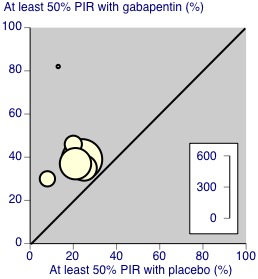
Painful diabetic neuropathy: Percentage of participants achieving at least 50% pain intensity reduction (PIR) over baseline with gabapentin 1200‐3600 mg daily, or placebo
Two studies (Rauck 2013a; Sandercock 2012; 35% of participants) used the gabapentin encarbil or gastroretentive formulations. Removing these from the analysis did not change the result. There were insufficient data for subgroup analyses based on dose or duration of studies.
Summary of results B. Efficacy outcomes with gabapentin in painful diabetic neuropathy (PDN) (1200 mg daily or greater)
| Number of | Percent with outcome | |||||
| Outcome | Studies | Participants | Gabapentin | Placebo | Risk ratio (95% CI) | NNT (95% CI) |
| Substantial benefit | ||||||
| At least 50% pain intensity reduction | 6 | 1277 | 38 | 21 | 1.9 (1.5 to 2.3) | 5.9 (4.6 to 8.3) |
| PGIC very much improved | 2 | 408 | 24 | 14 | 1.9 (1.3 to 3.0) | 9.6 (5.5 to 35) |
| Any definition of substantial benefit (at least 50% pain intensity reduction or PGIC very much improved) | 6 | 1277 | 38 | 21 | 1.9 (1.5 to 2.3) | 5.9 (4.6 to 8.3) |
| Moderate benefit | ||||||
| At least 30% pain intensity reduction | 2 | 744 | 54 | 43 | 1.2 (1.1 to 1.5) | 9.4 (5.6 to 29) |
| PGIC much or very much improved | 5 | 695 | 50 | 30 | 1.7 (1.4 to 2.0) | 4.9 (3.6 to 7.6) |
| PGIC much or very much improved (excluding Simpson 2001) | 4 | 635 | 51 | 31 | 1.6 (1.3 to 2.0) | 5.1 (3.7 to 8.3) |
| Any definition of moderate benefit (at least 30% pain intensity reduction or PGIC much or very much improved) | 7 | 1439 | 52 | 37 | 1.4 (1.3 to 1.6) | 6.6 (4.9 to 9.9) |
Gabapentin 600 mg daily produced lesser effects than 1200 mg and 2400 mg daily in a study that compared them (CTR 945‐224). In one placebo‐controlled cross‐over study involving 40 randomised participants, moderate or excellent pain intensity reduction was achieved by 17/40 (43%) with gabapentin 900 mg daily over six weeks, compared with 9/40 (23%) with placebo (Gorson 1999).
In one active‐controlled study involving 25 participants, gabapentin at 1800 mg daily was compared to amitriptyline 75 mg daily over six weeks. Complete or a lot of pain relief was achieved by 6/21 (29%) with gabapentin and 5/21 (24%) with amitriptyline (Morello 1999).
Mixed neuropathic pain
One exploratory study (Rauck 2013b) examined the effects of intrathecal gabapentin in participants with chronic, intractable non cancer pain, the majority (147/170; 86%) of whom were classified as having pain of neuropathic or mixed types. Three different doses (1 mg, 6 mg, and 30 mg daily) were compared with placebo. There was no significant reduction in group mean pain scores within and between groups over the 22 day treatment period. The number of participants experiencing at least 30% reduction in pain was 4/42, 4/41, 1/41, and 2/44 for the 1 mg, 6 mg, 30 mg, and placebo groups respectively.
Three studies examined the effects of oral gabapentin in mixed neuropathic painful conditions (Gilron 2005; Gilron 2009; Serpell 2002); two included participants with PHN and PDN (Gilron 2005; Gilron 2009) and in the other the most common conditions were CRPS and PHN (Serpell 2002). One had a parallel‐group comparison with placebo over eight weeks (Serpell 2002). The others had cross‐over designs that included placebo and morphine alone and in combination with gabapentin over five weeks (Gilron 2005), and nortriptyline alone or in combination with gabapentin over six weeks (Gilron 2009).
The parallel‐group comparison with placebo (Serpell 2002) used gabapentin titrated to a maximum of 2400 mg daily in 305 participants. Only for the PGIC outcome of much or very much improved was there a significant benefit of gabapentin (Summary of results C).
Summary of results C. Efficacy outcomes with gabapentin in mixed neuropathic pain (Serpell 2002)
| Number of | Percent with outcome | |||||
| Outcome | Studies | Participants | Gabapentin | Placebo | Risk ratio (95% CI) | NNT (95% CI) |
| At least 50% pain intensity reduction | 1 | 305 | 21 | 14 | 1.5 (0.9 to 2.4) | not calculated |
| PGIC very much improved | 1 | 305 | 12 | 6 | 2.0 (0.9 to 4.3) | not calculated |
| PGIC much or very much improved | 1 | 305 | 31 | 14 | 2.2 (1.4 to 3.4) | 5.9 (3.8 to 13) |
One placebo‐controlled cross‐over study (Gilron 2005) over five weeks provided results for moderate pain relief for participants who completed a given treatment period. Gabapentin alone (target dose 3200 mg daily), morphine alone (target dose 120 mg daily), and the combination (target dose gabapentin 2400 mg plus 60 mg morphine daily) were significantly better than placebo (Summary of results D). These results were calculated from the numbers and percentages with a moderate response. The total was larger than the 57 randomised, because some participated in more than one treatment arm.
Summary of results D. Efficacy outcomes with gabapentin in mixed neuropathic pain (Gilron 2005)
| Number of | Percent with outcome | |||||
| At least moderate pain relief | Studies | Participants | Gabapentin | Placebo | Risk ratio (95% CI) | NNT (95% CI) |
| Gabapentin alone | 1 | 96 | 61 | 25 | 2.5 (1.5 to 4.2) | 2.8 (1.8 to 5.6) |
| Morphine alone | 1 | 96 | 80 | 25 | 3.2 (1.9 to 5.2) | 1.8 (1.4 to 2.7) |
| Gabapentin plus morphine | 1 | 93 | 78 | 25 | 3.1 (1.9 to 5.1) | 1.9 (1.4 to 2.8) |
The other cross‐over study compared gabapentin alone (target dose 3600 mg daily), nortriptyline (target dose 100 mg daily) and the combination (target dose 3600 mg gabapentin plus 100 mg nortriptyline daily) over six weeks (Gilron 2009). Pain intensity was significantly lower with the combination, by less than 1 point out of 10 on a numerical rating pain scale.
Third tier evidence
This was the only evidence available for several other pain conditions. Here the issues were the imputation method and small numbers.
Spinal cord injury
The efficacy of gabapentin in spinal cord injury pain at maximum doses of 1800 mg or 3600 mg daily was compared with placebo in three cross‐over trials (Levendoglu 2004; Rintala 2007; Tai 2002) over periods of four and eight weeks. None of the studies reported dichotomous outcomes equivalent to moderate or substantial pain relief.
One eight‐week study randomised 20 participants to a maximum of 3600 mg gabapentin daily or placebo over eight weeks (Levendoglu 2004) and reported a 62% average fall in pain with gabapentin compared with a 13% fall with placebo.
A second eight‐week study randomised 38 participants to a maximum of 3600 mg gabapentin daily, amitriptyline 150 mg daily, or placebo over eight weeks (Rintala 2007). It claimed statistical superiority for amitriptyline for the 22 participants completing all three phases, and no benefit of gabapentin over placebo.
The final study comparing gabapentin with placebo over four weeks in seven participants had no interpretable results (Tai 2002).
Nerve injury pain
A single cross‐over study evaluated the efficacy of gabapentin at a maximum of 2400 mg daily compared with placebo over five‐week treatment periods (Gordh 2008). Among the 98 participants of the 120 randomised who completed both treatment periods, at least 50% pain intensity reduction was achieved by 13 (13%) on gabapentin and 9 (9%) on placebo, which did not reach statistical significance, risk ratio 1.4 (0.7 to 3.2). At least 30% pain intensity reduction was achieved by 29 (29%) on gabapentin and 19 (19%) on placebo, which did not reach statistical significance, risk ratio 1.5 (0.9 to 2.5).
Phantom limb pain
Two cross‐over studies evaluated the efficacy of gabapentin compared with placebo in phantom limb pain (Bone 2002; Smith 2005). One (Bone 2002) randomised 19 participants to a maximum of 2400 mg gabapentin daily, or the maximum tolerated dose, with six‐week treatment periods. Using an ITT approach, weekly VAS pain scores were lower at week six only with gabapentin, but not at any other time, nor with categorical pain measures. The other (Smith 2005) randomised 24 participants to gabapentin titrated to a maximum daily dose of 3600 mg. A "meaningful decrease in pain" (the top of a five‐point scale) was achieved by 13 participants (54%) with gabapentin and 5 (21%) with placebo, a statistically significant difference, with risk ratio 2.6 (1.1 to 6.2).
Cancer‐related neuropathic pain
Three studies examined gabapentin in the short term in cancer‐related neuropathic pain (Caraceni 2004; Mishra 2012; Rao 2007). A parallel‐group study (Caraceni 2004) randomised 121 participants to titration to a maximum of gabapentin 1800 mg daily or placebo, with 10 days of treatment. The average pain intensity was somewhat lower with gabapentin than with placebo, but the number of participants described as having pain under control was very similar with both treatments after six days, with 50% to 60% with pain under control over six to 10 days. A cross‐over study (Rao 2007) compared gabapentin titrated to 2700 mg daily with placebo in chemotherapy‐induced neuropathic pain over three weeks. There was no significant difference between gabapentin and placebo, but the study did recruit participants both with pain and sensory loss or paraesthesia, and baseline pain scores were only about 4/10 on a numerical rating scale. The study probably lacked sensitivity to detect any difference.
The third study compared gabapentin 1800 mg daily with pregabalin 600 mg daily and amitriptyline 100 mg daily for a total of four weeks. No dichotomous data were reported; a decrease in pain scores in all groups in all weeks was reported, together with a morphine‐sparing effect and improvement in functional capacity. Morphine‐sparing and functional capacity were significantly better with pregabalin than the other treatments.
HIV‐associated sensory neuropathies
A single parallel‐group study compared gabapentin titrated to 2400 mg daily with placebo over four weeks in 24 participants with painful HIV‐associated neuropathies (Hahn 2004). On average, pain and sleep improved substantially with both gabapentin and placebo, though the time courses differed. After four weeks, there was no difference in median pain scores, though the placebo response had an unusual time course in 11 participants.
Small fibre sensory neuropathies
A single cross‐over study with complete enrichment, compared gabapentin at doses up to 4800 mg daily with tramadol 50 mg (probably four times a day), and placebo in 18 participants with small fibre sensory neuropathies using two‐week treatment periods (Ho 2009). The number achieving at least 50% pain intensity reduction was 4/18 (22%) with gabapentin, 4/18 (22%) with tramadol, and 1/18 (6%) with placebo. Similar results were obtained for those feeling very much better.
Chronic masticatory myalgia
A single parallel‐group study compared gabapentin titrated to 4200 mg daily with placebo over 12 weeks in 50 participants with painful chronic masticatory myalgia, where pain is associated with central sensitisation (Kimos 2007). Gabapentin was significantly better than placebo for VAS pain, pain reduction, and VAS function, and an NNT of 3.4 for gabapentin compared with placebo was reported, though no details were recorded about outcome.
Complex regional pain syndrome (CRPS)
The efficacy of gabapentin in CRPS at maximum doses of 1800 mg daily was compared with placebo in 58 participants in a single placebo‐controlled cross‐over study lasting three weeks in each period (van de Vusse 2004). Over both periods, and using per protocol reporting, "much" pain improvement (undefined) was achieved by 8/46 (17%) with gabapentin compared with 2/46 (4%) with placebo. There was no significant difference, with a relative benefit of 4.0 (0.9 to 18).
Fibromyalgia
The efficacy of gabapentin in fibromyalgia at maximum doses of 2400 mg daily was compared with placebo in 150 participants in a single placebo (diphenhydramine) controlled parallel‐group study lasting 12 weeks (Arnold 2007). The outcome of 30% reduction in pain over baseline was reported, with 38/75 participants (49%) achieving the outcome with gabapentin compared with 23/75 (31%) with placebo. The relative benefit was 1.6 (1.1 to 2.4) and the NNT was 5.4 (2.9 to 31).
Overall efficacy across all conditions
For the 2011 review it was considered appropriate to produce an analysis of the efficacy of gabapentin across all chronic pain conditions included. The reason for this was that there was a suggestion that partial reporting of studies and outcomes had overestimated gabapentin effectiveness (Vedula 2009), perhaps to the extent that it may be of little value when considering benefits and harms together (Perry 2008). Estimating efficacy across all conditions is of little value when sufficient information exists for estimation of efficacy in particular conditions, which is where the real‐world interest lies. For this reason no results of overall efficacy across all conditions were included in this updated review.
Withdrawals (see Summary of results E)
All‐cause withdrawals
Twenty‐three studies with 4709 participants reported on withdrawals for any cause, which occurred in 20% of participants on gabapentin at daily doses of 1200 mg or more, and in 18% on placebo (Analysis 2.1). The risk ratio was 1.04 (0.90 to 1.2).
Analysis 2.1.

Comparison 2 Withdrawals ‐ placebo‐controlled studies, Outcome 1 All‐cause withdrawal.
Adverse event withdrawals
Twenty‐two studies with 4448 participants reported on adverse event withdrawals, which occurred in 11% of participants on gabapentin at daily doses of 1200 mg or more, and in 7.9% on placebo (Analysis 2.2). The risk ratio was 1.4 (1.1 to 1.7), and the NNH 31 (20 to 66).
Analysis 2.2.

Comparison 2 Withdrawals ‐ placebo‐controlled studies, Outcome 2 Adverse event withdrawal.
Lack of efficacy withdrawals
Sixteen studies with 3693 participants reported on lack of efficacy withdrawals, which occurred in 1.6% of participants on gabapentin at daily doses of 1200 mg or more, and in 3.1% on placebo (Analysis 2.3). The risk ratio was 0.5 (0.3 to 0.8), and the NNTp 67 (40 to 205).
Analysis 2.3.
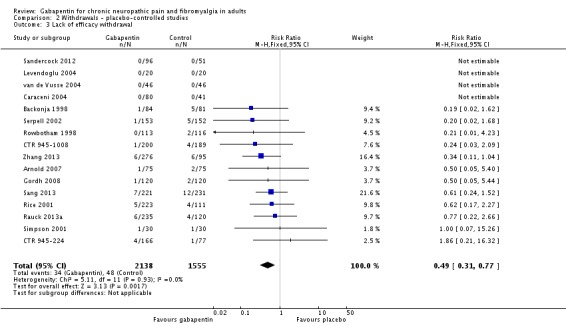
Comparison 2 Withdrawals ‐ placebo‐controlled studies, Outcome 3 Lack of efficacy withdrawal.
Adverse events (see Summary of results E)
Participants experiencing at least one adverse event
Seventeen studies with 4002 participants reported on participants experiencing at least one adverse event, which occurred in 62% of participants on gabapentin at daily doses of 1200 mg or more, and in 50% on placebo (Analysis 3.1). The risk ratio was 1.25 (1.2 to 1.3), and the NNH was 8.6 (6.8 to 12).
Analysis 3.1.
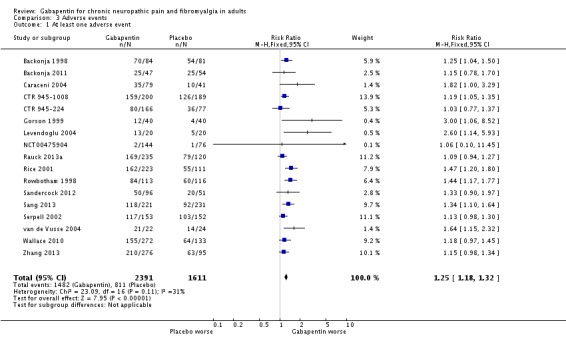
Comparison 3 Adverse events, Outcome 1 At least one adverse event.
Serious adverse events
NIneteen studies reported on 3952 participants experiencing a serious adverse event, which occurred in 3.2% of participants on gabapentin at daily doses of 1200 mg or more, and in 2.8% on placebo (Analysis 3.2). The risk ratio was 1.2 (0.8 to 1.7).
Analysis 3.2.

Comparison 3 Adverse events, Outcome 2 Serious adverse events.
Particular adverse events
Somnolence, drowsiness, or sedation was reported as an adverse event in 20 studies with 4125 participants, and it occurred in 14% of participants on gabapentin at doses of 1200 mg daily or more, and in 5% on placebo (Analysis 3.3). The risk ratio was 2.9 (2.3 to 3.6), and the NNH was 11 (9.4 to 14).
Analysis 3.3.

Comparison 3 Adverse events, Outcome 3 Somnolence.
Dizziness was reported as an adverse event in 22 studies with 4576 participants, and it occurred in 19% of participants on gabapentin at doses of 1200 mg daily or more, and in 6.1% on placebo (Analysis 3.4). The risk ratio was 3.1 (2.6 to 3.8), and the NNH was 7.6 (6.6 to 8.8).
Analysis 3.4.

Comparison 3 Adverse events, Outcome 4 Dizziness.
Peripheral oedema was reported as an adverse event in 12 studies with 3220 participants, and it occurred in 7.0% of participants on gabapentin at doses of 1200 mg daily or more, and in 2.2% on placebo (Analysis 3.5). The risk ratio was 3.3 (2.2 to 4.9), and the NNH was 21 (16 to 30).
Analysis 3.5.

Comparison 3 Adverse events, Outcome 5 Peripheral oedema.
Ataxia or gait disturbance was reported as an adverse event in five studies with 544 participants. It occurred in 26/295 (8.8%) participants on gabapentin at doses of 1200 mg daily or more, and in 3/249 (1.1%) on placebo, though all but one study reported no events with placebo (Analysis 3.6). This produced a risk ratio of 4.5 (1.9 to 11), and the NNH was 13 (9 to 24).
Analysis 3.6.
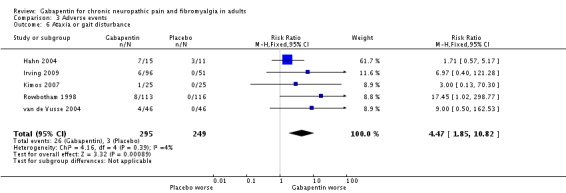
Comparison 3 Adverse events, Outcome 6 Ataxia or gait disturbance.
Summary of results E: Withdrawals and adverse events with gabapentin (1200 mg daily or more) compared with placebo
| Number of | Percent with outcome | |||||
| Outcome | Studies | Participants | Gabapentin | Placebo | Risk ratio (95% CI) | NNH (95% CI) |
| Withdrawal ‐ all‐cause | 23 | 4709 | 20 | 18 | 1.04 (0.90 to 1.2) | Not calculated |
| Withdrawal due to adverse events | 22 | 4448 | 11 | 7.9 | 1.4 (1.1 to 1.7) | 31 (20 to 66) |
| At least one adverse event | 17 | 4002 | 62 | 50 | 1.25 (1.2 to 1.3) | 8.6 (6.8 to 12) |
| Serious adverse event | 19 | 3952 | 3.2 | 2.8 | 1.2 (0.8 to 1.7) | Not calculated |
| Somnolence/drowsiness | 20 | 4125 | 14 | 5.0 | 2.9 (2.3 to 3.6) | 11 (9.4 to 14) |
| Dizziness | 22 | 4576 | 19 | 6.1 | 3.1 (2.6 to 3.8) | 7.6 (6.6 to 8.8) |
| Peripheral oedema | 12 | 3220 | 7.0 | 2.2 | 3.3 (2.2 to 4.9) | 21 (16 to 30) |
| Ataxia/gait disturbance | 5 | 544 | 8.8 | 1.2 | 4.5 (1.9 to 11) | 13 (9 to 24) |
| Outcome | Studies | Participants | Gabapentin | Placebo | Risk ratio (95% CI) | NNTp (95% CI) |
| Withdrawal ‐ lack of efficacy | 16 | 3693 | 1.6 | 3.1 | 0.5 (0.3 to 0.8) | 67 (40 to 205) |
Death
Deaths were rare in these studies. Five deaths occurred in PHN studies; three with placebo: one in 231 participants (Sang 2013), one in 116 (Rowbotham 1998) and one in 133 (Wallace 2010); two with gabapentin: one in 223 participants (Rice 2001), and one in 107 (Irving 2009). An unpublished study (CTR 945‐1008) reported two deaths: one of 200 participants treated with gabapentin, and one of 189 treated with placebo. A further study reported two deaths in 152 participants taking placebo (Serpell 2002). Overall, three deaths occurred with gabapentin and five with placebo.
Discussion
Summary of main results
Gabapentin is a reasonably effective treatment for a variety of neuropathic pain conditions. It has been demonstrated to be better than placebo across all studies for IMMPACT outcomes of substantial and at least moderate improvement, producing almost identical results for all trials and those in parallel‐group studies lasting six weeks or longer. Numbers needed to treat to benefit (NNTs) were between 5 and 7 for substantial and at least moderate improvement in PHN and PDN. Results were consistent across the major neuropathic pain conditions tested, though gabapentin was tested only in small numbers in uncommon neuropathic pain conditions and fibromyalgia. The review concentrated on doses of gabapentin of 1200 mg daily or greater, though a wide range of fixed doses and dose titration regimens were used.
Gabapentin was tested in nine different chronic pain conditions generally considered to be neuropathic in origin, and three other chronic pain conditions where the aetiology may be different (masticatory myalgia, CRPS‐1, and fibromyalgia). For only three neuropathic pain conditions was there sufficient information to be confident that it worked satisfactorily, namely PHN, PDN, and mixed neuropathic pain, itself principally, though not exclusively, PHN and PDN.
Benefit was balanced by more withdrawals due to adverse events, and participants taking gabapentin experienced more adverse events, including somnolence, dizziness, peripheral oedema, and gait disturbance than did those taking placebo. Serious adverse events were no more common with gabapentin than placebo, and death was an uncommon finding in these studies.
Overall completeness and applicability of evidence
Efficacy and adverse event outcomes were not consistently reported across the studies, and this limited the analyses to some extent. However, for the most important efficacy and adverse event outcomes, analyses across all conditions were mostly based on between 1000 and about 4700 participants. All the larger studies (typically those with more than 100 participants) reported some efficacy outcome that fitted one or both of the IMMPACT outcomes of at least moderate or substantial benefit. Clearly, analysis at the level of the individual patient would facilitate a more robust estimate.
There is one important unknown for most studies, namely whether the definition of response in the trials included only participants who had both an analgesic response and were able to take gabapentin. If response included an LOCF assessment of efficacy from those who discontinued, this could have affected the results (Moore 2012a). LOCF tends to generate overestimation of treatment effects when adverse event withdrawals with drug is higher than that with placebo. For gabapentin, the excess adverse withdrawal over placebo was about 3%. This is not likely to result in significant overestimation in treatment effect (Moore 2012a). In a similar situation, duloxetine produced little different NNTs using LOCF and BOCF in four different chronic pain conditions (Moore 2014).
Another issue is how to deal with relatively short term, small, multiple cross‐over studies that intensively study participants on a daily basis (Gilron 2005; Gilron 2009), but do not report outcomes of clinical relevance (participants with adequate pain relief), but rather average pain scores, whose relevance has been questioned because of underlying skewed distributions (Moore 2010d). This study design can provide useful and clinically relevant information, like the relatively rapid onset of effect of therapies in neuropathic pain, or how individual patients respond to several different drugs, they are difficult to include in pooled analyses, and their small size and brevity come with significant potential biases (Moore 2012b).
There were almost no data for direct comparisons with other active treatments. It is questionable how important direct comparisons may be; they compare average efficacy rates between different active therapies, but individual patients may respond to one drug, but not another (Moore 2013b).
We are aware that erectile dysfunction has been a cause for concern for younger men treated with antiepileptic drugs for epilepsy (Smalldone 2004), and anorgasmia has been reported with gabapentin (Perloff 2011). Adverse event reporting of erectile dysfunction or anorgasmia in these trials was sparse or not present, and the effects of gabapentin on sexual function may not be well represented.
Finally, there was no way to incorporate into the review important observations on the timing and consistency of analgesia with gabapentin in neuropathic pain. In PHN, individual patient level pooled analyses of several large trials have demonstrated that, judged by the proportion of participants with a 1 out of 10 point pain intensity reduction, around 20 to 40 days is needed for effects to be seen (Rauck 2013c). Early response, defined as a 30% pain intensity reduction or greater, was predictive of response after 10 weeks, while pain intensity reduction of <10% at week 5 was the best early predictor of lack of response at week 10 (Jensen 2012).
Quality of the evidence
The studies included in this review covered a large number of different painful conditions. The main quality issues involve reporting of outcomes of interest, particularly dichotomous outcomes equivalent to IMMPACT, as well as better reporting of adverse events. The earliest study was published in 1998, and the past decade or so has seen major changes in clinical trial reporting. The studies themselves appear to be well‐conducted, and individual patient analysis could overcome some of the shortcomings of reporting.
Potential biases in the review process
The review was restricted to randomised double‐blind studies, thus limiting the potential for bias. Other possible sources of bias that could have affected the review included the following:
Duration ‐ NNT estimates of efficacy in chronic pain studies tend to increase (get worse) with increasing duration (Moore 2010a). However, limiting studies to those of six weeks or longer did not change the main efficacy outcomes, mainly because most participants were in longer duration studies.
Outcomes may affect estimates of efficacy, but the efficacy outcomes chosen were of participants achieving the equivalent of IMMPACT‐defined moderate or substantial improvement, and it is likely that lesser benefits, such as 'any benefit' or 'any improvement', are potentially related to lesser outcomes, though this remains to be clarified.
The dose of gabapentin used differed between studies, in terms of maximum allowable dose, and whether the dose was fixed, titrated to effect, or titrated up to the maximum irrespective of beneficial or adverse effects. We chose to pool data irrespective of dose, within broad limits, because it was the only practical way to deal with dose in a pooled analysis, and because of a lack of good evidence of any clear dose‐response effect for gabapentin in neuropathic pain.
In some circumstances cross‐over trials have been shown to exaggerate treatment effects in comparison with parallel‐group designs (Khan 1996), but the extent is unclear, and it is unlikely to be the source of major bias (Elbourne 2002). Withdrawals from cross‐over studies meant that any results were likely to be per protocol for completers rather than a true ITT analysis. Parallel‐group studies were larger than cross‐over studies, and dominated the analyses in terms of number of participants. The 20 parallel‐group studies involved 3811 participants (median 162 ), while the 13 cross‐over studies involved 633 participants (median 40 participants). Additionally, few cross‐over studies reported outcomes that could be used in the analyses.
The absence of publication bias (unpublished trials showing no benefit of gabapentin over placebo) can never be proven. However, we can calculate the number of participants in studies of zero benefit (risk ratio of 1) required for the absolute benefit to reduce beneficial effects to a negligible amount (Moore 2008). If an NNT of 10 were considered a level that would make gabapentin clinically irrelevant, then across all types of neuropathic pain and for the outcome of at least 50% pain intensity reduction for PHN and PDN combined (6.9 in 3093 participants), there would have to be 1390 participants in zero effect studies. With median study size for parallel‐group studies of about 220 participants, this would require a minimum of six or seven unavailable studies. We know of no unpublished studies, and none of the ongoing studies identified through Clinicaltrials.gov would be relevant to efficacy assessment.
Agreements and disagreements with other studies or reviews
Previous version of this review
This review differs in two major respects from the original review (Wiffen 2005) from which it was split into two parts (acute pain (Straube 2010) and this review on chronic neuropathic pain and fibromyalgia (Moore 2011)).
The 2011 review (Moore 2011) and this update use strict definitions of what constitutes at least moderate and substantial benefit as defined by the 2008 IMMPACT criteria (Dworkin 2008). The 2005 review used a hierarchy of outcomes (pain intensity reduction of 50% or greater, global impression of clinical change, pain on movement, pain on rest or any other pain‐related measure) that would have allowed any pain benefit to have been counted. That was reasonable, and continued a process of demonstrating that antiepileptic drugs effectively relieved pain in neuropathic pain conditions that began a decade earlier (McQuay 1995). This update uses developing considerations that people with chronic pain want high levels of pain relief, ideally with more than 50% pain relief, and pain not worse than mild (Moore 2013c). Use of more stringent outcomes is likely to lead to lower estimates of efficacy, as has been described in acute migraine (Oldman 2002).
The 2011 review and this update together have more than three times the number of participants as the 2005 review, including several large long duration studies with different gabapentin formulations. These more modern studies have better reporting, especially of dichotomous efficacy outcomes. The review includes previously unpublished information, as has been recommended (Vedula 2009), and we have extended our search strategy for ongoing studies, in Clinicaltrials.gov for example.
A consequence of the stringent definition of outcome and the larger numbers available has resulted in a reduction in estimates of efficacy over all studies, and for PHN and PDN analysed separately, as shown by increased NNTs (Summary of results F). The decreased estimate of efficacy was most noticeable for PDN in the 2011 update, for which previously unpublished results made a major contribution to the updated review. The results have not changed noticeably since 2011.
Summary of findings F. Comparison of NNTs from previous and present reviews
| 2005 review | 2011 update | 2014 Update | |||
| Outcomes | Any improvement |
IMMPACT moderate benefit |
IMMPACT substantial benefit |
IMMPACT moderate benefit |
IMMPACT substantial benefit |
| All studies | 4.3 (3.5 to 5.7) | 5.8 (4.8 to 7.2) | 6.8 (5.6 to 8.7) | Not calculated in this review | |
| PHN | 3.9 (3.0 to 5.7) | 5.5 (4.3 to 7.7) | 7.5 (5.2 to 14) | 5.7 (4.6 to 7.5) | 6.8 (5.4 to 9.3) |
| PDN | 2.9 (2.2 to 4.3) | 8.1 (4.7 to 28) | 5.8 (4.3 to 9.0) | 6.6 (4.9 to 9.9) | 5.9 (4.6 to 8.3) |
Other systematic reviews
One other review has provided NNTs for gabapentin in different neuropathic pain conditions based on 50% pain relief, quoting NNTs of 4.7 and 4.3 for neuropathic pain and peripheral pain, and 4.6 for PHN and 3.9 for PDN (Finnerup 2005). A systematic review of therapies for PHN considered gabapentin effective, with an NNT of 4.6 (Hempenstall 2005). These efficacy estimates are more optimistic than NNTs for the IMMPACT substantial benefit calculated for this review, and more optimistic than NNTs calculated for the same outcome of at least 50% pain relief for PHN of 5.7 and PDN of 5.8. The use of more stringent criteria for efficacy, and availability of more information from longer duration studies has led to more conservative efficacy results. Both pregabalin and duloxetine produce NNTs in the region of five to six for at least 50% pain relief over eight to 12 weeks compared with placebo in PHN and PDN (Lunn 2009; Moore 2009a; Sultan 2008).
A number of other systematic reviews have examined the efficacy of gabapentin in neuropathic pain. Systematic reviews of gabapentin for neuropathic pain in spinal cord injury (Tzellos 2008) and fibromyalgia (Hauser 2009; Tzellos 2010) found no more studies than those reported here. An examination of the effects of enriched enrolment found no more studies, and produced similar results for withdrawals and adverse events based on a more limited data set (Straube 2008). A review comparing gabapentin and duloxetine in PDN was limited to two gabapentin studies, was statistical in nature, and restricted to average changes in some efficacy parameters (Quilici 2009). The most directly relevant was a comparison between gabapentin and tricyclic antidepressants (Chou 2009), in which a meta‐analysis of six placebo‐controlled gabapentin studies in PHN, PDN, and mixed neuropathic pain was performed. Using a mixture of outcomes the relative benefit compared with placebo was 2.2, similar to the benefits found for the 'all studies' analysis and for analyses for PHN, PDN, and mixed neuropathic pain in this review. A systematic review of pregabalin and gabapentin in fibromyalgia (Hauser 2009) reported only on the single study identified in this review, but reported overall good reductions in pain and other outcomes, with no major difference between gabapentin and pregabalin. Phillips 2010 examined the same single study of gabapentin (Hahn 2004) as part of a wider review of pharmacological interventions for HIV neuropathy and came to similar conclusions. The UK NICE guidance on pharmacological management of neuropathic pain has gabapentin as one of four drugs to try initially, with early switching when pain relief is not forthcoming (NICE 2013).
There is one further review in the public domain (Perry 2008) which was performed as part of a legal case in the United States ending in 2009. Perry 2008 considered similar outcomes to this review; NRS or VAS pain score was given hierarchical priority between ≥50% reduction in pain score (higher priority) and PGIC (lower priority) mainly because it was the pre‐defined primary end point in almost all studies, and for some studies it was difficult to determine how the secondary endpoints were manipulated during post hoc changes in statistical analysis plans. The Perry conclusions are very similar to those of the present review. The likely real differences would lie in the fact that Perry excluded Perez 2000 and Simpson 2001, and did not have access to Sandercock 2012, Irving 2009, and Wallace 2010.
Perry's conclusion on effectiveness was a clinical judgement based on balancing NNH against NNT, using the Cochrane glossary definition of effectiveness, and presuming that inherent biases in the studies (enrichment, exclusion of many typical real world patients) implied that on balance the benefit of gabapentin use on average does not exceed the harm, which is a somewhat different issue than addressed by this Cochrane review.
Authors' conclusions
There was no first tier evidence that was unequivocally unbiased. Second tier evidence, with potentially important residual biases, showed that gabapentin at doses of 1200 mg or more was effective for some people with painful neuropathic pain conditions. No evidence regarding a dose‐response effect was available for doses above 1200 mg daily, but limited evidence suggested that doses lower than 1200 mg daily were less effective. The outcome of at least 50% pain intensity reduction is regarded as a useful outcome of treatment by patients, and the achievement of this degree of pain relief is associated with important beneficial effects on sleep interference, fatigue, and depression, as well as quality of life, function, and work. About 35% achieved this degree of pain relief with gabapentin, compared with 21% for placebo. Over half of those treated with gabapentin will not have worthwhile pain relief. Results might vary between different neuropathic pain conditions, and the amount of evidence for gabapentin in some conditions (all except PHN, PDN, and mixed) is low, excluding any confidence that it works or does not work.
The level of efficacy found for gabapentin is consistent with the efficacy estimates for other drug therapies in these conditions.
The main research directions that would help improve clinical practice are as follows:
Analysis of all gabapentin studies at the level of the individual participant in order to have consistent outcomes, and analyses based on them. Individual patient analyses can provide important information, for example showing that good pain response delivers large functional and quality of life benefits beyond pain (Moore 2010c). Studies already concluded contain outcomes important to patients and clinical practice, but not reported or expressed in these terms. It would be of questionable efficacy to undertake new studies when data should be available for reasonably rapid analysis.
Participant level data might also be of importance in identifying responder clusters and characteristics.
More research in to the efficacy of gabapentin in painful neuropathic pain conditions where there is currently inadequate information. These conditions tend to be uncommon, and studies can be difficult, with few possible participants. Others, though, like fibromyalgia, are common.
The main issue, though, is not whether gabapentin is effective, but how best to use it in clinical practice to generate the best results for most patients with a chronic neuropathic pain condition, in the shortest time, and at the lowest cost. New study designs have been proposed to examine this (Moore 2009c).
Feedback
Feedback submitted 2015, 29 May 2015
Summary
Date of Submission: 29‐May‐2015
Name: Michael Chan BSc(Pharm); Danielle Ghag BSc(Pharm); Aaron Tejani PharmD
Affiliation: UBC
Role: Pharmacist
Comment: Written by Michael Chan BSc(Pharm), Danielle Ghag BSc(Pharm), Aaron Tejani PharmD
Dear Cochrane Review Team,
We read with great interest the systematic review of Gabapentin for chronic neuropathic pain and fibromyalgia in adults by Moore 2014. Although this systematic review has taken on the arduous task of ascertaining the highest level of available evidence, it is made difficult by the inherent bias that plagues the trials in the literature. This was evidenced upon further analysis of the 6 trials that were included in outcome 1.1, “At least 50% pain reduction over baseline”. The results of this outcome were subject to the limitations of the methodology in these studies that were not adequately accounted for in this review article.
The five‐point Oxford Scale was included for each study to assess the risk of bias. This scale has been shown to provide unreliable validity assessments and its use is discouraged because it does not address important biases such as allocation concealment. Moreover, since gabapentin has a profound side effect profile, participants may have correctly anticipated which treatment they received. Thus, we feel that blinding is not adequately assessed through the Oxford scale, as points are allocated for double blinding without considering whether blinding was maintained throughout the study. In these cases, the risk of bias due to blinding may be better represented as an unclear risk or as some may argue, high risk. This would lead to reclassification of Sang 2013, Wallace 2010 and Zhang 2013 from low risk to unclear or high risk of bias, which may impact our interpretation of outcome 1.1. Furthermore, the effect size of gabapentin may be an overestimation as compromised blinding may account for an exaggerated effect of 13% (Savović 2012).
The aforementioned risk of bias due to blinding may be exacerbated by partial enrichment of the population that was enrolled. Studies by Sang 2013, Wallace 2010 and Zhang 2013 included patients who had previously responded to gabapentin, and excluded those who did not respond or tolerate gabapentin. This subset of participants who have already received the active drug, may be able to determine which drug they are receiving based on their knowledge of its anticipated effects, therefore jeopardizing blinding. Thus, enrichment can introduce performance and selection bias, which falsely inflates the proportion of patients who respond to active treatment.
This review assumed that treatment effects were not significantly affected by partial enrichment based on the results of the systematic review by Straube 2008, which examined the effects of enrichment in 21 trials of gabapentin or pregabalin. Of the 12 studies that examined gabapentin specifically, 10 were not enriched and 2 were partially enriched. A limitation of Straube 2008 was that the 2 partially enriched studies did not provide the proportion of patients taking gabapentin at baseline. This makes it difficult to determine the degree and implications of enrichment. Also, Straube 2008 stated it was difficult to make meaningful comparisons between trials using different doses of gabapentin and enrolment strategies.
The issue of enriched enrolment is exemplified by the poorly described baseline characteristics in most of the studies for outcome 1.1. Although, Sang 2013 specified that 43.6% and 39.6% of those in the gabapentin and placebo groups respectively had received gabapentin or pregabalin prior to enrolment, other studies did not disclose this information. Due to the uncertainty surrounding the impact that enrichment has on the treatment effects of gabapentin, we believe that a subgroup analysis may be appropriate to analyze enriched and non‐enriched studies independently. The impact of enrichment may jeopardize internal and external validity, which we feel were not adequately addressed in the “Overall Completeness and Applicability of the Evidence”.
The majority of the included studies reported in outcome 1.1 did not disclose the proportion of patients receiving tricyclic antidepressants concomitantly or specify whether the dose was altered during the study. Since there is uncertainty surrounding the maintenance of blinding, this could lead to researchers favoring the gabapentin group by altering TCAs or other analgesics accordingly.
The review article stated that a fixed‐effects model would be used if statistically significant heterogeneity was found. Despite this, even though there was statistically significant heterogeneity for outcomes 1.2.2 and 1.3.1, a fixed effects model was still used. Moreover, the review did not provide an assessment of possible reasons for heterogeneity. A random‐effects model meta‐analyses would be a more conservative approach to address the heterogeneity to provide a more meaningful conclusion (Higgins 2011).
For outcome 1.1 Baseline Observation Carried Forward (BOCF) was utilized to address attrition in two of the six studies, which accounted for over half of the weight. Although deemed a conservative approach, it can lead to an overestimation or underestimation of the number of patients with greater than 50% improvement from baseline. For example, the BOCF may indirectly overestimate the treatment effect of gabapentin by not taking into account the proportion of those receiving placebo who experienced a 50% improvement. This is of particular concern since we believe that blinding may have been compromised in these trials as described above. This unclear risk of bias is not captured in the summary tables which classifies BOCF as low risk. Moreover, the Summary of Findings Table for Main Comparisons for postherpetic neuralgia states that “Imputation method used [was] (LOCF) and small study size could influence results to reduce gabapentin efficacy”. This statement is not entirely accurate as Sang 2013 and Wallace 2010, which account for approximately 58.1% of the weight of outcome 1.1, use BOCF. Even so, we disagree with the fact that the Last Observation Carried Forward (LOCF) would reduce the treatment as it may in fact increase or decrease it. Despite our best efforts to postulate whether or not LOCF and BOCF would alter treatment effects, the best approach would be delving into the individual studies and contacting the authors for missing information.
One possible intervention to increase the confidence of the results in this review would be to conduct a sensitivity analysis. We would have liked to see a sensitivity analysis performed regardless of the number of studies available. Sensitivity analysis would help to characterize the impact of methodological limitations on the results of the systematic review.
Best Regards,
Michael Chan BSc(Pharm),
Danielle Ghag BSc(Pharm) and
Aaron M Tejani PharmD
References:
1. Zhang L, Rainka M, Freeman R, Harden RN, Bell CF, Chen C, et al. A Randomized, Double‐Blind, Placebo‐Controlled Trial to Assess the Efficacy and Safety of Gabapentin Enacarbil in Subjects With Neuropathic Pain Associated With Postherpetic Neuralgia (PXN110748). J Pain. 2013 Jun;14(6):590–603.
2. Straube S, Derry S, McQuay HJ, Moore RA. Enriched enrolment: definition and effects of enrichment and dose in trials of pregabalin and gabapentin in neuropathic pain. A systematic review. Br J Clin Pharmacol. 2008 Aug;66(2):266–75.
3. Wallace MS, Irving G, Cowles VE. Gabapentin Extended‐Release Tablets for the Treatment of Patients with Postherpetic Neuralgia. Clin Drug Investig. 2010;30(11):765–76.
4. Moore RA, Wiffen PJ, Derry S, Toelle T, Rice ASC. Gabapentin for chronic neuropathic pain and fibromyalgia in adults. In: The Cochrane Collaboration, editor. Cochrane Database of Systematic Reviews [Internet]. Chichester, UK: John Wiley & Sons, Ltd; 2014 [cited 2015 May 29]. Available from: http://doi.wiley.com/10.1002/14651858.CD007938.pub3
5. Rice ASC, Maton S, Group1UK PNS, others. Gabapentin in postherpetic neuralgia: a randomised, double blind, placebo controlled study. Pain. 2001;94(2):215–24.
6. Sang CN, Sathyanarayana R, Sweeney M, Investigators D‐1796 S, others. Gastroretentive gabapentin (G‐GR) formulation reduces intensity of pain associated with postherpetic neuralgia (PHN). Clin J Pain. 2013;29(4):281–8.
7. Savović J, Jones H, Altman D, Harris R, Jűni P, Pildal J et al. Influence of reported study design characteristics on intervention effect estimates from randomised controlled trials: combined analysis of meta‐epidemiological studies. Health Technology Assessment. 2012;16(35). .
8. Higgins JPT, Green S (editors). Cochrane Handbook for Systematic Reviews of Interventions Version 5.1.0 [updated March 2011]. The Cochrane Collaboration, 2011. Available from www.cochrane‐handbook.org.
I agree with the conflict of interest statement below:
I certify that I have no affiliations with or involvement in any organization or entity with a financial interest in the subject matter of my feedback.
Reply
Chan and colleagues begin by suggesting that the presence of adverse events with an active drug may compromise an overall blinding of the trial by an external observer, as they would anticipate that a person with adverse events had had an active drug, while those without had placebo. That would be even when, as in the three studies you mentioned, there was a matched placebo so that neither patients nor observers were aware of the allocation initially.
Of course, for the individual patient, who cannot see the overall picture, that would not be the case. And since the individual patient makes their own judgment about pain and other outcomes, the position of the outside observer is irrelevant. Moreover, when you look at the actual event rates for adverse events in these three trials, and overall, there is a rather low increase in adverse event rates (RR 1.25 overall). Wallace and Zhang showed no difference in event rates between gabapentin and placebo, which makes it especially hard to see how this suggested bias would act.
In this circumstance, it is hard to see what justification they can have for their statements, unless supported with empirical evidence from elsewhere. We have been looking for some years now, as we have an interest in the methodology of systematic reviews and sources of bias, and are aware of none.
In passing, we use both the Oxford Quality Score (to help justify inclusion and exclusion – studies must be randomised and double blind to be accepted) and a version of Risk of Bias. The OQS now has well over 10,000 citations, and is validated. Cochrane RoB omits several important, and possibly crucial, sources of bias. Neither is perfect, but when detecting bias we need all the tools at our disposal.
They also make a point about partial enrichment. The situation right now is that there is zero empirical evidence that partial enrichment makes any difference to results of clinical trials in neuropathic pain. It may well be, as they say, that some residual bias is not accounted for, but that is speculation, and not fact. The fact is that the three studies that they seem to be concerned about are not out of line with others in the analyses, and one of them, for analysis of PGIC, was not different from placebo.
Chan and colleagues are also concerned with patients receiving TCAs. Actually, it is very unlikely that TCA prescribing changes affected the results. Most trials indicated that any concomitant therapies would not be changed during the course of the trial. It is an interesting speculation, but since tricyclic efficacy is as low as all others in NP (based on the rather inadequate evidence we have, as well as clinical experience), one would really need to push this to an extreme to explain any result. Is there any evidence that increasing doses of TCAs has any dramatic effect on analgesia? We know of none, and we also know that most people do not respond to TCAs while many suffer adverse events, which often make them desist. It is a hard argument to maintain.
Issues around statistics refer to situations with only a handful of studies, or where one study (Zhang) gave a result favouring placebo. Random effects models are more appropriate where there is clinical heterogeneity, which we try to avoid. Changing to random effects does not change the result, but we might revisit this. Actually RE is more appropriate where there are a number of small studies, which is where heterogeneity can occur – but there are number of issues intertwined here, so it isn't simple. For example, examples of fraudulent research often show high degrees of homogeneity, and heterogeneity tests can be used to detect fraud. We may need to reword the methods and revisit thinking on this.
We found their point about imputation rather difficult to understand. We cannot see why that should be because the imputation is applied equally to both active and placebo. In several individual patient level calculations that have used LOCF and BOCF there has been little effect of imputation method on placebo, only on active treatments where there is a large adverse event withdrawal rate, as we pointed out in our analysis in Pain. And there is good evidence of potentially very large positive bias for opioids in chronic non‐cancer pain.
We are sorry Chan and colleagues disagree with the current evidence on imputation method. We use BOCF to produce a result where patients who are able to remain on treatment with tolerable adverse events have a high degree of pain relief. That makes clinical sense, and is what systematic reviews tell us that patients want. It also makes sound economic sense. Using LOCF to impute results where up to 65% of patients drop out over 12 weeks (as in opioid studies in chronic non‐cancer pain) might be of some statistical interest, and might produce significant results where BOCF does not, but it takes some explaining as to its relevance to the real world. Unless and until that is explained to us and supported with empirical evidence, we are more than happy to stick to our guns on this.
As to contacting authors, we have done – or rather had discussions with pharmaceutical companies about the possibility of obtaining individual patient level data for gabapentin. This will not be possible. It is a shame, because in other circumstances where we could obtain patient level data we have been able to make some interesting and important methodological advances, even though you appear not to agree with them.
We find it hard to understand why Chan and colleagues would want sensitivity analysis with inadequate data. What we know is that small studies, and small numbers of small studies, can give us the wrong answer. This has been evident for at least 20 years, and is supported by several recent major studies, often in pain topics. To use unreliable evidence on which to base judgments like that seems retrograde.
Andrew Moore, Sheena Derry, Phil Wiffen
Editorial note: this review will be assessed for updating in 2019, and may then be split into two reviews: neuropathic pain, and fibromyalgia.
Contributors
Feedback Editor Kate Seers, Managing Editor Anna Hobson, and review authors.
Acknowledgements
We wish to thank Dr Thomas Perry for directing us to clinical trial reports and synopses of published and unpublished studies of gabapentin, and Dr Mike Clarke and colleagues for their advice and support relating to the 2011 update. Professor Henry McQuay was an author and contributor on all previous versions and provided considerable help and guidance throughout.
Appendices
Appendix 1. CENTRAL search strategy
(gabapentin* or neurontin* or neurotonin*):ti,ab,kw
MESH descriptor PAIN explode all trees
(pain* or discomfort* or analgesi*):ti,ab,kw
2 OR 3
1 AND 4
Limit 5 to Clinical Trials (CENTRAL)
Appendix 2. MEDLINE (via OVID) search strategy
(gabapentin* or neurontin* or neurotonin*).mp.
exp PAIN/
(pain* or discomfort* or analgesi*).mp.
2 OR 3
1 AND 4
randomized controlled trial.pt.
controlled clinical trial.pt.
randomized.ab.
placebo.ab.
drug therapy.fs
randomly.ab.
trial.ti.
groups.ab
OR/6‐13
5 AND 13
Appendix 3. EMBASE (via OVID) search strategy
Gabapentin/ OR (gabapentin* or neurontin* or neurotonin*).mp.
exp PAIN/ OR exp chronic pain/ OR exp neuropathic pain/
(pain* or discomfort* or analgesi*).mp.
2 OR 3
clinical trials.sh.
controlled clinical trials.sh.
randomized controlled trial.sh.
double‐blind procedure.sh.
(clin* adj25 trial*)
((doubl* or trebl* or tripl*) adj25 (blind* or mask*))
placebo*
random*
OR/6‐13
1 AND 4 AND 13
Appendix 4. Potential sources of bias in studies of chronic pain used in the 'Risk of bias' table
| Item | High | Unclear | Low |
| Randomisation | Not randomised | Claims randomisation, but no method given | Randomised by adequate method |
| Allocation concealment | Not reported | Reported but not described | Allocation undertaken independently and blind to investigator |
| Blinding | Not double‐blind | Claims double‐blind, but no method | Convincingly double‐blind |
| Duration | 2 weeks or less | 3 to 6 weeks | 7 weeks or more |
| Outcome | Anything less than 30% pain intensity reduction Pain state ≥ 50/100 mm or equivalent or undefined | Responder: pain intensity reduction of ≥ 30% from baseline State: final pain intensity < 50/100 mm, or equivalent | Responder: pain intensity reduction of ≥ 50% from baseline State: final pain intensity < 30/100 mm, or equivalent State: no worse than mild pain |
| Incomplete outcome assessment | Average results only | Responder or state with last observation carried forward or imputation method for missing data or after withdrawal not stated | Responder or state response, using baseline observation carried forward (zero improvement after withdrawal) |
| Size | < 50 patients per treatment arm | 50 to 199 patients per treatment arm | ≥ 200 patients per treatment arm |
Appendix 5. Summary of outcomes in individual studies
| Study | Withdrawals | Efficacy | Adverse events (general) | Adverse events (specific) |
| Postherpetic neuralgia | ||||
|
Rowbotham 1998 Rowbotham et al. JAMA 1998 280: 1837‐1842 Parke‐Davis 945‐211 CTR additional data Multicentre |
Gabapentin All‐cause 24 AE 21 LoE 0 Placebo All‐cause 21 AE 14 LoE 2 | PGIC moderate or much improved Gaba: 47/113 Plac: 14/116 PGIC CTR much improved Gaba: 21/113 Plac: 6/116 PGIC CTR moderately improved Gaba: 26/113 Plac: 8/116 No change in pain 60% placebo, 23% gabapentin No change or worse in pain 68% placebo, 26% gabapentin Significant improvement over placebo in 5/9 SF‐36 QoL and 5/7 mood states | At least one AE Gaba 84/113 Plac 60/116 Minor AE (treatment related) Gaba: 62/113 Plac: 32/116 SAE (treatment related) Gaba: 0/113 (10/113 CTR) Plac: 0/116 (5/116 CTR) Death: Gaba: 0/113 Plac: 1/116 | Somnolence Gaba: 31/113 Plac: 6/116 Dizziness Gaba: 27/113 Plac: 6/116 Ataxia Gaba: 8/113 Plac: 0/116 Peripheral oedema Gaba: 11/113 Plac: 4/116 |
|
Rice 2001 Rice et al. Pain 2001 94: 215‐224 Parke‐Davis 945‐295 CTR additional data Multicentre |
Gabapentin 1800 mg All‐cause 22 AE 15 LoE 4 Gabapentin 2400 mg All‐cause 23 AE 19 LoE 1 Placebo All‐cause 17 AE 7 LoE 4 | At least 50% reduction in mean pain score Gaba 1800: 37/115 Gaba 2400: 37/108 Plac: 16/111 PGIC very much or much improved Gaba 1800: 44/115 Gaba 2400: 42/108 Plac: 24/111 PGIC very much improved (CTR) Gaba 1800: 18/115 Gaba 2400: 12/108 Plac: 7/111 PGIC much improved (CTR) Gaba 1800: 26/115 Gaba 2400: 30/108 Plac: 17/111 Some significant differences in QoL measures and sleep | At least one AE Gaba 1800: 81/115 Gaba 2400: 81/108 Plac: 55/111 SAE Gaba 1800: 3/115 Gaba 2400: 1/108 Plac: 1/111 Death: Gaba 1800: 0/115 Gaba 2400: 1/108 Plac: 0/111 | Somnolence Gaba 1800: 20/115 Gaba 2400: 22/108 Plac: 7/111 Dizziness Gaba 1800: 36/115 Gaba 2400: 36/108 Plac: 11/111 Asthenia Gaba 1800: 7/115 Gaba 2400: 6/108 Plac: 4/111 Peripheral oedema Gaba 1800: 6/115 Gaba 2400: 12/108 Plac: 0/111 |
|
Chandra 2006 Chandra et al. Int J Clin Pharm Ther 2006 44: 358‐363 |
All‐cause withdrawal Gabapentin 3/38 Nortriptyline 2/38 AE withdrawal Gabapentin 0/38 Nortriptyline 1/38 LoE withdrawal Gabapentin 0/38 Nortriptyline 1/38 | At least 50% improvement over baseline pain (Likert) Gabapentin 7/38 Nortriptyline 9/38 At least 50% improvement over baseline pain (VAS) Gabapentin 13/38 Nortriptyline 14/38 | No serious AE reported No deaths reported | Sleepiness Gaba 4/38 Nort 6/38 Giddiness Gaba 1/38 Nort 0/38 |
|
Irving 2009 Irving et al. Clin J Pain 2009 25: 185‐192 Jensen et al. Clin J Pain 2009 25: 185‐192 Multicentre Extended release |
All‐cause withdrawal 15 total AE withdrawal Gabapentin 1800 single dose 4/44 Gabapentin 1800 split dose 6/52 Placebo 1/51 | At least 50% reduction in pain score Gaba 1800 single dose 14/55 Gaba 1800 split dose 15/52 Placebo 6/51 At least 30% reduction in pain score Gaba 1800 single dose 24/55 Gaba 1800 split dose 25/52 Placebo 16/51 PGIC very much or much improved Gaba 1800 single dose 18/55 Gaba 1800 split dose 21/52 Placebo 11/5 Significantly better sleep with gabapentin compared with placebo | Serious AE Gaba 1800 single dose 4/55 Gaba 1800 split dose 3/52 Placebo 1/51 Deaths Gaba 1800 single dose 0/55 Gaba 1800 split dose 1/52 Placebo 0/51 | Somnolence Gaba 1800 single dose: 5/55 Gaba 1800 split dose: 4/52 Plac: 4/51 Dizziness Gaba 1800 single dose: 12/55 Gaba 1800 split dose: 6/52 Plac: 5/51 Gait disturbance Gaba 1800 single dose: 4/55 Gaba 1800 split dose: 2/52 Plac: 0/51 Peripheral oedema Gaba 1800 single dose: 4/55 Gaba 1800 split dose: 1/52 Plac: 0/51 |
|
Wallace 2010 Wallace et al. Clin Drug Invest 2010 30: 765‐776 Extended release. Note that two different gabapentin regimens have been combined, both 1800 mg daily |
All‐cause withdrawal Gabapentin 56/269 Placebo 30/131 AE withdrawal Gabapentin 31/269 Placebo 14/131 | At least 50% improvement over baseline pain (Likert) Gabapentin 95/269 Placebo 36/131 Much or very much improved on PGIC Gabapentin 99/269 Placebo 32/131 |
At least one AE Gaba 155/272 Plac 64/133 Serious AE Gaba 10/272 Plac 4/133 Deaths Gaba 0/272 Plac 1/133 | Dizziness Gaba 34/272 Plac 4/133 Somnolence Gaba 13/272 Plac 3/133 Peripheral oedema Gaba 13/272 Plac 0/133 |
| Harden 2013 | All cause GabaEn 1200 12/91 GabeEn 3600 3/85 GabaEn 2400 1 (cross‐over) AE withdrawal GabaEn 1200 3/91 GabaEn 3600 0/85 LoE withdrawal GabaEn 1200 4/91 GabaEn 3600 0/85 | ≥ 50% red in PI At end of period 1 GabaEn 1200 7/49 GabaEn 3600 5/44 At end of period 2 GabaEn 1200 8/41 GabaEn 3600 11/41 ≥ 30% red in PI At end of period 1 GabaEn 1200 13/49 GabaEn 360013/44 At end of period 2 GabaEn 120015/41 GabaEn 3600 19/41 PGIC much or v much improved GabaEn 1200 17/63 GabaEn 3600 28/61 [paper says ITT ‐ not sure where denominator comes from; summary says 'at last week of treatment' ‐ completer?] | Overall incidence of AEs and changes in safety parameters were small and similar between doses One SAE during down titration (auditory hallucination) At least 1 AE B'line Gaba 1800 2/94 GabaEn 1200 15/91 GabaEn 2400 2.82 GabaEn 3600 14/85 Down‐titration 2/80 | Dizziness GabaEn 1200 0/91 GabaEn 3600 3/85 Somnolence GabaEn 1200 3/91 GabaEn 3600 2/85 Peripheral oedema GabaEn 1200 1/91 GabaEn 3600 1/85 |
| NCT00475904 | All cause Gabapentin 13/144 A+K cream 15/140 Placebo 4/76 No reasons for withdrawal given | Reduction in PI from baseline Mean data only NSD between gaba and cream Cream marginally better than placebo Note ‐ claims ITT analysis with LOCF, but numbers analysed are fewer than randomised (Gaba 6, Cream 5) | At least 1 AE Gaba 2/144 Cream 7/144 Placebo 1/76 No SAE Assume no deaths | Vertigo Gaba 2/144 Cream 7/144 Placebo 1/76 No other AEs reported |
| Sang 2013 | All cause withdrawal Gabapentin 35/221 Placebo 37/231 AE withdrawal Gabapentin 19/221 Placebo 10/231 LoE withdrawal Gabapentin 7/221 Placebo 12/231 | At least 50% reduction in pain Gabapentin 65/221 Placebo 52/231 PGIC very much or much improved Gabapentin 94/221 Placebo 77/231 | At least one AE Gabapentin 118/221 Placebo 92/231 Serious AE Gabapentin 4/221 Placebo 6/231 none attributed to study drug Deaths Gabapentin 0/221 Placebo 1/231 | Dizziness Gabapentin 25/221 Placebo 4/231 Somnolence Gabapentin 12/221 Placebo 7/231 Headache Gabapentin 10/221 Placebo 9.231 Nausea Gabapentin 10/221 Placebo 7/231 Peripheral oedema Gabapentin 7/221 Placebo 1/231 Nasopharyngitis Gabapentin 5/221 Placebo 6/231 |
| Zhang 2013 | To end of maintenance phase All cause withdrawal GabaEr1200 20/107 GabaEr 2400 21/82 GabaEr 3600 30/87 Placebo 30/95 AE withdrawal GabaEr1200 6/107 GabaEr 2400 12/82 GabaEr 3600 16/87 Placebo 11/95 LoE GabaEr1200 1/107 GabaEr 2400 1/82 GabaEr 3600 4/87 Placebo 6/95 Withdrawal of consent and protocol deviation most common other reasons | At least 50% reduction in pain by end maintenance GabaEr1200 44/107 GabaEr 2400 28/82 GabaEr 3600 37/87 Placebo 22/95 At least 30% reduction in pain by end maintenance GabaEr1200 57/107 GabaEr 2400 48/82 GabaEr 3600 52/87 Placebo 40/95 PGIC much and very much improved GabaEr1200 24/85 GabaEr 2400 45/103 GabaEr 3600 35/78 Placebo 39/76 Note not ITT | At least 1 AE GabaEr1200 75/107 GabaEr 2400 64/82 GabaEr 3600 71/87 Placebo 63/95 SAE: GabaEr1200 0/107 GabaEr 2400 4/82 GabaEr 3600 2/87 Placebo 2/95 No deaths | Dizziness GabaEr120018/107 GabaEr 2400 21/82 GabaEr 3600 26/87 Placebo 14/95 Somnolence GabaEr120011/107 GabaEr 2400 9/82 GabaEr 3600 12/87 Placebo 8/95 Peripheral oedema GabaEr1200 6/107 GabaEr 2400 6/82 GabaEr 3600 5/87 Placebo 0/95 Other AEs in ≥ 5% reported |
| Painful diabetic neuropathy | ||||
|
Backonja 1998 Backonja et al. JAMA 1998 280: 1831‐1836 Parke‐Davis Pfizer 945‐210 Multicentre |
All‐cause withdrawal Gabapentin 14/84 Placebo 16/81 AE withdrawal Gabapentin 7/84 Placebo 5/81 LoE withdrawal Gabapentin 1/84 Placebo 5/81 | PGIC much or moderately improved Gabapentin 47/84 Placebo 25/81 At least 50% reduction in pain (CTR) Gabapentin 39/84 Placebo 16/81 PGIC much improved (CTR) Gabapentin 33/84 Placebo 12/81 PGIC moderately or much improved (CTR) Gabapentin 47/84 Placebo 25/81 | At least one AE Gaba 70/84 Plac 54/81 Serious AE Gaba 3/84 Plac 2/81 Deaths Gaba 0/84 Plac 0/81 | Dizziness Gaba 20/84 Plac 4/81 Somnolence Gaba 19/84 Plac 5/81 |
|
Gorson 1999 Gorson et al. J Neurol, Neurosurg Psych 1999 66:251‐252 |
Moderate or excellent pain relief (both phases) Gabapentin 17/40 Placebo 9/40 | At least one AE Gaba 12/40 Plac 4/40 Serious AE Gaba 0/40 Plac 0/40 Deaths (inferred) Gaba 0/40 Plac 0/40 | ||
|
Morello 1999 Morello et al. Archives of Internal Medicine 1999 159: 1931‐1937 |
All‐cause withdrawal/early cross‐over Gabapentin 3/25 Amitriptyline 4/25 AE withdrawal/early cross‐over Gabapentin 2/25 Amitriptyline 3/25 LoE withdrawal/early cross‐over Gabapentin 0/25 Amitriptyline 1/25 | No significant difference at end of treatment Pain relief at end of treatment (6‐point global score), complete, a lot Gabapentin 6/21 Amitriptyline 5/21 Pain relief at end of treatment (global score), at least moderate Gabapentin 11/21 Amitriptyline 14/21 | At least one AE Gabapentin 18/23 Amitriptyline 17/24 No serious AEs or deaths noted | Sedation Gaba 12/23 Amit 8/24 Dizziness Gaba 7/23 Amit 2/24 Ataxia Gaba 5/23 Amit 2/24 Peripheral oedema Gaba 3/23 Amit 2/24 |
| CTR 945‐224 Multicentre | All‐cause withdrawal Gabapentin 600 12/82 Gabapentin 1200 6/82 Gabapentin 2400 19/84 Placebo 12/77 AE withdrawal Gabapentin 600 8/82 Gabapentin 1200 3/82 Gabapentin 2400 11/84 Placebo 8/77 LoE withdrawal Gabapentin 600 0/82 Gabapentin 1200 0/82 Gabapentin 2400 4/84 Placebo 1/77 |
At least 50% reduction in pain score Gabapentin 600 13/82 Gabapentin 1200 33/82 Gabapentin 2400 25/84 Placebo 19/77 PGIC very much improved Gabapentin 600 9/82 Gabapentin 1200 14/82 Gabapentin 2400 14/84 Placebo 10/77 PGIC much or very much improved Gabapentin 600 22/82 Gabapentin 1200 36/82 Gabapentin 2400 36/84 Placebo 26/77 | At least 1 AE Gabapentin 600 40/82 Gabapentin 1200 35/82 Gabapentin 2400 45/84 Placebo 36/77 Serious AE Gabapentin 600 5/82 Gabapentin 1200 2/82 Gabapentin 2400 3/84 Placebo 4/77 There were no deaths | Somnolence Gabapentin 600 4/82 Gabapentin 1200 3/82 Gabapentin 2400 11/84 Placebo 1/77 Dizziness Gabapentin 600 7/82 Gabapentin 1200 4/82 Gabapentin 2400 6/84 Placebo 2/77 Peripheral oedema Gabapentin 600 4/82 Gabapentin 1200 1/82 Gabapentin 2400 2/84 Placebo 2/77 |
| CTR 945‐1008 Multicentre | All‐cause withdrawal Gabapentin 64/200 Placebo 54/189 AE withdrawal Gabapentin 27/200 Placebo 18/189 LoE withdrawal Gabapentin 1/200 Placebo 4/189 | At least 30% reduction in pain Gabapentin 113/200 Placebo 77/189 At least 50% reduction in pain Gabapentin 77/200 Placebo 46/189 | At least one AE Gaba 159/200 Plac 126/189 Serious AE Gaba 15/200 Plac 15/189 Deaths Gaba 1/200 Plac 1/189 | Somnolence Gaba 31/200 Plac 8/189 Dizziness Gaba 38/200 Plac 15/189 Asthenia Gaba 22/200 Plac 8/189 Peripheral oedema Gaba 33/200 Plac 7/189 |
|
Simpson 2001 Simpson J Clin Neuromusc Dis 2001 3: 53‐62. |
All‐cause withdrawal Gabapentin 3/30 Placebo 3/30 Lack of efficacy Gabapentin 1/30 Placebo 1/30 Adverse event Gabapentin 2/30 Placebo 2/30 | PGIC moderate or much improved Gaba: 15/30 Plac: 7/30 | No deaths reported, and no serious adverse events reported | Somnolence Gaba 6/27 Plac 1/27 Dizziness Gaba 6/27 Plac 1/28 |
|
Perez 2000 Perez & Sanchez. American Journal of Medicine 2000 108: 689 |
No withdrawals apparent | At least 50% reduction in pain by 4 weeks Gabapentin 14/17 Placebo 2/15 | No major side effects reported for gabapentin group | No data |
|
Sandercock 2012 Sandercock et al. Diabetes Care 2009 32: e20 |
All cause withdrawal Gabapentin [1] 4/46 Gabapentin [2] 3/50 Placebo 2/51 Adverse event Gabapentin [1] 2/46 Gabapentin [2] 2/50 Placebo 2/51 No lack of efficacy withdrawals ‐ remaining 3 were protocol violation (1) and withdrew consent (2) | At least 50% reduction in pain from baseline to week 4 (BOCF) Gabapentin [1] 34.8% = 16/46 Gabapentin [2] 26.0% = 13/50 Placebo 7.8% = 4/51 PGIC much or very much improved Gabapentin [1] 55.3% = 25/45 Gabapenti [2] 67.4% = 34/50 Placebo 34% = 17/51 Similar results for sleep interference | At least one AE Gabapentin [1] 27/47 Gabapentin [2] 23/49 Placebo 20/51 Serious AE Gabapentin [1] 0/47 Gabapentin [2] 0/49 Placebo 1/51 (judged not related) No deaths | Dizziness Gabapentin [1] 8/47 Gabapentin [2] 6/49 Placebo 0/51 Somnolence Gabapentin [1] 6/47 Gabapentin [2] 2/49 Plaeboc 0/51 Nausea Gabapentin [1] 2/47 Gabapentin [2] 3/49 Plaeboc 0/51 Headache Gabapentin [1] 2/47 Gabapentin [2] 3/49 Plaeboc 2/51 |
| Rauck 2013a | All cause withdrawal GabaEr1200 15/62 GabaEr 2400 19/56 GabaEr 3600 38/117 Pregab 300 19/66 Placebo 30/120 AE withdrawal GabaEr1200 5/62 GabaEr 2400 12/56 GabaEr 3600 21/117 Pregab 300 6/66 Placebo 11/120 LoE withdrawal GabaEr1200 2/62 GabaEr 2400 0/56 GabaEr 3600 4/117 Pregab 300 3/66 Placebo 4/120 Protocol deviation most common other cause for not completing | At least 50% reduction in pain by end M week 12 GabaEr1200 26/62 GabaEr 2400 15/56 GabaEr 3600 46/117 Pregab 300 14/66 Placebo 35/120 At least 30% reduction in pain by end M week 12 GabaEr1200 31/62 GabaEr 2400 25/56 GabaEr 3600 66/117 Pregab 300 28/66 Placebo 57/120 | At least 1 AE GabaEr1200 45/62 GabaEr 2400 38/56 GabaEr 3600 86/117 Pregab 300 47/66 Placebo 79/120 SAE: 22 participants reported 29 nonfatal SAEs ‐ no clear differences between groups No deaths | Dizziness GabaEr1200 9/62 GabaEr 2400 8/56 GabaEr 3600 16/117 Pregab 300 9/66 Placebo 7/120 Somnolence GabaEr1200 2/62 GabaEr 2400 7/56 GabaEr 3600 16/117 Pregab 300 9/66 Placebo 5/120 Peripheral oedema GabaEr1200 2/62 GabaEr 2400 0/56 GabaEr 3600 11/117 Pregab 300 3/66 Placebo 5/120 Details of other AEs occurring in at least 5% of any group |
| Mixed neuropathic pain | ||||
|
Serpell 2002 Serpell. Pain 2002 99: 557‐566 Parke_Davis/Pfizer 945‐430‐306 |
All‐cause withdrawals Gabapentin 32/153 Placebo 41/152 AE withdrawals Gabapentin 24/153 Placebo 25/152 LoE withdrawals Gabapentin 1/153 Placebo 5/152 | At least 50% reduction in pain Gabapentin 32/153 Placebo 22/152 PGIC very much or much improved Gabapentin 48/153 Placebo 22/152 PGIC very much improved CTR Gabapentin 18/153 Placebo 9/152 PGIC much improved CTR Gabapentin 30/153 Placebo 13/152 | At least one AE Gabapentin 117/153 Placebo 103/152 Serious AE Gabapentin 4/153 Placebo 4/152 Deaths Gabapentin 0/153 Placebo 2/152 | Somnolence Gabapentin 22/153 Placebo 8/152 Dizziness Gabapentin 37/153 Placebo 12/152 |
|
Gilron 2005 Gilron et al. NEJM 2005 352: 1324‐1334. |
16 withdrawals during treatment | At least moderate pain relief (5‐point scale) for those completing a given treatment: Placebo 13/42 Gabapentin 27/44 Morphine 35/44 gabapentin/morphine 32/41 | Not interpretable | Not interpretable |
|
Gilron 2009 Gilron et al. Lancet 2009 374:1252‐1261 |
All‐cause withdrawals Gabapentin 8/54 Nortriptyline 2/52 Combination 1/52 AE withdrawals Gabapentin 7/54 Nortriptyline 1/52 Combination 1/52 | Pain significantly lower with combination than either drug alone, by < 1/10 points | No serious AE recorded | Individual AE reporting showed higher incidence during titration than at maximum tolerated dose |
| Fibromyalgia | ||||
|
Arnold 2007 Arnold et al. Arthritis & Rheumatism 2007 56: 1336‐1344 Multicentre |
All‐cause withdrawals Gabapentin 18/75 Placebo 13/75 AE withdrawals Gabapentin 12/75 Placebo 7/75 LoE withdrawals Gabapentin 1/75 Placebo 2/75 | At least 30% reduction in pain Gabapentin 38/75 Placebo 23/75 PG any improvement (7‐point scale) Gabapentin 78% Placebo 36% | "no significant differences in the percentage of serious treatment emergent adverse events" | Sedation Gaba 18/75 Somnolence Gaba 14/75 Placebo 6/75 Dizziness Gaba 19/75 Plac 7/75 Asthenia Gaba 6/75 Plac 5/751 Peripheral oedema Gaba 12/75 Plac 6/75 |
| Complex Regional Pain Syndrome type 1 | ||||
|
van de Vusse 2004 van de Vusse et al 20 BMC Neurology 2004 4:13 |
Both periods AE withdrawal Gabapentin 3/46 Placebo 0/46 LoE withdrawal Gabapentin 0/46 Placebo 0/46 | Much improved (per protocol) both periods Gabapentin 8/46 Placebo 2/46 Much improved (per protocol) first period Gabapentin 3/22 Placebo 1/24 | At least one AE First period Gaba 21/22 Placebo 14/24 | Both periods Somnolence Gaba 15/54 Plac 3/51 Dizziness Gaba 20/54 Plac 2/51 Disturbed gait Gaba 4/54 Plac 0/51 Oedema Gaba 1/54 Plac 3/51 |
| Spinal cord injury | ||||
|
Tai 2002 Tai ‐ J Spinal Cord Medicine 2002 25:100‐5. |
Discontinuations All‐cause 7/14 Urinary retention 1/14 | Not interpretable | No data "No significant side effects noted at the maximum dosage" | No data |
|
Levendoglu 2004 Levendoglu et al. Spine 2004 29: 743‐751 |
All completed | Average fall in pain 62% with gabapentin, 13% with placebo Mean scores without SD. No dichotomous results | All‐cause AE Gaba 13/20 Plac 5/20 | Sedation Gaba 3/20 Plac 0/20 Oedema Gaba 3/20 Plac 0/20 |
|
Rintala 2007 Rintala et al. Arch Phys Med Rehabil 2007 88: 1547‐1560 |
16/38 withdrew | No dichotomous data. The paper claims statistical superiority of amitriptyline over gabapentin using paired t‐tests for 22 patients completing all 3 phases. It also claims no benefit of gabapentin over placebo | No dichotomous data | No dichotomous data |
| Nerve injury pain | ||||
|
Gordh 2008 Gordh et al. Pain 2008 138: 255‐266 Multicentre |
All‐cause withdrawal Gabapentin 11/120 Placebo 11/120 AE withdrawal Gabapentin 7/120 Placebo 3/120 LoE withdrawal Gabapentin 1/120 Placebo 2/120 | Marked pain relief Gabapentin 18/98 Placebo 5/98 Marked or moderate pain relief Gabapentin 31/98 Placebo 14/98 No pain relief Gabapentin 54/98 Placebo 70/98 At least 50% pain relief Gabapentin 11 13/98 Placebo 7 9/98 At least 30% pain relief Gabapentin 20 29/98 Placebo 10 19/98 Benefits from gabapentin over placebo for sleep and some aspects of quality of life | Serious AE Gaba 5/120 Plac 1/120 | Dizziness Gaba 39/120 Plac 9/120 |
| Phantom | ||||
|
Smith 2005 Smith et al. Journal of Rehabilitation Research & Development 2005 42: 645‐654 |
No apparent withdrawals | "Meaningful decrease in pain" (top of 5‐point scale) Gabapentin 13/24 Placebo 5/24 | No data | No data |
|
Bone 2002 Bone et al. Regional Anesthesia and Pain medicine 2002 27: 481‐486 |
No data on where withdrawals occurred | No dichotomous data Significant benefit for gabapentin by week 6 for pain | No data | Somnolence Gaba 7/19 Plac 2/19 Dizziness Gaba 2/19 Plac 1/19 |
| Cancer associated neuropathic pain | ||||
|
Caraceni 2004 Caraceni et al. Journal of Clinical Oncology 2004 22: 2909‐2917 |
All‐cause withdrawal Gabapentin 21/80 Placebo 10/41 AE withdrawal Gabapentin 6/80 Placebo 3/41 LoE withdrawal Gabapentin 0/80 Placebo 0/41 | Somewhat better pain responses with gabapentin than placebo | No data Any AE Gaba 35/79 Placebo 10/41 | Somnolence Gaba 18/79 Plac 4/41 Dizziness Gaba 7/89 Plac 0/41 |
|
Rao 2007 Rao et al. Cancer 2007 110: 2110‐2118 |
All‐cause withdrawal Gabapentin 23/115 Placebo 26/115 | No significant difference between gabapentin and placebo, but pain scores were low and the study may have lacked sensitivity | No data | Dizziness Gaba 8/91 Plac 4/89 |
| HIV | ||||
|
Hahn 2004 Hahn et al. Journal of Neurology 2004 251: 1260‐1266 |
All‐cause withdrawal Gabapentin 1/15 Placebo 1/11 AE withdrawal Gabapentin 1/15 Placebo 0/11 | Improvement in pain and sleep interference with gabapentin and placebo, with sustained difference in sleep but not pain | No serious AE or deaths reported | Somnolence Gaba 12/15 Plac 2/11 Dizziness Gaba 9/15 Plac 5/11 Disturbed gait Gaba 7/15 Plac 3/11 |
| Other | ||||
|
Kimos 2007 Kimos et al. Pain 2007 127: 151‐160 Chronic masticatory myalgia |
All‐cause withdrawal Gabapentin 6/25 Placebo 8/25 6 did not return after initial visit | NNT calculated for clinically significant reported pain reduction (pain reduction of 30% or more) 3.4 | No data | Drowsiness Gaba 7/25 Plac 5/25 Dizziness Gaba 7/25 Plac 2/25 Ataxia Gaba 1/25 Plac 0/25 |
|
Ho 2009 Ho et al. Pain 2009 141: 19‐24 Small fibre sensory neuropathy |
All‐cause withdrawal 3/18 in first 4 weeks (withdrawn consent) | At least 50% improvement in pain Gabapentin 4/18 Tramadol 4/18 Placebo 1/18 At least 30% improvement in pain Gabapentin 9/18 Tramadol 8/18 Placebo 4/18 Very much better Gabapentin 5/18 Tramadol 3/18 Placebo 1/18 Much or very much better Gabapentin 9/18 Tramadol 6/18 Placebo 2/18 | No serious AE or deaths reported | AE not ascribed consistently to drugs |
| AE = adverse event; Amit = amitriptyline; Gaba = gabapentin; Nort = nortriptyline; PGIC = Patient Global Impression of Change; Plac = placebo; QoL = quality of life; SAE = serious adverse event; VAS = visual analogue scale; CTR = clinical trial report; LOE = lack of efficacy | ||||
Data and analyses
Comparison 1.
Efficacy ‐ placebo‐controlled studies
| Outcome or subgroup title | No. of studies | No. of participants | Statistical method | Effect size |
|---|---|---|---|---|
| 1 At least 50% pain reduction over baseline | 15 | Risk Ratio (M‐H, Fixed, 95% CI) | Subtotals only | |
| 1.1 Postherpetic neuralgia | 6 | 1816 | Risk Ratio (M‐H, Fixed, 95% CI) | 1.56 [1.31, 1.85] |
| 1.2 Painful diabetic neuropathy | 6 | 1277 | Risk Ratio (M‐H, Fixed, 95% CI) | 1.86 [1.53, 2.27] |
| 1.3 Mixed neuropathic pain | 1 | 305 | Risk Ratio (M‐H, Fixed, 95% CI) | 1.45 [0.88, 2.37] |
| 1.4 Nerve injury pain | 1 | 196 | Risk Ratio (M‐H, Fixed, 95% CI) | 1.44 [0.65, 3.22] |
| 1.5 Small fibre sensory neuropathy | 1 | 36 | Risk Ratio (M‐H, Fixed, 95% CI) | 5.0 [0.65, 38.65] |
| 2 Very much improved | 8 | Risk Ratio (M‐H, Fixed, 95% CI) | Subtotals only | |
| 2.1 Postherpetic neuralgia | 2 | 563 | Risk Ratio (M‐H, Fixed, 95% CI) | 2.70 [1.51, 4.82] |
| 2.2 Painful diabetic neuropathy | 2 | 408 | Risk Ratio (M‐H, Fixed, 95% CI) | 1.94 [1.26, 2.99] |
| 2.3 Mixed neuropathic pain | 1 | 305 | Risk Ratio (M‐H, Fixed, 95% CI) | 1.99 [0.92, 4.28] |
| 2.4 Complex regional pain syndrome I | 1 | 92 | Risk Ratio (M‐H, Fixed, 95% CI) | 4.0 [0.90, 17.83] |
| 2.5 Nerve injury pain | 1 | 196 | Risk Ratio (M‐H, Fixed, 95% CI) | 3.6 [1.39, 9.31] |
| 2.6 Small fibre sensory neuropathy | 1 | 36 | Risk Ratio (M‐H, Fixed, 95% CI) | 5.0 [0.65, 38.65] |
| 3 Much or very much improved | 15 | Risk Ratio (M‐H, Fixed, 95% CI) | Subtotals only | |
| 3.1 Postherpetic neuralgia | 7 | 2013 | Risk Ratio (M‐H, Fixed, 95% CI) | 1.32 [1.16, 1.50] |
| 3.2 Painful diabetic neuropathy | 5 | 695 | Risk Ratio (M‐H, Fixed, 95% CI) | 1.66 [1.36, 2.03] |
| 3.3 Mixed neuropathic pain | 1 | 305 | Risk Ratio (M‐H, Fixed, 95% CI) | 2.17 [1.38, 3.41] |
| 3.4 Nerve injury pain | 1 | 196 | Risk Ratio (M‐H, Fixed, 95% CI) | 2.21 [1.26, 3.90] |
| 3.5 Small fibre sensory neuropathy | 1 | 36 | Risk Ratio (M‐H, Fixed, 95% CI) | 1.5 [0.67, 3.34] |
| 4 IMMPACT outcome of substantial improvement | 18 | Risk Ratio (M‐H, Fixed, 95% CI) | Subtotals only | |
| 4.1 Postherpetic neuralgia | 7 | 2045 | Risk Ratio (M‐H, Fixed, 95% CI) | 1.63 [1.37, 1.93] |
| 4.2 Painful diabetic neuropathy | 6 | 1277 | Risk Ratio (M‐H, Fixed, 95% CI) | 1.86 [1.53, 2.27] |
| 4.3 Mixed neuropathic pain | 1 | 305 | Risk Ratio (M‐H, Fixed, 95% CI) | 1.45 [0.88, 2.37] |
| 4.4 Complex regional pain syndrome I | 1 | 92 | Risk Ratio (M‐H, Fixed, 95% CI) | 4.0 [0.90, 17.83] |
| 4.5 Nerve injury pain | 1 | 196 | Risk Ratio (M‐H, Fixed, 95% CI) | 1.44 [0.65, 3.22] |
| 4.6 Phantom pain | 1 | 48 | Risk Ratio (M‐H, Fixed, 95% CI) | 2.6 [1.10, 6.16] |
| 4.7 Small fibre sensory neuropathy | 1 | 36 | Risk Ratio (M‐H, Fixed, 95% CI) | 5.0 [0.65, 38.65] |
| 5 IMMPACT outcome of at least moderate improvement | 19 | Risk Ratio (M‐H, Fixed, 95% CI) | Subtotals only | |
| 5.1 Postherpetic neuralgia | 7 | 2045 | Risk Ratio (M‐H, Fixed, 95% CI) | 1.59 [1.40, 1.82] |
| 5.2 Painful diabetic neuropathy | 7 | 1439 | Risk Ratio (M‐H, Fixed, 95% CI) | 1.41 [1.24, 1.59] |
| 5.3 Mixed neuropathic pain | 2 | 391 | Risk Ratio (M‐H, Fixed, 95% CI) | 2.10 [1.49, 2.95] |
| 5.4 Fibromyalgia | 1 | 150 | Risk Ratio (M‐H, Fixed, 95% CI) | 1.61 [1.07, 2.42] |
| 5.5 Nerve injury pain | 1 | 196 | Risk Ratio (M‐H, Fixed, 95% CI) | 1.53 [0.92, 2.53] |
| 5.6 Small fibre sensory neuropathy | 1 | 36 | Risk Ratio (M‐H, Fixed, 95% CI) | 2.25 [0.84, 5.99] |
Comparison 2.
Withdrawals ‐ placebo‐controlled studies
| Outcome or subgroup title | No. of studies | No. of participants | Statistical method | Effect size |
|---|---|---|---|---|
| 1 All‐cause withdrawal | 23 | 4709 | Risk Ratio (M‐H, Fixed, 95% CI) | 1.04 [0.92, 1.17] |
| 2 Adverse event withdrawal | 22 | 4448 | Risk Ratio (M‐H, Fixed, 95% CI) | 1.37 [1.13, 1.66] |
| 3 Lack of efficacy withdrawal | 16 | 3693 | Risk Ratio (M‐H, Fixed, 95% CI) | 0.49 [0.31, 0.77] |
Comparison 3.
Adverse events
| Outcome or subgroup title | No. of studies | No. of participants | Statistical method | Effect size |
|---|---|---|---|---|
| 1 At least one adverse event | 17 | 4002 | Risk Ratio (M‐H, Fixed, 95% CI) | 1.25 [1.18, 1.32] |
| 2 Serious adverse events | 19 | 3952 | Risk Ratio (M‐H, Fixed, 95% CI) | 1.19 [0.83, 1.71] |
| 3 Somnolence | 20 | 4125 | Risk Ratio (M‐H, Fixed, 95% CI) | 2.88 [2.30, 3.61] |
| 4 Dizziness | 21 | 4576 | Risk Ratio (M‐H, Fixed, 95% CI) | 3.11 [2.58, 3.76] |
| 5 Peripheral oedema | 12 | 3220 | Risk Ratio (M‐H, Fixed, 95% CI) | 3.30 [2.23, 4.89] |
| 6 Ataxia or gait disturbance | 5 | 544 | Risk Ratio (M‐H, Fixed, 95% CI) | 4.47 [1.85, 10.82] |
What's new
Last assessed as up‐to‐date: 17 March 2014.
| Date | Event | Description |
|---|---|---|
| 13 March 2017 | Amended | Deleted error in Summary table A. |
History
Protocol first published: Issue 3, 2009 Review first published: Issue 3, 2011
| Date | Event | Description |
|---|---|---|
| 23 July 2015 | Amended | This review is being split; see Published notes |
| 6 July 2015 | Feedback has been incorporated | See Feedback section for details. |
| 19 May 2014 | Amended | Mistake in Summary of findings table corrected |
| 28 April 2014 | Review declared as stable | This review will be assessed for updating in 2019. |
| 17 March 2014 | New search has been performed | New searches. New studies added. Minor methodological amendments made, in line with current standards. The original chronic pain review included 14 studies with 1392 participants in 13 reports. The 2011 update involved 29 studies in 29 reports with 3571 participants. In this update we consider 33 studies in 34 reports, involving 4388 participants taking oral gabapentin. We have added seven new studies of oral gabapentin with 1919 participants (Backonja 2011; Harden 2013; Mishra 2012; NCT00475904; Rauck 2013a; Sang 2013; Zhang 2013) and another new publication (Sandercock 2012) that provided results for a study that was already included but did not provide usable data (Sandercock 2009). We also identified a small study, with 170 participants, using an experimental formulation of injected (intrathecal) gabapentin (Rauck 2013b). |
| 17 March 2014 | New citation required but conclusions have not changed | Additional studies did not change efficacy or harm estimates in any clinically significant way |
Differences between protocol and review
The protocol for the original gabapentin review (Wiffen 2005) was superceded and split, and an updated protocol produced for the 2011 review (Moore 2011), to reflect, at least in part, the more recent developments in understanding of potential biases in chronic pain trials, and new outcomes of direct relevance to patients. The main difference between the original review and the updated protocol was more emphasis being given to a set of core outcomes, although all of those outcomes were included in the updated protocol.
In this 2014 update we emphasise the difference between first tier and second tier evidence, and also emphasise the differences between conditions now defined as neuropathic pain, and other conditions like masticatory pain, CRPS‐1, and fibromyalgia.
Characteristics of studies
Characteristics of included studies [ordered by study ID]
| Methods | Multicentre, randomised, double‐blind, placebo‐controlled, parallel‐group, partial enrichment, LOCF Titration to limit of tolerability or maximum 2400 mg daily over 6 weeks, then 6 weeks stable dose (12 weeks in total) |
|
| Participants | Fibromyalgia (ACR criteria for diagnosis). N = 150 , median age 48 years, 90% women. PI at randomisation ≥4/10, initial pain score 5.8/10 Excluded: individuals with prior treatment with gabapentin or pregabalin |
|
| Interventions | Gabapentin 2400 mg daily (max), n = 75 Placebo, n = 75 Maximum dose 2400 mg daily, placebo was diphenhydramine Paracetamol and OTC NSAIDs allowed (no dose limit stated) |
|
| Outcomes | ≥ 30% reduction in pain Adverse events Withdrawals |
|
| Notes | Oxford Quality Score: R = 1, DB = 2, W = 1, Total = 4 | |
| Risk of bias | ||
| Bias | Authors' judgement | Support for judgement |
| Random sequence generation (selection bias) | Unclear risk | Not described |
| Allocation concealment (selection bias) | Unclear risk | Not described |
| Blinding (performance bias and detection bias) All outcomes | Low risk | "matching placebo" |
| Incomplete outcome data (attrition bias) Efficacy | Unclear risk | LOCF |
| Size Efficacy | Low risk | 229 |
| Study duration Efficacy | Low risk | 8 weeks |
| Outcomes reported | Unclear risk | ≥30% reduction in pain |
| Methods | Multicentre, randomised, double‐blind, placebo‐controlled, parallel‐group, not enriched, LOCF Titration to maximum tolerated dose or 3600 mg daily over 4 weeks, then stable dose for 4 weeks (8 weeks in total) |
|
| Participants | Painful diabetic neuropathy. N = 165, mean age 53 years, 40% women. Pain duration > 3 months before treatment, PI ≥40/100 at randomisation, initial mean pain score 6.4/10 | |
| Interventions | Gabapentin 3600 mg daily (max), n = 84 Placebo, n = 81 Medication for diabetes control remained stable during study. Paracetamol (max 3 g daily) allowed |
|
| Outcomes | PGIC much or moderately improved ≥ 50% reduction in pain (CTR) PGIC much improved (CTR) PGIC moderately or much improved (CTR) Adverse events Withdrawals |
|
| Notes | Oxford Quality Score: R = 2, DB = 2, W = 1, Total = 5 Parke‐Davies/Pfizer sponsored |
|
| Risk of bias | ||
| Bias | Authors' judgement | Support for judgement |
| Random sequence generation (selection bias) | Low risk | Computer‐generated random code |
| Allocation concealment (selection bias) | Unclear risk | Not reported |
| Blinding (performance bias and detection bias) All outcomes | Low risk | "supplied in identical capsules in blinded fashion". "All participants were supplied with an equal number of capsules". |
| Incomplete outcome data (attrition bias) Efficacy | Unclear risk | LOCF |
| Size Efficacy | Unclear risk | 165 |
| Study duration Efficacy | Low risk | 8 weeks |
| Outcomes reported | Low risk | At least 50% reduction in pain |
| Methods | Randomised, double blind, placebo controlled, parallel group, enriched for tolerance (but not response), LOCF Open label titration with gabapentin from 300 mg at night to maximum 600 mg three times daily (1800 mg/d) over 4 days, maintained on maximum tolerated dose for 7 days, then randomised to double blind treatment with 600 mg gabapentin encarbil twice daily or placebo for 2 weeks |
|
| Participants | Postherpetic neuralgia. N = 102 in double‐blind phase, and 116 in open‐label phase, mean age 65 years, 51% women. Pain > 3 months after healing of skin rash. PI at randomisation ≥ 40/100, initial average daily pain score 6.1/10, and 4.5 before randomisation | |
| Interventions | Gabapentin encarbil 1200 mg daily, n = 47 (equivalent to 624 mg gabapentin, given as divided dose) Placebo, n = 54 Antiepileptic medication discontinued ≥7 days before open label phase. Antidepressant and narcotic analgesics continued if stable > 1 month |
|
| Outcomes | ≥ 50% reduction in pain ≥ 30% reduction in pain PGIC much and very much improved Withdrawals Adverse events |
|
| Notes | Oxford Quality Score: R = 1, DB = 2, W = 1, Total = 4 XenoPort sponsored |
|
| Risk of bias | ||
| Bias | Authors' judgement | Support for judgement |
| Random sequence generation (selection bias) | Unclear risk | Not described |
| Allocation concealment (selection bias) | Unclear risk | Not reported |
| Blinding (performance bias and detection bias) All outcomes | Low risk | "matching placebo" |
| Incomplete outcome data (attrition bias) Efficacy | Unclear risk | LOCF |
| Size Efficacy | High risk | < 50 participants per treatment arm |
| Study duration Efficacy | High risk | 2 weeks of double blind treatment |
| Outcomes reported | Low risk | ≥ 50% and ≥ 30% reduction in pain |
| Methods | Randomised, double‐blind, placebo‐controlled, cross‐over, not enriched. No imputation method mentioned Titration to maximum tolerated dose or 2400 mg daily over 1 week, then stable dose for 5 weeks (6 weeks total); 1‐week washout, then cross‐over |
|
| Participants | Established phantom limb pain ≥ 6 months, N = 19, mean age 56 years, 21% women. PI before treatment > 3/10, initial pain score 6.4/10 14 completed both treatment periods |
|
| Interventions | Gabapentin 2400 mg daily (max) Placebo Paracetamol + codeine 500 mg/30mg (max 12 tablets daily) allowed as rescue medication. Stable, low doses of TCAs continued |
|
| Outcomes | No dichotomous efficacy data Adverse events |
|
| Notes | Oxford Quality Score: R = 2, DB = 2, W = 1, Total = 5 | |
| Risk of bias | ||
| Bias | Authors' judgement | Support for judgement |
| Random sequence generation (selection bias) | Low risk | Computer‐generated random numbers |
| Allocation concealment (selection bias) | Low risk | "The hospital pharmacists were also responsible for issuing identical, coded medication bottles containing identical tablets of gabapentin or placebo" |
| Blinding (performance bias and detection bias) All outcomes | Low risk | "identical, coded medication bottles containing identical tablets of gabapentin or placebo" |
| Incomplete outcome data (attrition bias) Efficacy | Unclear risk | No imputation mentioned |
| Size Efficacy | High risk | 19 randomised |
| Study duration Efficacy | Unclear risk | 6 weeks each period |
| Outcomes reported | High risk | No dichotomous data |
| Methods | Randomised, double‐blind, placebo‐controlled, parallel‐group, partial enrichment. No imputation method mentioned Titration to pain ≤ 3/10 or limit of tolerability, or maximum 1800 mg daily (10 days in total) |
|
| Participants | Neuropathic cancer pain despite regular systemic opioid therapy. N = 121, mean age 60 years, 56% women. Pain at randomisation ≥ 5/10, initial pain intensity 7.3/10 | |
| Interventions | Gabapentin 1800 mg daily (max), n = 80 Placebo, n = 41 Any previous analgesics continued unchanged. One additional dose of opioid allowed for rescue medication |
|
| Outcomes | No dichotomous efficacy data Adverse events Withdrawals |
|
| Notes | Oxford Quality Score: R = 2, DB = 2, W = 1, Total = 5 | |
| Risk of bias | ||
| Bias | Authors' judgement | Support for judgement |
| Random sequence generation (selection bias) | Low risk | Block of three randomisation list |
| Allocation concealment (selection bias) | Low risk | Remote pharmacy department provided numbered containers |
| Blinding (performance bias and detection bias) All outcomes | Low risk | "identical capsules" |
| Incomplete outcome data (attrition bias) Efficacy | Unclear risk | Imputation not mentioned |
| Size Efficacy | Unclear risk | 121 randomised |
| Study duration Efficacy | High risk | 10 days |
| Outcomes reported | High risk | No dichotomous outcomes |
| Methods | Randomised, double‐blind, active controlled, parallel‐group, no enrichment Dose escalation every 2 weeks until adequate pain relief obtained or limit of tolerability, to maximum nortriptyline 150 mg daily or gabapentin 2700 mg daily by 4 weeks, then stable dose for 5 weeks (9 weeks in total) |
|
| Participants | Postherpetic neuralgia. N = 76, mean age 54 years, 50% women. Pain > 2 months after healing of skin rash. PI at randomisation ≥ 40/100, initial average daily pain score 5.7/10 | |
| Interventions | Gabapentin 2700 mg daily (max), n = 38 Nortriptyline 150 mg daily (max), n = 38 Of 'responders' ˜80% gabapentin took 2700 mg daily, ˜66% nortriptyline took 75 mg daily |
|
| Outcomes | ≥ 50% pain relief over baseline pain ≥ 50% pain relief over (VAS) Adverse events Withdrawals |
|
| Notes | Oxford Quality Score: R = 2, DB = 2, W = 1, Total = 5 Sponsored Pfizer/independent |
|
| Risk of bias | ||
| Bias | Authors' judgement | Support for judgement |
| Random sequence generation (selection bias) | Low risk | "block‐of‐three randomization list was used" |
| Allocation concealment (selection bias) | Low risk | "code supplied in sealed envelopes, opened at time of enrolment", "drugs dispensed in sealed envelopes" |
| Blinding (performance bias and detection bias) All outcomes | Low risk | "drugs placed in identical capsules", "matching placebo of nortriptyline" to blind different dosing schedules |
| Incomplete outcome data (attrition bias) Efficacy | Unclear risk | Imputation not mentioned |
| Size Efficacy | Unclear risk | 76 randomised |
| Study duration Efficacy | Low risk | 9 weeks |
| Outcomes reported | Low risk | At least 50% reduction in pain |
| Methods | Multicentre, randomised, double‐blind, placebo‐controlled, parallel‐group, no obvious enrichment, LOCF Titration from 300 mg/day to maximum tolerated dose or 3600 mg daily over 3 weeks, then stable dose for 12 weeks (15 weeks total) |
|
| Participants | Painful diabetic neuropathy. N =389, mean age 58 years, "more men than women". Pain duration > 3 months, PI at randomisation ≥ 40/100 | |
| Interventions | Gabapentin 3600 mg daily (max), n = 200 Placebo, n = 189 |
|
| Outcomes | ≥ 30% reduction in pain ≥ 50% reduction in pain Adverse events Withdrawals |
|
| Notes | Oxford Quality Score: R = 1, DB = 2, W = 1, Total = 4 Pfizer sponsored |
|
| Risk of bias | ||
| Bias | Authors' judgement | Support for judgement |
| Random sequence generation (selection bias) | Unclear risk | Not described |
| Allocation concealment (selection bias) | Unclear risk | Not described |
| Blinding (performance bias and detection bias) All outcomes | Low risk | Matching placebo |
| Incomplete outcome data (attrition bias) Efficacy | Unclear risk | LOCF |
| Size Efficacy | Low risk | 389 randomised |
| Study duration Efficacy | Unclear risk | 14 weeks |
| Outcomes reported | Low risk | At least 50% reduction in pain |
| Methods | Multicentre, randomised, double‐blind, placebo‐controlled, parallel‐group, no enrichment, probably LOCF Titration over 3 weeks to 600, 1200, or 2400 mg daily, then stable dose to 4 weeks (7 weeks total) |
|
| Participants | Painful diabetic neuropathy for 1 to 5 years. N = 325, mean age 60 years, 44% women. PI at randomisation ≥ 40/100, initial pain score 6.2/10 | |
| Interventions | Gabapentin 600 mg, n = 82 Gabapentin 1200 mg, n = 82 Gabapentin 2400 mg, n = 84 Placebo, n = 77 |
|
| Outcomes | ≥ 50% reduction in pain score PGIC very much improved PGIC much or very much improved Adverse events Withdrawals |
|
| Notes | Oxford Quality Score: R = 2, DB = 2, W = 1, Total = 5 Parke‐Davis/Pfizer sponsored |
|
| Risk of bias | ||
| Bias | Authors' judgement | Support for judgement |
| Random sequence generation (selection bias) | Low risk | Randomisation code |
| Allocation concealment (selection bias) | Low risk | Randomisation code broken after last patient completed |
| Blinding (performance bias and detection bias) All outcomes | Low risk | Matching placebo |
| Incomplete outcome data (attrition bias) Efficacy | Unclear risk | Probably LOCF |
| Size Efficacy | Low risk | 325 randomised |
| Study duration Efficacy | Unclear risk | 7 weeks |
| Outcomes reported | Low risk | At least 50% reduction in pain |
| Methods | Randomised, double‐blind, placebo‐controlled 4‐period cross‐over, no enrichment. No imputation method mentioned (but if half of scores missing, outcome considered missing) Titration to target doses or limit of tolerability over 3 weeks, then stable dose for 1 week, and tapered dose for 1 week (5 weeks in total); 3‐day washout and cross‐over to next treatment |
|
| Participants | PDN and PHN. N = 57, median age 62 years, 44% women. Pain ≥ moderate for 3 months, initial mean pain score 5.8/10 | |
| Interventions | Gabapentin 3200 mg daily (max) Morphine 120 mg daily (max) Gabapentin plus morphine 2400 mg/60 mg daily (max) Placebo (lorazepam) 1.6 mg Mean maximum tolerated doses: gabapentin alone 2207 ± 89 mg, morphine alone 45.3 ± 3.9 mg, gabapentin + morphine 1705 ± 83 + 34.4 ± 2.6 mg |
|
| Outcomes | Pain relief for those completing a given treatment (5‐point scale) Withdrawals |
|
| Notes | Oxford Quality Score: R = 2, DB = 2, W = 1, Total = 5 | |
| Risk of bias | ||
| Bias | Authors' judgement | Support for judgement |
| Random sequence generation (selection bias) | Low risk | Balanced Latin‐square crossover design |
| Allocation concealment (selection bias) | Low risk | "concealed allocation schedule" prepared remotely |
| Blinding (performance bias and detection bias) All outcomes | Low risk | "identical appearing blue and grey capsules .... in accord with a double‐dummy design" |
| Incomplete outcome data (attrition bias) Efficacy | Unclear risk | Imputation not mentioned |
| Size Efficacy | High risk | Although 57 randomised, data available 40‐44 completing a given treatment |
| Study duration Efficacy | Unclear risk | 5 weeks each period |
| Outcomes reported | Unclear risk | At least moderate pain relief |
| Methods | Randomised, double‐blind, placebo‐controlled 3‐period cross‐over, no enrichment. No imputation method mentioned Titration to target doses or limit of tolerability over 24 days, then stable dose for 1 week, and tapered dose for 1 week (6 weeks in total); 6‐day washout and cross‐over to next treatment |
|
| Participants | PDN and PHN. N = 56, median age 64 years, 40% women. Pain ≥ moderate for 6 months, initial mean pain score 5.4/10 | |
| Interventions | Gabapentin 3600 mg daily (max) Nortriptyline 100 mg daily (max) Gabapentin plus nortriptyline 3600 mg/100 mg daily (max) Mean (SE) maximum tolerated doses: gabapentin alone 2433 ± 106 mg, nortriptyline alone 62 ± 3.6 mg, gabapentin + nortriptyline 2180 ± 108 + 50 ± 3.5 mg |
|
| Outcomes | Pain relief (average) Withdrawals Adverse events |
|
| Notes | Oxford Quality Score: R = 2, DB = 2, W = 1, Total = 5 | |
| Risk of bias | ||
| Bias | Authors' judgement | Support for judgement |
| Random sequence generation (selection bias) | Low risk | Balanced Latin‐square crossover design |
| Allocation concealment (selection bias) | Low risk | "concealed allocation" |
| Blinding (performance bias and detection bias) All outcomes | Low risk | "double dummy" |
| Incomplete outcome data (attrition bias) Efficacy | Unclear risk | Imputation not mentioned |
| Size Efficacy | High risk | Reporting on < 50 completing 2 periods |
| Study duration Efficacy | Unclear risk | 5‐week period on treatment |
| Outcomes reported | High risk | No dichotomous data |
| Methods | Multicentre, randomised, double‐blind, placebo‐controlled, cross‐over, not enriched. No imputation method mentioned Titration over 2 weeks from 300 mg to maximum pain relief at a tolerable dose or 2400 mg daily, then stable dose for 3 weeks (5 weeks total); 3‐week washout, then cross‐over |
|
| Participants | Peripheral nerve injury with pain ≥ 6 months. N = 120, mean age 49 years, 53% women. PI at randomisation > 30/100, initial pain intensity 53/100 Efficacy analysis based on 98 who completed both treatment periods |
|
| Interventions | Gabapentin 2400 mg daily (max) Placebo Mean daily dose of gabapentin 2243 ± 402 mg Paracetamol ± codeine and dextropropoxyphene permitted as rescue medication Analgesics and NSAIDs used by ˜50% during study |
|
| Outcomes | ≥ 50% pain relief (weekly mean pain score) ≥ 30% pain relief Marked pain relief (5‐point scale) Marked or moderate pain relief (5‐point scale) Adverse events Withdrawals |
|
| Notes | Oxford Quality Score: R = 2, DB = 2, W = 1, Total = 5 | |
| Risk of bias | ||
| Bias | Authors' judgement | Support for judgement |
| Random sequence generation (selection bias) | Low risk | Randomization list was generated by the Clinical Pharmaceutical Operation Center in Freiburg |
| Allocation concealment (selection bias) | Low risk | Central, remote allocation, "sealed code envelope" |
| Blinding (performance bias and detection bias) All outcomes | Low risk | "capsules that were identical in appearance" |
| Incomplete outcome data (attrition bias) Efficacy | Unclear risk | Imputation not mentioned |
| Size Efficacy | Unclear risk | 120 randomised |
| Study duration Efficacy | Unclear risk | 5‐week period |
| Outcomes reported | Low risk | At least 50% reduction in pain |
| Methods | Randomised, double‐blind, placebo‐controlled, cross‐over, not enriched. No imputation method mentioned Titration over 3 days to 900 mg, then fixed dose for remainder of 6‐week period; 3 week washout, then cross‐over |
|
| Participants | Painful diabetic neuropathy 1 to 5 years, pain ≥ moderate for over 3 months. N = 40, mean age 62 years, 23% women. Pain intensity at randomisation ≥ 40/100, initial pain intensity not reported | |
| Interventions | Gabapentin 900 mg, n = 19 (first phase) Placebo, n = 21 (first phase) Medication for diabetes control remained stable during study. Stable doses of NSAID or narcotics allowed |
|
| Outcomes | Pain relief at end of treatment (4‐point global score) moderate or excellent Adverse events |
|
| Notes | Oxford Quality Score: R = 1, DB = 1, W = 0, Total = 3 Sponsored by Warner Lambert/Parke‐Davis Note: no separate data for first period, small group sizes, non standard global scale |
|
| Risk of bias | ||
| Bias | Authors' judgement | Support for judgement |
| Random sequence generation (selection bias) | Unclear risk | Not reported |
| Allocation concealment (selection bias) | Unclear risk | Not reported |
| Blinding (performance bias and detection bias) All outcomes | Unclear risk | Not reported |
| Incomplete outcome data (attrition bias) Efficacy | Unclear risk | Imputation not mentioned |
| Size Efficacy | High risk | 40 randomised |
| Study duration Efficacy | Unclear risk | 6‐week period |
| Outcomes reported | Unclear risk | Moderate or excellent pain relief |
| Methods | Randomised, double‐blind, placebo‐controlled, parallel‐group, not enriched. No imputation method mentioned Titration over 2 weeks to adequate pain relief or 2400 mg daily, then stable dose for 2 weeks (4 weeks in total) |
|
| Participants | Painful HIV sensory neuropathy by standard definitions. N = 26, mean age 45 years, 23% women. Pain at any level including mild pain at randomisation, initial mean pain score 4.9/10 (lower limit of range 1.5) | |
| Interventions | Gabapentin 2400 mg daily (max), n = 15 (10 participants took max dose) Placebo, n = 11 |
|
| Outcomes | No dichotomous efficacy data Adverse events Withdrawals |
|
| Notes | Oxford Quality Score: R = 2, DB = 2, W = 1, Total = 5 | |
| Risk of bias | ||
| Bias | Authors' judgement | Support for judgement |
| Random sequence generation (selection bias) | Low risk | "Randomisation was performed by producing a randomisation schedule that assigned each patient to GBP or a matching placebo" |
| Allocation concealment (selection bias) | Low risk | Remote allocation |
| Blinding (performance bias and detection bias) All outcomes | Low risk | "identically appearing capsules" |
| Incomplete outcome data (attrition bias) Efficacy | Unclear risk | Imputation not mentioned |
| Size Efficacy | High risk | 26 randomised |
| Study duration Efficacy | Unclear risk | 4 weeks |
| Outcomes reported | High risk | No dichotomous data |
| Methods | Randomised, double blind, crossover, dose‐comparison. Two 4‐week treatments plus 4 day washout | |
| Participants | Postherpetic neuralgia for at least 3 months after rash healing, with inadequate response to gabapentin 1800 mg daily, but not no response to either gabapentin or pregabalin. Mean age 63 years, 39% women, mean baseline pain 6/10. N = 138 | |
| Interventions | Gabaoentin encarbil at two different dose ranges | |
| Outcomes | ≥50% and ≥30% pain reduction at end of treatment periods. Adverse events | |
| Notes | Oxford Quality Score: R = 2, DB = 1, W = 1, Total = 5 | |
| Risk of bias | ||
| Bias | Authors' judgement | Support for judgement |
| Random sequence generation (selection bias) | Low risk | Computer generated |
| Allocation concealment (selection bias) | Low risk | Remote allocation |
| Blinding (performance bias and detection bias) All outcomes | Unclear risk | No details |
| Incomplete outcome data (attrition bias) Efficacy | Unclear risk | LOCF |
| Size Efficacy | Unclear risk | 50‐200 |
| Study duration Efficacy | Unclear risk | 4 weeks |
| Outcomes reported | Low risk | ≥50% pain reduction |
| Methods | Randomised, double‐blind, active placebo‐controlled, cross‐over. Analyses included all data available assuming that missing data were missing at random Titration over 1 week of gabapentin at pre‐study dose (up to 4800 mg daily), tramadol 50 mg "q.i.d." (probably once daily in USA ‐ officially 4 times daily), or diphenhydramine 50 mg "qhs" (qh = every hour, but more likely 4 x daily) as active placebo, then stable dose for 1 week (2 weeks in total); 1‐week washout, then cross‐over to next treatment |
|
| Participants | Painful small fibre sensory neuropathy with gabapentin‐sensitive pain that worsened with placebo, in a complete enrichment design. N = 18, mean age 59 years, 44% women. Pain at randomisation > 3, initial mean pain score 4.9/10 | |
| Interventions | Gabapentin 4800 mg daily (max) Tramadol 200 mg daily (max) Placebo Stable pain medication other than gabapentin was continued Paracetamol (325 mg tablets, dose not specified) allowed for rescue medication. If inadequate patient could take additional 400 mg gabapentin, up to 1200 mg daily |
|
| Outcomes | ≥ 50% improvement in pain ≥ 30% improvement in pain PGIC very much better PGIC much or very much better Withdrawals |
|
| Notes | Oxford Quality Score: R = 2, DB = 2, W = 1, Total = 5 | |
| Risk of bias | ||
| Bias | Authors' judgement | Support for judgement |
| Random sequence generation (selection bias) | Low risk | Computer‐generated random allocation schedule |
| Allocation concealment (selection bias) | Low risk | Remote allocation |
| Blinding (performance bias and detection bias) All outcomes | Low risk | "matching capsules" |
| Incomplete outcome data (attrition bias) Efficacy | Unclear risk | Imputation not mentioned |
| Size Efficacy | High risk | 54 randomised to 3 groups. Gabapentin comparison with placebo 36 patients maximum |
| Study duration Efficacy | High risk | 2 weeks |
| Outcomes reported | Low risk | At least 50% reduction in pain |
| Methods | Multicentre, randomised, double‐blind, placebo‐controlled, parallel‐group, partial enrichment, LOCF, extended release formulation Gradual titration to 1800 mg over 2 weeks, then stable for 2 weeks (4 weeks in total) |
|
| Participants | Postherpetic neuralgia. N = 158, mean age 70 years, 53% women. Pain > 3 months after healing of skin rash, PI at randomisation ≥ 4/10, initial average daily pain score 6.5/10 | |
| Interventions | Gabapentin ER 1800 mg daily, n = 55 Gabapentin ER 1800 mg daily in split doses, n = 52 Placebo, n = 51 Rescue with paracetamol up to 4000 mg daily, or paracetamol plus hydrocodone 500 mg/5 mg up to 8 tablets daily |
|
| Outcomes | ≥ 50% reduction in pain score ≥ 30% reduction in pain score PGIC much or very much improved Adverse events Withdrawals |
|
| Notes | Oxford Quality Score: R = 2, DB = 2, W = 1, Total = 5 Sponsored by Depomed |
|
| Risk of bias | ||
| Bias | Authors' judgement | Support for judgement |
| Random sequence generation (selection bias) | Low risk | Computer generated list |
| Allocation concealment (selection bias) | Unclear risk | Not described |
| Blinding (performance bias and detection bias) All outcomes | Low risk | Double‐dummy method |
| Incomplete outcome data (attrition bias) Efficacy | Unclear risk | LOCF |
| Size Efficacy | Unclear risk | 158 randomised |
| Study duration Efficacy | Unclear risk | 4 weeks |
| Outcomes reported | Low risk | At least 50% reduction in pain |
| Methods | Randomised, double‐blind, placebo‐controlled, parallel‐group, not enriched. No imputation method mentioned Titration to adequate pain relief, limit of tolerability or 4200 mg daily, then stable dose for remainder of 12‐week study |
|
| Participants | Chronic masticatory myalgia (pain classification based on defined criteria) lasting ≥ 6 months, not resulting from trauma or active inflammatory cause. N = 50, mean age 34 years, 100% women. PI at randomisation ≥ 50/100, initial average daily pain score 6.2/10 | |
| Interventions | Gabapentin 4200 mg daily (max), n = 25 Placebo, n = 25 Stable doses of antidepressants continued Paracetamol (max 4000 mg daily) allowed as rescue medication |
|
| Outcomes | ≥ 30% reduction in pain Adverse events Withdrawals |
|
| Notes | Oxford Quality Score: R = 2, DB = 2, W = 1, Total = 5 Note: withdrawals > 10% |
|
| Risk of bias | ||
| Bias | Authors' judgement | Support for judgement |
| Random sequence generation (selection bias) | Low risk | "computer‐generated randomization code list" |
| Allocation concealment (selection bias) | Low risk | "concealed randomization and the according allocation were implemented by a research assistant" (not involved with patients or investigators) |
| Blinding (performance bias and detection bias) All outcomes | Low risk | "identical looking capsules ... packaged in identical clear bottles" |
| Incomplete outcome data (attrition bias) Efficacy | Unclear risk | Imputation not mentioned |
| Size Efficacy | Unclear risk | 50 randomised |
| Study duration Efficacy | Low risk | 12 weeks |
| Outcomes reported | Unclear risk | Pain reduction of 30% or more |
| Methods | Randomised, double‐blind, placebo‐controlled, cross‐over, not enriched. No imputation method mentioned Titration to limit of tolerability or maximum of 3600 mg over 4 weeks, then stable dose for remainder of 8‐week period; 2‐week washout then cross‐over |
|
| Participants | Complete traumatic SCI at lumbar or thoracic level. N = 20, mean age 36 years, 35% women. Pain duration before treatment ≥ 6 months, PI at randomisation > 4/10, initial average daily pain 9/10 | |
| Interventions | Gabapentin 3600 mg daily (max) Placebo Mean max tolerated dose of gabapentin 2850 ± 751 mg No concurrent analgesics allowed |
|
| Outcomes | Pain reduction (mean data only) Adverse events Withdrawals |
|
| Notes | Oxford Quality Score: R = 1, DB = 2, W = 1, Total = 4 | |
| Risk of bias | ||
| Bias | Authors' judgement | Support for judgement |
| Random sequence generation (selection bias) | Unclear risk | Not reported |
| Allocation concealment (selection bias) | Unclear risk | Not reported |
| Blinding (performance bias and detection bias) All outcomes | Low risk | "identically appearing capsules" |
| Incomplete outcome data (attrition bias) Efficacy | Unclear risk | Imputation not mentioned |
| Size Efficacy | High risk | 20 randomised |
| Study duration Efficacy | Low risk | 8‐week period |
| Outcomes reported | High risk | No dichotomous data |
| Methods | Randomised, double blind, active and placebo controlled, parallel group. Not enriched. No imputation method mentioned Three active treatments, with low starting dose and increases at start of weeks 2 and 3. total duration 4 weeks Gabapentin 900 mg/d (divided x2) increasing to 1800 mg/d (divided x3) Pregabalin 150 mg/d (divided x2) increasing to 600 mg (divided x2) Amitriptyline 50 mg/d increasing to 100 mg/d at bedtime |
|
| Participants | Cancer with neuropathic pain. N = 120, age and sex distribution not reported. Baseline pain 7.6/10 | |
| Interventions | Gabapentin 1800 mg daily, n = 30 Pregabalin 600 mg daily, n = 30 Amitriptyline 100 mg daily, n = 30 Placebo, n = 30 |
|
| Outcomes | Mean changes for pain functional capacity and opioid sparing | |
| Notes | Oxford Quality Score: R = 2, DB = 1, W = 0, Total = 3 | |
| Risk of bias | ||
| Bias | Authors' judgement | Support for judgement |
| Random sequence generation (selection bias) | Low risk | Computerised random list |
| Allocation concealment (selection bias) | Unclear risk | Not reported |
| Blinding (performance bias and detection bias) All outcomes | Unclear risk | All drugs encapsulated, but no mention of equal numbers and regimen or double dummy method |
| Incomplete outcome data (attrition bias) Efficacy | Unclear risk | Imputation not mentioned |
| Size Efficacy | High risk | < 50 participants per treatment arm |
| Study duration Efficacy | Unclear risk | 4 weeks |
| Outcomes reported | High risk | Mean data or P‐values reported |
| Methods | Randomised, double‐blind, placebo‐controlled, cross‐over, not enriched. No imputation method mentioned Titration over 2 days and adjusted thereafter until adequate pain relief obtained or limit of tolerability to maximum 1800 mg gabapentin or 75 mg amitriptyline daily, then stable dose for remainder of 6‐week period; 1‐week washout, then cross‐over |
|
| Participants | Painful diabetic neuropathy. N = 25, mean age 60 years, 4% women. Pain duration > 3 months before treatment, no initial PI at inclusion, initial pain intensity mild/moderate 19 completed 6 weeks with both study drugs |
|
| Interventions | Gabapentin 1800 mg daily (max) Amitriptyline 75 mg daily (max) Paracetamol allowed as rescue medication (max 1300 mg daily) |
|
| Outcomes | Pain relief at end of treatment (6‐point global score), complete or a lot Pain relief at end of treatment (6‐point global score), at least moderate Adverse events Withdrawal |
|
| Notes | Oxford Quality Score: R = 1, DB = 2, W = 1, Total = 4 Note: no separate data for first period, small group sizes, non standard global scale |
|
| Risk of bias | ||
| Bias | Authors' judgement | Support for judgement |
| Random sequence generation (selection bias) | Unclear risk | Not reported |
| Allocation concealment (selection bias) | Unclear risk | Not reported (all except clinical research pharmacist remained blinded until study termination) |
| Blinding (performance bias and detection bias) All outcomes | Low risk | "all capsules were identical in taste, color, size, and shape" |
| Incomplete outcome data (attrition bias) Efficacy | Unclear risk | Imputation not mentioned |
| Size Efficacy | High risk | 25 randomised |
| Study duration Efficacy | Unclear risk | 6‐week period |
| Outcomes reported | Low risk | Complete, a lot of pain relief |
| Methods | Randomised, double‐blind, double‐dummy, placebo‐controlled, parallel‐group, 4 weeks | |
| Participants | Postherpetic neuralgia at least 3 months after healing of rash. Age ≥18 years. Mean age 53 years, 38% women. N = 360 | |
| Interventions | Gabapentin 1800 mg daily, topical cream with amitriptyline and ketamine, placebo for oral and cream | |
| Outcomes | Mean reduction in PI from baseline | |
| Notes | Oxford Quality Score: R = 1, DB = 2, W = 1, Total = 4 | |
| Risk of bias | ||
| Bias | Authors' judgement | Support for judgement |
| Random sequence generation (selection bias) | Unclear risk | No details |
| Allocation concealment (selection bias) | Unclear risk | No details |
| Blinding (performance bias and detection bias) All outcomes | Low risk | Double dummy |
| Incomplete outcome data (attrition bias) Efficacy | Unclear risk | LOCF |
| Size Efficacy | Unclear risk | 50‐200 |
| Study duration Efficacy | Unclear risk | 4 weeks |
| Outcomes reported | Unclear risk | Mean data only |
| Methods | Randomised, double‐blind, placebo‐controlled, parallel‐group, not obviously enriched. No imputation method mentioned Dose adjusted on clinic successive visits, "based on clinical symptoms", to a maximum of 1200 mg daily (12 weeks total) |
|
| Participants | Painful diabetic neuropathy. N = 32, mean age 54 years, 53% female. Failed conventional treatment. PI ≥ 60/100 at randomisation | |
| Interventions | Gabapentin 1200 mg daily (max), n = 17 Placebo, n = 15 All participants continued with non‐opioid analgesia |
|
| Outcomes | ≥ 50% pain reduction | |
| Notes | Oxford Quality Score: R = 1, DB = 1, W = 0, Total = 2 Published as letter, some details confirmed by correspondence |
|
| Risk of bias | ||
| Bias | Authors' judgement | Support for judgement |
| Random sequence generation (selection bias) | Unclear risk | Not reported |
| Allocation concealment (selection bias) | Unclear risk | Not reported |
| Blinding (performance bias and detection bias) All outcomes | Unclear risk | Not reported |
| Incomplete outcome data (attrition bias) Efficacy | Unclear risk | Imputation not mentioned |
| Size Efficacy | High risk | 32 randomised |
| Study duration Efficacy | Low risk | 12‐week period |
| Outcomes reported | Low risk | At least 50% reduction in pain |
| Methods | Randomised, double‐blind, placebo‐controlled, cross‐over, not enriched. Missing data handled in a number of ways, and results presented without imputation Titration over 3 weeks to limit of tolerability or 2700 mg daily, then stable dose for 3 weeks (6 weeks total); then 2‐week weaning‐off and washout, and cross‐over |
|
| Participants | Chemotherapy‐induced peripheral neuropathy lasting ≥ 1 month. N = 115, mean age 59 years, 73% women. PI at randomisation ≥ 4/10, initial average daily pain 4/10 | |
| Interventions | Gabapentin 2700 mg daily (max) Placebo Usual cancer therapy continued |
|
| Outcomes | No dichotomous data Adverse events Withdrawals |
|
| Notes | Oxford Quality Score: R = 1, DB = 2, W = 1, Total = 4 | |
| Risk of bias | ||
| Bias | Authors' judgement | Support for judgement |
| Random sequence generation (selection bias) | Unclear risk | Not reported |
| Allocation concealment (selection bias) | Unclear risk | Not described |
| Blinding (performance bias and detection bias) All outcomes | Low risk | "identical placebo capsules" |
| Incomplete outcome data (attrition bias) Efficacy | Low risk | Results presented without imputation |
| Size Efficacy | Unclear risk | 115 randomised |
| Study duration Efficacy | Unclear risk | 6‐week period |
| Outcomes reported | High risk | No dichotomous data |
| Methods | Randomised, double‐blind, double‐dummy, parallel‐group, placebo and active controlled. Screening 4 weeks, baseline 1 week, up titration 1 week, maintenance 12 weeks, down titration 1 week | |
| Participants | Painful diabetic neuropathy for ≥6 months, ≥18 years, PI ≥4/10. N = 420. Mean age 59 years, 41% women, baseline PI 6.5/10 | |
| Interventions | GabaEn 1200 mg daily, GabaEn 2400 mg daily, GabeEn 3600 mg daily, pregabalin 300 mg daily, placebo Titration over 1 week | |
| Outcomes | Pain intensity reduction of at least 50% and at least 30% end of maintenance over baseline. Adverse events | |
| Notes | Oxford Quality Score: R = 2, DB = 2, W = 1, Total = 5 GSK sponsored |
|
| Risk of bias | ||
| Bias | Authors' judgement | Support for judgement |
| Random sequence generation (selection bias) | Low risk | Computer generated |
| Allocation concealment (selection bias) | Low risk | Third party pharmacist |
| Blinding (performance bias and detection bias) All outcomes | Low risk | Double dummy |
| Incomplete outcome data (attrition bias) Efficacy | Unclear risk | LOCF |
| Size Efficacy | Unclear risk | 50‐200 |
| Study duration Efficacy | Low risk | 12 weeks |
| Outcomes reported | Low risk | ≥50% pain reduction |
| Methods | Randomised, double‐blind, placebo‐controlled, parallel‐group, not enriched. Both LOCF and BOCF imputation methods used in analyses Itrathecal drug delivery system implanted and filled with saline until randomisation. Fixed dose of gabapentin (1 mg, 6 mg or 30 mg/d) or placebo for 22 days, followed by 7‐day taper |
|
| Participants | Chronic intractable pain below neck for ≥ 1 year (86% classified as neuropathic or mixed). N = 170, mean age 50 years, 58% women. PI at randomisation 7.5/10, initial average daily pain ≥ 5/10 | |
| Interventions | Gabapentin injection 1 mg, 6 mg, 30 mg daily, n = 42, 41, 43 respectively Placebo (saline) injection, n = 44 |
|
| Outcomes | Pain intensity reduction Adverse events Withdrawals |
|
| Notes | Oxford Quality Score: R = 1, DB = 2, W = 1, Total = 4 | |
| Risk of bias | ||
| Bias | Authors' judgement | Support for judgement |
| Random sequence generation (selection bias) | Unclear risk | Not reported |
| Allocation concealment (selection bias) | Low risk | "coded drug syringe labels, stored in sealed, sequentially numbered randomization envelopes". Pharmacist took next sequential envelope, prepared assigned drug, and attached coded label before sending to clinic |
| Blinding (performance bias and detection bias) All outcomes | Low risk | Both treatments were clear liquids. Saline (placebo) "seemed identical to gabapentin" |
| Incomplete outcome data (attrition bias) Efficacy | Low risk | BOCF analysis reported alongside LOCF |
| Size Efficacy | High risk | < 50 participants per treatment group |
| Study duration Efficacy | High risk | 22 days |
| Outcomes reported | Unclear risk | ≥ 30% reduction in pain |
| Methods | Multicentre, randomised, double‐blind, placebo‐controlled, parallel‐group, partial enrichment, LOCF 4 day forced titration, then further titration over 2 weeks to target dose, and stable dose for 4 weeks (7 weeks in total). Participants unable to tolerate dosing regimen were withdrawn |
|
| Participants | Postherpetic neuralgia. N = 334, median age 75 years, 59% women. Pain > 3 months after healing of rash, PI ≥ 40/100 at randomisation, initial average daily pain 6.5/10 | |
| Interventions | Gabapentin 1800 mg daily, n = 115 Gabapentin 2400 mg daily, n = 108 Placebo, n = 111 |
|
| Outcomes | ≥ 50% reduction in mean pain score PGIC much or very much improved PGIC much and very much improved (CTR) Adverse events Withdrawals |
|
| Notes | Oxford Quality Score: R = 2, DB = 2, W = 1, Total = 5 Pfizer sponsored |
|
| Risk of bias | ||
| Bias | Authors' judgement | Support for judgement |
| Random sequence generation (selection bias) | Low risk | "computer generated randomisation list" |
| Allocation concealment (selection bias) | Low risk | List held securely and released only after study completion |
| Blinding (performance bias and detection bias) All outcomes | Low risk | "identical‐appearing capsules" |
| Incomplete outcome data (attrition bias) Efficacy | Unclear risk | LOCF |
| Size Efficacy | Low risk | 334 randomised |
| Study duration Efficacy | Unclear risk | 7‐week period |
| Outcomes reported | Low risk | At least 50% reduction in pain |
| Methods | Randomised, double‐blind, placebo‐controlled, 3‐way cross‐over, not enriched. No imputation method mentioned Titration over 4 weeks to pain control, limit of tolerability, or maximum amitriptyline 150 mg daily, gabapentin 3600 mg daily, then stable dose for remainder of 8‐week period; 1‐week washout then cross‐over Analysis for completers only |
|
| Participants | SCI at any level and degree of completeness. N = 38, only 22 patients completed all three cross‐overs. Mean age 43 years, 9% women. Pain duration before treatment > 6 months, PI at randomisation > 5/10, initial pain intensity 5.6/10 | |
| Interventions | Amitriptyline 150 mg daily (max) Gabapentin 3600 mg daily (max) Placebo (diphenhydramine) 75 mg daily Oxycodone + paracetamol 5/325 mg (max 8 tablets daily) allowed for rescue medication |
|
| Outcomes | No dichotomous data for efficacy or harm Withdrawals |
|
| Notes | Oxford Quality Score: R = 2, DB = 2, W = 1, Total = 5 | |
| Risk of bias | ||
| Bias | Authors' judgement | Support for judgement |
| Random sequence generation (selection bias) | Low risk | "table of random numbers" |
| Allocation concealment (selection bias) | Low risk | Prepared, packaged and labelled by remote, commercial compounding pharmacy |
| Blinding (performance bias and detection bias) All outcomes | Low risk | "identical capsules" |
| Incomplete outcome data (attrition bias) Efficacy | High risk | Completers only |
| Size Efficacy | High risk | 38 randomised |
| Study duration Efficacy | Low risk | 8‐week period |
| Outcomes reported | High risk | No dichotomous data |
| Methods | Multicentre, randomised, double‐blind, placebo‐controlled, parallel‐group, no enrichment, LOCF 4‐week titration to maximum tolerated dose, or 3600 mg then stable dose for 4 weeks (8 weeks in total) |
|
| Participants | Postherpetic neuralgia. N = 229, median age 73 years, 48% women. Pain > 3 months after healing of rash, PI at randomisation ≥ 40/100, initial average daily pain 6.4/10 | |
| Interventions | Gabapentin 3600 mg daily (max), n = 113. (83% had ≥ 2400 mg daily) Placebo, n = 116 |
|
| Outcomes | PGIC moderate or much improved PGIC CTR moderate and much improved No change in pain SF36 and QoL Adverse events Withdrawals |
|
| Notes | Oxford Quality Score: R = 1, DB = 2, W = 1, Total = 3 Parke‐Davies sponsored |
|
| Risk of bias | ||
| Bias | Authors' judgement | Support for judgement |
| Random sequence generation (selection bias) | Unclear risk | Not reported |
| Allocation concealment (selection bias) | Low risk | "subject‐specific bottles based on randomisation schedule" |
| Blinding (performance bias and detection bias) All outcomes | Low risk | "identically appearing capsules" |
| Incomplete outcome data (attrition bias) Efficacy | Unclear risk | LOCF |
| Size Efficacy | Low risk | 229 randomised |
| Study duration Efficacy | Low risk | 8‐week period |
| Outcomes reported | Low risk | PGIC much improved (top level) |
| Methods | Randomised, double‐blind, placebo‐controlled, parallel‐group, no obvious enrichment. Gabapentin titrated over 2 weeks to 3000 mg daily, then stable dose for 2 weeks (4 weeks total) |
|
| Participants | Painful diabetic neuropathy. N = 147, mean age 59 years, 45% women. PI at randomisation ≥ 4/10, initial PI 6.8/10 | |
| Interventions | Gabapentin ER, 3000 mg daily (as single dose), n = 46 Gabapentin ER, 3000 mg daily (as divided dose), n = 50 Placebo, n = 51 |
|
| Outcomes | ≥ 50% decrease in average daily pain PGIC much or very much improved Adverse events Withdrawals |
|
| Notes | Oxford Quality Score: R = 1, DB = 2, W = 1, Total = 4 Full publication of study previously partially published as letter (Sandercock 2009) |
|
| Risk of bias | ||
| Bias | Authors' judgement | Support for judgement |
| Random sequence generation (selection bias) | Unclear risk | Not reported |
| Allocation concealment (selection bias) | Unclear risk | Not described |
| Blinding (performance bias and detection bias) All outcomes | Unclear risk | "All patients received an appropriate combination of active and placebo tablets to achieve the required dosing and maintain the study blind ‐ implies active and placebo were indistinguishable" |
| Incomplete outcome data (attrition bias) Efficacy | Low risk | BOFC analysis provided for primary outcome |
| Size Efficacy | Unclear risk | 147 randomised |
| Study duration Efficacy | Unclear risk | 4‐week period |
| Outcomes reported | Low risk | At least 50% reduction in pain |
| Methods | Multicentre, randomised, double‐blind, placebo‐controlled, parallel‐group, partial enrichment, BOCF 2‐week titration to maximum tolerated dose, or 3600 mg then stable dose for 8 weeks (10 weeks in total), then 1 week taper |
|
| Participants | Postherpetic neuralgia. N = 452, mean age 65 years, 63% women. Pain > 6 months and < 5 years after healing of rash, PI at randomisation ≥ 40/100, initial average daily pain 6.5/10 | |
| Interventions | Gabapentin ER, 1800 mg daily (as single dose), n = 221 Placebo, n = 231 |
|
| Outcomes | ≥ 50% reduction in pain | |
| Notes | Oxford Quality Score: R = 2, DB = 2, W = 1, Total = 5 | |
| Risk of bias | ||
| Bias | Authors' judgement | Support for judgement |
| Random sequence generation (selection bias) | Low risk | "electronic randomization scheme that was stratified by site" |
| Allocation concealment (selection bias) | Unclear risk | Not described |
| Blinding (performance bias and detection bias) All outcomes | Low risk | "matched placebo" |
| Incomplete outcome data (attrition bias) Efficacy | Low risk | BOCF for primary endpoint |
| Size Efficacy | Low risk | > 200 participants per treatment group |
| Study duration Efficacy | Low risk | 10 week treatment period |
| Outcomes reported | Low risk | ≥ 50% reduction in pain |
| Methods | Multicentre, randomised, double‐blind, placebo‐controlled, parallel‐group, partial enrichment. No imputation method mentioned. Patients withdrawing due to lack of efficacy were defined as non‐responders (n = 6), but treatment of substantial AE withdrawals (n = 49) and all‐cause withdrawals (n = 73) not reported Titration over 5 weeks from 900 mg daily until pain controlled, or to maximum of 2400 mg daily, then fixed dose (8 weeks in total) |
|
| Participants | Mixed neuropathic pain, most common conditions were CRPS (28%), PHN (14%). N = 305, median age 57 years, 53% women. PI at randomisation ≥ 4/10, initial mean pain score 7.2/10 Excluded: individuals who had previously failed to respond to gabapentin at ≥ 900 mg daily, or had experienced intolerable side effects at any dose |
|
| Interventions | Gabapentin 2400 mg daily (max), n = 153 Placebo, n = 152 101 took 2400 mg, 189 took 1800 mg, 27 took 900 mg Stable antidepressant therapy and NSAID/opioid therapy for other conditions allowed Paracetamol 500 mg/codeine 30 mg or paracetamol 500 mg (max 8 tablets daily) allowed as rescue medication |
|
| Outcomes | ≥ 50% reduction in pain PGIC much or very much improved PGIC much improved and very much improved (CTR) Adverse events Withdrawals |
|
| Notes | Oxford Quality Score: R = 2, DB = 2, W = 1, Total = 5 Parke‐Davies sponsored |
|
| Risk of bias | ||
| Bias | Authors' judgement | Support for judgement |
| Random sequence generation (selection bias) | Low risk | Computer generated randomization list |
| Allocation concealment (selection bias) | Low risk | Randomisation list centrally held ‐ remote allocation |
| Blinding (performance bias and detection bias) All outcomes | Low risk | "identical capsules" |
| Incomplete outcome data (attrition bias) Efficacy | Unclear risk | Imputation not mentioned |
| Size Efficacy | Low risk | 305 randomised |
| Study duration Efficacy | Low risk | 8‐week period |
| Outcomes reported | Low risk | At least 50% reduction in pain |
| Methods | Randomised, double‐blind, placebo‐controlled, parallel‐group, not obviously enriched (part 1 of study only) Titration over 4 weeks to maximum tolerated dose, then stable dose for 4 weeks (8 weeks in total) |
|
| Participants | Painful diabetic neuropathy. N = 60, mean age 50 years, 40% female. Pain duration > 3 months before treatment, PI ≥ 40/100 at randomisation, initial pain score 6.5/10 | |
| Interventions | Gabapentin 3600 mg daily (max), n = 30 Placebo, n = 30 |
|
| Outcomes | PGIC moderate or much improved Adverse events Withdrawals |
|
| Notes | Oxford Quality Score: R = 1, DB = 1, W = 1, Total = 3 | |
| Risk of bias | ||
| Bias | Authors' judgement | Support for judgement |
| Random sequence generation (selection bias) | Unclear risk | Not reported |
| Allocation concealment (selection bias) | Unclear risk | Not reported |
| Blinding (performance bias and detection bias) All outcomes | Unclear risk | Not reported |
| Incomplete outcome data (attrition bias) Efficacy | Unclear risk | Imputation not mentioned |
| Size Efficacy | Unclear risk | 60 randomised |
| Study duration Efficacy | Low risk | 8‐week period |
| Outcomes reported | Unclear risk | Moderate or much improved |
| Methods | Randomised, double‐blind, placebo‐controlled, cross‐over, no enrichment. No imputation method mentioned Titration in 300 mg increments every 2 to 3 days until pain intensity of 0 or uncomfortable side effects, or maximum 3600 mg daily, then stable dose for remainder of 6‐week treatment period, followed by titration off medication in week 7; 5‐week washout, then cross‐over |
|
| Participants | Phantom limb pain and residual limb pain. N = 24, mean age 52 years, 25% women. Time since amputation ≥ 6 months, PI before randomisation > 3/10, initial pain intensity 4.4/10 | |
| Interventions | Gabapentin 3600 mg daily (max), (19/24 took max dose) Placebo |
|
| Outcomes | Meaningful decrease in pain (5‐point scale) | |
| Notes | Oxford Quality Score: R = 2, DB = 2, W = 0, Total = 4 | |
| Risk of bias | ||
| Bias | Authors' judgement | Support for judgement |
| Random sequence generation (selection bias) | Low risk | Computer generated random numbers |
| Allocation concealment (selection bias) | Unclear risk | Not described |
| Blinding (performance bias and detection bias) All outcomes | Low risk | "capsules that were identical in appearance" |
| Incomplete outcome data (attrition bias) Efficacy | Unclear risk | Imputation not mentioned |
| Size Efficacy | High risk | 24 randomised |
| Study duration Efficacy | Unclear risk | 6‐week period |
| Outcomes reported | Unclear risk | Meaningful decrease in pain (probably top of 5‐point scale) |
| Methods | Randomised, double‐blind, placebo‐controlled, cross‐over, no enrichment. No imputation method mentioned Titration to limit of tolerability or maximum 1800 mg over 3 weeks, then stable for remainder of 4‐week period; 2‐week washout then cross‐over |
|
| Participants | Traumatic spinal cord injury. N = 14, 7 patients with data, age 27 to 48 years, 6/7 male. Pain duration before treatment > 4/10 | |
| Interventions | Gabapentin 1800 mg daily (max) Placebo NSAID, TCA and narcotics allowed for rescue medication as needed |
|
| Outcomes | Withdrawals | |
| Notes | Oxford Quality Score: R = 2, DB = 2, W = 1, Total = 5 | |
| Risk of bias | ||
| Bias | Authors' judgement | Support for judgement |
| Random sequence generation (selection bias) | Low risk | Random distribution table |
| Allocation concealment (selection bias) | Unclear risk | Not reported |
| Blinding (performance bias and detection bias) All outcomes | Low risk | Capsules with "identical shape and colour" |
| Incomplete outcome data (attrition bias) Efficacy | Unclear risk | Imputation not mentioned |
| Size Efficacy | High risk | 7 patients with data of 14 |
| Study duration Efficacy | Unclear risk | 4‐week period |
| Outcomes reported | High risk | No dichotomous data |
| Methods | Randomised, double‐blind, placebo‐controlled, cross‐over, no enrichment Gabapentin titrated to maximum of 1800 mg daily over 5 days, then stable dose for remainder of 3‐week treatment period; 2‐week washout then cross‐over |
|
| Participants | Complex regional pain syndrome type 1 (IASP criteria for diagnosis). N = 58, mean age 44 years, 17% women. Pain duration before treatment > 3/10, initial pain intensity 6.3/10 46 patients completed both periods, with 12 excluded from analysis because they withdrew at some stage. Analysis performed only on complete data sets |
|
| Interventions | Gabapentin 1800 mg daily Placebo Usual analgesics continued without dose changes |
|
| Outcomes | Much improved (per protocol) Adverse events Withdrawals |
|
| Notes | Oxford Quality Score: R = 2, DB = 2, W = 1, Total = 5 | |
| Risk of bias | ||
| Bias | Authors' judgement | Support for judgement |
| Random sequence generation (selection bias) | Low risk | Table of random numbers |
| Allocation concealment (selection bias) | Low risk | "closed envelopes containing assignments were prenumbered and kept at the pharmacy" |
| Blinding (performance bias and detection bias) All outcomes | Low risk | "identical placebo capsules" |
| Incomplete outcome data (attrition bias) Efficacy | High risk | Analysis performed on completers |
| Size Efficacy | High risk | Only 46 in final analysis |
| Study duration Efficacy | Unclear risk | 3‐week period |
| Outcomes reported | Unclear risk | Much improved |
| Methods | Randomised, double‐blind, placebo‐controlled, cross‐over, partial enrichment, with exclusion of participants known not to respond to gabapentin or pregabalin, or who experienced dose limiting adverse events with gabapentin Gabapentin extended release given in fixed doses of 1800 mg, either as a single morning dose, or divided between 600 mg morning plus 1200 mg evening. No titration |
|
| Participants | Neuropathic pain at least 3 months after healing of acute herpes zoster skin rash. N = 400, mean age 66 years, 52% women. Initial pain ≥4/10 on 0 to 10 scale. Mean initial pain 6.5/10 | |
| Interventions | Gabapentin ER 1800 mg daily Placebo |
|
| Outcomes | A range of pain measures were used, but main results reported on numeric 0‐10 rating scale, as well as patient global impression of change Adverse events Withdrawals |
|
| Notes | Oxford Quality Score: R = 1, DB = 2, W = 1, Total = 4 Sponsored by Depomed |
|
| Risk of bias | ||
| Bias | Authors' judgement | Support for judgement |
| Random sequence generation (selection bias) | Unclear risk | Not reported |
| Allocation concealment (selection bias) | Low risk | Use of blinded medication carton |
| Blinding (performance bias and detection bias) All outcomes | Low risk | Identical blister packs |
| Incomplete outcome data (attrition bias) Efficacy | Low risk | BOCF used for main results, with LOCF also |
| Size Efficacy | Unclear risk | Over 100 per treatment group |
| Study duration Efficacy | Low risk | 10‐week duration |
| Outcomes reported | Low risk | At least 50% pain reduction over baseline |
| Methods | Randomised, double‐blind, placebo‐controlled, parallel‐group. Screening 4 weeks, baseline 1 week, up titration 1 week, maintenance 12 weeks, down titration 1 week | |
| Participants | PHN ≥ 3 months after healing of rash, PI ≥ 4/10, age ≥ 18 years. Mean age 62 years, 48% women, baseline PI 6/10 N = 371 |
|
| Interventions | GabaEn 1200 mg daily, GabaEn 2400 mg daily, GabeEn 3600 mg daily, placebo. Titration over 1 week | |
| Outcomes | At least 50% and at least 30% pain intensity reduction by end of maintenance over baseline. PGIV much or very much improved. Adverse events | |
| Notes | Oxford Quality Score: R = 2, DB = 2, W = 1, Total = 5 Sponsored by GSK XenoPort |
|
| Risk of bias | ||
| Bias | Authors' judgement | Support for judgement |
| Random sequence generation (selection bias) | Low risk | Computer generated |
| Allocation concealment (selection bias) | Low risk | Interactive voice response system |
| Blinding (performance bias and detection bias) All outcomes | Low risk | Matching placebo |
| Incomplete outcome data (attrition bias) Efficacy | Unclear risk | LOCF |
| Size Efficacy | Unclear risk | 80‐110 per group |
| Study duration Efficacy | Low risk | 12 weeks |
| Outcomes reported | Low risk | At least 50% pain reduction over baseline |
AE = adverse event; CRPS = complex regional pain syndrome; DB = double‐blinding; ER = extended release; LOCF = last observation carried forward; BOCF = baseline observation carried forward; NSAID = non‐steroidal anti‐inflammatory drug; OTC = over the counter; PDN = painful diabetic neuropathy; PGIC = Patient Global Impression of Change; PHN = postherpetic neuralgia; QoL = quality of life; R = randomisation; W = withdrawals; ACR = American College of Rheumatology; CTR = clinical trial report; IASP = International Association for the Study of Pain; PI = pain intensity; SCI = spinal cord injury; TCA = tricyclic antidepressants; OTC = over the counter
Characteristics of excluded studies [ordered by study ID]
| Study | Reason for exclusion |
|---|---|
| Arai 2010 | No mention of blinding of therapies in gabapentin plus imipramine additions to opioids in cancer pain |
| Berry 2005 | Single dose of gabapentin for treatment of acute herpes zoster |
| Dallocchio 2000 | Painful diabetic neuropathy, open comparison of gabapentin and amitriptyline |
| Dworkin 2009 | Study for acute herpes zoster pain |
| Jean 2005 | Postherpetic neuralgia, with open administration of gabapentin |
| Kasimcan 2010 | Acute and chronic radicular pain, with open administration of gabapentin |
| Keskinbora 2007 | Neuropathic cancer pain, with open administration of gabapentin |
| Ko 2010 | Open comparison of gabapentin and tramadol/paracetamol in painful diabetic neuropathy |
| McCleane 2001 | Low back pain |
| NCT00634543 | Open label study |
| NCT01263132 | No active or placebo comparator, randomised for B vitamins not gabapentin |
| NCT01623271 | Single group cohort without comparator |
| Nikolajsen 2006 | Trial of gabapentin in surgery to test whether use in surgery prevents development of phantom pain. There was no beneficial effect |
| Pandey 2002 | Guillain‐Barré syndrome |
| Pandey 2005 | Guillain‐Barré syndrome |
| Salvaggio 2008 | Facial pain, open administration of gabapentin plus tramadol |
| Sator‐Katzenschlager 2005 | Chronic pelvic pain, with open administration of gabapentin |
| Tanenberg 2011 | Open label study |
| Yaksi 2007 | Lumbar spinal stenosis, with open administration of gabapentin |
| Yelland 2009 | No‐of‐1 study with short treatment periods of 2 weeks in chronic neuropathic pain, and with high withdrawal rate. Study design highly unusual and difficult to interpret |
| Yildrim 2003 | Not double‐blind. Radiculopathy, not classic neuropathic pain |
Characteristics of ongoing studies [ordered by study ID]
| Trial name or title | Acupuncture in acute herpes zoster pain therapy (ACUZoster) – design and protocol of a randomised controlled trial |
| Methods | Double blinded, randomised controlled trial, parallel groups |
| Participants | Confirmed diagnosis of acute herpes zoster, pain intensity > 30 mm on a visual analogue scale (VAS 0–100 mm), standardised antiviral therapy. Male and female, ≥ 18 years old |
| Interventions | Semi‐standardised acupuncture, sham laser acupuncture, gabapentin with individualised dosage between 900–3600 mg/d |
| Outcomes | Alteration of pain intensity before and 1 week after treatment sessions |
| Starting date | Recruitment for the trial started in November 2008 |
| Contact information | dominik.irnich@med.uni‐muenchen.de |
| Notes | NCT00885586 ‐ still recruiting as of March 2013 |
| Trial name or title | Effect of gabapentin on heart rate variability in diabetic painful peripheral neuropathy: a double blinded randomized clinical trial |
| Methods | Double blinded, randomised controlled trial, parallel groups |
| Participants | Diabetic painful peripheral neuropathy. Male and female, ≥ 18 years old |
| Interventions | Gabapentin capsule 100 mg in the first day, 200 mg in the second day, and 300 mg daily from third day for three months plus moisturizing cream (as placebo) with a phalanx size three times a day for three months Capsule like gabapentin including starch (as placebo) daily for three months plus Kapsycin cream for reducing pain with a phalanx size three times a day for three months |
| Outcomes | Standard deviation of N‐N (SDNN) using 24 hours Holter monitoring device Orthostatic hypotension Resting tachycardia Any adverse events |
| Starting date | Recruitment stared 21 December 2012, expected to end March 2013 |
| Contact information | m.vasheghani@umsha.ac.ir |
| Notes | Recruitment complete |
| Trial name or title | A study of the efficacy of gabapentin in neuropathic pain patients as measured by quantitative sensory testing |
| Methods | Randomised, double blind, crossover |
| Participants | Male and female, ≥ 18 years old. Neuropathic pain of peripheral origin as a consequence of either post‐herpetic neuralgia or post‐traumatic neuropathic pain. Pain ≥4/10 for von Frey filament‐evoked allodynia at the skin area |
| Interventions | Gabapentin titrated to 1800 mg/day, placebo |
| Outcomes | Presence/intensity of punctate allodynia (von Frey filament) |
| Starting date | July 2004, completed 2006 |
| Contact information | Director, Clinical Trial Disclosure Group, Pfizer, Inc. |
| Notes | Possible exclude as response to evoked pain, but inadequate information to judge. 23 enrolled |
| Trial name or title | A study of lidocaine patch 5% alone, gabapentin alone, and lidocaine patch 5% and gabapentin in combination for the relief of pain in patients with diverse peripheral neuropathic pain conditions |
| Methods | Double blinded, double dummy, randomised controlled trial, parallel groups. Male and female, ≥ 18 years old |
| Participants | Various peripheral neuropathic pain conditions |
| Interventions | Gabapentin, lidocaine patch, placebo for both |
| Outcomes | Average daily pain intensity |
| Starting date | January 2003 ‐ completed 2006 |
| Contact information | Sr Director, Clinical R&D, Endo Pharmaceuticals Inc |
| Notes | 62 enrolled |
Contributions of authors
PW registered the title. PW, RAM, and SD wrote the 2011 protocol.
PW, SD, and RAM assessed inclusion of papers and extracted data.
RAM wrote up the 2011 review and SD made changes for the 2014 update.
TRT and AR commented on clinical aspects relating to gabapentin.
All authors contributed to the final draft and approved the published version.
PW will be responsible for the update.
Sources of support
Internal sources
No sources of support supplied
External sources
NHS Cochrane Collaboration Programme Grant Scheme, UK.
European Union Biomed 2 Grant no. BMH4 CT95 0172, UK.
Declarations of interest
SD and PW have received research support from charities, government and industry sources at various times.
RAM has consulted for various pharmaceutical companies and received lecture fees from pharmaceutical companies related to analgesics and other healthcare interventions, including (in the past five years) AstraZeneca, Eli Lilly, Flynn Pharma, Furtura Medical, Grünenthal, GSK, Horizon Pharma, Lundbeck, Menarini, MSD, Pfizer, Reckitt Benckiser, Sanofi Aventis, Urgo, Astellas, Novartis, and Vifor Pharma.
TRT has consulted for various pharmaceutical companies and received lecture fees from pharmaceutical companies related to chronic pain and analgesics, including (in the past five years) Allergan, Astellas, AstraZeneca, Boeringer, Eli Lilly, Grünenthal, GSK, Janssen‐Cilag, Pfizer, Mundipharma.TRT is an Principal Investigator in the EuroPain consortium. EuroPain has received support from the Innovative Medicines Initiative Joint Undertaking under grant agreement n° 115007, a European Union's Seventh Framework Programme (FP7/20072013) and EFPIA companies (www.imieuropain.org). TRT is a site investigator for the Neuropain project, funded by Pfizer.
ASCR undertakes Consultancy work through Imperial College Consultants. In last two years this has included work for Astellas, Spinifex and Servier. ASCR has share options in Spinifex. ASCR is a Principal Investigator in the EuroPain consortium. EuroPain has received support from the Innovative Medicines Initiative Joint Undertaking under grant agreement n° 115007, resources for which are composed of financial contribution from the European Union's Seventh Framework Programme (FP7/20072013) and EFPIA companies (www.imieuropain.org). Specifically, research funding for ASCR’s laboratory has been received from Pfizer and Astellas. ASCR is a site investigator for the Neuropain project, funded by Pfizer.ASCR is Chair of the IASP Special Interest Group on Neuropathic Pain (www.neupsig.org). ASCR serves on the Executive Committee of ACTTION (Analgesic, Anesthetic, and Addiction Clinical Trial Translations, Innovations, Opportunities, and Networks; www.acttion.org).
None of the authors have received any funds from any company with an interest in gabapentin for research on gabapentin, and none from any source for the production of this review.
Notes
This review is being split into separate reviews on fibromyalgia and neuropathic pain. A new protocol is in development for fibromyalgia. In due course, this version of the review will be updated to focus only on neuropathic pain.
Edited (no change to conclusions)
References
References to studies included in this review
- Arnold LM, Goldenberg DL, Stanford SB, Lalonde JK, Sandhu HS, Keck PE Jr, et al. Gabapentin in the treatment of fibromyalgia: a randomized, double‐blind, placebo‐controlled, multicenter trial. Arthritis and Rheumatism 2007;56(4):1336‐44. [DOI: 10.1002/art.22457] [DOI] [PubMed] [Google Scholar]
- Trial summary ‐ Parke Davis/Pfizer 945‐210. Unpublished report. ; Backonja M, Beydoun A, Edwards KR, Schwartz SL, Fonseca V, Hes M, et al. Gabapentin for the symptomatic treatment of painful neuropathy in patients with diabetes mellitus: a randomized controlled trial. JAMA 1998;280(21):1831‐6. [PUBMED: 9846777] [DOI] [PubMed] [Google Scholar]
- Backonja MM, Canafax DM, Cundy KC. Efficacy of gabapentin enacarbil vs placebo in patients with postherpetic neuralgia and a pharmacokinetic comparison with oral gabapentin. Pain Medicine 2011;12(7):1098‐108. [DOI: 10.1111/j.1526-4637.2011.01139.x] [DOI] [PubMed] [Google Scholar]
- Bone M, Critchley P, Buggy DJ. Gabapentin in postamputation phantom limb pain: a randomized, double‐blind, placebo‐controlled, cross‐over study. Regional Anesthesia and Pain Medicine 2002;27(5):481‐6. [DOI: 10.1053/rapm.2002.35169] [DOI] [PubMed] [Google Scholar]
- Caraceni A, Zecca E, Bonezzi C, Arcuri E, Yaya Tur R, et al. Gabapentin for neuropathic cancer pain: a randomized controlled trial from the Gabapentin Cancer Pain Study Group. Journal of Clinical Oncology 2004;22(14):2909‐17. [DOI: 10.1200/JCO.2004.08.141] [DOI] [PubMed] [Google Scholar]
- Chandra K, Shafiq N, Pandhi P, Gupta S, Malhotra S. Gabapentin versus nortriptyline in post‐herpetic neuralgia patients: a randomized, double‐blind clinical trial ‐ the GONIP Trial. International Journal of Clinical Pharmacology and Therapeutics 2006;44(8):358‐63. [PUBMED: 16961166] [DOI] [PubMed] [Google Scholar]
- Anon. Protocol A9451008. A 15 Week, randomized, double‐blind, placebo‐controlled, parallel‐group, multi‐center study of Neurontin (gabapentin) for efficacy and quality of life in patients with painful diabetic peripheral neuropathy. PhrmaWebSynopsis ‐ Final 2 June 2005.
- Protocol 945‐224. A double‐blind placebo‐controlled trial With 3 doses of gabapentin for treatment of painful diabetic peripheral neuropathy. May 29, 1998 through September 7, 1999. Unpublished.
- Gilron I, Bailey JM, Tu D, Holden RR, Weaver DF, Houlden RL. Morphine, gabapentin, or their combination for neuropathic pain. New England Journal of Medicine 2005;352(13):1324‐34. [PUBMED: 15800228] [DOI] [PubMed] [Google Scholar]
- Gilron I, Bailey JM, Tu D, Holden RR, Jackson AC, Houlden RL. Nortriptyline and gabapentin, alone and in combination for neuropathic pain: a double‐blind, randomised controlled crossover trial. Lancet 2009;374(9697):1252‐61. [DOI: 10.1016/s0140-6736(09)61081-3] [DOI] [PubMed] [Google Scholar]
- Gordh TE, Stubhaug A, Jensen TS, Arner S, Biber B, Boivie J, et al. Gabapentin in traumatic nerve injury pain: a randomized, double‐blind, placebo‐controlled, cross‐over, multi‐center study. Pain 2008;138(2):255‐66. [DOI: 10.1016/j.pain.2007.12.011] [DOI] [PubMed] [Google Scholar]
- Gorson KC, Schott C, Herman R, Ropper AH. Gabapentin in the treatment of painful diabetic neuropathy: a placebo controlled, double blind, crossover trial. Journal of Neurology, Neurosurgery and Psychiatry 1999;66:251‐2. [DOI] [PMC free article] [PubMed] [Google Scholar]
- Hahn K, Arendt G, Braun JS, Giesen HJ, Husstedt IW, et al. German Neuro‐AIDS Working Group. A placebo‐controlled trial of gabapentin for painful HIV‐associated sensory neuropathies. Journal of Neurology 2004;251(10):1260‐6. [DOI: 10.1007/s00415-004-0529-6] [DOI] [PubMed] [Google Scholar]
- Harden RN, Freeman R, Rainka M, Zhang L, Bell C, Berges A, et al. A phase 2a, randomized, crossover trial of gabapentin enacarbil for the treatment of postherpetic neuralgia in gabapentin inadequate responders. Pain Medicine 2013;14(12):1918‐32. [DOI: 10.1111/pme.12227] [DOI] [PubMed] [Google Scholar]
- Ho TW, Backonja M, Ma J, Leibensperger H, Froman S, Polydefkis M. Efficient assessment of neuropathic pain drugs in patients with small fiber sensory neuropathies. Pain 2009;14(1‐2):19‐24. [DOI: 10.1016/j.pain.2008.07.013] [DOI] [PubMed] [Google Scholar]
- Irving G, Jensen M, Cramer M, Wu J, Chiang YK, Tark M, et al. Efficacy and tolerability of gastric‐retentive gabapentin for the treatment of postherpetic neuralgia: results of a double‐blind, randomized, placebo‐controlled clinical trial. Clinical Journal of Pain 2009;25(3):185‐92. [DOI: 10.1097/AJP.0b013e3181934276] [DOI] [PubMed] [Google Scholar]; Jensen MP, Chiang YK, Wu J. Assessment of pain quality in a clinical trial of gabapentin extended release for postherpetic neuralgia. Clinical Journal of Pain 2009;25(4):286‐92. [DOI: 10.1097/AJP.0b013e318192bf87] [DOI] [PubMed] [Google Scholar]
- Kimos P, Biggs C, Mah J, Heo G, Rashiq S, Thie NM, et al. Analgesic action of gabapentin on chronic pain in the masticatory muscles: a randomized controlled trial. Pain 2007;127(1‐2):151‐60. [DOI: 10.1016/j.pain.2006.08.028] [DOI] [PubMed] [Google Scholar]
- Levendoglu F, Ogun CO, Ozerbil O, Ogun TC, Ugurlu H. Gabapentin is a first line drug for the treatment of neuropathic pain in spinal cord injury. Spine 2004;29(7):743‐51. [DOI: 10.1097/01.BRS.0000112068.16108.3A] [DOI] [PubMed] [Google Scholar]
- Mishra S, Bhatnagar S, Goyal GN, Rana SP, Upadhya SP. A comparative efficacy of amitriptyline, gabapentin, and pregabalin in neuropathic cancer pain: a prospective randomized double‐blind placebo‐controlled study. American Journal of Hospice and Palliative Care 2012;29(3):177‐82. [DOI: 10.1177/1049909111412539] [DOI] [PubMed] [Google Scholar]
- Morello CM, Leckband SG, Stoner CP, Moorhouse DF, Sahagian GA. Randomized double‐blind study comparing the efficacy of gabapentin with amitriptyline on diabetic peripheral neuropathy pain. Archives of Internal Medicine 1999;159(16):1931‐7. [PUBMED: 10493324] [DOI] [PubMed] [Google Scholar]
- A Phase II, Double‐Blind, Randomized, Placebo‐Controlled Non‐inferiority Trial of EpiCept™ NP‐1 Topical Cream (2% Ketamine / 4% Amitriptyline) vs. Oral Gabapentin in Postherpetic Neuralgia (PHN). www.clinicaltrials.gov. [NCT: NCT00475904]
- Perez HET, Sanchez GF. Gabapentin therapy for diabetic neuropathic pain. Journal of Medicine 2000;108:689. [DOI] [PubMed] [Google Scholar]
- Rao RD, Michalak JC, Sloan JA, Loprinzi CL, Soori GS, Nikcevich DA, et al. North Central Cancer Treatment Group. Efficacy of gabapentin in the management of chemotherapy‐induced peripheral neuropathy: a phase 3 randomized, double‐blind, placebo‐controlled, crossover trial (N00C3). Cancer 2007;110(9):2110‐8. [DOI: 10.1002/cncr.23008] [DOI] [PubMed] [Google Scholar]
- Rauck R, Makumi CW, Schwartz S, Graff O, Meno‐Tetang G, Bell CF, et al. A randomized, controlled trial of gabapentin enacarbil in subjects with neuropathic pain associated with diabetic peripheral neuropathy. Pain Practice 2013;13(6):485‐96. [DOI: 10.1111/papr.12014] [DOI] [PubMed] [Google Scholar]
- Rauck R, Coffey RJ, Schultz DM, Wallace MS, Webster LR, McCarville SE, et al. Intrathecal gabapentin to treat chronic intractable noncancer pain. Anesthesiology 2013;119(3):675‐86. [DOI: 10.1097/ALN.0b013e3182a10fbf; NCT: NCT00414466] [DOI] [PubMed] [Google Scholar]
- Study detail and analysis, Parke‐Davis 945‐295. Unpublished Report No. RR‐430‐001242000. ; Rice AS, Maton S, Postherpetic Neuralgia Study Group. Gabapentin in postherpetic neuralgia: a randomised, double blind, placebo controlled study. Pain 2001;94(2):215‐24. [DOI: 10.1016/S0304-3959(01)00407-9] [DOI] [PubMed] [Google Scholar]
- Rintala DH, Holmes SA, Courtade D, Fiess RN, Tastard LV, Loubser PG. Comparison of the effectiveness of amitriptyline and gabapentin on chronic neuropathic pain in persons with spinal cord injury. Archives of Physical Medicine and Rehabilitation 2007;88(12):1547‐60. [DOI: 10.1016/j.apmr.2007.07.038] [DOI] [PubMed] [Google Scholar]
- Detailed summary, study No.4, Parke‐Davis 945‐211. Unpublished Report No. RR‐995‐000701998. ; Rowbotham M, Harden N, Stacey B, Bernstein P, Magnus‐Miller L. Gabapentin for the treatment of postherpetic neuralgia: a randomized controlled trial. JAMA 1998;280(21):1837‐42. [PUBMED: 9846778] [DOI] [PubMed] [Google Scholar]
- Sandercock D, Cramer M, Biton V, Cowles VE. A gastroretentive gabapentin formulation for the treatment of painful diabetic peripheral neuropathy: efficacy and tolerability in a double‐blind, randomized, controlled clinical trial. Diabetes Research and Clinical Practice 2012;97(3):438‐45. [DOI: 10.1016/j.diabres.2012.03.010] [DOI] [PubMed] [Google Scholar]; Sandercock D, Cramer M, Wu J, Chiang YK, Biton V, Heritier M. Gabapentin extended release for the treatment of painful diabetic peripheral neuropathy: efficacy and tolerability in a double‐blind, randomized, controlled clinical trial. Diabetes Care 2009;32(2):e20. [DOI: 10.2337/dc08-1450] [DOI] [PMC free article] [PubMed] [Google Scholar]
- Sang CN, Sathyanarayana R, Sweeney M, DM‐1796 Study Investigators. Gastroretentive gabapentin (G‐GR) formulation reduces intensity of pain associated with postherpetic neuralgia (PHN). Clinical Journal of Pain 2013;29(4):281‐8. [DOI: 10.1097/AJP.0b013e318258993e] [DOI] [PubMed] [Google Scholar]
- Parke Davis/Pfizer. 945‐430‐306. Unpublished2000. ; Serpell MG, Neuropathic pain study group. Gabapentin in neuropathic pain syndromes: a randomised, double‐blind, placebo‐controlled trial. Pain 2002;99(3):557‐66. [DOI: 10.1016/S0304-3959(02)00255-5] [DOI] [PubMed] [Google Scholar]
- Simpson DA. Gabapentin and venlafaxine for the treatment of painful diabetic neuropathy. Journal of Clinical Neuromuscular Disease 2001;3(2):53‐62. [PUBMED: 19078655] [DOI] [PubMed] [Google Scholar]
- Smith DG, Ehde DM, Hanley MA, Campbell KM, Jensen MP, Hoffman AJ, et al. Efficacy of gabapentin in treating chronic phantom limb and residual limb pain. Journal of Rehabilitation Research and Development 2005;42(5):645‐54. [DOI: 10.1682/JRRD.2005.05.0082] [DOI] [PubMed] [Google Scholar]
- Tai Q, Kirshblum S, Chen B, Millis S, Johnston M, DeLisa JA. Gabapentin in the treatment of neuropathic pain after spinal cord injury: a prospective, randomized, double‐blind, crossover trial. Journal of Spinal Cord Medicine 2002;25(2):100‐5. [PUBMED: 12137213] [DOI] [PubMed] [Google Scholar]
- Vusse AC, Stomp‐van den Berg SG, Kessels AH, Weber WE. Randomised controlled trial of gabapentin in Complex Regional Pain Syndrome type 1 [ISRCTN84121379]. BMC Neurology 2004;4:13. [DOI: 10.1186/1471-2377-4-13] [DOI] [PMC free article] [PubMed] [Google Scholar]
- Wallace MS, Irving G, Cowles VE. Gabapentin extended‐release tablets for the treatment of patients with postherpetic neuralgia: a randomized, double‐blind, placebo‐controlled, multicentre study. Clinical Drug Investigation 2010;30(11):765‐76. [DOI: 10.2165/11539520-000000000-00000] [DOI] [PubMed] [Google Scholar]
- Zhang L, Rainka M, Freeman R, Harden RN, Bell CF, Chen C, et al. A randomized, double‐blind, placebo‐controlled trial to assess the efficacy and safety of gabapentin enacarbil in subjects with neuropathic pain associated with postherpetic neuralgia (PXN110748). Journal of Pain 2013;14(6):590‐603. [DOI: 10.1016/j.jpain.2013.01.768] [DOI] [PubMed] [Google Scholar]
References to studies excluded from this review
- Arai YC, Matsubara T, Shimo K, Suetomi K, Nishihara M, Ushida T, et al. Low‐dose gabapentin as useful adjuvant to opioids for neuropathic cancer pain when combined with low‐dose imipramine. Journal of Anesthesia 2010;24(3):407‐10. [DOI: 10.1007/s00540-010-0913-6] [DOI] [PubMed] [Google Scholar]
- Berry JD, Petersen KL. A single dose of gabapentin reduces acute pain and allodynia in patients with herpes zoster. Neurology 2005;65(3):444‐7. [PUBMED: 16087911] [DOI] [PubMed] [Google Scholar]
- Dallocchio C, Buffa C, Mazzarello P, Chiroli S. Gabapentin vs. amitriptyline in painful diabetic neuropathy: an open‐label pilot study. Journal of Pain and Symptom Management 2000;20(4):280‐5. [DOI: 10.1016/S0885-3924(00)00181-0] [DOI] [PubMed] [Google Scholar]
- Dworkin RH, Barbano RL, Tyring SK, Betts RF, McDermott MP, Pennella‐Vaughan J, et al. A randomized, placebo‐controlled trial of oxycodone and of gabapentin for acute pain in herpes zoster. Pain 2009;142(3):209‐17. [DOI: 10.1016/j.pain.2008.12.022] [DOI] [PubMed] [Google Scholar]
- Jean WH, Wu CC, Mok MS, Sun WZ. Starting dose of gabapentin for patients with post‐herpetic neuralgia‐‐a dose‐response study. Acta Anaesthesiologica Taiwan 2005;43(2):73‐7. [PUBMED: 16060401] [PubMed] [Google Scholar]
- Kasimcan O, Kaptan H. Efficacy of gabapentin for radiculopathy caused by lumbar spinal stenosis and lumbar disk hernia. Neurologia Medico Chirurgica (Tokyo) 2010;50(12):1070‐3. [DOI: 10.2176/nmc.50.1070] [DOI] [PubMed] [Google Scholar]
- Keskinbora K, Pekel AF, Aydinli I. Gabapentin and an opioid combination versus opioid alone for the management of neuropathic cancer pain: a randomized open trial. Journal of Pain Symptom Management 2007;34(2):183‐9. [10.1016/j.jpainsymman.2006.11.013] [DOI] [PubMed] [Google Scholar]
- Ko SH, Kwon HS, Yu JM, Baik SH, Park IB, Lee JH, et al. Comparison of the efficacy and safety of tramadol/acetaminophen combination therapy and gabapentin in the treatment of painful diabetic neuropathy. Diabetes Medicine 2010;27(9):1033‐40. [DOI: 10.1111/j.1464-5491.2010.03054.x] [DOI] [PubMed] [Google Scholar]
- McCleane GJ. Does gabapentin have an analgesic effect on background, movement and referred pain? A randomised, double‐blind, placebo controlled study. The Pain Clinic 2001;13:103. [Google Scholar]
- A Study to Compare Safety and Efficacy of Tramadol Hydrochloride/Acetaminophen With Gabapentin in Participants With Diabetic Neuropathy. www.clinicaltrials.gov. [NCT: NCT00634543]
- Neuropathic Pain Treatment Using F0434 vs. Gabapentin in Patients With Chronic Distal Diabetic Polyneuropathy: A Randomized, Controlled, Double‐blind Study. www.clinicaltrials.gov. [NCT: NCT01263132]
- Treatment of Complex Regional Pain Syndrome With Once Daily Gastric‐Retentive Gabapentin (Gralise). www.clinicaltrials.gov. [NCT: NCT01623271]
- Nikolajsen L, Finnerup NB, Kramp S, Vimtrup AS, Keller J, Jensen TS. A randomized study of the effects of gabapentin on postamputation pain. Anesthesiology 2006;105(5):1008‐15. [ISSN: 0003‐3022] [DOI] [PubMed] [Google Scholar]
- Pandey CK, Bose N, Garg G, Singh N, Baronia A, Agarwal A, et al. Gabapentin for the treatment of pain in Guillain‐Barre syndrome: a double‐blinded, placebo‐controlled, crossover study. Anesthesia and Analgesia 2002;95(6):1719‐23. [DOI] [PubMed] [Google Scholar]
- Pandey CK, Raza M, Tripathi M, Navkar DV, Kumar A, Singh UK. The comparative evaluation of gabapentin and carbamazepine for pain management in Guillain‐Barre syndrome patients in the intensive care unit. Anesthesia and Analgesia 2005;101(1):220‐5. [DOI: 10.1213/01.ANE.0000152186.89020.36] [DOI] [PubMed] [Google Scholar]
- Salvaggio I, Adducci E, Dell'Aquila L, Rinaldi S, Marini M, Zappia L, et al. Facial pain: a possible therapy with stellate ganglion block. Pain Medicine 2008;9(7):958‐62. [DOI: 10.1111/j.1526-4637.2008.00515.x] [DOI] [PubMed] [Google Scholar]
- Sator‐Katzenschlager SM, Scharbert G, Kress HG, Frickey N, Ellend A, Gleiss A, et al. Chronic pelvic pain treated with gabapentin and amitriptyline: a randomized controlled pilot study. Wiener Klinische Wochenschrift 2005;117(21‐22):761‐8. [DOI: 10.1007/s00508-005-0464-2] [DOI] [PubMed] [Google Scholar]
- Tanenberg RJ, Irving GA, Risser RC, Ahl J, Robinson MJ, Skljarevski V, et al. Duloxetine, pregabalin, and duloxetine plus gabapentin for diabetic peripheral neuropathic pain management in patients with inadequate pain response to gabapentin: an open‐label, randomized, noninferiority comparison. Mayo Clinic proceedings 2011;86(7):615‐26. [DOI: 10.4065/mcp.2010.0681; NCT: NCT00385671] [DOI] [PMC free article] [PubMed] [Google Scholar]
- Yaksi A, Ozgonenel L, Ozgonenel B. The efficiency of gabapentin therapy in patients with lumbar spinal stenosis. Spine 2007;32(9):939‐42. [DOI: 10.1097/01.brs.0000261029.29170.e6] [DOI] [PubMed] [Google Scholar]
- Yelland MJ, Poulos CJ, Pillans PI, Bashford GM, Nikles CJ, Sturtevant JM, et al. N‐of‐1 randomized trials to assess the efficacy of gabapentin for chronic neuropathic pain. Pain Medicine 2009;10(4):754‐61. [DOI: 10.1111/j.1526-4637.2009.00615.x] [DOI] [PubMed] [Google Scholar]
- Yildirim K, Siseciolglu M, Karatay S, Erdal A, Levent A, Ugur M. The effectiveness of gabapentin in patients with chronic radiculopathy. The Pain Clinic 2003;15(3):213‐8. [Google Scholar]
References to ongoing studies
- Fleckenstein J, Kramer S, Hoffrogge P, Thoma S, Lang PM, Lehmeyer L, et al. Acupuncture in acute herpes zoster pain therapy (ACUZoster) ‐ design and protocol of a randomised controlled trial. BMC Complementary and Alternative Medicine 2009;9:31. [DOI: 10.1186/1472-6882-9-31] [DOI] [PMC free article] [PubMed] [Google Scholar]
- Vasheghani M (contact person). Effect of gabapentin on heart rate variability in diabetic painful peripheral neuropathy: a double blinded randomized clinical trial. ICTRP Search Portal (http://apps.who.int/trialsearch/default.aspx).
- A Study Of The Efficacy Of Gabapentin In Neuropathic Pain Patients As Measured By Quantitative Sensory Testing. www.clinicaltrials.gov. [NCT: NCT00674687]
- A Study Of Lidocaine Patch 5% Alone, Gabapentin Alone, And Lidocaine Patch 5% And Gabapentin In Combination For The Relief Of Pain In Patients With Diverse Peripheral Neuropathic Pain Conditions. www.clinicaltrials.gov. [NCT: NCT00904202]
Additional references
- Apkarian AV, Hashmi JA, Baliki MN. Pain and the brain: specificity and plasticity of the brain in clinical chronic pain. Pain 2011;152(3 Suppl):S49‐64. [DOI: 10.1016/j.pain.2010.11.010] [DOI] [PMC free article] [PubMed] [Google Scholar]
- PaPaS author and referee guidance. http://papas.cochrane.org/papas‐documents (accessed 22 January 2013).
- Eroglu C, Allen NJ, Susman MW, O'Rourke NA, Park CY, Ozkan E, et al. Gabapentin receptor alpha2delta‐1 is a neuronal thrombospondin receptor responsible for excitatory CNS synaptogenesis. Cell 2009;139(2):380‐92. [DOI: 10.1016/j.cell.2009.09.025] [DOI] [PMC free article] [PubMed] [Google Scholar]
- Birse F, Derry S, Moore RA. Phenytoin for neuropathic pain and fibromyalgia in adults. Cochrane Database of Systematic Reviews 2012, Issue 5. [DOI: 10.1002/14651858.CD009485.pub2] [DOI] [PMC free article] [PubMed] [Google Scholar]
- Bouhassira D, Lant?ri‐Minet M, Attal N, Laurent B, Touboul C. Prevalence of chronic pain with neuropathic characteristics in the general population. Pain 2008;136(3):380‐7. [DOI] [PubMed] [Google Scholar]
- Chou R, Carson S, Chan BK. Gabapentin versus tricyclic antidepressants for diabetic neuropathy and post‐herpetic neuralgia: discrepancies between direct and indirect meta‐analyses of randomized controlled trials. Journal of General Internal Medicine 2009;24(2):178‐88. [DOI: 10.1007/s11606-008-0877-5] [DOI] [PMC free article] [PubMed] [Google Scholar]
- Corrigan R, Derry S, Wiffen PJ, Moore RA. Clonazepam for neuropathic pain and fibromyalgia in adults. Cochrane Database of Systematic Reviews 2012, Issue 5. [DOI: 10.1002/14651858.CD009486.pub2] [DOI] [PMC free article] [PubMed] [Google Scholar]
- Derry S, Moore RA. Topical capsaicin (low concentration) for chronic neuropathic pain in adults. Cochrane Database of Systematic Reviews 2012, Issue 9. [DOI: 10.1002/14651858.CD010111] [DOI] [PMC free article] [PubMed] [Google Scholar]
- Derry S, Sven‐Rice A, Cole P, Tan T, Moore RA. Topical capsaicin (high concentration) for chronic neuropathic pain in adults. Cochrane Database of Systematic Reviews 2013, Issue 2. [DOI: 10.1002/14651858.CD007393.pub3] [DOI] [PubMed] [Google Scholar]
- Dworkin RH, Turk DC, Wyrwich KW, Beaton D, Cleeland CS, Farrar JT, et al. Interpreting the clinical importance of treatment outcomes in chronic pain clinical trials: IMMPACT recommendations. Journal of Pain 2008;9(2):105‐21. [DOI: 10.1016/j.jpain.2007.09.005] [DOI] [PubMed] [Google Scholar]
- Elbourne DR, Altman DG, Higgins JP, Curtin F, Worthington HV, Vail A. Meta‐analyses involving cross‐over trials: methodological issues. International Journal of Epidemiology 2002;31(1):140‐9. [DOI] [PubMed] [Google Scholar]
- Electronic Medicines Compendium. http://emc.medicines.org.uk/ (accessed 1 May 2009).
- Finnerup NB, Otto M, McQuay HJ, Jensen TS, Sindrup SH. Algorithm for neuropathic pain treatment: an evidence based proposal. Pain 2005;118(3):289‐305. [DOI: 10.1016/j.pain.2005.08.013] [DOI] [PubMed] [Google Scholar]
- Gill D, Derry S, Wiffen PJ, Moore RA. Valproic acid and sodium valproate for neuropathic pain and fibromyalgia in adults. Cochrane Database of Systematic Reviews 2011, Issue 10. [DOI: 10.1002/14651858.CD009183.pub2] [DOI] [PMC free article] [PubMed] [Google Scholar]
- Gustorff B, Dorner T, Likar R, Grisold W, Lawrence K, Schwarz F, et al. Prevalence of self‐reported neuropathic pain and impact on quality of life: a prospective representative survey. Acta Anaesthesiologica Scandinavica 2008;52(1):132‐6. [DOI] [PubMed] [Google Scholar]
- Hall GC, Carroll D, McQuay HJ. Primary care incidence and treatment of four neuropathic pain conditions: a descriptive study, 2002‐2005. BMC Family Practice 2008;9:26. [DOI: 10.1186/1471-2296-9-26] [DOI] [PMC free article] [PubMed] [Google Scholar]
- Hall GC, Morant SV, Carroll D, Gabriel ZL, McQuay HJ. An observational descriptive study of the epidemiology and treatment of neuropathic pain in a UK general population. BMC Family Practice 2013;14:28. [DOI: 10.1186/1471-2296-14-28] [DOI] [PMC free article] [PubMed] [Google Scholar]
- Haüser W, Bernardy K, Uceyler N, Sommer C. Treatment of fibromyalgia syndrome with gabapentin and pregabalin ‐ a meta‐analysis of randomized controlled trials. Pain 2009;145(1‐2):69‐81. [DOI: 10.1016/j.pain.2009.05.014] [DOI] [PubMed] [Google Scholar]
- Hempenstall K, Nurmikko TJ, Johnson RW, A'Hern RP, Rice AS. Analgesic therapy in postherpetic neuralgia: a quantitative systematic review. PLoS Medicine 2005;2(7):e164. [DOI: 10.1371/journal.pmed.0020164] [DOI] [PMC free article] [PubMed] [Google Scholar]
- Higgins JPT, Green S, editor(s). Chapter 8: Assessing risk of bias in included studies. In: Higgins JPT, Altman DG, Sterne JAC editor(s). Cochrane Handbook for Systematic Reviews of Interventions Version 5.1.0 [updated March 2011]. The Cochrane Collaboration, 2011. www.cochrane‐handbook.org. [Google Scholar]
- Hoffman DL, Sadosky A, Dukes EM, Alvir J. How do changes in pain severity levels correspond to changes in health status 3 and function in patients with painful diabetic peripheral neuropathy?. Pain 2010;149(2):194‐201. [DOI: 10.1016/j.pain.2009.09.017] [DOI] [PubMed] [Google Scholar]
- Jadad AR, Moore RA, Carroll D, Jenkinson C, Reynolds DJM, Gavaghan DJ, et al. Assessing the quality of reports of randomized clinical trials: is blinding necessary?. Controlled Clinical Trials 1996;17(1):1‐12. [DOI] [PubMed] [Google Scholar]
- Jensen TS, Baron R, Haanpää M, Kalso E, Loeser JD, Rice AS, et al. A new definition of neuropathic pain. Pain2011; Vol. 152, issue 10:2204‐5. [DOI: 10.1016/j.pain.2011.06.017] [DOI] [PubMed]
- Jensen MP, Hsu PH, Vanhove GF. Early pain reduction can predict treatment response: results of integrated efficacy analyses of a once‐daily gastroretentive formulation of gabapentin in patients with postherpetic neuralgia. Pain Medicine 2012;13(8):1059‐66. [DOI: 10.1111/j.1526-4637.2012.01427.x.] [DOI] [PubMed] [Google Scholar]
- Katusic S, Williams DB, Beard CM, Bergstralh EJ, Kurland LT. Epidemiology and clinical features of idiopathic trigeminal neuralgia and glossopharyngeal neuralgia: similarities and differences, Rochester, Minnesota,1945‐1984. Neuroepidemiology 1991;10(5‐6):276‐81. [DOI] [PubMed] [Google Scholar]
- Khaliq W, Alam S, Puri N. Topical lidocaine for the treatment of postherpetic neuralgia. Cochrane Database of Systematic Reviews 2007, Issue 2. [DOI: 10.1002/14651858.CD004846.pub2] [DOI] [PubMed] [Google Scholar]
- Khan KS, Daya S, Jadad A. The importance of quality of primary studies in producing unbiased systematic reviews. Archives of Internal Medicine 1996;156(6):661‐6. [PubMed] [Google Scholar]
- Koopman JS, Dieleman JP, Huygen FJ, Mos M, Martin CG, Sturkenboom MC. Incidence of facial pain in the general population. Pain 2009;147(1‐3):122‐7. [DOI: 10.1016/j.pain.2009.08.023] [DOI] [PubMed] [Google Scholar]
- Koroschetz J, Rehm SE, Gockel U, Brosz M, Freynhagen R, Tölle TR, et al. Fibromyalgia and neuropathic pain‐‐differences and similarities. A comparison of 3057 patients with diabetic painful neuropathy and fibromyalgia. BMC Neurology 2011;11:55. [DOI: 10.1186/1471-2377-11-55] [DOI] [PMC free article] [PubMed] [Google Scholar]
- L'Abbé KA, Detsky AS, O'Rourke K. Meta‐analysis in clinical research. Annals of Internal Medicine 1987;107:224‐33. [DOI] [PubMed] [Google Scholar]
- Landefeld CS, Steinman MA. The Neurontin legacy ‐ marketing through misinformation and manipulation. New England Journal of Medicine 2009;360(2):103‐6. [PUBMED: 19129523] [DOI] [PubMed] [Google Scholar]
- Lunn MP, Hughes RA, Wiffen PJ. Duloxetine for treating painful neuropathy or chronic pain. Cochrane Database of Systematic Reviews 2009, Issue 4. [DOI: 10.1002/14651858.CD007115.pub2] [DOI] [PubMed] [Google Scholar]
- McNally JD, Matheson DA, Bakowsky VS. The epidemiology of self‐reported fibromyalgia in Canada. Chronic Diseases in Canada 2006;27(1):9‐16. [PubMed] [Google Scholar]
- McQuay H, Carroll D, Jadad AR, Wiffen P, Moore A. Anticonvulsant drugs for management of pain: a systematic review. BMJ 1995;311(7012):1047‐52. [DOI] [PMC free article] [PubMed] [Google Scholar]
- McQuay H, Moore R. An evidence‐based resource for pain relief. An evidence‐based resource for pain relief. Oxford: Oxford University Press, 1998. [ISBN: 0‐19‐263048‐2] [Google Scholar]
- McQuay HJ, Smith LA, Moore RA. Chronic Pain. In: Stevens A, Raftery J, Mant J, Simpson S editor(s). Health Care Needs Assessment: The Epidemiologically Based Needs Assessment Reviews: Third Series. Oxford: Radcliffe Publishing, 2007. [ISBN: 978‐1‐84619‐063‐6] [Google Scholar]
- McQuay HJ, Derry S, Moore RA, Poulain P, Legout V. Enriched enrolment with randomised withdrawal (EERW): Time for a new look at clinical trial design in chronic pain. Pain 2008;135(3):217‐220. [DOI] [PubMed] [Google Scholar]
- Moisset X, Bouhassira D. Brain imaging of neuropathic pain. Neuroimaging 2007;37(Suppl 1):S80‐8. [DOI: 10.1016/j.neuroimage.2007.03.054] [DOI] [PubMed] [Google Scholar]
- Moore RA, Gavaghan D, Tramèr MR, Collins SL, McQuay HJ. Size is everything ‐ large amounts of information are needed to overcome random effects in estimating direction and magnitude of treatment effects. Pain 1998;78(3):209‐16. [DOI: 10.1016/S0304-3959(98)00140-7] [DOI] [PubMed] [Google Scholar]
- Moore RA, Edwards JE, McQuay HJ. Acute pain: individual patient meta‐analysis shows the impact of different ways of analysing and presenting results. Pain 2005;116(3):322‐31. [DOI: 10.1016/j.pain.2005.05.001] [DOI] [PubMed] [Google Scholar]
- Moore RA, Derry S, Makinson GT, McQuay HJ. Tolerability and adverse events in clinical trials of celecoxib in osteoarthritis and rheumatoid arthritis: systematic review and meta‐analysis of information from company clinical trial reports. Arthritis Research and Therapy 2005;7(3):R644‐65. [DOI: 10.1186/ar1704] [DOI] [PMC free article] [PubMed] [Google Scholar]
- Moore RA, Barden J, Derry S, McQuay HJ. Managing potential publication bias. In: McQuay HJ, Kalso E, Moore RA editor(s). Systematic Reviews in Pain Research: Methodology Refined. Seattle: IASP Press, 2008:15‐24. [ISBN: 978‐0‐931092‐69‐5] [Google Scholar]
- Moore RA, Straube S, Wiffen PJ, Derry S, McQuay HJ. Pregabalin for acute and chronic pain in adults. Cochrane Database of Systematic Reviews 2009, Issue 3. [DOI: 10.1002/14651858.CD007076] [DOI] [PMC free article] [PubMed] [Google Scholar]
- Moore RA, Moore OA, Derry S, Peloso PM, Gammaitoni AR, Wang H. Responder analysis for pain relief and numbers needed to treat in a meta‐analysis of etoricoxib osteoarthritis trials: bridging a gap between clinical trials and clinical practice. Annals of the Rheumatic Diseases 2009;[Epub ahead of print]:http://ard.bmj.com/cgi/content/abstract/ard.2009.107805v1 (accessed 1 March 2009). [DOI: 10.1136/ard.2009.107805] [DOI] [PMC free article] [PubMed] [Google Scholar]
- Moore RA, Derry S, McQuay HJ, Straube S, Aldington D, Wiffen P, et al. for the ACTINPAIN writing group of the IASP Special Interest Group (SIG) on Systematic Reviews in Pain Relief. Clinical effectiveness: an approach to clinical trial design more relevant to clinical practice, acknowledging the importance of individual differences. Pain 2009;Sep 10:Epub ahead of print. [DOI: 10.1016/j.pain.2009.08.007] [DOI] [PubMed] [Google Scholar]
- Moore RA, Moore OA, Derry S, Peloso PM, Gammaitoni AR, Wang H. Responder analysis for pain relief and numbers needed to treat in a meta‐analysis of etoricoxib osteoarthritis trials: bridging a gap between clinical trials and clinical practice. Annals of the Rheumatic Diseases 2010;69(2):374‐9. [DOI: 10.1136/ard.2009.107805] [DOI] [PMC free article] [PubMed] [Google Scholar]
- Moore RA, Straube S, Derry S, McQuay HJ. Topical review: chronic low back pain analgesic studies ‐ a methodological minefield. Pain 2010;149(3):431‐4. [DOI: 10.1016/j.pain.2010.02.032] [DOI] [PubMed] [Google Scholar]
- Moore RA, Straube S, Paine J, Phillips CJ, Derry S, McQuay HJ. Fibromyalgia: moderate and substantial pain intensity reduction predicts improvement in other outcomes and substantial quality of life gain. Pain 2010;149(2):360‐4. [DOI: 10.1016/j.pain.2010.02.039] [DOI] [PubMed] [Google Scholar]
- Moore RA, Eccleston C, Derry S, Wiffen P, Bell RF, Straube S, McQuay H, ACTINPAIN Writing Group of the IASP Special Interest Group on Systematic Reviews in Pain Relief, Cochrane Pain, Palliative and Supportive Care Systematic Review Group Editors. "Evidence" in chronic pain‐‐establishing best practice in the reporting of systematic reviews. Pain 2010;150(3):386‐9. [DOI: 10.1016/j.pain.2010.05.011] [DOI] [PubMed] [Google Scholar]
- Moore RA, Straube S, Eccleston C, Derry S, Aldington D, Wiffen P, et al. Estimate at your peril: imputation methods for patient withdrawal can bias efficacy outcomes in chronic pain trials using responder analyses. Pain 2012;153(2):265‐8. [DOI: 10.1016/j.pain.2011.10.004] [DOI] [PubMed] [Google Scholar]
- Moore RA, Derry S, Aldington D, Cole P, Wiffen PJ. Amitriptyline for neuropathic pain and fibromyalgia in adults. Cochrane Database of Systematic Reviews 2012, Issue 12. [DOI: 10.1002/14651858.CD008242.pub2] [DOI] [PubMed] [Google Scholar]
- Moore RA, Derry S, Taylor RS, Straube S, Phillips CJ. The costs and consequences of adequately managed chronic non‐cancer pain and chronic neuropathic pain. Pain Practice 2013;March 6:Epub ahead of print. [DOI: 10.1111/papr.12050] [DOI] [PubMed] [Google Scholar]
- Moore A, Derry S, Eccleston C, Kalso E. Expect analgesic failure; pursue analgesic success. BMJ 2013;346:f2690. [DOI: 10.1136/bmj.f2690] [DOI] [PubMed] [Google Scholar]
- Moore RA, Straube S, Aldington D. Pain measures and cut‐offs ‐ 'no worse than mild pain' as a simple, universal outcome. Anaesthesia 2013;68(4):400‐12. [DOI: 10.1111/anae.12148] [DOI] [PubMed] [Google Scholar]
- Moore RA, Cai N, Skljarevski V, Tölle TR. Duloxetine use in chronic painful conditions ‐ individual patient data responder analysis. European Journal of Pain 2014;18(1):67‐75. [DOI: 10.1002/j.1532-2149.2013.00341.x] [DOI] [PMC free article] [PubMed] [Google Scholar]
- Draft Guidance. National Institute for Health and Clinical Excellence (2013) Neuropathic pain – pharmacological management: the pharmacological management of neuropathic pain in adults in non‐specialist settings. National Institute for Health and Care Excellence2013, issue November. [http://publications.nice.org.uk/neuropathic‐pain‐pharmacological‐management‐cg173] [PubMed]
- Nüesch E, Trelle S, Reichenbach S, Rutjes AW, Tschannen B, Altman DG, Egger M, Jüni P. Small study effects in meta‐analyses of osteoarthritis trials: meta‐epidemiological study. British Medical Journal 2010;341:c3515. [DOI: 10.1136/bmj.c3515] [DOI] [PMC free article] [PubMed] [Google Scholar]
- O'Brien EM, Staud RM, Hassinger AD, McCulloch RC, Craggs JG, Atchison JW, et al. Patient‐centered perspective on treatment: outcomes in chronic pain. Pain Medicine 2010;11:6‐15. [DOI: 10.1111/j.1526-4637.2009.00685.x] [DOI] [PubMed] [Google Scholar]
- O'Connor, AB, Dworkin RH. Treatment of neuropathic pain: an overview of recent guidelines. American Journal of Medicine 2009;122(10 Suppl):S22‐32. [DOI: 10.1016/j.amjmed.2009.04.007] [DOI] [PubMed] [Google Scholar]
- Oldman AD, Smith LA, McQuay HJ, Moore RA. Pharmacological treatments for acute migraine: quantitative systematic review. Pain 2002;97(3):247‐57. [DOI: 10.1016/S0304-3959(02)00024-6] [DOI] [PubMed] [Google Scholar]
- Perloff MD, Thaler DE, Otis JA. Anorgasmia with gabapentin may be common in older patients. American Journal of Geriatric Pharmacotherapy 2011;9(3):199‐203. [DOI: 10.1016/j.amjopharm.2011.04.007] [DOI] [PubMed] [Google Scholar]
- Perry T. Neurontin ‐ expert opinion on efficacy and effectiveness for pain. http://dida.library.ucsf.edu/tid/oxx18p102008; Vol. (accessed 2 March 2010).
- Phillips TJ, Cherry CL, Cox S, Marshall SJ, Rice AS. Pharmacological treatment of painful HIV‐associated sensory neuropathy: a systematic review and meta‐analysis of randomised controlled trials. PLOS One 2010;5(12):e14433. [DOI: 10.1371/journal.pone.0014433] [DOI] [PMC free article] [PubMed] [Google Scholar]
- Quilici S, Chancellor J, Lothgren M, Simon D, Said G, Le TK, et al. Meta‐analysis of duloxetine vs. pregabalin and gabapentin in the treatment of diabetic peripheral neuropathic pain. BMC Neurology 2009;9:6. [DOI: 10.1186/1471-2377-9-6] [DOI] [PMC free article] [PubMed] [Google Scholar]
- Rappaport ZH, Devor M. Trigeminal neuralgia: the role of self‐sustaining discharge in the trigeminal ganglion. Pain 1994;56(2):127‐38. [DOI: 10.1016/0304-3959(94)90086-8] [DOI] [PubMed] [Google Scholar]
- Rauck RL, Irving GA, Wallace MS, Vanhove GF, Sweeney M. Once‐daily gastroretentive gabapentin for postherpetic neuralgia: integrated efficacy, time to onset of pain relief and safety analyses of data from two phase 3, multicenter, randomized, double‐blind, placebo‐controlled studies. Journal of Pain and Symptom Management 2013;46(2):219‐28. [DOI: 10.1016/j.jpainsymman.2012.07.011] [DOI] [PubMed] [Google Scholar]
- The Nordic Cochrane Centre, The Cochrane Collaboration. Review Manager (RevMan). Version 5.2. Copenhagen: The Nordic Cochrane Centre, The Cochrane Collaboration, 2012.
- Smaldone M, Sukkarieh T, Reda A, Khan A. Epilepsy and erectile dysfunction: a review. Seizure 2004;13(7):453‐9. [DOI: 10.1016/j.seizure.2003.12.006] [DOI] [PubMed] [Google Scholar]
- Soni A, Batra R, Gwilym S, Spector T, Hart D, Arden N, et al. Neuropathic features of joint pain: A community‐based study. Arthritis & Rheumatism 2013;April 1:Epub ahead of print. [DOI: 10.1002/art.37962] [DOI] [PMC free article] [PubMed] [Google Scholar]
- Straube S, Derry S, McQuay HJ, Moore RA. Enriched enrollment: definition and effects of enrichment and dose in trials of pregabalin and gabapentin in neuropathic pain. A systematic review. British Journal of Clinical Pharmacology 2008;66(2):266‐75. [DOI: 10.1111/j.1365-2125.2008.03200.x] [DOI] [PMC free article] [PubMed] [Google Scholar]
- Straube S, Derry S, Moore RA, Wiffen PJ, McQuay HJ. Single dose oral gabapentin for established acute postoperative pain in adults. Cochrane Database of Systematic Reviews 2010, Issue 5. [DOI: 10.1002/14651858.CD008183.pub2] [DOI] [PMC free article] [PubMed] [Google Scholar]
- Sultan A, Gaskell H, Derry S, Moore RA. Duloxetine for painful diabetic neuropathy and fibromyalgia pain: systematic review of randomised trials. BMC Neurology 2008;8:29. [DOI: 10.1186/1471-2377-8-29] [DOI] [PMC free article] [PubMed] [Google Scholar]
- Torrance N, Smith BH, Bennett MI, Lee AJ. The epidemiology of chronic pain of predominantly neuropathic origin. Results from a general population survey. Journal of Pain 2006;7(4):281‐9. [DOI] [PubMed] [Google Scholar]
- Tracey I. Can neuroimaging studies identify pain endophenotypes in humans?. Nature Reviews Neurology 2011;7(3):173‐81. [doi: 10.1038/nrneurol.2011.4] [DOI] [PubMed] [Google Scholar]
- Treede RD, Jensen TS, Campbell JN, Cruccu G, Dostrovsky JO, Griffin JW, et al. Neuropathic pain: redefinition and a grading system for clinical and research purposes. Neurology 2008;70(18):1630‐5. [DOI: 10.1212/01.wnl.0000282763.29778.59] [DOI] [PubMed] [Google Scholar]
- Tzellos TG, Papazisis G, Amaniti E, Kouvelas D. Efficacy of pregabalin and gabapentin for neuropathic pain in spinal‐cord injury: an evidence‐based evaluation of the literature. European Journal of Clinical Pharmacology 2008;64(9):851‐8. [DOI: 10.1007/s00228-008-0523-5] [DOI] [PubMed] [Google Scholar]
- Tzellos TG, Toulis KA, Goulis DG, Papazisis G, Zampeli VA, Vakfari A, et al. Gabapentin and pregabalin in the treatment of fibromyalgia: a systematic review and a meta‐analysis. Journal of Clinical Pharmacology and Therapeutics 2010;35(6):369‐56. [DOI: 10.1111/j.1365-2710.2009.01144.x] [DOI] [PubMed] [Google Scholar]
- Tölle TR, Backonja M. Pharmacological therapy for neuropathic pain. In: McMahon SB, Koltenburg M, Tracey I, Turk DC editor(s). Wall and Melzack's textbook of pain. 5. Philadelphia: Elsevier, 2013:1003‐1011. [ISBN 978‐0‐7020‐4059‐7] [Google Scholar]
- Vedula SS, Bero L, Scherer RW, Dickersin K. Outcome reporting in industry‐sponsored trials of gabapentin for off‐label use. New England Journal of Medicine 2009;361(20):1963‐71. [DOI] [PubMed] [Google Scholar]
- Vos T, Flaxman AD, Naghavi M, Lozano R, Michaud C, Ezzati M, et al. Years lived with disability (YLDs) for 1160 sequelae of 289 diseases and injuries 1990–2010: a systematic analysis for the Global Burden of Disease Study 2010. Lancet 2012;380(9859):2163‐96. [DOI: 10.1016/S0140-6736(12)61729-2] [DOI] [PMC free article] [PubMed] [Google Scholar]
- Wiffen PJ, Collins S, McQuay HJ, Carroll D, Jadad A, Moore RA. Anticonvulsant drugs for acute and chronic pain. Cochrane Database of Systematic Reviews 2010, Issue 1. [DOI: 10.1002/14651858.CD001133.pub3] [DOI] [PMC free article] [PubMed] [Google Scholar]
- Wiffen PJ, Derry S, Moore RA, McQuay HJ. Carbamazepine for acute and chronic pain in adults. Cochrane Database of Systematic Reviews 2011, Issue 1. [DOI: 10.1002/14651858.CD005451.pub2] [DOI] [PMC free article] [PubMed] [Google Scholar]
- Wiffen PJ, Derry S, Moore RA. Lamotrigine for acute and chronic pain. Cochrane Database of Systematic Reviews 2011, Issue 2. [DOI: 10.1002/14651858.CD006044.pub3] [DOI] [PMC free article] [PubMed] [Google Scholar]
- Wiffen PJ, Derry S, Moore RA, Aldington D, Cole P, Rice ASC, Lunn MPT, Hamunen K, Kalso EA. Antiepileptic drugs for neuropathic pain and fibromyalgia. Cochrane Database of Systematic Reviews 2013, Issue 6. [DOI: 10.1002/14651858.CD010567] [DOI] [PMC free article] [PubMed] [Google Scholar]
- Wiffen PJ, Derry, Lunn MPT, Moore RA. Topiramate for neuropathic pain and fibromyalgia in adults. Cochrane Database of Systematic Reviews 2013, Issue 8. [DOI: 10.1002/14651858.CD008314.pub2] [DOI] [PMC free article] [PubMed] [Google Scholar]
- Wolfe F, Smythe HA, Yunus MB, Bennett RM, Bombardier C, Goldenberg DL, et al. The American College of Rheumatology 1990 Criteria for the Classification of Fibromyalgia. Report of the Multicenter Criteria Committee. Arthritis and Rheumatism 1990;33(2):160‐72. [DOI] [PubMed] [Google Scholar]
- Wolfe F, Clauw DJ, Fitzcharles MA, Goldenberg DL, Katz RS, Mease P, et al. The American College of Rheumatology preliminary diagnostic criteria for fibromyalgia and measurement of symptom severity. Arthritis Care and Research 2010;62(5):600‐10. [DOI: 10.1002/acr.20140] [DOI] [PubMed] [Google Scholar]
References to other published versions of this review
- Moore RA, Wiffen PJ, Derry S, McQuay HJ. Gabapentin for chronic neuropathic pain and fibromyalgia in adults. Cochrane Database of Systematic Reviews 2011, Issue 3. [DOI: 10.1002/14651858.CD007938.pub2] [DOI] [PMC free article] [PubMed] [Google Scholar]
- Wiffen P, Collins S, McQuay H, Carroll D, Jadad A, Moore A. Anticonvulsant drugs for acute and chronic pain. Cochrane Database of Systematic Reviews 2000, Issue 3. [DOI: 10.1002/14651858.CD001133.pub2] [DOI] [PubMed] [Google Scholar]
- Wiffen PJ, McQuay HJ, Edwards JE, Moore RA. Gabapentin for acute and chronic pain. Cochrane Database of Systematic Reviews 2005, Issue 3. [DOI: 10.1002/14651858.CD005452] [DOI] [PubMed] [Google Scholar]