



Abstract
Diabetes mellitus (DM) affects millions of Americans and is a common cause of death. The medical examiner/coroner (ME/C) may be called to investigate the death of a person with DM due to the possibility of a suicide, accident, or even homicide that relates to the treatment or lack of treatment of the disease. The ME/C can ellicit abundant circumstantial information from a death scene investigation and interrogation of devices such as glucometers, insulin pumps, continuous glucose monitors, and insulin injector pens used for the management of diabetes. These devices contain stored information that can very powerfully assist the ME/C in determining the cause and manner of death. This article provides a review of DM treatment and common medical devices used in the treatment and management of DM, offers the ME/C some instruction for interrogating the devices on their own, and highlights the benefits of beholding the information contained within the devices. At the conclusion of this review, the reader should have an understanding of how these devices work, how the information they contain can be accessed, and how useful that information can be in death investigation.
Keywords: Forensic pathology, Diabetes mellitus, Insulin pump, Glucometer, Medical device interrogation
Introduction
Diabetes mellitus (DM), either type 1 or type 2, is estimated to affect 29.1 million people (9.3% of the United States population) (1). Type 2 diabetes accounts for 90-95% of all diabetes diagnoses (2). The medical management of 3.1 million people with DM requires the delivery of insulin to adequately control blood glucose levels and reduce the risks of diabetes-related complications such as cardiovascular disease, retinopathy, neuropathy, and nephropathy (1). Effective insulin treatment requires motivated patients, sound disease-based education, and strong medical and psychosocial support (3).
The Diabetes Control and Complications Trial (DCCT) Research Group recommended intensive treatment of type 1 diabetes, as did the United Kingdom Prospective Diabetes Study (UKPDS) Research Group in persons with type 2 diabetes (4-6). Following these landmark studies, technology has advanced to support tight glycemic control with a goal of glycosylated Hemoglobin A1c level less than 7% (7).
With intensive glycemic control there are risks of severe hypoglycemia and death. In 2011, about 282 000 emergency room visits for adults 18 years of age and older were coded as hypoglycemia in the setting of DM (1). Severe hypoglycemia is defined as hypoglycemia with cognitive impairment that may or may not be recognized by the individual and may progress to loss of consciousness, seizure, coma, or death. The cognitive impairment is reversed by administration of rapid-acting glucose. Severe hypoglycemia can result in accidental self-harm and even injury to others, for example, with a motor vehicle collision.
The effects of hyperglycemia lead to serious complications of DM. In 2011, about 175 000 emergency room visits were for hyperglycemic crisis (ketoacidosis or hyperglycemic hyperosmolar state). In 2010, among adults 20 years of age and older, hyperglycemic crises resulted in 2361 deaths (1).
Diabetes mellitus was the seventh leading underlying cause of death in the United States in 2010 based on a review of death certificates and 234 051 of all death certificates mentioned DM (1). However, studies suggest that DM may be an underreported cause of death (1).
Given the importance of tight control of blood glucose, technology has evolved to assist the individual with DM. Medical devices used in the treatment of DM include glucometers, insulin injector pens, insulin infusion pumps, and continuous blood glucose monitors, all developed to make living with DM easier.
Discussion
Role of Medical Examiner and the Scene Investigation
Medical examiners and coroners (ME/C) are often called to investigate the deaths of persons with known or suspected DM. Most of these deaths are not unexpected, are not suspicious, and the persons are commonly under the care of at least one physician who is willing to certify the death. In those situations, jurisdiction is often declined.
However, a scene investigation by a trained medicolegal death investigator may turn up information that could draw the manner of death into question. The presence of several vials of insulin or insulin injector pens laid out near the body or a suicide note or end of life documents prominently displayed at the scene may raise the possibility of a suicide. The presence of a new medical device, such as an insulin pump, may raise questions in family members as to whether the device malfunctioned. Law enforcement officials may even raise concerns of criminality in rare instances when intentional over-administration of insulin by another person to the deceased or even a caregiver withholding insulin from a dependent individual is suspected. These scenarios would result in the ME/C taking jurisdiction over the death and performing an autopsy with ancillary studies.
The scene investigation in deaths thought to be associated with DM can be a powerful aid to the ME/C. A thorough scene investigation includes an assessment of the diet of the deceased, which requires a survey of the cabinets and refrigerator, taking note of any food or drink that is left out on counter tops or near the deceased, followed by an assessment of the medical therapy for DM: a look in the refrigerator for vials of insulin or prefilled insulin injector pens, a survey for prescription medications related to DM and the treatment of its complications, a look around the scene for a glucometer or glucose tablets/glucagon, and an examination of the body for medical alert jewelry and diabetes-related medical devices (e.g., insulin pump, continuous blood glucose monitor). Often, investigators will discover a calendar or small notebook with handwritten recordings of blood glucose readings; a review of these entries by the investigator can quickly provide a sense of how well the DM is controlled. It may also provide a point in time when the deceased was last known alive.
A diabetes-focused interview with family or friends of the decedent should shed some light on the decedent's level of attention to DM (e.g., history of diabetic ketoacidosis or severe hypoglycemia), their diet, the recent health status (e.g., ill or well, high or low blood sugar) and what the behavior of the individual was when last known alive (e.g., usual self, confused, less alert).
A thorough body examination includes looking at the position of the body, the clothing for vomitus or incontinence, the fingertip pads for new and old lancet puncture sites from blood glucose monitoring, and looking at the abdomen, lateral thighs, and lateral buttocks for pinpoint ecchymoses as common locations for insulin injection sites. As with any scene, a trauma assessment is performed, which can be particularly important to note given the risks of physical trauma, for example, falls or injuries following seizures due to severe hypoglycemia.
All medical devices, including insulin injector pens, should be collected and brought to the ME/C office for evaluation. Devices that are attached to the body should remain so for the ME/C to examine the insertion sites.
Diabetes Management, Technology and the Medical Examiner
Medical Management of Diabetes
To understand if the medical interventions for DM could have resulted in the death being investigated, the ME/C must first have an understanding of the commonly prescribed medical treatments for the condition.
Type 1 Diabetes: Type 1 diabetes is a disease where insulin production is decreased or absent due to a progressive loss of pancreatic islet β cells (2). Without insulin, hyperglycemia and ketoacidosis ensue. The current recommendations for the management of type 1 diabetes involves blood glucose monitoring at least seven to ten times a day and an insulin regimen that includes basal dosing and bolus dosing (7, 8). The typical amount of insulin necessary for an individual is derived from weight-based calculations: 0.6 to 0.7 units of insulin are required per kilogram of body weight. Fifty percent of the total daily dose should be administered in divided increments over 24 hours as basal insulin (with ultrarapid acting insulin in a pump) or one to three times a day (with longer acting insulins and traditional injection) and the other 50% divided across meals and corrections, as boluses. As an example, for an 80 kilogram person, the total daily dose of insulin would be 48 to 56 units, with 24 to 28 units administered as basal insulin (1 unit per hour) and the rest divided as boluses to cover meals and snacks. Insulin dosing can be done with traditional vials and syringes or through injector pens or an insulin infusion pump. Carbohydrate counting is used for determining the insulin dose to be administered with food. For an 80 kilogram individual, each 10 grams of carbohydrate ingested will require 1 unit of insulin to maintain blood glucose within targeted range. The American Diabetes Association (ADA) recommended goal for preprandial blood glucose is 80-130 mg/dL and postprandial is <180 mg/dL (7). Insulin self-administered to correct hyperglycemia is typically dosed as 1 to 4 units for every 50 mg/dL blood glucose >150 mg/dL.
The clinical definition of hypoglycemia is blood glucose < 70 mg/dL (7). Correction of hypoglycemia can be accomplished through ingestion of rapid-acting glucose in the form of tablets or gels, ingestion of high sugar content beverages, or injection of glucagon.
There are several types of insulin available, all of which are synthetic (Table 1). Insulins are characterized by their onset, peak and duration and are commonly referred to as rapid-acting, regular- or short-acting, intermediate-acting, and long-acting.
Table 1.
Common Insulin Preparations
| Classification | Common Name | Onset | Peak | Duration |
|---|---|---|---|---|
| Rapid | Glulisine, Lispro, Aspart | 15 min | 1 hr | 2 to 4 hrs |
| Regular or Short | Regular | 30 min | 2 to 3 hrs | 3 to 6 hrs |
| Intermediate | NPH | 2 to 4 hrs | 4 to 12 hrs | 12 to 18 hrs |
| Long | Detemir, Glargine | Several hrs | N/A | 24 hrs |
Type 2 Diabetes: Type 2 diabetes is a disease of insulin resistance with compensatory hyperinsulinemia followed later in the disease course by insulin deficiency (2). With increased resistance to insulin the glucose cannot be shifted from the blood into the tissues, resulting in chronic hyperglycemia, despite elevated levels of insulin. Ketoacidosis does not typically occur, although hyperosmolar hyperglycemic nonketotic syndrome can occur. The ADA guidelines for management of type 2 diabetes involves blood glucose monitoring with less frequency, typically once to twice daily in those treated with medications that pose low risk of hypoglycemia and more frequently in individuals on insulin therapy (9). Oftentimes patients attempt management of blood glucose through dietary modifications and oral medications (59%); insulin is less commonly used. First line pharmacological monotherapy is initiated with metformin. In persons with continually elevated blood glucose, dual therapy may be recommended through the use of metformin plus a sulfonylurea, thiazolidinedione, DPP-4 inhibitor, SGLT2 inhibitor, glucagon-like peptide 1 receptor agonist, or insulin (8). Basal insulin dosing in type 2 diabetes begins at 0.1 to 0.2 units/kg/day, and is usually as a long-acting insulin preparation.
Technological Management of Diabetes
Glucometers, insulin injector pens, insulin pumps, and continuous glucose monitors are medical devices commonly used by individuals with type 1 diabetes and less frequently in individuals with type 2 diabetes. These devices can all be interrogated by the ME/C and valuable information can be obtained that exponentially expands the investigation into the cause and manner of death in persons with diabetes. The ME/C should feel comfortable interrogating these devices.
Glucometer
Appropriate management of DM requires a glucometer and test strips. A capillary blood glucometer is a small computer that analyzes the glucose content of whole blood applied to a test strip (acquired following a lancet pinprick) and displays a numerical result that is also stored in the device memory. Most glucometers have a manufacturer reported range with sensitivities and a high reading threshold where once a blood glucose reading exceeds 500 mg/dL, the device only displays “high.” Devices vary, but most devices retain up to one month of individual readings. Interrogation of the glucometer can determine the last time a reading was taken and can show how often readings were taken as well as the highest and lowest values in the memory.
Newer glucometers have the ability for the memory to be downloaded and the information saved to a computer. Others transmit the readings to a doctor's office and even to an insulin pump in an attempt to achieve a “closed-loop” insulin delivery system. The most recent specifications of various manufactured glucometers are available for review (10).
Insulin Injector Pens
Insulin injector pens (Images 1 and 2) are commonly prescribed and come prefilled with various types of insulin. The benefit of the pens to the patient are the ease of dialing up a precise amount of insulin to dispense and the comfort during injection as the needles are very fine. The pens may come with replacement needles that attach to a reservoir containing insulin. The body of the pen is typically clear, so the volume of insulin can be easily observed. The dial is turned to the desired number of units of insulin to be delivered, the needle is inserted in the subcutaneous adipose tissue and a button is pressed to inject the volume. A detailed description of commonly used pens is available for review (11).
Image 1:

Insulin injector pen, capped
Image 2:
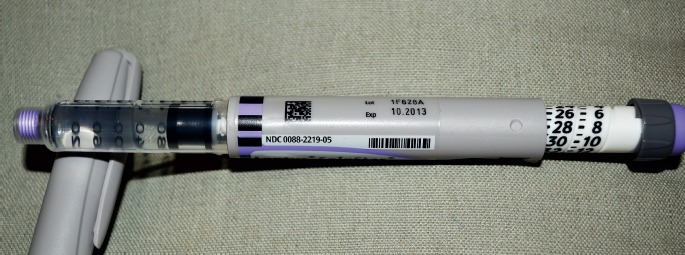
Insulin injector pen, uncapped. Left of image shows insulin filled reservoir with volume markings. Right of image shows dial and plunger. Following injection the dial returns to zero.
Insulin Infusion Pump
Insulin infusion pumps (Image 3) are programmable medical devices that contain a reservoir of rapid-acting insulin that is attached to an infusion set (plastic tubing and subcutaneous catheter site with adhesive). The pump can be programmed to deliver a specified amount of insulin across the day (basal rate) and can be manually adjusted to deliver a tailored amount of insulin at mealtime and snacktimes and to correct for hyperglycemia. The pump is worn around the clock and the reservoir and infusion set are refilled and replaced generally every two to three days. Some insulin pumps communicate directly with a continuous blood glucose monitor (see below) and even others have remote controls for patient use. There are various biomedical companies that manufacture insulin pumps. The basic operations are relatively standard across devices. A detailed description of each insulin pump is available for review (12).
Image 3:
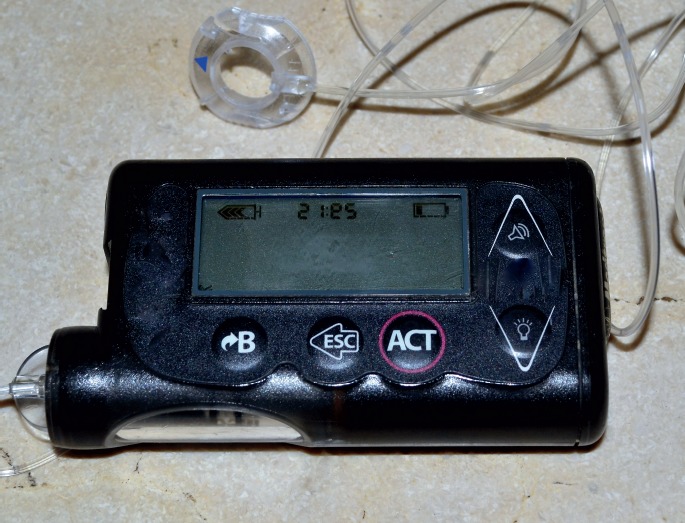
Insulin infusion pump with reservoir, tubing and insertion site connector. This is a representative insulin pump. At the center of the device is the display window showing a battery life icon (right), a digital clock and a reservoir volume indicator icon (left). Clear plastic tubing runs from the insulin reservoir (bottom left) to the ring shaped clip (top of image), which attaches to the subcutaneous catheter site that is secured to the individual. The “ACT” button is equivalent to an “enter” button. It is used to enter the various pump menus including: bolus, basal, insulin totals, alarms and settings. The arrow buttons are used to scroll through menus and commands in the device, enter blood glucose readings and to select the amount of insulin to be delivered. The “ESC” button brings the prior menu into view or reverts back to a prior action. The “B” button takes the user directly to a bolus screen.
Continuous Blood Glucose Monitor
Continuous blood glucose monitors (Image 4) are medical devices with a subcutaneous sensor that determines the glucose content of interstitial fluid. The device is worn 24 hours a day and the subcutaneous sensor must be replaced every three to seven days. The sensor transmits the glucose reading to a separate pager-sized device, an insulin pump, personal computer, or cell phone that displays the reading and sounds an alert for readings that exceed a set high or low threshold. The device determines interstitial fluid glucose levels anywhere from every one to five minutes. The benefit of the device is in the ability to follow trends across 24 hours, importantly during periods of sleep. The goal is to obtain better control of glucose levels throughout the day and night by making alterations to basal insulin administration. Unfortunately, fingerstick glucose readings with a standard glucometer are still necessary to ensure that the continuous glucose monitor reading is accurate as there is a lag time between interstitial glucose readings and equilibration with blood glucose. In the United States, the Food and Drug Administration has not approved these devices as the only means of determining blood glucose concentration. Several companies manufacture continuous glucose monitors, and each device has slight variations (13).
Image 4:

Continuous blood glucose monitor sensor and transmitter. This a representative continuous blood glucose monitor, composed of two parts: a transmitter (left side opaque portion of device) and a sensor (clear plastic with subcutaneous catheter). The sensor catheter is inserted in the subcutaneous tissue and secured with an adhesive strip. This particular device transmits blood glucose readings directly to an insulin pump.
Interrogation of Medical Technology
The medical technology used in the management of DM was created to be user-friendly for the patient with DM, in an effort to make disease management easier and increase compliance with recommendations. The physicians treating patients with DM have come to rely heavily on the information contained within these devices; so should the ME/C. The data within these devices can assist in the determination of cause and manner of death. The ME/C should learn to examine glucometers, insulin injector pens, insulin pumps, and continuous glucose monitors to aid in the evaluation of deaths associated with DM. Although these devices are easy to work with, additional support is available through online device manuals, diabetes educators, and manufacturer representatives. Several companies that manufacture insulin pumps may even request that the device be returned to them for evaluation. Depending on the preliminary circumstances of death, an expert evaluation of the device may be warranted, particularly if there is concern for homicide (14). These evaluations can be performed by the device manufacturer and a report can be requested. Take the following scenario as an example of how these devices can assist the ME/C. A 25-year-old woman with a 13-year history of type 1 diabetes, managed with an insulin pump, is found dead in her bedroom in the morning. She was last seen alive by her family the night before. The family admits that she has been more withdrawn lately and they worry that she committed suicide. Her body is brought to the ME/C office for investigation along with her glucometer and insulin pump. The ME/C assigned to investigate the death performs the autopsy, submits samples for toxicology and vitreous glucose and electrolytes analysis. They sign the death certificate as “Pending” for cause of death and consider how to determine whether the manner of death may be suicide (15). The glucometer and insulin pump are available for interrogation and may hold answers to the manner of death.
Tips for Interrogation of Insulin Pump
-
1)
Note the make and model of the device.
-
2)
Device is most likely already “on.”
-
3)
Check the status of the battery. If the battery dies the memory in the device may be lost. Have a battery available (see pump manual for type required) if device will be held by ME/C.
-
4)
Check device clock and compare with current date and time. Calculate any discrepancy between device time and real time and correct times of pertinent data points.
-
5)
Look through display window to see the volume of insulin in reservoir. Make a note of volume and current date and time.
-
6)
Assess the pump tubing for knots/kinks and verify that the adhesive insertion site on the body is intact.
-
7)
Scroll through the pump menus:
-
a.
Suspend – immediately select the option to suspend insulin delivery. This will preserve battery life and keep the data more contemporaneous with the death investigation. Unsuspend device when ready to interrogate.
-
b.
Reservoir volume – current amount and date last filled.
-
c.
Boluses – scroll through timestamped boluses and the volumes.
-
d.
Basal – evaluate typical basal insulin delivery.
-
e.
Alarms – see if any alarms occurred during the time interval of concern (low volume, low battery, no delivery).
-
f.
Glucometer readings – some devices have the patient enter glucometer reading into a bolus wizard that calculates the recommended volume of bolus. Other devices communicate directly with a continuous glucose monitor.
-
g.
Insulin totals – review insulin totals over several days/weeks.
-
h.
Thresholds/Lockouts – observe settings for maximum bolus (typically 10 units).
-
a.
-
8)
Following interrogation, turn device “off” if possible (conserve battery life, preserve memory) or suspend.
Interpretation of Insulin Pump Data
Following the interrogation, the ME/C will have one datapoint on the last known alive timeline by noting the date and time of last bolus (for meal or correction). The amount of insulin taken at that time can be noted, along with any information on alarms or overrides. The patient may have input a blood glucose level that corresponds to the time of bolus delivery; this information could also be acquired from a side-by-side interrogation of the glucometer. This information is what is most pertinent to the investigation into manner of death. The ME/C should compare the information from the device around the time of death and critically compare that with the patient's usual trends. Questions for the ME/C to ask themselves would be 1) whether the last bolus exceeded the expected amount of insulin for the correction of a given blood glucose measurement; 2) whether the day in question had a similar pattern for total insulin usage and volume of boluses; and 3) whether there were any alarms during the day in question or the days prior.
Combining the information from the scene, the autopsy, the vitreous chemistry/glucose, and the device interrogation, it may be possible to determine whether the death was most likely due to hypoglycemia from overdosage of insulin, either intentionally or not.
Tips for Interrogation of Glucometer (Capillary or Continuous)
-
1)
Note the make and model of the device.
-
2)
Turn on device.
-
3)
Check device clock and compare with current date and time. Calculate any discrepancy between device time and real time and correct times for pertinent data points.
-
4)
Scroll through prior blood glucose readings (may establish a last known alive time).
-
5)
Look at total number of tests per day on average and see mean and high and low readings over one month.
-
6)
Continuous glucose monitor will likely be “on.” Suspend the sensor (may even be alarming after death). A last known alive time may not be possible from this device.
Interpretation of Glucometer Data
This tiny device has provided a point on the last known alive timeline associated with a specific blood glucose value. This information can be used to evaluate the nature of the control of DM in the deceased and could even show that the last blood glucose reading was dangerously high or low. This information combined with the scene, autopsy and vitreous chemistry will allow a determination of the role that DM played in the death.
Tips for Evaluation of Insulin Injector Pen
-
1)
Note the types of insulin contained in pen or pens.
-
2)
Assess volume of insulin in reservoir (most pens start with total of 300 units of insulin).
-
3)
Maximum insulin dispensed per injection can range from 30 units if rapid-acting (boluses) to 80 units if slow acting (once daily).
-
4)
Contact prescribing doctor and/or pharmacy to get prescribing instructions.
-
5)
Review typical insulin dosing as described above and compare with scene investigation.
Interpretation of Information from Insulin Injector Pen
The ME/C can readily observe how much insulin has been used from each pen. Typically, one to two (long-acting and short-acting insulin) pens may be used at a time, so if the scene suggests otherwise then there may have been insulin overdosage. If the prescription date and extent of usage do not match up, then there may been insulin under or overdosage.
Conclusion
Diabetes mellitus, type 1 and 2, affects millions of Americans. The optimum management of diabetes involves medications and medical devices to improve quality of life and decrease morbidity from complications as well as mortality. The assessment of the scene of death and the medical devices associated with diabetes should not be overlooked, as there is invaluable information to be obtained that may assist the medical examiner/coroner in determining the cause and manner of death. The medical examiner/coroner should develop some degree of comfort in interrogating and examining the medical devices.
Footnotes
Ethical Approval: As per Journal Policies, ethical approval was not required for this manuscript
Statement of Human and Animal Rights: This article does not contain any studies conducted with animals or on living human subjects
Statement of Informed Consent: No identifiable personal data were presented in this manuscript
Disclosures & Declaration of Conflicts of Interest: The authors, reviewers, editors, and publication staff do not report any relevant conflicts of interest
Financial Disclosure: The authors have indicated that they do not have financial relationships to disclose that are relevant to this manuscript
References
- 1.Centers for Disease Control and Prevention. National diabetes statistics report: estimates of diabetes and its burden in the United States [Internet]. Atlanta: U.S. Department of Health and Human Services; 2014. 12 p. [Google Scholar]
- 2.American Diabetes Association. 2. Classification and diagnosis of diabetes. Diabetes Care. 2016. Jan; 39 Suppl 1: S13–22. PMID: 26696675. 10.2337/dc16-s005. [DOI] [PubMed] [Google Scholar]
- 3.American Diabetes Association. 3. Foundations of care and comprehensive medical evaluation. Diabetes Care. 2016. Jan; 39 Suppl 1: S23–35. 10.2337/dc16-s006. [DOI] [PubMed] [Google Scholar]
- 4.Nathan DM; DCCT/EDIC Research Group. The diabetes control and complications trial/epidemiology of diabetes interventions and complications study at 30 years: overview. Diabetes Care. 2013. Dec 19; 37(1): 9–16. PMID: 24356592. PMCID: PMC3867999. 10.2337/dc13-2112. [DOI] [PMC free article] [PubMed] [Google Scholar]
- 5.Intensive blood-glucose control with sulphonylureas or insulin compared with conventional treatment and risk of complications in patients with type 2 diabetes (UKPDS 33). UK Prospective Diabetes Study (UKPDS) Group. Lancet. 1998. Sep 12; 352(9131): 837–53. PMID: 9742976. 10.1016/s0140-6736(98)07019-6. [DOI] [PubMed] [Google Scholar]
- 6.Effect of intensive blood-glucose control with metformin on complications in overweight patients with type 2 diabetes (UKPDS 34). UK Prospective Diabetes Study (UKPDS) Group. Lancet. 1998. Sep 12; 352(9131): 854–65. PMID: 9742977. 10.1016/s0140-6736(98)07037-8. [DOI] [PubMed] [Google Scholar]
- 7.American Diabetes Association. 5. Glycemic targets. Diabetes Care. 2016. Jan; 39 Suppl 1: S39–46. PMID: 26696679. 10.2337/dc16-s008. [DOI] [PubMed] [Google Scholar]
- 8.American Diabetes Association. 7. Approaches to glycemic treatment. Diabetes Care. 2016. Jan; 39 Suppl 1: S52–9. PMID: 26696682. 10.2337/dc16-s010. [DOI] [PubMed] [Google Scholar]
- 9.Bailey T.S., Grunberger G., Bode B.W. et al. American Association of Clinical Endocrinologists and American College of Endocrinology 2016 outpatient glucose monitoring consensus statement. Endocr Pract. 2016. Feb; 22(2): 231–61. PMID: 26848630. 10.4158/ep151124.cs. [DOI] [PubMed] [Google Scholar]
- 10.McElwee-Malloy M. Diabetes forecast: the healthy living magazine. Alexandria (VI): American Diabetes Association; c2016. Product guide: blood glucose meters; 2016. Mar [cited 2016 Mar 31]. Available from: http://www.diabetesforecast.org/2016/mar-apr/product-guide-blood-glucose-meters.html. [Google Scholar]
- 11.Wahowiak L. Diabetes forecast: the healthy living magazine. Alexandria (VI): American Diabetes Association; c2016. Product guide: insulin pens; 2016. Mar [cited 2016 Mar 31]. Available from: http://www.diabetesforecast.org/2016/mar-apr/product-guide-insuilin-pens.html. [Google Scholar]
- 12.Scheiner G. Diabetes forecast: the healthy living magazine. Alexandria (VI): American Diabetes Association; c2016. Product guide: insulin pumps; 2016. Mar [cited 2016 Mar 31]. Available from: http://www.diabetesforecast.org/2016/mar-apr/product-guide-insulin-pumps.html. [Google Scholar]
- 13.McElwee-Malloy M. Diabetes forecast: the healthy living magazine. Alexandria (VI): American Diabetes Association; c2016. Product guide: continuous glucose monitors; 2016. Mar [cited 2016 Mar 31]. Available from: http://www.diabetesforecast.org/2016/mar-apr/product-guide-continuous-glucose-monitors.html. [Google Scholar]
- 14.Benedict B., Keyes R., Sauls F.C. The insulin pump as murder weapon: a case report. Am J Forensic Med Pathol. 2004. Jun; 25(2): 159–60. PMID: 15166770 10.1097/01.paf.0000127383.69760.72. [DOI] [PubMed] [Google Scholar]
- 15.Winston D.C. Suicide via insulin overdose in nondiabetics: the New Mexico experience. Am J Forensic Med Pathol. 2000. Sep; 21(3): 237–40. PMID: 10990283. 10.1097/00000433-200009000-00010. [DOI] [PubMed] [Google Scholar]