



Abstract
Purpose
Prior systematic reviews on yoga and diabetes have given conflicting results. They have been limited by inclusion of uncontrolled unblinded single group observational studies. No reviews are available which have used the Cochrane methodology and GRADE (Grades of Recommendation, Assessment, Development and Evaluation) approach. This meta-analysis evaluated the efficacy of yoga on glycaemia and lipids in T2DM using the Cochrane methodology and GRADE approach.
Methods
Major repositories were searched to pick randomized controlled trials involving T2DM patients receiving yoga. Primary outcome was to evaluate changes in fasting plasma glucose (FPG) and glycated haemoglobin (HbA1c). Secondary outcomes were to evaluate changes in post-prandial plasma glucose (PPG), total cholesterol (TC), triglycerides, low-density lipoprotein cholesterol (LDL-C) and high-density lipoprotein cholesterol (HDL-C). Sub-group analysis involving people undergoing structured exercise regimen (SER) versus those undergoing standard diabetes care in controls was done.
Results
Data from 13 studies involving 1440 patients were analysed. Compared to controls, individuals doing yoga had significantly lower FPG [mean difference (MD) -17.22 mg/dl (95% CI: −26.19 – −8.26 mg/dl); p < 0.01; considerable heterogeneity (CH); low certainty of evidence (LCE)], PPG [MD -27.77 mg/dl (95% CI: −35.73 – −19.81 mg/dl); p < 0.01; low heterogeneity; moderate certainty of evidence (MCE)], TC [MD -19.48 mg/dl (95% CI: −31.97 – −6.99 mg/dl); p < 0.01; CH; LCE], triglycerides [MD -12.99 mg/dl (95% CI: −23.74 – −2.25 mg/dl); p < 0.01; CH; LCE], LDL-C [MD -11.71 mg/dl (95% CI: −17.49 – −5.93 mg/dl); p < 0.01; I2 = 69% CH; LCE] and significantly higher HDL-C [MD 4.58 mg/dl (95% CI: 3.98–5.18 mg/dl); p < 0.01; low heterogeneity; MCE]. On sub-group analysis, where yoga was compared to SER, FPG was significantly lower in yoga group.
Conclusion
Yoga improves glycaemia and lipid parameters in T2DM with additional benefits seen both in people doing/not doing structured exercise.
Supplementary Information
The online version contains supplementary material available at 10.1007/s40200-021-00751-0.
Keywords: Yoga, Diabetes, Exercise, Meta-analysis
Highlights
• This meta-analysis evaluated the impact of yoga on glycaemia and dyslipidaemia in type 2 diabetes mellitus (T2DM)
• Yoga was effective in significantly reducing both fasting and post prandial plasma glucose as compared to controls.
• Yoga also effectively reduced total cholesterol, triglycerides, and LDL-cholesterol
• Additional benefits of yoga was seen in people following structured exercise regimen as well as in those following standard diabetes care
• The current evidence has some bias, heterogeneity and moderate to low certainty of evidence.
• Standardizing yoga practices and conducting large multicentric RCTs will promote and streamline yoga in T2DM
Introduction
India has the unfortunate tag of being the diabetes capital of the world. The current prevalence of type 2 diabetes mellitus (T2DM) and prediabetes in Indians is 9% and 14% respectively [1, 2]. Some unique challenges with regard to T2DM in Indians are onset of diabetes two decades earlier as compared to the western world (peak incidence of T2DM in fourth decade), higher prevalence of insulin resistance and their clinical markers, leaner phenotype [lower body mass index (BMI) at disease onset], greater central/visceral adiposity and increased underlying systemic inflammation [1, 2]. Therapeutic lifestyle interventions (diet and exercise) remain the back bone of diabetes prevention and treatment [3]. However their implementation and compliance in day to day life remains poor in India [3].
Yoga, having its roots in India, dating back to 3000 B.C. is a holistic mix of breathing exercises (pranayama) and physical postural exercises (asanas) and meditation aiming at harmonizing the body, mind, and emotions, for physical, emotional and spiritual well-being [4, 5] Yoga and yogic practices are commonly used in day-to-day life in many Indian households since many centuries. The last two decades have seen a greater interest in evaluating the role of yoga in non-communicable diseases. Beneficial impact of yoga has been documented on mental health, stress reduction, musculoskeletal and cardiovascular function [6–9]. Yoga may have a beneficial role improving compliance to therapeutic lifestyle interventions, apart from its direct impact on glycaemia [9]. Yoga is believed to have a beneficial impact on diabetes through different psycho-neuro-endocrine and immune mechanisms [5]. Yogic practices promote mindful and healthy eating, helps in controlling binge eating [4]. Yoga has ben reported to reduce stress. There are reports to suggest that yoga reduces systemic inflammation (interleukin-6), oxidative stress (malondialdehyde), insulin resistance, with favourable impact on adiponectin and leptin levels [5]. Though several systematic reviews and metanalysis have been published previously evaluating the role of yoga in diabetes care, there results have been conflicting. Most of these reviews have been limited by inclusion of uncontrolled, unblinded, single group, observational studies. No reviews are available which have used the validated Cochrane methodology and GRADE (Grades of Recommendation, Assessment, Development and Evaluation) approach for critically analysing the results of different randomized controlled trials (RCTs) on yoga in diabetes care. Hence, the main objective of this meta-analysis was to examine the impact of yoga on glycaemic control and blood lipid parameters in individuals living with T2DM using the Cochrane and GRADE methodology.
Methods
The meta-analysis was carried out according to the recommendations of the Cochrane Handbook for Systematic Reviews of Interventions [10]. The predefined protocol has been registered with PROSPERO having registration number CRD42020183698. RCTs published till March 2020 were considered for this meta-analysis. This meta-analysis has been reported in accordance with the Preferred Reporting Items for Systematic Reviews and Meta-Analyses (PRISMA), the filled checklist of which can be found at the end of the manuscript [11]. Since ethical approval already exists for the individual studies included in the meta-analysis, no separate approval was required for this study.
The PICOS criteria was used to screen and select the studies for this meta-analysis with patients (P) being people living with T2DM; intervention (I) being yoga over the background of standard diabetes care; control (C) being patients with T2DM on standard diabetes care but not doing yoga; outcomes (O) being evaluated were impact on glycaemic control and blood lipid parameters. Only patients with T2DM were considered. Patients with other forms of diabetes were excluded. Also people with prediabetes and gestational diabetes were excluded. Studies were included in this meta-analysis which had at least 2 treatment arms/groups, with one of the groups having patients with T2DM receiving yoga therapy on the background standard care and the other arm/group being a placebo/non-intervention/simple exercise group instead of yoga, who also continued to receive background standard care for diabetes. This meta-analysis intended to evaluate the efficacy of yoga in T2DM. A sub-group analysis involving people undergoing structured exercise regimen (SER) versus those undergoing standard diabetes care (SDC) in the control arm was also performed.
The primary outcome was to evaluate the changes in fasting plasma glucose (FPG) and glycated haemoglobin (HbA1c). The secondary outcomes were to evaluate alterations in post-prandial plasma glucose (PPG), total cholesterol (TC), triglycerides, low-density lipoprotein cholesterol (LDL-C) and high-density lipoprotein cholesterol (HDL-C). RCTs whose outcomes evaluated at least one of the primary end-points/outcome or at least 2 secondary end-points/outcomes were included in the meta-analysis.
Search method for identification of studies
A detailed electronic databases of Medline (Via PubMed), Embase (via Ovid SP), Cochrane central register of controlled trials (CENTRAL) (for trials only), ctri.nic.in, clinicaltrials.gov, global health and Google scholar were searched using a Boolean search strategy: ((yoga) OR OR (yog*) OR (pranayam*) OR (asana*)) AND ((diabetes) OR (“diabetes mellitus”)).
Data extraction and study selection
Data extraction was carried out independently by two authors using standard data extraction forms. In cases where more than one publication of a single study group were found, results were grouped together and relevant data from each report were used in the analyses. Data on the primary and secondary outcomes as stated above was extracted. Patient characteristics (including demographic information and comorbidities) from the different studies included and excluded from the analysis were noted in a tabular form (Tables 1,2). All disagreements were resolved by the fourth and fifth authors.
Table 1.
Patients and yoga intervention characteristics of randomized controlled trials evaluated in this meta-analysis
| Study details | Number of patients in yoga & control groups | Nature & types of Yoga | Duration of intervention (yoga) | Total sessions (days/weeks/months) | Outcomes evaluated in the study | |
|---|---|---|---|---|---|---|
| (1) Popli U et al., Delhi, India [12] | y = 80, c = 50 | (1) kapalabathi breathing, (2) sun salutation (surya namaskar), (3) cobra pose (bhujangasana), (4) locust pose (shalabhasana), (5) seated-forward bend (paschimottasana), (6) tree pose (tadasana), (7) triangle pose (trikonasana), (8) pavan muktasana, (9) matsyasana, (10) halasana, (11) naukasana, (12) mandukasana, and (13) mayurasana. | Under supervision of qualified yoga trainer for first 1 month followed by independently for total of 12 months | 1 h daily, 5 days per week, for the duration, no intervention in control group | The primary outcome measure was fasting glucose (FBS), which was collected monthly. Postprandial glucose (PBS) and glycated hemoglobin (HbA1c) were tested every 3 monthly (authors has mistakenly written three times a month) | |
| (2) Hegde SV et al., Mangalore, India [13] | y = 20, c(sham yoga or stretching exercise) = 20 | Yoga group | 3 months | 75–90 min at a maximum, 6 days a week in both groups | Primary outcome measures were malondialdehyde, reduced glutathione, vitamin C, and superoxide dismutase. Secondary outcomes comprised fasting plasma glucose, glycosylated hemoglobin (HbA1c), waist circumference, body mass index (BMI), and blood pressure | |
| Asana | Duration (min) | |||||
| Tadasana (mountain) | 2 | |||||
| Padahastasana (standing forward bend) | 3 | |||||
| Vriksasana (tree) | 3 | |||||
| Trikonasana (triangle) | 3 | |||||
| Parsvottanasana (lateral forward stretch) | 3 | |||||
| Vajrasana (thunderbolt) | 3 | |||||
| Vakrasana (seated twist) | 4 | |||||
| Gomukhasana (cow-face pose) | 4 | |||||
| Paschimottasana (seated forward bend) | 4 | |||||
| Uttanapadasana (raised-leg pose) | 4 | |||||
| Pavana muktasana (wind-releasing pose) | 5 | |||||
| Bhujangasana (cobra) | 3 | |||||
| Salabhasana (locust) | 3 | |||||
| Dhanurasana (bow) | 3 | |||||
| Viparita karani (inverted-action, or supported shoulder stand, pose) | 4 | |||||
| Sitkari pranayama (teeth hissing) | 8 | |||||
| Brahmari pranayama (bee breath) | 6 | |||||
| Nadi shodhana (alternate-nostril breath) | 10 | |||||
| Savasana (corpse) | 10 | |||||
| Sham yoga group | ||||||
| Activity | Duration (min) | |||||
| Chair exercises | ||||||
| Neck stretches | 5 | |||||
| Shoulder shrugs | 3 | |||||
| Shoulder circles | 3 | |||||
| Seated leg raise | 3 | |||||
| Knee lifts | 3 | |||||
| Standing exercises | ||||||
| Hip rotations | 4 | |||||
| Knee rotations | 4 | |||||
| Chest expansions | 3 | |||||
| Backward bend | 3 | |||||
| Forward bend | 5 | |||||
| Side stretch | 3 | |||||
| Heel walk | 3 | |||||
| Toe walk | 3 | |||||
| Slow walking | 20 | |||||
| (3) Skoro-Kondza L et al. London, UK [14] |
y = 29, c = 30 |
Classes were run by an experienced yoga teacher who used judgement to adapt the exercises to the needs and abilities of the participants. The exercises focused primarily on breathing and relaxation (pranayama) but also included gentle stretching and postures (asanas). |
12 weeks |
Twice-weekly 90-min yoga class (total 24). Control group was waiting list for yoga class. |
Primary outcome - HbA1c. Secondary outcome measures - (a) blood glucose levels before and after each yoga session; (b) UKPDS cardiovascular risk score (a composite of blood pressure, smoking status, lipid ratio, presence of atrial fibrillation, and HbA1c); (c) BMI; (d) waist circumference; (e) ADDQoL; (f) MYMOP; (g) self-efficacy; (h) attendance Measures were taken at baseline, immediately on completion of the yoga class (or control period), and six months later |
|
| (4) Jyotsna et al., New Delhi, India [15–17] |
n = 120 y = 60 c = 60 |
Comprehensive yogic breathing program with Sudarshan Kriya yoga plus standard therapy for diabetes versus standard therapy only for control group The SKY group patients underwent a comprehensive yogic breathing program for 3 days. This course included yogic movements and postures (asanas), relaxation practices, meditation, group processes and discussion of stress-relieving principles. Patients underwent 1 h of long group breathing technique, which included three stages of Pranayam, three rounds of 20 each of Bhastrika, three times Om chanting and Sudarshan Kriya (long kriya) followed by rest in supine position on the first and second day. On the third day, they were taught the short breathing technique, which included three stages of Pranayam, three rounds of 20 each of Bhastrika, three times Om chanting and Sudarshan Kriya (short kriya) followed by rest in supine position. This process took a total of 25–35 min and was learnt under the guidance of a certified teacher. (As per first article - Jyotsna 2012 et al.) |
6 months |
SKY group continued the standard treatment and practice of short kriya daily at home. To ensure home practice, they were asked to fill a follow-up book in which they marked the days on which they did SKY and got it countersigned by a relative or attendant. They were required to come weekly for group Sudarshan Kriya Yoga and Pranayam (long kriya) to a center in the hospital and get the follow-up book signed by the yoga teacher each time they attended. |
Glycemic control (FPG, PPBG, HBA1C), cardiac autonomic function testing, WHO BREF QOL. | |
| (5) Gordon et al. Havana, Cuba [18] |
y = 77, conventional PT – 77, c = 77 |
Hatha yoga and conventional PT exercise were trained for 24 weeks in basic exercise techniques, diabetes education and instructions Yoga class was designed by a certified Hatha yoga instructor attend one yoga class weekly was conducted for 24 weeks along with home exercise. Each yoga session consisted of 20 min of pranayamas (breath-control exercises), 25 min of dynamic warm-up exercises, 60 min of asanas (yogic postures), and 15 min of supine relaxation in savasana (corpse pose). The conventional PT exercises consisted of one class (2 h) per week for 24 weeks along with home exercise. The conventional PT sessions consisted of 15 min of warm up exercises, 30 min of aerobic walking on an outdoor 400-m track, 20 min of body flexibility exercises, 20 min of aerobic dance, 25 min of games and 10 min of warm down exercises. Daily home exercise 3–4 times per week for 1 h in the same Rate of Perceived Exertion was encouraged for subjects in both the Hatha yoga and conventional PT exercise classes. |
24 weeks |
1 class per week for 24 weeks Daily home exercise 3–4 times per week for 1 h in the same Rate of Perceived Exertion was encouraged for subjects in both the Hatha yoga and conventional PT exercise classes. |
Fasting blood glucose (FBG), serum total cholesterol (TC), triglycerides, low-density lipoprotein (LDL), very low-density lipoproteins (VLDL) and high-density lipoprotein (HDL). The oxidative stress indicators were (malondialdehyde – MDA, protein oxidation – POX, phospholipase A2 – PLA2 activity) and oxidative status [superoxide dismutase (SOD) and catalase activities]. All were measured at 0, 3 and 6 months. |
|
| (6) Keerthi GS et al. Puducherry, India.20 |
y = 62, c = 62 |
Yoga therapy module | Duration of practice (in minutes) | 12 weeks | Yoga therapy as per the module formulated in accordance with guidelines of Morarji Desai National Institute of Yoga (MDNIY) for three days per week for 12 weeks in Advanced centre for yoga, JIPMER. Each session lasted for 45 min. | Flanagan QoL scale, IDRS questionnaire, Fasting Plasma Glucose (FPG) and fasting insulin levels and HOMA-IR. |
| Sukshma vyayama/ loosening exercises | 5 | |||||
|
Neck movements Hands stretch breathing Elbow flexion and extension Wrist movements Waist rotation Knee movements Leg stretch and movements Tadasana breathing Kati chakrasana breathing |
||||||
|
Suryanamaskara 3 rounds with breathing |
3 | |||||
| Asana | 15 | |||||
| Padahastasana Konasana Vakrasana Ardhamatsyendrasana Paschimottanasana Shalabhasana Dhanurasana Pavanamuktasana Ardha Halasana Sarala Matsyasana | ||||||
| Pranayama | 10 | |||||
| Nadi Shodhana Pranayama (9 rounds) Bhramari Pranayama (9 rounds) Chandra Nadi Pranayama (9 rounds) | ||||||
| Meditation | 2 | |||||
|
A kara (3 rounds) U kara (3 rounds) M kara (3 rounds) A-U-M kara (3 rounds) |
||||||
| Relaxation | 10 | |||||
|
Shavasana Yoga Nidra & A-U-M Chanting |
||||||
| Total Duration of Practice | 45 | |||||
| Control arm advised to take up walking for 45 min duration three times/week for 12 weeks. Their adherence to treatment was followed up by regular phone contact and with their follow up visits to OPD. | ||||||
| (7) Datey P et al. Bhopal, India [19]. |
y = 37 r + y = 38 c = 37 |
Asana | Amount | 3 months | 60 min daily for 7 days a week for 3 months | The FBS and postprandial blood sugar (PPBS) levels were measured every 15 days beginning on day 1, and the hemoglobin A1c (HbA1c) levels were de- termined before and after the intervention |
| Flexion exercises | Once – 10 min | |||||
| Surya Namaskar | 2 rounds −15 min | |||||
| Cyclic meditation | once | |||||
| Pranayama | ||||||
| Alternate nostril | 2 lots of 10 rounds | |||||
| Bhramari | 2 lots of 10 rounds | |||||
| Vocalize A, U, M | 2 rounds twice daily | |||||
|
The pranayama-related techniques were practiced by the participants each evening before going to bed. Ayurveda herbal juices in additional to yoga was given in one of the intervention groups. The control group did not receive any intervention. | ||||||
| (8) Bock BC et al. Providence, USA [20]. |
y = 24 c = 24 |
Each class consisted of: guided meditation and breath-work, active and passive asanas (including standing, sitting, twists and restorative postures), and guided relaxation. Participants were encouraged to practice yoga at home and workbooks, props and a DVD were provided to aid home practice. Standard Exercise (SE) consisted of a 60-min session twice weekly for 12 weeks to match the dose and duration of the yoga condition. Sessions were held at a gym-type facility that included an indoor walking track, treadmills, ellipticals, and stationary bicycles. Each session included a 5-min warm-up (i.e. stretches), 50 min of moderate-intensity exercise and a 5-min cool-down. |
12 week | Two 60-min sessions weekly for 12 weeks |
Primary outcomes assessed feasibility and acceptability, including enrolment rates, attendance, study completion, and participant satisfaction. Secondary outcomes included HbA1c, physical activity, and measures of diabetes-related emotional distress, self-care and quality of life (QOL). Assessments were conducted at baseline, end of treatment, 6-months and 9-months post-enrolment. |
|
| (9) Sreedevi A. et al. Njarackal, Ernakulam district, Kerala, India [21] |
y = 32 p = 33 c = 35 |
The 60 min sessions consisted of 25 min-Surya namaskara-12 steps, 5–7 min Deep relaxation-Muscle relaxation technique, 15 min Asana or yoga postures. The postures consisted of Pava- namuktasana in the supine position, Bhujangasana and Shalabhasana in the prone position, Ardhamatsyaendrasana in the sitting position as recommended by yoga experts for diabetes. This was followed by 15 min of pranayama. On the other days the women were instructed to practice at home and maintain a daily log. Each peer mentor would visit 13–14 women with diabetes. A face to face meeting with the woman with diabetes in a week for about 45–60 min on assistance in applying disease management or prevention plans in daily life, providing emotional and social support and proactive flexible ongoing support. This was followed up by a telephone call in the same week. A monthly review of the activities was also undertaken by the principal investigator. The control group was given the usual standard of care including continuing oral hypoglycaemic drugs, advise on diabetic diet and exercise for at least 10 min a day to a level of 150 min/week. |
12 weeks | 60 min on two days a week. |
Primary outcomes studied were fasting plasma glucose, HbA1c, quality of life and pharmacological adherence. Adherence to drugs was measured by Morisky Medication adherence scale (MMAS–8) in local language. The secondary outcomes studied were BMI and waist hip ratio (WHR), blood pressure and total cholesterol (the last two were added later as funds became available) |
|
|
(10) Bairy S et al. Vijayawada, India [22]. |
y = 78 c = 83 |
3- month residential naturopathy intervention program comprising diet, yoga, hydriatic treatments, massage, and didactic and interactive lectures on lifestyle modification and type 2 diabetes mellitus self- management. Patients underwent a structured routine which involved physical activity, yoga program with asanas, pranayama, meditation and relaxation, calorie restriction, and salt-restricted diet. The diet prescribed was a low glycemic index, low-salt high-fiber plant-based diet containing whole grains, legumes, vegetables, and fruits with no added oil, sugar, or salt. They also underwent short intermittent juice fasting with calorie restriction over 3–4 days a month. They had to undergo a structured routine of hydriatic treatments such as hip bath, immersion bath, jets, sprays, douche, and mud and steam bath apart from partial and full-body Swedish massages. The control group received conventional antidiabetic treatment as per the standard guidelines. They also received a diabetes self-management program by a diabetes educator during their hospital visits. |
3 months | 3 months residential program, details and duration of yoga session not available. |
Primary outcome – HbA1c, Secondary outcome – Fasting blood glucose, postprandial blood glucose, Medication score using Diabetes Medication Satisfaction Tool, Parenteral medication (insulin) score. Assessment done at baseline, 3, 6, and 12 months |
|
|
(11) Vaishali K, et al. Mangalore, India [23]. |
y = 27 c = 30 |
Vajrasana | 30 s | 12 weeks | 45–60 min daily for 6 days a week over 12 weeks | Glycosylated 22ehaviour22n, Fasting glucose level, and Serum lipid profile at baseline and at 12 weeks |
| Supthavajrasana | 30 s | |||||
| Tadasana | 10 counts for 2 min | |||||
| Padahastasana | 1 min for each side | |||||
| Trikonasana | 1 min for each side | |||||
| Paravakonasana | 1 min for each side | |||||
| Trikonasana | 1 min for each side | |||||
| Vakrasana | 1 min for each side | |||||
| Pavanamukthasana | 1 min for each side | |||||
| Bujangasana | 1 min for each side | |||||
| Shalabasana | 1 min for each side | |||||
| Ujjayi Pranayama | 4–5 min | |||||
| Anuloma Viloma Pranayama | 4–5 min | |||||
| Shavasana | 10–15 min | |||||
| Both the groups received advice and ed- ucational leaflets on maintaining a general healthy lifestyle and regular physical exercise along with conventional hypoglycemic medications. For every one month, the adherence to the lifestyle modification was confirmed through direct interview method. | ||||||
| (12) McDermott KA et al. Bangalore, India [24]. |
y = 20 c = 18 |
1. Didactics—10 min Diabetes causes, complications and lifestyle factors Principles, philosophy, and practices related to a yoga based lifestyle program Stress response Maladaptive 23ehaviour and 23ehaviour change Emotion and coping 2. Pranayama (Breathing exercises)—6 min Hands stretch breathing Ankle stretch breathing Tiger breathing Rabbit breathing 3. Loosening exercises (any 3)—10 min Jogging Forward, backward, side bending Twisting Pavanamuktasana kriya (Supine knees to chest) Surya namaskara (3 sun salutations) 4. Standing asana (any 3)—8 min Padahasthasana (Foot hand) Ardhachakrasana (Half moon) Trikonasana (Triangle) Parshvakonasana (Side angle) Ardhakati chakrasana (Half wheel) Vrikshasana (Tree) 5. Supine asana—8 min Sarvangasana (Shoulder stand) Halasana (Plough) Matsyasana (Fish) Pavanamuktasana (Supine knee chest position) Naukasana (Boat) 6. Prone asana—8 min Bhujangasana I, II, III (Cobra) Shalabhasana – alternate legs, both (Locust) Dhanurasana (Bow) Navasana (Boat) 7. Sitting asana—8 min Paschimottanasana (Seated forward bend) Vakrasana/ardhamatsyendrasana (Half twist) Ustrasana (Camel) Sashankasana (Rabbit) 8. Relaxation Shavasana (Corpse) with guided scan—6 min 9. Chanting ‘OM’ monosyllables, primordial sounds in Indian philosophy Both yoga and the control group attended the same day long (eight hour) group counselling session on lifestyle changes with their spouses. The control group was asked to do 30 min of walking plus breaks for rest on three to six days per week during each of the eight weeks of the study. Including rest breaks, the total time was approximately equivalent to the 75 min yoga class. |
8 weeks |
At least three, and up to six, yoga classes per week over the eight weeks of the study. Yoga classes were offered on six days of each week. Each class lasted 75 min Participants were asked to do a home practice if they were unable to attend at least three classes in a given week and were asked to keep track of each home practice in a daily diary. |
Primary outcomes included: changes in BMI, waist circumference, fasting blood glucose, postprandial blood glucose, insulin, insulin resistance, blood pressure, and cholesterol. We also looked at measures of psychological well-being including changes in depression, anxiety, positive and negative affect and perceived stress. | |
| (13) Shantakumari N. et al. Trivandrum, India [25]. |
Y = 50 c = 50 |
Yoga | Time (mins) | 3 months |
The experimental group was taught a series of yoga postures in groups of 25 patients each. They were instructed to practise them daily for 1 h duration and were asked to record the number of minutes they engaged in yoga per day. At the end of 2 weeks of supervised yogic training each subject was given advice on ongoing medical treatment and was given a booklet illustrating personalized yoga program to practice regularly at home. |
BMI, W/H circumference and lipid profile of all the participants were measured at baseline and at the end of 3 months. |
| Asanas (body postures) | 30–35 | |||||
| Suryanamaskaram (sun salutation) | 5 | |||||
| Yoga Mudrasana (psychic union pose) | 2 | |||||
| Vajrasana (thunderbolt pose) | 2 | |||||
| Vakrasana (twisted pose) | 2 | |||||
| Paschimottasana (seated forward bend) | 2 | |||||
| Pavanamuktasana (wind relieving pose) | 2 | |||||
| Sashankasana (hare pose) | 2 | |||||
| Ushtrasana (camel pose) | 2 | |||||
| Bhujangasan (cobra pose) | 2 | |||||
| Dhanurasana (bow pose) | 2 | |||||
| Arthakatichakrasana (lateral arc pose) | 2 | |||||
| Parivatha trilokasanaan (revolved triangle pose) | 2 | |||||
| Shavasana (corpse pose) | 5 | |||||
| Pranayama (breathing exercises) | 10 | |||||
| Ujjayi pranayama | 5 repeats | |||||
| Anuloma viloma | 10–15 repeats | |||||
| Alternate Kapalapathi pranayama | 5 repeats | |||||
| Suryabhedha pranayama | 5 repeats | |||||
| Meditation | 15 | |||||
| One-one meditation | 5 | |||||
| Breath counting meditation | 5 | |||||
| Thought counting meditation | 5 | |||||
y yoga, c control, PT Physical exercise therapy, r = rasahara (ayurvedic juices), p = peer support
Table 2.
Patients and yoga intervention characteristics of randomized controlled trials excluded from this meta-analysis
| Study details | Number of patients in yoga & control groups | Nature & types of Yoga | Duration of intervention (yoga) | Outcomes evaluated in the study | Reasons for exclusion from the meta-analysis |
|---|---|---|---|---|---|
|
(1) Ebrahimi M et al. Semnan, Iran [26]. |
y = 15 a = 13 c = 11 |
1 Pawanmuktasana – 10 min 2. Salabhasana, virabhadrasana, Trikonasana, Upavistha Konasana, vrikshasana, Padahastasana, uttanasana, vajrasana, vakrasana, gomukhasana, paschimottanasana, uttanpadasana, bhujangasana, salabhasana, dhanurasana, viparita karani – 30 min 3. Surya namaskar – 20 min 4 Sitkari and bhramari pranayama – 15 min 5.Nadi shodhana, kapalbhati, and Shavasana – 10 min 6. Yoga nidra – 5 min Aerobic exercise included running on a treadmill. For first four weeks, exercise performed for 25 min with 60–65% of the maximum heart rate reserve (MHRR). During second four weeks, time of exercise was 30 min with an intensity 60–65% of the MHRR, and for third four weeks, time increased to 35 min and intensity raised up to 70–75% of the MHRR. The calculation of the exercise intensity was done using Karvonen formula. |
12 weeks 3 sessions every week (90 min) |
Pittsburgh Sleep Quality Index (PSQI) | None of the primary and secondary outcomes were analysed. |
|
(3) Sharma R et al. Gaya district of Bihar [27] |
B1 (lifestyle modification and Yoga along with allopathic medication) = 13 B2 (Ayurveda medication, lifestyle modification and Yoga along with allopathic medication) = 2529 Cohort A1 and A2 included prediabetics only = 502 |
Yogasana Surya Namaskar, Tadasana, Katichakrasana, Sarvangasana, Halasana, Matsyasana, Ushtrasana, Gomukhasana, Ardha Matsyendrasana, Mandukasana, Paschimottanasana, Pawanmuktaasana, Bhujangasana, Shalabhasana, Dhanurasana, Vajrasana, Shavasana Pranayama Nadi Shodhana, Suryabhedi, Bhastrika Kriya Kunjal, Agnisara Kapalabhati, |
6 months |
1. FBS and PPBS at baseline and the 6th month 2. Subjective symptoms of diabetes such as polyuria, polydipsia, polyphagia, weakness, non-healing ulcer and blurred vision of the individual patients were measured on following scoring: Absent: 0 Mild: 1 Moderate: 2 Severe: 3 |
Randomisation strategy not clear. Control group not receiving yoga absent in the study |
|
(4) Sreedevi A et al. Njarackal, Ernakulam district, Kerala, India [28] |
y = 31 p = 26 c = 26 |
The 60 min sessions consisted of 25 min-Surya namaskara-12 steps, 5–7 min Deep relaxation-Muscle relaxation technique, 15 min Asana or yoga postures. The postures consisted of Pava- namuktasana in the supine position, Bhujangasana and Shalabhasana in the prone position, Ardhamatsyaendrasana in the sitting position as recommended by yoga experts for diabetes. This was followed by 15 min of pranayama. On the other days the women were instructed to practice at home and maintain a daily log. Each peer mentor would visit 13–14 women with diabetes. A face to face meeting with the woman with diabetes in a week for about 45–60 min on assistance in applying disease management or prevention plans in daily life, providing emotional and social support and proactive flexible ongoing support. This was followed up by a telephone call in the same week. A monthly review of the activities was also undertaken by the principal investigator. The control group was given the usual standard of care including continuing oral hypoglycaemic drugs, advise on diabetic diet and exercise for at least 10 min a day to a level of 150 min/week. |
12 weeks | QOL was measured by the widely used WHOQOL-BREF validated in the local language |
Another paper from the same group elaborating on the primary outcomes (FPG, HbA1c) has already been included (vide supra) This paper exclusively provides data on impact of yoga on different aspects of quality of life (QOL) only, and hence excluded |
|
(5) Nagarathna R. et al. India [29] |
N = 694 | The practices (Diabetes Yoga protocol) were taught by a certified Yoga instructor volunteers in nine day camps (2 h daily) in their respective villages or wards. Subsequently, they were asked to continue the practices daily (one hour) at home, through the use of DVDs. Weekly follow up classes were conducted at the same venues for three months. | 3 months | Fasting blood glucose, glycated hemoglobin (HbA1c), total cholesterol, triglycerides, LDL, VLDL, and HDL | Not an RCT, no control group |
y = yoga, c = control, a = aerobic exercise; RCT Randomized controlled trial, LDL Low density lipoprotein, HDL High density lipoprotein, VLDL Very low density lipoprotein
Assessment of risk of bias in included studies
Three authors independently assessed the risk of bias using the risk of bias assessment tool in Review Manager (Revman) Version 5.3 (The Cochrane Collaboration, Oxford, UK 2014) software. The following points were taken into consideration like whether there was adequate sequence generation (selection bias). We also looked into whether the allocation was adequately concealed (selection bias), whether knowledge of the allocated interventions adequately prevented during the study among the study investigators, participants, personnel (performance bias) and outcome assessors (detection bias) and whether incomplete outcome data adequately addressed (attrition bias). We specifically looked for whether the reports were free of suggestion of selective outcome reporting (reporting bias). Lastly we looked for whether the study apparently free of other problems that could put it at a risk of bias, like involvement of pharmaceutical industry (other bias). Any disagreements were resolved by the fourth and fifth author.
Measures of treatment effect
Since all the primary and secondary outcomes of this study were continuous variables, the outcomes were expressed as mean differences (MD). Conventional units were used for analysis, and all studies reporting results in SI units were converted to conventional units for analysis. RevMan 5.3 was used for comparing MD of the different primary and secondary outcomes between the yoga and the control groups of the included studies.
Assessment of heterogeneity
Heterogeneity was initially assessed by studying the forest plot generated for the primary and secondary outcomes. Subsequently heterogeneity was analysed using a Chi2 test on N-1 degrees of freedom, with an alpha of 0.05 used for statistical significance and with the I2 test [10]. The interpretation of I2 values is as follows: 0% to 40%: might not be important; 30% to 60%: may represent moderate heterogeneity; 50% to 90%: may represent substantial heterogeneity; 75% to 100%: considerable heterogeneity. The importance of the observed value of I2 depends on the magnitude and direction of treatment effects and the strength of the evidence for heterogeneity (e.g. p value from the Chi2 test, or a confidence interval for I2) [11].
Grading of the results
An overall grading of the evidence related to each of the primary and secondary outcomes of the meta-analysis was done using the GRADE approach [30]. The GRADE approach defines the quality of a body of evidence as the extent to which one can be confident that an estimate of effect or association is close to the true quantity of specific interest. The quality of a body of evidence involves consideration of within-trial risk of bias (methodological quality), directness of evidence, heterogeneity, precision of effect estimates and risk of publication bias [30]. The GRADEpro Guideline Development Tool (GDT) software (McMaster University and Evidence Prime Inc., 2015) was used to create the Summary of Findings (SoF) table in this meta-analysis (Table 3).
Table 3.
Summary of findings highlighting the impact of yoga on glycemia and lipid parameters in type-2 diabetes
| Outcomes | Anticipated absolute effects* (95% CI) | № of participants (studies) | Certainty of the evidence (GRADE) | |
|---|---|---|---|---|
| Risk with Control | Risk with Yoga | |||
| Fasting Glucose | The mean fasting Glucose was 162.87 mg/dl |
MD 17.22 mg/dl lower (26.19 lower to 8.26 lower) |
1002 (11 studies) |
⨁⨁◯◯ LOW a,b |
| Glycated Hemoglobin (HbA1c%) | The mean hbA1c was 9.22% |
MD 0.32% lower (0.79 lower to 0.16 higher) |
751 (9 studies) |
⨁⨁◯◯ LOW a,c |
| 2 h Postprandial Glucose | The mean 2 h Postprandial Glucose was 258.43 mg/dl |
MD 27.77 mg/dl lower (35.73 lower to 19.81 lower) |
523 (5 studies) |
⨁⨁⨁◯ MODERATE a |
| Total Cholesterol | The mean total Cholesterol was 197.22 mg/dl |
MD 19.48 mg/dl lower (31.97 lower to 6.99 lower) |
416 (5 studies) |
⨁⨁◯◯ LOW a,d |
| Triglycerides | The mean triglycerides was 203.08 mg/dl |
MD 12.99 mg/dl lower (23.74 lower to 2.25 lower) |
349 (4 studies) |
⨁⨁◯◯ LOW a,e |
| Low density lipoprotein (LDL) Cholesterol | The mean LDL Cholesterol was 121.93 mg/dl |
MD 11.71 mg/dl lower (17.49 lower to 5.93 lower) |
349 (4 studies) |
⨁⨁◯◯ LOW a,f |
| High density lipoprotein (HDL) Cholesterol | The mean HDL Cholesterol was 40.79 mg/dl |
MD 4.58 mg/dl higher (4.16 higher to 5.00 higher) |
157 (2 studies) |
⨁⨁⨁◯ MODERATE a |
*The risk in the intervention group (and its 95% confidence interval) is based on the assumed risk in the comparison group and the relative effect of the intervention (and its 95% CI)
CI: Confidence interval; MD: Mean difference; Intervention: Yoga; Comparison: Control
GRADE Working Group grades of evidenceHigh certainty: We are very confident that the true effect lies close to that of the estimate of the effectModerate certainty: We are moderately confident in the effect estimate: The true effect is likely to be close to the estimate of the effect, but there is a possibility that it is substantially differentLow certainty: Our confidence in the effect estimate is limited: The true effect may be substantially different from the estimate of the effectVery low certainty: We have very little confidence in the effect estimate: The true effect is likely to be substantially different from the estimate of effect
Explanations
a. 50% of the studies had high risk of bias with regard to performance bias and detection bias, see Figure-2
b. Due to large variation in effect, confidence intervals do not overlap, P value for heterogeneity is <0.01 and I2 is 94% (Figure-4)
c. Due to large variation in effect, confidence intervals do not overlap, P value for heterogeneity is <0.01 and I2 is 97% (Figure-5)
d. Due to large variation in effect, confidence intervals do not overlap, P value for heterogeneity is <0.01 and I2 is 91% (Figure-7)
e. Due to large variation in effect, confidence intervals do not overlap, P value for heterogeneity is <0.01 and I2 is 88% (Figure-8)
f. Due to large variation in effect, confidence intervals do not overlap, P value for heterogeneity is 0.02 and I2 is 69% (Figure-9)
Data synthesis
Data was pooled as random effect model for the analysis of primary and secondary outcomes. The outcomes were expressed as 95% confidence intervals (95%CI). Forrest plots were plotted with left side of the graph favouring yoga and right side of the graph favouring control using RevMan 5.3 software. p < 0.05 was considered statistically significant.
Results
A total of 278 different articles were found after the initial search. Following screening of the titles, abstracts, followed by full-texts, the search was reduced down to 19 studies (Figure 1) [12–24, 31]. One RCT had resulted in 3 publications (Jyotsna VP et al), and hence they were considered together as one for this meta-analysis [15–17]. Hence twelve studies were included in the meta-analysis as they fulfilled the primary outcome of the analysis [16–18, and, 13-15, 18-26]. One additional study was included in the meta-analysis as they fulfilled the criteria of more than 2 secondary outcomes being analysed in it, although it did not fulfil any of the primary outcomes [25]. Hence data from 13 studies involving 1440 patients were analysed. Of the 13 studies included, in 3 studies (Hegde et al., Gordon et al. and Bock et al) the control group underwent SER [13, 18, 20]. For these 3 studies, a sub-group analysis (SER sub-group) has been done for all the primary and secondary outcomes to evaluate the impact of yoga vs SER. In the remaining 10 studies, the control group did not undergo any SER and hence were considered as SDC arm of the sub-group analysis.
Fig. 1.

Flowchart elaborating on study retrieval and inclusion in the meta-analysis. RCT: randomized controlled trial
Four studies were excluded from this meta-analysis [26–29]. Two studies were excluded as they did not fulfil the primary or secondary outcome criteria [26, 28]. In another study, a control group not practising yoga was missing [27]. One among them did not assess any of the primary or secondary outcomes [29]. It was however continuation of an RCT already included in the meta-analysis [21]. The patient characteristics, their age and disease profile in the different studies which have been included in the metanalysis have been elaborated in Table 1. The details of the studies which have been excluded, and the reasons for exclusion have been elaborated in table 2. Details of the intervention (type of yoga) and control conditions have been provided in Table 1. The mean duration of follow-up in the 13 studies included in the meta-analysis was 17.31 ± 8.16 weeks (Table 1).
Risk of bias in the included studies
The summaries of risk of bias of the 13 studies included in the meta-analysis have been elaborated in Fig. 2 and Fig. 3. Random sequence generation was judged to be at low risk of bias in 6 studies (46.15%). Allocation concealment was judged to be at low risk of bias in 9 studies (69.23%). Performance bias (blinding of participants and investigators) was judged to be at low risk of bias in 4 studies (30.77%). Detection bias (blinding of outcome assessors) was judged to be at low risk of bias in 4 studies (30.77%). Attrition bias was judged to be at low risk of bias in 12 studies (92.31%). Reporting bias was judged to be at low risk of bias in 12 studies (92.31%). Source of funding, especially pharmaceutical and conflict of interests were looked into the “other bias” section. Other bias was judged to be at low risk in 12 studies (92.31%) (Figs. 2 and 3).
Fig. 2.

Risk of bias graph: review authors’ judgements about each risk of bias item presented as percentages across all included studies
Fig. 3.
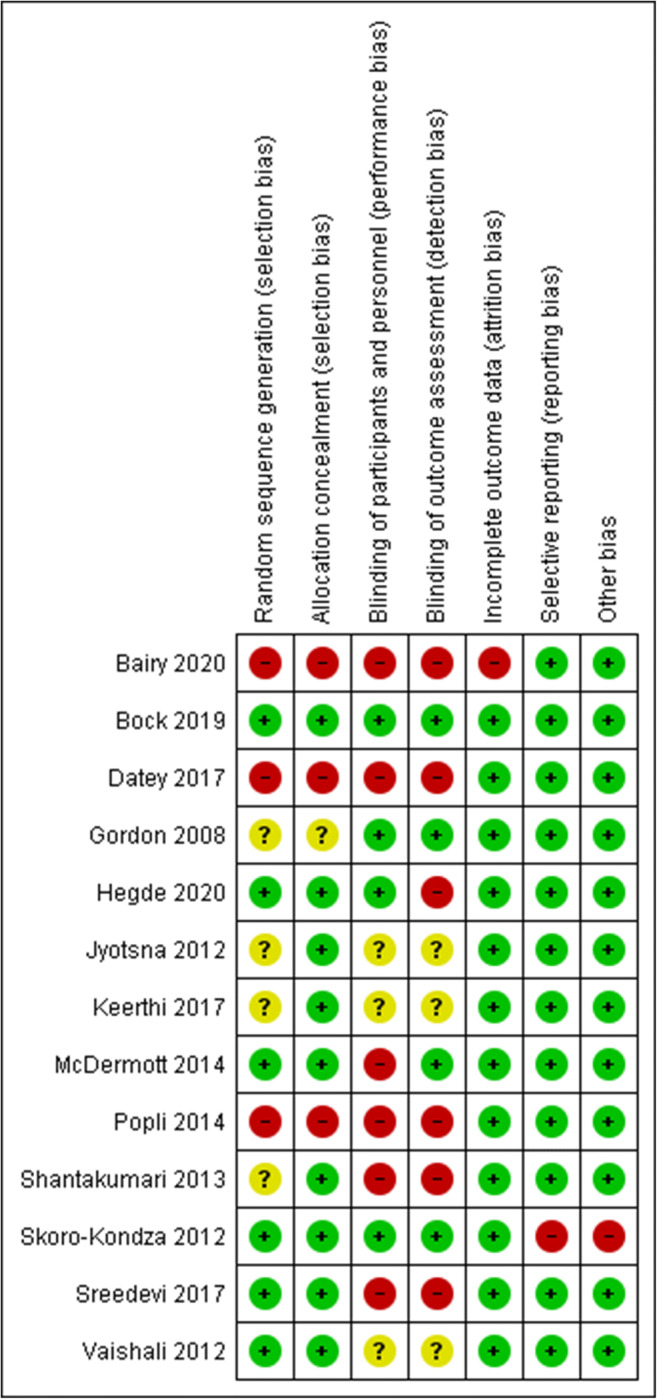
Risk of bias summary: review authors’ judgements about each risk of bias item for each included study
Effect of yoga on primary outcomes
Fasting plasma glucose
Data from 11 studies involving 1002 people with T2DM was analysed to find out the impact of yoga on FPG. Individuals doing yoga had significantly lower FPG as compared to the controls [MD -17.22 mg/dl (95% CI: −26.19 – −8.26 mg/dl); p < 0.01; I2 = 94% (considerable heterogeneity); figure 4a; low certainty of evidence]. On sub-group analysis, FPG in people doing yoga was not significantly lower when compared to both the SER group [MD -2.85 mg/dl (95% CI: −6.97 – 1.27 mg/dl); p = 0.18; I2 = 57% (moderate heterogeneity); supplementary figure-1a; low certainty of evidence], but was significantly lower when compared with the SDC group [MD -22.60 mg/dl (95% CI: −34.19 – −11.00 mg/dl); p < 0.01; I2 = 89% (considerable heterogeneity); supplementary figure-1a; low certainty of evidence]. The quantum of reduction with yoga was lesser in the SER group as compared to SDC group.
Fig. 4.

Forest plot evaluating the impact of yoga on (a): fasting glucose; (b): glycated haemoglobin (Hba1c); (c): post-prandial glucose; (d): total cholesterol; (e): triglycerides; (f): low density lipoprotein cholesterol. The sizes of the boxes are proportional to the weight of each individual study in the analyses. The summary effect size is represented by a diamond
HbA1c
Data from nine studies involving 751 subjects with T2DM was analysed to find out he impact of yoga on HbA1c. The reduction in HbA1c after an average of 12 weeks was not statistically different among yoga participants as compared to the controls [MD -0.32% (95%CI: −0.79 – 0.16%; p = 0.19; I2 = 97% (considerable heterogeneity); figure 4b; low certainty of evidence]. On sub-group analysis, HbA1c in people doing yoga was not significantly lower when compared to the SER group [MD -0.01% (95% CI: −0.19 – 0.17%); p = 0.52; I2 = 0% (low heterogeneity); supplementary figure-1b; low certainty of evidence] as well as the SDC group [MD -0.37% (95% CI: −1.01 – 0.27%); p = 0.26; I2 = 98% (considerable heterogeneity); supplementary figure-1b; low certainty of evidence].
Effect of yoga on secondary outcomes
Post-prandial glucose
Data from five studies involving 523 patients was analysed to evaluate the impact of yoga on PPG. Individuals doing yoga had significantly lower PPG as compared to the control group [MD -27.77 mg/dl (95% CI: −35.73 – −19.81 mg/dl); p < 0.01; I2 = 31% (low/insignificant heterogeneity); figure 4c; moderate certainty of evidence]. Sub-group analysis was not possible as none of the five studies included subjects who underwent SER (Supplementary figure-1c).
Total cholesterol
Data from five studies involving 416 patients was analysed to evaluate the impact of yoga on TC. Those performing yoga had significantly lower TC as compared to the control group [MD -19.48 mg/dl (95% CI: −31.97 – −6.99 mg/dl); p < 0.01; I2 = 91% (considerable heterogeneity); figure 4d; low certainty of evidence]. On sub-group analysis, TC in people doing yoga was significantly lower when compared to both the SER group [MD -30.93 mg/dl (95% CI: −32.76 – −29.10 mg/dl); p < 0.01; supplementary figure-1d; low certainty of evidence] as well as the SDC group [MD -15.85 mg/dl (95% CI: −28.67 – −3.04 mg/dl); p < 0.01; I2 = 78% (considerable heterogeneity); supplementary figure-1d; low certainty of evidence]. The quantum of reduction with yoga was greater when compared to the active exercise control group. There was however only one study which analysed TC in SER group.
Triglycerides
Data from five studies involving 349 patients was analysed to evaluate the impact of yoga on triglycerides. Individuals doing yoga had significantly lower triglycerides as compared to the control group [MD -12.99 mg/dl (95% CI: −23.74 – −2.25 mg/dl); p = 0.02; I2 = 89% (considerable heterogeneity); figure 4e; low certainty of evidence]. On sub-group analysis, triglycerides in people doing yoga was significantly lower when compared to both the SER group [MD -15.94 mg/dl (95% CI: −19.44 – −12.44 mg/dl); p < 0.01; supplementary figure-2a; low certainty of evidence] as well as the SDC [MD -12.94 mg/dl (95% CI: −28.32 – 2.43 mg/dl); p = 0.1; I2 = 85% (considerable heterogeneity); supplementary figure-2a; low certainty of evidence]. The quantum of reduction with yoga was greater in the SER group as compared to the SDC group. The SER group had only one study.
Low density lipoprotein cholesterol
Data from four studies involving 349 patients was analysed to evaluate the impact of yoga on LDL-C. People doing yoga had significantly lower LDL-C as compared to the control group [MD -11.71 mg/dl (95% CI: −17.49 – −5.93 mg/dl); p < 0.01; I2 = 69% (substantial heterogeneity); figure 4f; low certainty of evidence]. On sub-group analysis, LDL-C in people doing yoga was significantly lower when compared to both the SER group [MD -9.66 mg/dl (95% CI: −11.25 – −8.07 mg/dl); p < 0.01; supplementary figure-2b; low certainty of evidence] as well as the SDC group [MD -13.47 mg/dl (95% CI: −24.02 – −2.92 mg/dl); p = 0.01; I2 = 77% (moderate heterogeneity); supplementary figure 2b; low certainty of evidence]. The quantum of reduction with yoga was lesser in the SER group as compared to SDC group. The SER group had only one study.
High density lipoprotein cholesterol
Data from two studies involving 157 patients was analysed to evaluate the impact of yoga on HDL-C. Those performing yoga had significantly higher HDL-C as compared to the control group [MD 4.58 mg/dl (95% CI: 3.98–5.18 mg/dl); p < 0.01; I2 = 0% (low/insignificant heterogeneity); moderate certainty of evidence]. Meaningful sub-group analysis was not possible as both the studies included subjects belonging to SDC group (Supplementary figure-2c).
Discussion
In a metanalysis involving 832 people with prediabetes from 14 studies, yoga was found to have a beneficial impact on blood pressure, blood glucose and lipid parameters [32]. Hence yoga may have a role in the prevention of diabetes. In this meta-analysis, a contemporary comprehensive review of the efficacy of yoga on glycaemic control and blood lipid parameters in individuals with T2DM was done. Our metanalysis highlighted that people with diabetes doing yoga had significantly lower fasting glucose, post prandial glucose, TC, LDL-C, triglycerides along with significantly higher HDL-C. HbA1c lowering was not significantly different among people doing yoga as compared to those not doing yoga. It must be highlighted that most of the studies did not evaluate all the primary and secondary outcomes of this meta-analysis. This is evidenced from the fact that whereas data from 1002 patients were available with regard to assessing impact on FPG, data from only 751, 523, 416, 349, 349 and 157 patients were available with regard to assessment of the impact on HbA1c, PPG, TC, triglycerides, LDL-C and HDL-C respectively.
In spite of a large number of studies, the current strength of evidence on the impact of yoga on glycemic control and lipid parameters in T2DM remains largely low. Fifty percent of evaluated studies had significant performance bias and detection bias. Twenty percent of the studies had significant associated selection bias with regard to random sequence generation and allocation concealment (figure 2). In addition there was an additional problem of significant heterogeneity among the results of different studies with regard to both primary and secondary end points. Except for PPG and HDL-C, a large variation in effect was noticed as evidenced by confidence intervals not overlapping; P value for heterogeneity being <0.01 and I2 being more than 80% for FPG, HBA1c, TC, triglycerides and LDL-C. Hence although a significant alteration in FPG, TC, triglycerides, LDL-C and HDL-C was noted in the yoga group as compared to the control group, major issues remain if the same can be replicated in the day to day clinical practice, due to the low grade of evidence. The heterogeneity persisted even after exclusion of each of the RCTs included in this meta-analysis, highlighting that no particular study was primarily responsible for this heterogeneity. Instead the methodologic differences in the different studies, especially with regard to the different types of yoga used, the duration and nature of yoga therapy may have contributed to this heterogeneity.
It must be highlighted that there was no significant lowering of HbA1c in people doing yoga as compared to the control group, and again the grade of evidence of this observation was low. This was discordant to the observation of significant reduction in both FPG and PPG. It must also be highlighted that the strength of data was moderate strong without any significant heterogeneity, with regard to significant reduction in post-prandial blood glucose and the increase in HDL-C in people doing yoga as compared to controls. There was no data available addressing the safety issue of yoga in people with T2DM. Data was lacking on the occurrence and severity of hypoglycaemia in people doing yoga as compared to the control group.
To our knowledge, this is the first review which has used both the established and standardized Cochrane meta-analysis tool to evaluate the outcome of yoga on glycemia and dyslipidaemia in T2DM, as well as graded the quality of evidence. Prior to this study, there have been eight systematic review or meta-analysis published related to impact on yoga on diabetes, the earliest being in 2006 and the last one being in 2018 [33–40]. The first review published in 2006 involved 15 uncontrolled trials, 6 nonrandomized controlled trials and 4 RCTs, and concluded that yoga may improve physiologic and anthropometric risk profiles in T2DM, with a note on lack of high quality data [33]. In a systematic review published in 2010 involving 5 trials with 363 participants, no definite conclusion could be made with regard to recommending yoga in T2DM [34]. Cui et al. in a meta-analysis involving 12 RCTs (864 patients) published in 2016 had documented the beneficial impact of yoga on glycemia and diabetic dyslipidaemia [35]. A significant reduction in FPG [−23.72 mg/dL (95% CI -37.78 to −9.65; P = 0.001; I2 = 82%)], HbA1c [−0.47% (95% CI -0.87 to −0.07; P = 0.02; I2 = 82%)], PPG [−17.38 mg/dL (95% CI -27.88 to −6.89; P = 0.001; I2 = 0%)], TC [−18.50 mg/dL (95% CI -29.88 to −7.11; P = 0.001; I2 = 75%)], triglycerides [−12.57 mg/dL (95% CI -29.91 to 4.76; P = 0.16; I2 = 48%)], LDL-C [−12.95 mg/dL (95% CI -18.84 to −7.06; P < 0.0001; I2 = 37%)] and elevation in HDL-C [4.30 mg/dL (95% CI 3.25 to 5.36; P < 0.00001; I2 = 10%)] was noted in that study [35]. This meta-analysis was limited by the high heterogeneity of data, as evidenced by the high I2 values. Our study included several new RCTs which were published subsequently to the meta-analysis by Cui et al. The results of our study was similar to Cui et al. except with regard to HbA1c reduction. Innes et al. in a systematic review published in 2016, evaluated data from 13 nonrandomized trials and 12 RCTs (2170 participants) and noted that yogic practices may have a beneficial impact on glycemia, lipids and body composition in T2DM [36]. However questions on the quality of the data remained [36]. Kumar et al. in their systematic review replicated the observation from previous studies. However issues remained with regard to study selection in this meta-analysis and the associated high risk of bias [37]. Vizcanio et al. in their meta-analysis published in 2016 involving 11 RCTs noted a significant reduction on FPG, PPG and HbA1c, with data being most consistent with regard to FPG and inconsistent with regard to PPG and HbA1c [38]. The limitations on ambiguity over study methodology was also noted by Vizcanio et al. [39]. Thind et al. (2017) documented similar beneficial impact on yoga on glycaemic and lipid parameters, the observations limited by short follow up data of 3 months, with only 41% of studies having sufficient methodologic quality [39]. Studies without valid control groups (Nagarathna et al., 2012) have been included in some of the prior published meta-analysis [35, 36, 38, 39]. It is concerning that the issues of high data heterogeneity remained in our meta-analysis, highlighting that the newer studies published in the last 3–4 years on this topic have not improved in terms of study quality. Hence there is an urgent need for proper methodologic quality RCT in the field of yoga and diabetes.
Yoga was superior to SDC (daily walk for around 39 min) with regard to reduction in fasting glucose and lipid parameters. However an important observation from our meta-analysis is the additional reduction in FPG, TC, LDL-C and triglycerides noted in people doing yoga even when compared to those engaging in structured exercise regimen (SER). This highlights that yoga optimises the metabolic outcomes in people engaged in SER. Hence, yoga instead of being considered as complimentary to regular exercise, should be considered as synergistic to SER for improving clinical outcomes in diabetes. In a metanalysis involving 842 patients, Jayawardena et al. also demonstrated that doing yoga was associated with additional reduction in blood glucose, HbA1c and body weight in people with T2DM, when compared to people doing regular exercise [40].
Strengths of this meta-analysis include the systematic search of electronic databases and methodological soundness of data extraction, use of standardized tool for analysis and assessment of risk of bias. We strictly restricted our analysis to people with T2DM. Many of the prior meta-analysis had included people with metabolic syndrome, prediabetes and not just people with T2DM, hence making it difficult to take their results into perspective. Two authors independently assessed all the studies, and any differences in interpretation were discussed with disagreements resolved by the fifth author. None of the authors assessing the studies or performing data extraction had any conflicts of interest to declare.
Conclusion
To summarize, this meta-analysis highlights that yoga is probably beneficial in T2DM. Yoga works well and provide additional metabolic benefits in comparison to individuals undergoing active exercise protocols as well as in those who undergo standard diabetes management with regard to improvement in some of the glycaemic and lipid parameters. Yoga has a major supportive role to play along with pharmacotherapy in ensuring good metabolic control. However the current evidence has some bias, heterogeneity and moderate to low certainty of evidence, due to the heterogeneity in yoga used in different studies. Hence there is an urgent need to standardize and establish yoga practices. High-quality large multi-centric double blinded RCT on yoga in T2DM with long follow-up can clarify these doubts.
Supplementary Information
(DOC 64 kb)
Supplementary Table-1: Risk of Bias assessment table for the meta-analysis (DOCX 24 kb)

Supplementary Figure-1: Forest plot evaluating the impact of yoga on (a): fasting blood glucose with subgroup analysis; (b): glycated haemoglobin (Hba1c) with subgroup analysis; (c): post-prandial blood glucose with subgroup analysis; (d): total cholesterol with subgroup analysis The sizes of the boxes are proportional to the weight of each individual study in the analyses. The summary effect size is represented by a diamond; Active exercise regimen controls represent the structured exercise regimen (SER) sub-group; Passive control group represent the standard diabetes care (SDC) sub-group (JPG 743 kb)

Supplementary Figure-2: Forest plot evaluating the impact of yoga on (a): triglycerides with subgroup analysis; (b): LDL-cholesterol with subgroup analysis; (c): HDL-cholesterol with subgroup analysis. The sizes of the boxes are proportional to the weight of each individual study in the analyses. The summary effect size is represented by a diamond; Active exercise regimen controls represent the structured exercise regimen (SER) sub-group; Passive control group represent the standard diabetes care (SDC) sub-group (JPG 380 kb)
Declarations
Conflict of interests
DD, SB, MS, DK, VS and SK have no conflict of interests with regard to this research work and have nothing to declare.
Footnotes
Publisher’s note
Springer Nature remains neutral with regard to jurisdictional claims in published maps and institutional affiliations.
Contributor Information
Deep Dutta, Email: deepdutta2000@yahoo.com.
Saptarshi Bhattacharya, Email: saptarshi515@gmail.com.
Meha Sharma, Email: docmsharma@gmail.com.
Deepak Khandelwal, Email: khandelwalaiims@gmail.com.
Vineet Surana, Email: vks183@gmail.com.
Sanjay Kalra, Email: brideknl@gmail.com.
References
- 1.Dutta D, Ghosh S. Young-onset diabetes: an Indian perspective. Indian J Med Res. 2019;149:441–442. doi: 10.4103/ijmr.IJMR_1938_18. [DOI] [PMC free article] [PubMed] [Google Scholar]
- 2.Dutta D, Mukhopadhyay S. Intervening at prediabetes stage is critical to controlling the diabetes epidemic among Asian Indians. Indian J Med Res. 2016;143:401–404. doi: 10.4103/0971-5916.184281. [DOI] [PMC free article] [PubMed] [Google Scholar]
- 3.Gupta L, Khandelwal D, Lal PR, Gupta Y, Kalra S, Dutta D. Factors determining the success of therapeutic lifestyle interventions in diabetes - role of partner and family support. Eur Endocrinol. 2019;15:18–24. doi: 10.17925/EE.2019.15.1.18. [DOI] [PMC free article] [PubMed] [Google Scholar]
- 4.Raveendran AV, Deshpandae A, Joshi SR. Therapeutic role of yoga in type 2 diabetes. Endocrinol Metab (Seoul) 2018;33:307–317. doi: 10.3803/EnM.2018.33.3.307. [DOI] [PMC free article] [PubMed] [Google Scholar]
- 5.Kiecolt-Glaser JK, Christian LM, Andridge R, Hwang BS, Malarkey WB, Belury MA, et al. Adiponectin, leptin, and yoga practice. Physiol Behav. 2012;107:809–813. doi: 10.1016/j.physbeh.2012.01.016. [DOI] [PMC free article] [PubMed] [Google Scholar]
- 6.Hagins M, States R, Selfe T, Innes K. Effectiveness of yoga for hypertension: systematic review and meta-analysis. Evid Based Complement Alternat Med. 2013;2013:1–13.7. doi: 10.1155/2013/649836. [DOI] [PMC free article] [PubMed] [Google Scholar]
- 7.Raub JA. Psychophysiologic effects of hatha yoga on musculoskeletal andcardiopulmonary function: a literature review. J Alternat Complement Med. 2002;8:797–812.8. doi: 10.1089/10755530260511810. [DOI] [PubMed] [Google Scholar]
- 8.Campbell DE, Moore KA. Yoga as a preventative and treatment for depression,anxiety, and stress. Int J Yoga Ther. 2004;14:53–58.12. doi: 10.17761/ijyt.14.1.t7427823p2478255. [DOI] [Google Scholar]
- 9.Sharma M. Yoga as an alternative and complementary approach for stressmanagement: a systematic review. J Evid Based Complement Alternat Med. 2014;19:59–67.14. doi: 10.1177/2156587213503344. [DOI] [PubMed] [Google Scholar]
- 10.Higgins JP, Altman DG, Gotzsche PC, et al. Cochrane Collaboration’s tool for assessing risk of bias in randomised trials. BMJ. 2011;343:d5928. doi: 10.1136/bmj.d5928. [DOI] [PMC free article] [PubMed] [Google Scholar]
- 11.Liberati A, Altman DG, Tetzlaff J, et al. The PRISMA statement for reporting systematic reviews and metaanalyses of studies that evaluate healthcare interventions: explanation and elaboration. BMJ. 2009;339:b2700. doi: 10.1136/bmj.b2700. [DOI] [PMC free article] [PubMed] [Google Scholar]
- 12.Popli U, Subbe CP, Sunil K. Research letter-the role of yoga as a lifestyle modification in treatment of diabetes mellitus: results of a pilot study. Altern Ther Health Med. 2014;20:24–26. [PubMed] [Google Scholar]
- 13.Hegde SV, Adhikari P, Kotian SM, Shastry R. Effects of Yoga Versus Sham Yoga on Oxidative Stress, Glycemic Status, and Anthropometry in Type 2 Diabetes Mellitus: A Single-Blinded Randomized Pilot Study. Int J Yoga Therap. 2019. 10.17761/D-18-2020-00018. [DOI] [PubMed]
- 14.Skoro-Kondza L, Tai SS, Gadelrab R, Drincevic D, Greenhalgh T. Community based yoga classes for type 2 diabetes: an exploratory randomised controlled trial. BMC Health Serv Res. 2009;9:33. doi: 10.1186/1472-6963-9-33. [DOI] [PMC free article] [PubMed] [Google Scholar]
- 15.Jyotsna VP, Dhawan A, Sreenivas V, Deepak KK, Singla R. Completion report: effect of comprehensive yogic breathing program on type 2 diabetes: a randomized control trial. Indian J Endocr Metab. 2014;18:582–584. doi: 10.4103/2230-8210.137499. [DOI] [PMC free article] [PubMed] [Google Scholar]
- 16.Jyotsna VP, Ambekar S, Singla R, Joshi A, Dhawan A, Kumar N, et al. Cardiac autonomic function in patients with diabetes improves with practice of comprehensive yogic breathing program. Indian J Endocr Metab. 2013;17:480–485. doi: 10.4103/2230-8210.111645. [DOI] [PMC free article] [PubMed] [Google Scholar]
- 17.Jyotsna VP, Joshi A, Ambekar S, Kumar N, Dhawan A, Sreenivas V. Comprehensive yogic breathing program improves quality of life in patients with diabetes. Indian J Endocr Metab. 2012;16:423–428. doi: 10.4103/2230-8210.95692. [DOI] [PMC free article] [PubMed] [Google Scholar]
- 18.Gordon LA, Morrison EY, McGrowder DA, Young R, Fraser YT, Zamora EM, et al. Effect of exercise therapy on lipid profile and oxidative stress indicators in patients with type 2 diabetes. BMC Complement Altern Med. 2008;8:21. doi: 10.1186/1472-6882-8-21. [DOI] [PMC free article] [PubMed] [Google Scholar]
- 19.Datey P, Hankey A, Nagendra HR. Combined Ayurveda and yoga practices for newly diagnosed type 2 diabetes mellitus: a controlled trial. Complement Med Res. 2018;25:16–23. doi: 10.1159/000464441. [DOI] [PubMed] [Google Scholar]
- 20.Bock BC, Thind H, Fava JL, Dunsiger S, Guthrie KM, Stroud L, et al. Feasibility of yoga as a complementary therapy for patients with type 2 diabetes: The Healthy Active and in Control (HA1C) study. Complement Ther Med. 2019;42:125–131. doi: 10.1016/j.ctim.2018.09.019. [DOI] [PMC free article] [PubMed] [Google Scholar]
- 21.Sreedevi A, Gopalakrishnan UA, Karimassery Ramaiyer S, Kamalamma L. A randomized controlled trial of the effect of yoga and peer support on glycaemic outcomes in women with type 2 diabetes mellitus: a feasibility study. BMC Complement Altern Med. 2017;17:100. doi: 10.1186/s12906-017-1574-x. [DOI] [PMC free article] [PubMed] [Google Scholar]
- 22.Bairy S, Rao MR, Edla SR, Manthena SR, Tatavarti NVGD. Effect of an integrated naturopathy and yoga program on long-term glycemic control in type 2 diabetes mellitus patients: a prospective cohort study. Int J Yoga. 2020;13:42–49. doi: 10.4103/ijoy.IJOY_32_19. [DOI] [PMC free article] [PubMed] [Google Scholar]
- 23.Vaishali K, Vijaya Kumar K, Adhikari P, UnniKrishnan B. Effects of yoga-based program on glycosylated hemoglobin level serum lipid profile in community dwelling elderly subjects with chronic type 2 diabetes mellitus–a randomized controlled trial. Phys Occup Ther Geriatrics. 2012;30:22–30. doi: 10.3109/02703181.2012.656835. [DOI] [Google Scholar]
- 24.McDermott KA, Rao MR, Nagarathna R, Murphy EJ, Burke A, Nagendra RH, et al. A yoga intervention for type 2 diabetes risk reduction: a pilot randomized controlled trial. BMC Complement Altern Med. 2014;14:212. doi: 10.1186/1472-6882-14-212. [DOI] [PMC free article] [PubMed] [Google Scholar]
- 25.Shantakumari N, Sequeira S. El deeb R. Effects of a yoga intervention on lipid profiles of diabetes patients with dyslipidemia. Indian Heart J. 2013;65:127–131. doi: 10.1016/j.ihj.2013.02.010. [DOI] [PMC free article] [PubMed] [Google Scholar]
- 26.Ebrahimi M, Guilan-Nejad TN, Pordanjani AF. Effect of yoga and aerobics exercise on sleep quality in women with type 2 diabetes: a randomized controlled trial. Sleep Sci. 2017;10:68–72. doi: 10.5935/1984-0063.20170012. [DOI] [PMC free article] [PubMed] [Google Scholar]
- 27.Sharma R, Shahi VK, Khanduri S, Goyal A, Chaudhary S, Rana RK, et al. Effect of Ayurveda intervention, lifestyle modification and Yoga in prediabetic and type 2 diabetes under the National Programme for Prevention and Control of Cancer, Diabetes, Cardiovascular Diseases and Stroke (NPCDCS)–AYUSH integration project. AYU. 2019;40:8–15. doi: 10.4103/ayu.AYU_105_19. [DOI] [PMC free article] [PubMed] [Google Scholar]
- 28.Sreedevi A, Unnikrishnan AG, Karimassery SR, Deepak KS. The effect of yoga and peer support interventions on the quality of life of women with diabetes: results of a randomized controlled trial. Indian J Endocr Metab. 2017;21:524–530. doi: 10.4103/ijem.IJEM_28_17. [DOI] [PMC free article] [PubMed] [Google Scholar]
- 29.Nagarathna R, Tyagi R, Kaur G, Vendan V, Acharya IN, Anand A, Singh A, Nagendra HR. Efficacy of a Validated Yoga Protocol on Dyslipidemia in Diabetes Patients: NMB-2017 India Trial. Medicines (Basel). 2019 6(4). E100. doi: 10.3390/medicines6040100. [DOI] [PMC free article] [PubMed]
- 30.Guyatt GH, Oxman AD, Vist GE, Kunz R, Falck-Ytter Y, Alonso-Coello P, et al. GRADE: an emerging consensus on rating quality of evidence and strength of recommendations. BMJ. 2008;336:924–926. doi: 10.1136/bmj.39489.470347.AD. [DOI] [PMC free article] [PubMed] [Google Scholar]
- 31.Keerthi GS, Pal P, Pal GK, Sahoo JP, Sridhar MG, Balachander J. Effect of 12 weeks of yoga therapy on quality of life and Indian diabetes risk score in normotensive Indian Young adult Prediabetics and diabetics: randomized control trial. J Clin Diagn Res. 2017;11:CC10–CC14. doi: 10.7860/JCDR/2017/29307.10633. [DOI] [PMC free article] [PubMed] [Google Scholar]
- 32.Ramamoorthi R, Gahreman D, Skinner T, Moss S. The effect of yoga practice on glycemic control and other health parameters in the prediabetic state: a systematic review and meta-analysis. PLoS One. 2019;14(10):e0221067. doi: 10.1371/journal.pone.0221067. [DOI] [PMC free article] [PubMed] [Google Scholar]
- 33.Innes KE, Vincent HK. The influence of yoga-based programs on risk profiles in adults with type 2 diabetes mellitus: a systematic review. Evid Based Complement Alternat Med. 2007;4:469–486. doi: 10.1093/ecam/nel103. [DOI] [PMC free article] [PubMed] [Google Scholar]
- 34.Aljasir B, Bryson M, Al-Shehri B. Yoga practice for the Management of Type II diabetes mellitus in adults: a systematic review. Evid Based Complement Alternat Med. 2010;7(4):399–408. doi: 10.1093/ecam/nen027. [DOI] [PMC free article] [PubMed] [Google Scholar]
- 35.Cui J, Yan JH, Yan LM, Pan L, Le JJ, Guo YZ. Effects of yoga in adults with type 2 diabetes mellitus: a meta-analysis. J Diabetes Investig. 2017;8:201–209. doi: 10.1111/jdi.12548. [DOI] [PMC free article] [PubMed] [Google Scholar]
- 36.Innes KE, Selfe TK. Yoga for adults with type 2 diabetes: a systematic review of controlled trials. J Diabetes Res. 2016;2016:6979370. doi: 10.1155/2016/6979370. [DOI] [PMC free article] [PubMed] [Google Scholar]
- 37.Kumar V, Jagannathan A, Philip M, Thulasi A, Angadi P, Raghuram N. Role of yoga for patients with type II diabetes mellitus: a systematic review and meta-analysis. Complement Ther Med. 2016;25:104–112. doi: 10.1016/j.ctim.2016.02.001. [DOI] [PubMed] [Google Scholar]
- 38.Vizcaino M, Stover E. The effect of yoga practice on glycemic control and other health parameters in type 2 diabetes mellitus patients: a systematic review and meta-analysis. Complement Ther Med. 2016;28:57–66. doi: 10.1016/j.ctim.2016.06.007. [DOI] [PubMed] [Google Scholar]
- 39.Thind H, Lantini R, Balletto BL, Donahue ML, Salmoirago-Blotcher E, Bock BC, et al. The effects of yoga among adults with type 2 diabetes: A systematic review and meta-analysis. Prev Med. 2017;105:116–126. doi: 10.1016/j.ypmed.2017.08.017. [DOI] [PMC free article] [PubMed] [Google Scholar]
- 40.Jayawardena R, Ranasinghe P, Chathuranga T, Atapattu PM, Misra A. The benefits of yoga practice compared to physical exercise in the management of type 2 diabetes mellitus: a systematic review and meta-analysis. Diabetes Metab Syndr. 2018;12(5):795–805. doi: 10.1016/j.dsx.2018.04.008. [DOI] [PubMed] [Google Scholar]
Associated Data
This section collects any data citations, data availability statements, or supplementary materials included in this article.
Supplementary Materials
(DOC 64 kb)
Supplementary Table-1: Risk of Bias assessment table for the meta-analysis (DOCX 24 kb)
Supplementary Figure-1: Forest plot evaluating the impact of yoga on (a): fasting blood glucose with subgroup analysis; (b): glycated haemoglobin (Hba1c) with subgroup analysis; (c): post-prandial blood glucose with subgroup analysis; (d): total cholesterol with subgroup analysis The sizes of the boxes are proportional to the weight of each individual study in the analyses. The summary effect size is represented by a diamond; Active exercise regimen controls represent the structured exercise regimen (SER) sub-group; Passive control group represent the standard diabetes care (SDC) sub-group (JPG 743 kb)
Supplementary Figure-2: Forest plot evaluating the impact of yoga on (a): triglycerides with subgroup analysis; (b): LDL-cholesterol with subgroup analysis; (c): HDL-cholesterol with subgroup analysis. The sizes of the boxes are proportional to the weight of each individual study in the analyses. The summary effect size is represented by a diamond; Active exercise regimen controls represent the structured exercise regimen (SER) sub-group; Passive control group represent the standard diabetes care (SDC) sub-group (JPG 380 kb)