



Background
The prevalence of food allergy among children has been steadily rising over the past several decades. Published studies have reported a prevalence among children as high as 10%1. The National Health and Nutrition Examination (NHANES), a population-based survey conducted in the United States, reported that self-reported food allergy among children in 2007–2010 was 6.53%, with the most common foods being reported as milk(1.94%), peanut(1.16%) and shellfish(0.87%)2,3.
Among this group of food allergy children, there is a wide range of phenotypes present. These phenotypes can be divided into several sub-categories, not only by specific food, but also by race and presence of other atopic manifestations. There is growing evidence that there are significant racial disparities present in food allergy, among other allergic diseases. There are also differences in the phenotype of food allergy among children who have co-existence of eczema, asthma and allergic rhinitis compared to those that have food allergy alone. Investigating these phenotypes allow us to decipher the multiple risk factors that predispose children to have food allergy, as well as those that increase the risk for other allergic diseases. The purpose of this manuscript is to detail the phenotypes of the food allergic patient, with emphasis on published data from significant longitudinal birth cohorts both here in the United States as well as across the globe.
Evaluation
1. Familial inheritance:
Previous studies looking at familial aggregation and twin studies have found a strong genetic component in food allergy, with heritability rates ranging from 15% to 82%4–7. Two twin studies currently exist looking at these rates among monozygotic and dizygotic twin pairs. Sicherer et al. looked at the rates of peanut allergy among 58 twin pairs. Among the monozygotic twin pairs (n=14), there was a concordance rate of 64.3%(n=9) for peanut allergy compared to 6.8%(n=3) among dizygotic twins (n=44)8. Second, a study looking at Chinese twins reported the sensitization rates for 9 foods and 5 aeroallergens among 472 monozygotic and 354 dizygotic twins ages 12–28 years. They found that there was a higher concordance rate for sensitization among monozygotic than dizygotic twins. However, there were differences in which allergens the twins were sensitized to, relaying a role of environmental factors in the allergic phenotype. Monozygotic twins sensitized to peanut and shellfish had the highest concordance rate at 58%9,10. These two studies demonstrate the strong genetic component in food allergy, specifically of peanut. There is a need for further twin studies to delineate the heritability patterns among other food allergens and the role of genetic risk with compounding environmental factors.
A common question in the office among parents with food allergy is how likely is their child to also develop food allergy? Liu et al. investigated the maternal genotypic and parent-of-origin effects among 588 Caucasian food allergy trios from the Chicago Food Allergy Study. They identified 1 single nucleotide polymorphism (rs423235) with significant maternal effect of any food allergy located in a noncoding RNA (LOC101927947). In addition, they identified 3 other loci with maternal genetic effects: 1 for any food allergy (rs976078 on 13q31.1) and 2 for egg allergy (rs1343795 and rs4572450 in ZNF652 gene). Interestingly, they further demonstrated specific loci that showed significant parent-of-origin effects in boys only: 1 for peanut allergy (rs4896888 in the ADGB gene) and 2 for any food allergy (rs1036504 and rs2917750 in IQCE gene)4. These findings support a strong parent to child inheritance pattern in the food allergy phenotype, and a specific strong inheritance pattern from mother to child. Further investigations are needed to identify possible interventions that could protect an infant from these genetic patterns and prevent the onset of food allergy.
2. Atopic march
The atopic march has been used to signify the progression of allergic diseases through childhood with different ages of mean onset. This progression has identified atopic dermatitis as the predisposing ailment that can lead to other allergic diseases, including food allergy. Atopic dermatitis is thought to provide a break in the skin barrier, that allows sensitization to foods with progression to clinical allergy later on in childhood. However, food allergy can also follow atopic dermatitis, signifying the different endotypes and pathways of the disease. In general, atopic dermatitis has an earlier age of onset with a peak at 6 months11, with food sensitization starting shortly after12. Although atopic dermatitis can signify the start of a phenotype for food allergy, there is insufficient evidence to recommend routine panel food allergy testing to all infants with atopic dermatitis. Current guidelines do recommend testing for specific foods, such as peanut, to risk stratify infants with specific risk factors and promote early introduction when appropriate13. A similar relationship is seen with the incidence of food allergy with asthma and allergic rhinitis. Several birth cohorts have identified these different “food allergic phenotypes,” signifying that the allergic disease progression may not truly be a “march” per se in being sequential, but instead dependent on key allergic disease risk factors and characteristics. Table 1 details key highlights with respect to food allergy phenotypes from four specific birth cohorts: WHEALS, CCAPS, HEALTHNUT and PASTURE. The remainder of this article will go into detail specific on these studies.
Table 1.
Longitudinal birth cohorts and food allergy
| Birth cohort | WHEALS | CCAPS | HEALTHNUTS | PASTURE |
|---|---|---|---|---|
| Geographic location | Southeast Michigan, USA | Greater Cincinnati area, Ohio, USA | Melbourne, Australia | Rural areas of 5 European nations: Austria, Finland, France, Germany and Switzerland |
| Unique characteristics of cohort | Racially diverse with 62% Black race | Higher risk cohort with at least one atopic parent | Used challenge-proven outcomes to assess the role of infantile food allergy in development of asthma | Assessed role of farm animals on allergic disease presence |
| Times of follow-up postnatally | 1, 6, 12, 24 and 48-months of age | 1,2,3,4, and 7 years | 11 or 15 months, 1 year, 4 years | 1, 4, 6 years |
| Total recruited | 1258 | 762 | 5276 | 1133 |
| Food allergens tested | Egg, peanut, milk | Cow’s milk, egg | Egg, peanut, sesame, and cow’s milk or shrimp | Cow’s milk, hen’s egg, cow’s milk, peanut, hazelnut, carrot, and wheat |
| Key food allergy phenotype finding | Black race was a significant risk factor for milk and egg allergy | Food sensitization in the presence of KIF3A mutations poses a significant risk for asthma, independent of aeroallergen sensitization | Asthma at 4 years of age is twice as common in children with food allergy, irrespective of whether child outgrows allergy | Farm exposure can alter sensitization patterns |
| PMIDs for key food allergy articles | 24636082 | 30830718, 19759553 | 29153880, 20608942 | 28531273 |
Longitudinal birth cohort data
WHEALS cohort:
The Wayne County Health, Environment, Allergy and Asthma Longitudinal Study (WHEALS), a birth cohort from southeastern Michigan, recruited pregnant females between the ages of 21 and 49 in predefined cluster of zip codes in Detroit and surrounding suburbs from August 2003 to November 200714. Follow up occurred at 1, 6, 12, 24 and 48-months after the child’s birth. Total IgE and sIgE was collected from children’s blood at 2 years of age for the following 10 allergens: Der f, dog, cat, Timothy grass, ragweed, Alternaria alternata, egg, peanut, milk and German cockroach.
A latent class analysis was performed, which was described as “an unsupervised statistical method that simultaneously considers a number of variables to identify homogenous, mutually exclusive groups or classes within a heterogenous population”15. This analysis was utilized to determine if children could be grouped together based on their patterns of sensitization. The 594 of the 1258 women-children pairs (that had blood samples available) clustered into 4 groups: Class I (n=457) - low to no sensitization, Class 2 (n=16) - highly sensitized, Class 3 (n=91) - milk and egg dominated, and Class 4 (n=30) - peanut and inhalant/no milk. Class 1 children were characterized as no sensitization (67.8%, n=310) or mono-sensitized to either egg (17.2%, n=23), Alternaria (16.4%, n=22), Der f (7.5%, n=10), dog (4.5%, n=6), cat (1.5%, n=2) or Timothy grass (0.8%, n=1). Class 2 children were all sensitized to at least 4 of the following allergens: milk, egg, peanut and Timothy grass.
In regard to food allergy, Class 3 and 4 had the most striking patterns. Class 3 children predominated (94.5%, n=86) with milk and egg sensitization. 27.9% of these children (n=24) were sensitized to milk, egg and peanut. 80% of Class 4 was sensitized to peanut (n=24). Egg sensitization occurred in 43.3% of the individuals (n=13). This study also reported interesting findings regarding race. Class 3 (milk and egg dominated), was statistically significantly associated with the Black race whereas Classes 2 and 3 were associated but not statistically significant. In terms of the occurrence of wheezing, Class 4 were 2.9 times more likely to have wheezed than those in Class 1, but this pattern was not seen in the other 2 classes. Cord blood had also been collected in this cohort. Cord blood total IgE level was significantly higher (p<0.01) in both Class 2 (highly sensitized) and Class 3 (milk and egg dominated), but not in Class 4 (peanut and inhalants).
This study demonstrated phenotypes of allergic disease based on allergen-specific IgE patterns. Although the atopic march refers to a step-wise direction in allergic disease onset, it does not address the possibility of different phenotypes in the allergic group.
Key highlights:
The “highly sensitized” group Class 2 were the most likely to ever had atopic dermatitis and more likely to ever had wheeze and doctor diagnosis of asthma than the “low to no sensitization” Class 1.
Associations between class and asthma diagnosis were similar in Class 3 and Class 4, suggesting that food allergens are not as strongly associated with asthma as being highly sensitized
There appears to be a co-sensitization pattern with peanut sensitization being equally likely to be paired with at least 1 inhalant sensitization as with two other food sensitizations.
Milk and egg co-sensitization was the most common pairing, with this pairing consistently associated with the lowest rate of allergic disease outcomes among the three higher risk groups (Class 2,3,4).
There are racial differences in which allergic diseases predominate in the Black race, with milk and egg food allergies having a statistically significant association.
Race was the most obvious risk factor across the classes. The authors propose that the racial differences observed could play a role in the racial disparities seen in asthma if early life food allergen sensitization is more strongly associated with asthma than with other types of sensitizations.
CCAAPS:
The Cincinnati Childhood Allergy and Air Pollution Study (CCAAPS) is a birth cohort of 762 infants born to atopic parent(s) between 2001 and 200316. Follow-up evaluations occurred at 1,2,3,4, and 7 years of age where skin prick testing (SPT) to milk, egg and 15 aeroallergens was performed. Since only two food allergens were tested, they did not examine the pattern of co-sensitization of foods but did examine the presence of food sensitization and timing of asthma and eczema onset compared to aeroallergen sensitization. As previous data had shown, of the children that had food and aeroallergen sensitization, 70% were food sensitized by their first birthday, and food sensitization preceded aeroallergen sensitization in 52% of co-sensitized children. In the presence of early eczema, the odds of having food sensitization (OR=3) compared to aeroallergen sensitization (OR=1.9) was higher in the food sensitized group. 43% of their food sensitized children did not have eczema compared to 58% of the aeroallergen group. This signifies that eczema or AD is not a mandatory precursor to food sensitization.
In regards to presence of asthma risk compared to sensitization patterns, a multivariate model revealed that aeroallergen sensitization load, but not food sensitization load was associated with asthma among children without a history of early eczema17. Among those with early eczema, neither aeroallergen sensitization nor food sensitization was significantly associated with asthma risk. However, being African American was associated with asthma risk among children without early eczema but not among those with early eczema.
This study revealed significant genotype patterns with other allergic disease as well. They specifically looked at the role of a coding subunit of the kinesin-2 motor complex, KIF3A, which plays a role in the formation and/or function of primary and motile cilia18. In children with early eczema, genotype KIF3A rs12186803 and food sensitization interacted to significantly increase the risk of asthma at 7 years of age, while neither variable on its own was associated with asthma risk. This pattern did not depend on the presence of early aeroallergen sensitization. This signified the role of food sensitization in altering the allergic disease progression to asthma in specific genotypes of children with early eczema onset.
Another analysis focused on the Caucasian children in the group (76.6%, 583) demonstrated food sensitization to be the highest risk factor for development of eczema by age 1–319. They reported that children with positive skin prick testing (SPT) (this included foods and/or aeroallergens) by age 3 were three times more likely to have a specific genotype in CD14 and IL4α compared to children without eczema who had negative SPT. This further portrayed the role of genetic susceptibility to allergic disease, such as food allergy, and eczema.
Key highlights:
Although eczema predisposes a child to food sensitization, there is a significant number of children (47% in this cohort) who have food sensitization in the absence of eczema.
Food sensitization in the presence of early eczema posed a significant increase in asthma risk for those with genotype KIF3A rs12186803, independent of the presence of early aeroallergen sensitization.
Food sensitization in Caucasian children were found to be the highest risk factor for development of eczema by age 1–3.
HEALTHNUTS cohort
The HEALTHNUTS cohort is a longitudinal population-based cohort study of allergic disease in Melbourne, Australia20. 5276 infants between 11 and 15 months were recruited from immunization clinics around Melbourne with a 74% participation rate. These participants were skin prick tested to egg, peanut, sesame, and cow’s milk or shrimp and were examined for eczema. If the SPT was positive to egg, peanut or sesame, the child was invited for an oral food challenge (OFC) to that food. At 4 years of age, the parents were given a questionnaire about their allergic outcomes (asthma, eczema and allergic rhinitis). The aim of this study was to determine the relationship between the presence and number of food allergies at age 1 and asthma at age 4.
They reported that asthma at 4 years of age was twice as common in those with challenge-proven food allergy. Egg allergy alone was associated with higher risk of asthma, but peanut allergy alone was not. Children with 2 or more food allergies and coexistent eczema were almost 3 times more likely to develop asthma compared to children without food allergy and those with a single food allergy21. Interestingly, asymptomatic food sensitization and OFC-proven food allergy in infancy were associated with an increased risk of asthma by 4 years of age. Furthermore, the increased risk of asthma was similarly high among food allergic infants that outgrew and did not outgrow their food allergy. This study further demonstrates the risk that sensitization to foods in addition to challenge-proven food allergy contribute to childhood asthma, and defining the food allergy phenotypes.
They performed a latent class analysis, similar to the WHEALS cohort, to identify phenotypes of food allergy22. From their analysis, they defined 5 classes: Class 1 - No allergic disease (70%), Class 2 - Non-food-sensitized eczema (16%), Class 3 - Single egg allergy (9%), Class 4 - Multiple food allergies, predominately peanut (3%), Class 5 - Multiple food allergies, predominately egg (2%).
They further investigated the risk factors for the different phenotypes. For all phenotypes, males were at increased risk of belonging to non-food-sensitized eczema and multiple food allergy phenotypes (classes 2,4,5). As far as environmental risk factors, exposure to pet dogs in the home was associated with reduced risk of membership in non-food-sensitized eczema and multiple food allergies - peanut phenotypes but the difference was not statistically significant. Presence of siblings reduced the risk of single egg allergy and non-food-sensitized eczema, but not multiple food allergies.
They also noted that filaggrin gene mutations were associated with a higher risk for the non-food-sensitized eczema and egg allergy phenotypes, with an odds ratio of 2.37, but interestingly was not associated with either multiple food allergy phenotypes. There has also been research investigating the role of Vitamin D insufficiency in the risk of food allergy. The HEALTHNUTS study group found that the association between vitamin D insufficiency and allergy phenotypes was modified by parent’s country of birth. Vitamin D insufficiency was a risk factor for the three food allergy phenotypes (class 3–5) only among those infants with both parents born in Australia.
Similar to WHEALS, HEALTHNUTS also identified race as a risk factor for food allergy phenotypes. HEALTHNUTS reported that for infants with one or both parents born in Asia, compared to those in both parents born in Australia, were at an increased risk of all three food allergy phenotypes. This further emphasizes the role of race and genetic background in the different phenotypes of food allergy. Together, this cohort further identified different food allergy phenotypes and risk factors associated with these classes. It emphasizes that a “one-size-fits-all” approach in both preventive medicine in averting food allergy as well as treatment options would not address the needs and risk factors for each phenotype.
Key highlights:
Asthma at 4 years of age was twice as common in those with challenge-proven food allergy, irrespective of whether the child outgrew the food allergy
Those with 2 or more food allergies and coexistent eczema were almost 3 times more likely to develop asthma compared to those children without food allergy and those with a single food allergy
Vitamin D insufficiency was a risk factor for the three food allergy phenotypes (class 3–5) only among those infants with both parents born in Australia.
Infants with one or both parents born in Asia compared to those in both parents born in Australia, were at an increased risk of all three food allergy phenotypes
PASTURE study
The Protection Against Allergy Study in Rural Environments (PASTURE) birth cohort included children form rural areas in 5 European countries: Austria, Finland, France, Germany and Switzerland23. It was designed to evaluate risk and preventive factors for atopic diseases. Pregnant women recruited between 2001 and 2005 were divided into 2 groups: those living on family-run farms where livestock was kept (farm group), and those not living on a farm from those same rural areas (reference group). Altogether, 1133 children were included.
A latent class analysis was performed on 1038 of the children24. Consistent with other birth cohorts, they identified that early phenotypes of AD (onset before age 2) were strongly associated with food allergy, but late phenotypes were not. They also assessed IgE sensitization patterns within the first 12 months of life and maternal and environmental influences. Sensitization to foods was assessed by cord blood (infancy) and peripheral blood (ages 1, 4 and 6 years) to 6 foods. Food sensitization was more common in the farm group only at lower specific IgE levels. This study portrayed the influence of environmental factors on sensitization patterns and the possible alterations due to a modified immune response on production of specific IgE25.
Key highlights:
Environmental factors, such as being on a farm, can alter food sensitization patterns through a modified immune response.
Discussion
Food allergy presents in different phenotypes in children, with each phenotype carrying varying risks for future allergic diseases. There are several birth cohorts that have tried to delineate these risks including those risk factors predisposing infants to become allergic to begin with (Figure 1). In this manuscript, we detail 4 studies that highlight a portion of identified food allergy phenotypes. Each cohort is unique and significant in the field of allergy in its own way, contributing to different aspects from racial background to genetic risks and environmental factors. Together, they identify that food allergy and food sensitization poses a risk for future allergic diseases, but that it may not be in pattern of the traditional atopic march as previously described.
Figure 1.
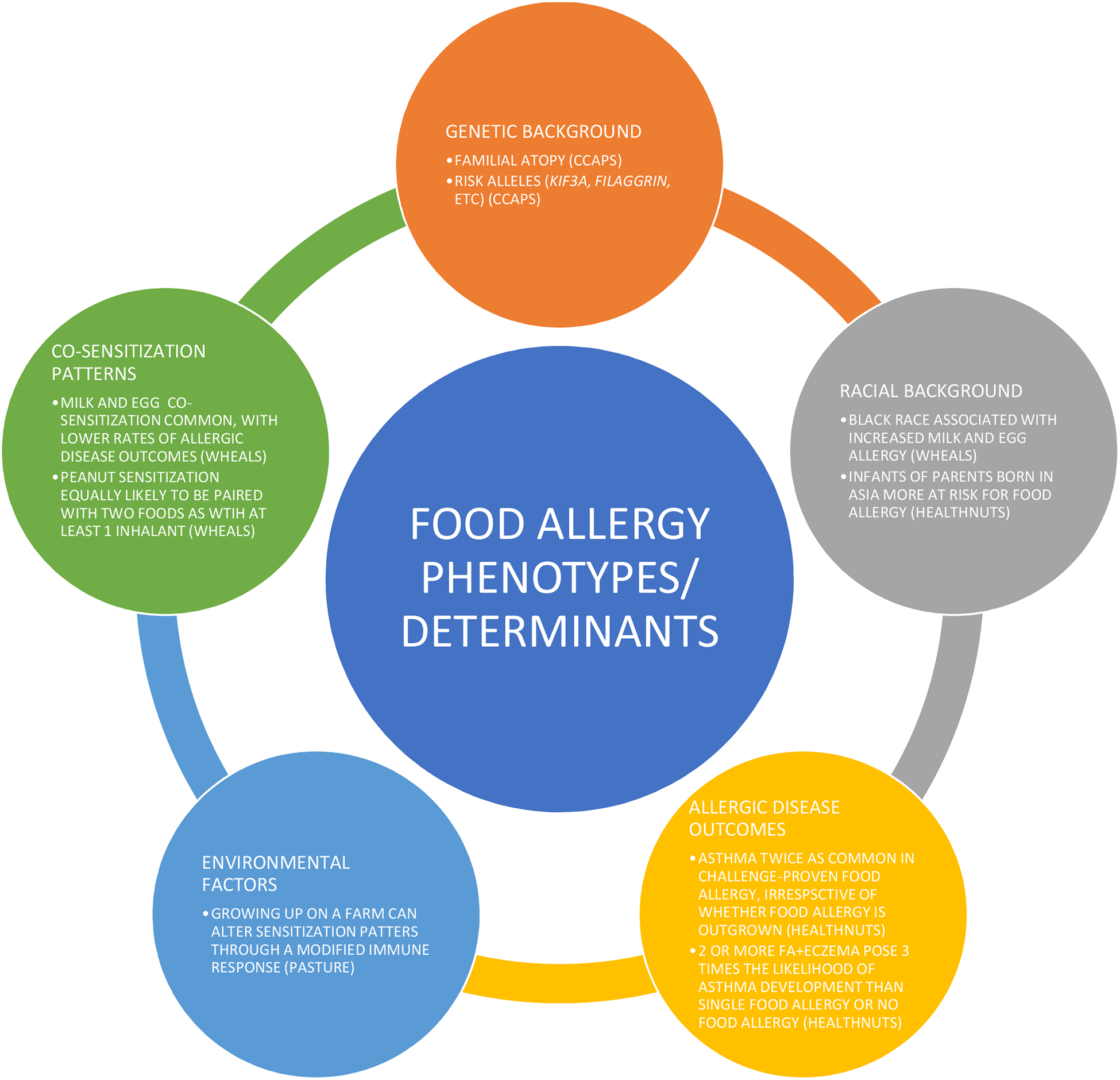
Food allergy phenotypes/determinants. Figure details phenotypes detailed by allergy birth cohort data from 4 cohorts: WEHALS, CCAPS, HEALTHNUTS, and PASTURE.
A meta-analysis and systemic review aimed to assess the association of food sensitization and subsequent allergic diseases in birth cohort studies26. Their search revealed thirteen cohorts across the globe. A common theme among these cohorts was that food sensitization in the first 2 years of life was related to eczema in late infancy, wheeze/asthma, eczema or allergic rhinitis in childhood and asthma in young adults. Identifying sensitization patterns such as foods sensitized to, as well as predisposing factors such as family atopy, racial background and living conditions can allow physicians to assess the predisposing factors for each patient and allow more personalized management of each child’s food allergy. It can also allow physicians to provide anticipatory guidance to families on the possibilities of other allergic diseases such as asthma that may appear in their child.
Additional birth cohorts are needed to further detail these risks and possible role of interventions in preventing allergy in not only different ethnicities and genetic backgrounds, but also varying living conditions to tie in the role of environmental factors with genetics. Overall, food allergy changes quality of life in and of itself, and with the addition of other allergic diseases, poses different risks in different groups of children27. It is imperative that physicians assess the role of food allergy in each infant and the different phenotypes in which it may present as to properly counsel each patient.
Summary
Longitudinal birth cohorts have identified previously undescribed food allergy phenotypes that pose different risks for future allergic diseases in children. They characterize different factors that place infant at risk for food allergies. Identifying these phenotypes allows physicians to risk assess each child that comes into the allergy office, and also provide a management plan that is best fit for each different phenotype.
Key Points.
Food allergy presents with different phenotypes that are adjusted based on genetic risk, racial background and environmental factors
Sensitization patterns exist in food allergy, and these patterns can give light to the phenotype of food allergy the child may have
Food allergy and sensitization is a risk factor for asthma, independent of whether the food allergy is outgrown
Assessing the food allergy phenotype of a child can allow physicians to provide the appropriate medical management of their food allergy as well as anticipatory guidance on the presence of other allergic diseases
Synopsis.
Food allergy’s increasing prevalence across the globe has initiated research into risk factors associated with the disease and co-existence with other allergic diseases. Longitudinal birth cohorts have identified food allergy phenotypes of patients based on genetic background, racial diversity and environmental factors. Identifying food sensitization patterns and co-existence of other allergic diseases allows physicians to provide appropriate care for food allergy and personalized anticipatory guidance for the appearance of other allergic diseases. We seek to detail key findings of 4 longitudinal allergy birth cohorts that investigate food allergy and other allergic diseases to further characterize food allergy phenotypes.
Clinics Care Points.
Food allergy has several different phenotypes; identifying these phenotypes can allow physicians to provide better patient-focused care.
Food sensitization patterns can identify which infants are at risk for future allergic disease, even in children who outgrow their clinical food allergy.
Food allergy and sensitization is a strong risk factor for asthma, and physicians should consider counseling both groups of this risk.
Racial disparities occur in food allergy, and it is important to consider a patient’s racial background when assessing management protocols for not only their food allergy, but also other allergic diseases
Identifying infants early on with risk factors such as food sensitization and AD can help give anticipatory guidance to parents on management of their child’s care
Determining single food versus multiple food sensitizations can lead to better counseling for parents.
Footnotes
Publisher's Disclaimer: This is a PDF file of an unedited manuscript that has been accepted for publication. As a service to our customers we are providing this early version of the manuscript. The manuscript will undergo copyediting, typesetting, and review of the resulting proof before it is published in its final form. Please note that during the production process errors may be discovered which could affect the content, and all legal disclaimers that apply to the journal pertain.
Disclosure Statement
The authors have nothing to disclose
References
- 1.Sicherer SH, Sampson HA. Food allergy: A review and update on epidemiology, pathogenesis, diagnosis, prevention, and management. J Allergy Clin Immunol. 2018;141(1):41–58. [DOI] [PubMed] [Google Scholar]
- 2.McGowan EC, Keet CA. Prevalence of self-reported food allergy in the National Health and Nutrition Examination Survey (NHANES) 2007–2010. J Allergy Clin Immunol. 2013;132(5):1216–1219 e1215. [DOI] [PMC free article] [PubMed] [Google Scholar]
- 3.Savage J, Johns CB. Food allergy: epidemiology and natural history. Immunol Allergy Clin North Am. 2015;35(1):45–59. [DOI] [PMC free article] [PubMed] [Google Scholar]
- 4.Liu X, Hong X, Tsai HJ, et al. Genome-wide association study of maternal genetic effects and parent-of-origin effects on food allergy. Medicine (Baltimore). 2018;97(9):e0043. [DOI] [PMC free article] [PubMed] [Google Scholar]
- 5.Tsai HJ, Kumar R, Pongracic J, et al. Familial aggregation of food allergy and sensitization to food allergens: a family-based study. Clin Exp Allergy. 2009;39(1):101–109. [DOI] [PMC free article] [PubMed] [Google Scholar]
- 6.Hong X, Tsai HJ, Wang X. Genetics of food allergy. Curr Opin Pediatr. 2009;21(6):770–776. [DOI] [PMC free article] [PubMed] [Google Scholar]
- 7.Hourihane JO, Dean TP, Warner JO. Peanut allergy in relation to heredity, maternal diet, and other atopic diseases: results of a questionnaire survey, skin prick testing, and food challenges. BMJ. 1996;313(7056):518–521. [DOI] [PMC free article] [PubMed] [Google Scholar]
- 8.Sicherer SH, Furlong TJ, Maes HH, Desnick RJ, Sampson HA, Gelb BD. Genetics of peanut allergy: a twin study. J Allergy Clin Immunol. 2000;106(1 Pt 1):53–56. [DOI] [PubMed] [Google Scholar]
- 9.Liu X, Zhang S, Tsai HJ, et al. Genetic and environmental contributions to allergen sensitization in a Chinese twin study. Clin Exp Allergy. 2009;39(7):991–998. [DOI] [PMC free article] [PubMed] [Google Scholar]
- 10.Carter CA, Frischmeyer-Guerrerio PA. The Genetics of Food Allergy. Curr Allergy Asthma Rep. 2018;18(1):2. [DOI] [PubMed] [Google Scholar]
- 11.In: Atopic Eczema in Children: Management of Atopic Eczema in Children from Birth up to the Age of 12 Years. London: 2007. [PubMed] [Google Scholar]
- 12.Burks AW, Jones SM, Boyce JA, et al. NIAID-sponsored 2010 guidelines for managing food allergy: applications in the pediatric population. Pediatrics. 2011;128(5):955–965. [DOI] [PMC free article] [PubMed] [Google Scholar]
- 13.Randomized Trial of Peanut Consumption in Infants at Risk for Peanut Allergy. N Engl J Med. 2016;375(4):398. [DOI] [PubMed] [Google Scholar]
- 14.Havstad S, Wegienka G, Zoratti EM, et al. Effect of prenatal indoor pet exposure on the trajectory of total IgE levels in early childhood. J Allergy Clin Immunol. 2011;128(4):880–885 e884. [DOI] [PMC free article] [PubMed] [Google Scholar]
- 15.Havstad S, Johnson CC, Kim H, et al. Atopic phenotypes identified with latent class analyses at age 2 years. J Allergy Clin Immunol. 2014;134(3):722–727 e722. [DOI] [PMC free article] [PubMed] [Google Scholar]
- 16.LeMasters GK, Wilson K, Levin L, et al. High prevalence of aeroallergen sensitization among infants of atopic parents. J Pediatr. 2006;149(4):505–511. [DOI] [PMC free article] [PubMed] [Google Scholar]
- 17.Johansson E, Biagini Myers JM, Martin LJ, et al. Identification of two early life eczema and non-eczema phenotypes with high risk for asthma development. Clin Exp Allergy. 2019;49(6):829–837. [DOI] [PMC free article] [PubMed] [Google Scholar]
- 18.Malicki J Who drives the ciliary highway? Bioarchitecture. 2012;2(4):111–117. [DOI] [PMC free article] [PubMed] [Google Scholar]
- 19.Biagini Myers JM, Wang N, LeMasters GK, et al. Genetic and environmental risk factors for childhood eczema development and allergic sensitization in the CCAAPS cohort. J Invest Dermatol. 2010;130(2):430–437. [DOI] [PMC free article] [PubMed] [Google Scholar]
- 20.Osborne NJ, Koplin JJ, Martin PE, et al. The HealthNuts population-based study of paediatric food allergy: validity, safety and acceptability. Clin Exp Allergy. 2010;40(10):1516–1522. [DOI] [PubMed] [Google Scholar]
- 21.Vermeulen EM, Koplin JJ, Dharmage SC, et al. Food Allergy Is an Important Risk Factor for Childhood Asthma, Irrespective of Whether It Resolves. J Allergy Clin Immunol Pract. 2018;6(4):1336–1341 e1333. [DOI] [PubMed] [Google Scholar]
- 22.Peters RL, Allen KJ, Dharmage SC, et al. Differential factors associated with challenge-proven food allergy phenotypes in a population cohort of infants: a latent class analysis. Clin Exp Allergy. 2015;45(5):953–963. [DOI] [PubMed] [Google Scholar]
- 23.Loss G, Bitter S, Wohlgensinger J, et al. Prenatal and early-life exposures alter expression of innate immunity genes: the PASTURE cohort study. J Allergy Clin Immunol. 2012;130(2):523–530 e529. [DOI] [PubMed] [Google Scholar]
- 24.Roduit C, Frei R, Depner M, et al. Phenotypes of Atopic Dermatitis Depending on the Timing of Onset and Progression in Childhood. JAMA Pediatr. 2017;171(7):655–662. [DOI] [PMC free article] [PubMed] [Google Scholar]
- 25.Hose AJ, Depner M, Illi S, et al. Latent class analysis reveals clinically relevant atopy phenotypes in 2 birth cohorts. J Allergy Clin Immunol. 2017;139(6):1935–1945 e1912. [DOI] [PubMed] [Google Scholar]
- 26.Alduraywish SA, Lodge CJ, Campbell B, et al. The march from early life food sensitization to allergic disease: a systematic review and meta-analyses of birth cohort studies. Allergy. 2016;71(1):77–89. [DOI] [PubMed] [Google Scholar]
- 27.Shaker MS, Schwartz J, Ferguson M. An update on the impact of food allergy on anxiety and quality of life. Curr Opin Pediatr. 2017;29(4):497–502. [DOI] [PubMed] [Google Scholar]